
World War Two
Published 14 Jun 2025May 12, 1940: Blitzkrieg, WW2’s new form of war, arrives in Sedan as Heinz Guderian’s Panzers capture the town and prepare to cross the river. Further north, Erwin Rommel drives toward the Meuse in the face of fierce French resistance. With the Luftwaffe dominating the skies and French reinforcements en route, the battle for Sedan is about to ignite.
June 15, 2025
Day Three – Guderian, Rommel, and The Race to Cross The Meuse – Ten Days in Sedan
Comments Off on Day Three – Guderian, Rommel, and The Race to Cross The Meuse – Ten Days in Sedan
Militarizing the Canadian Coast Guard (or not?)
Noah tries to get some solid information on the recent announcement by the Prime Minister that as part of changes to bring Canada into line with our decade-old NATO commitments, the Canadian Coast Guard would be moved from the civilian oversight of the Ministry of Fisheries and Oceans to the military oversight of the Ministry of National Defence. Oddly, the government seems to have been caught rather flat-footed by the PM’s announcement:
When Monday came I was invited to take part in a Media Briefing before [the PM] took questions. My immediate goal was to bring this topic up and get some sort of official words on what these plans were, especially after it wasn’t mentioned in [Carney’s] speech beforehand.
[…]
What we were told was that no such move was taking place, nor plans to arm the Coast Guard and that the current plan was to focus on augmenting their capabilities through new sensors and further collaboration with the RCN.
It was a definitive statement, one that we all agreed was cut and dry. I even reached out to other journalists before adding it to the livethread to make sure we were on [the same] page.
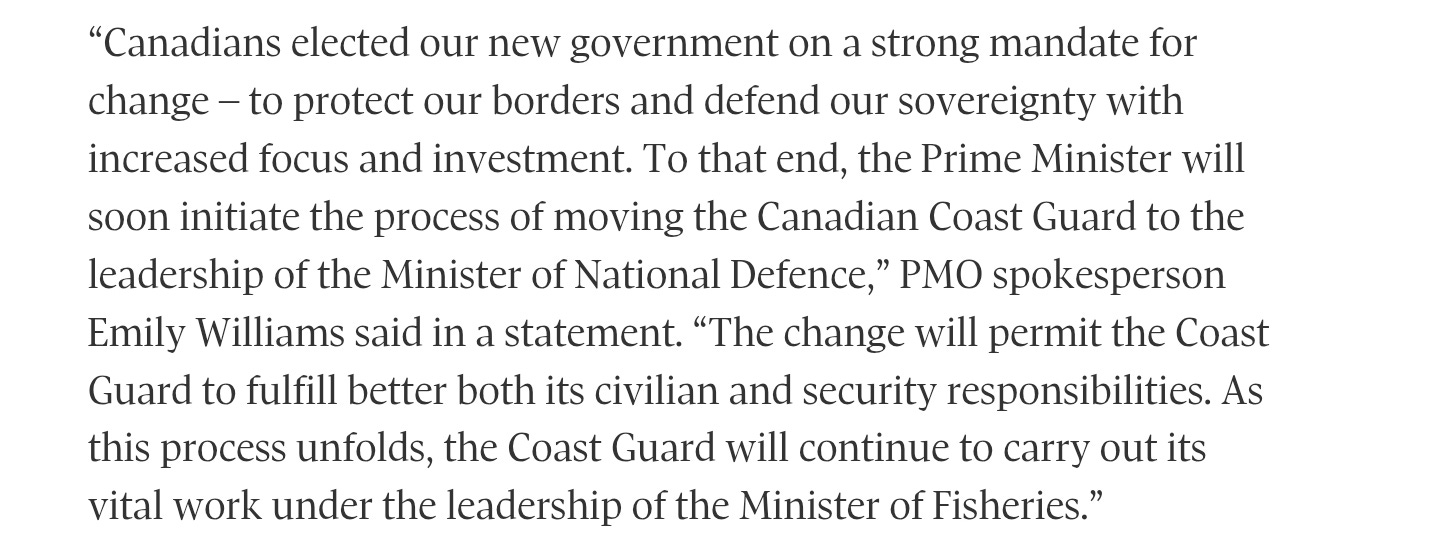
So imagine my surprise when Steven at the G&M came out blazing with a straight no, the plan is to move them. He even came backed up with a statement from the PMO, and credit to Steven, he was quick on this:
Credit to Steven Chase at the Globe & Mail
So as you can imagine my new goal was to figure out what exactly the hell was happening to the Coast Guard, with multiple competing statements on the subject. I made it my mission to have a definitive answer.
So it was back to asking, and emailing, everyone, from the DND to the PMO, CCG to the DFO. I got in contact, I dug into sources, even went as far as to ask people in industry if they had heard anything.
What I got for the first few days was chaos. Multiple statements saying that info wasn’t available, more time was needed. I got outright denial from the DND, only to be told they would email me back with info (they never did)
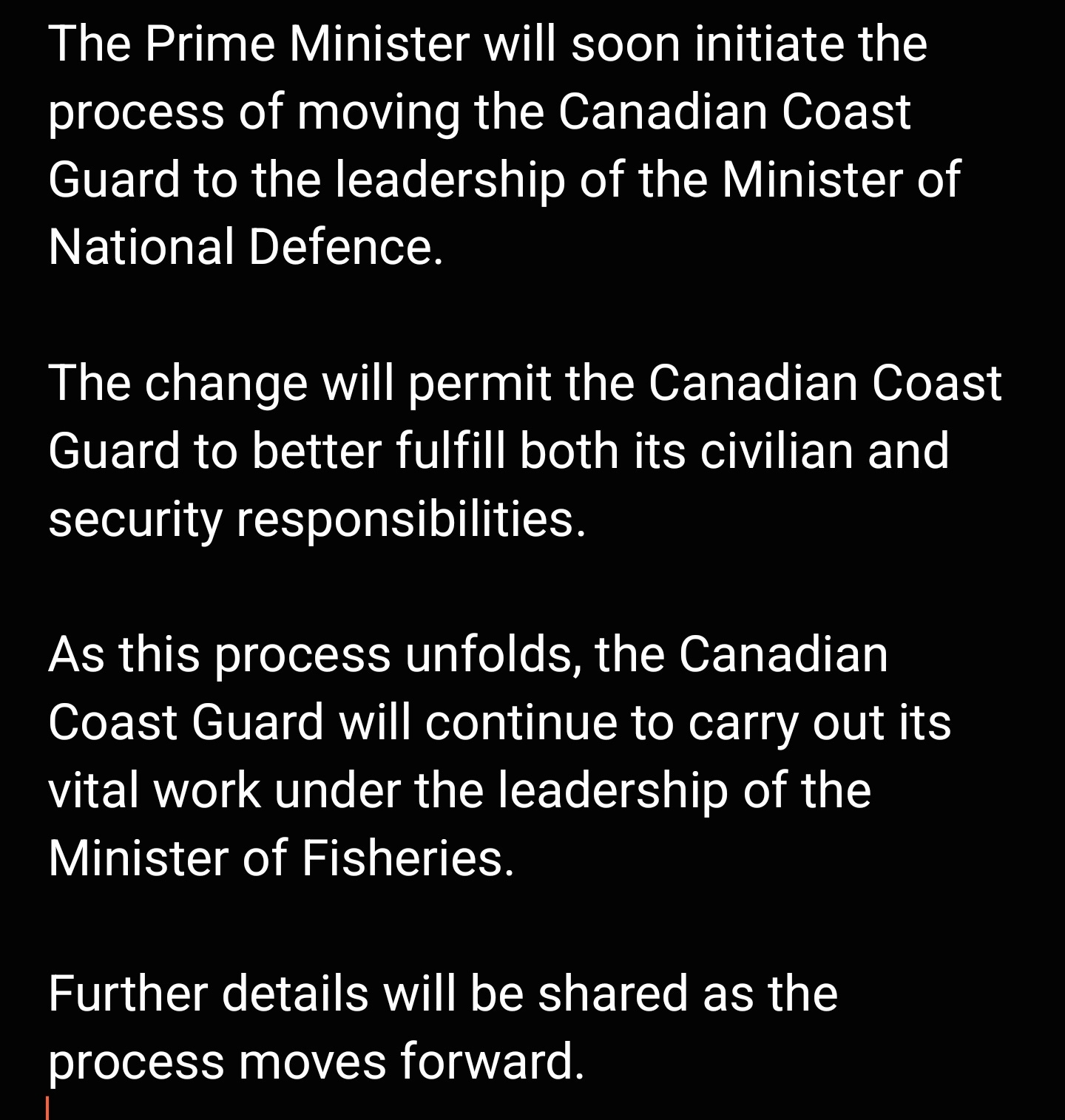
The PMO also told me info would be available when they had it. Evidently as of the time of this writing they have not responded. The only one to stay in contact and provide an answer to my question:
So as far as I was concerned this was a deal closer. The Coast Guard will be moving under the leadership of the Minister of National Defence. What will this look like? We don’t know. I had hit a dead end at this point, where sadly my reach was no longer wide enough for info.
Thankfully, there were others also keen on this, and wanting to get to the bottom of this, and they got farther than me. I will highly recommend my boy Stuart’s article on this as he got farther than me.
What has become evidently clear is:
- The Coast Guard is moving
- The idea is facing stiff resistance
This isn’t a shock at all. The DFO folks I talked to felt very caught off guard by everything, and the general reaction I have talking around was that this was a bit unexpected.
If accurate, then it is clear that this is the choice of the Prime Minister. He is the one who wants this, and so is making the final push. That isn’t to say he is the only one, but this has his backing and he will push that through.
Comments Off on Militarizing the Canadian Coast Guard (or not?)
America’s Forgotten SMG: The Hyde/Marlin M2
Forgotten Weapons
Published 4 Oct 2019 #36270The United States went into World War Two with the Thompson submachine gun — a weapon far too heavy and too expensive for its role. The British went to the other extreme with the Sten and while the US did not want a gun quite that crude, the Sten did spur a desire for something cheaper than the Thompson. George Hyde (then working for the Inland Division of GM) had worked on submachine gun designs in the 1930s, and he put together a weapon that would fit US needs. It was much cheaper than the Thompson and weighed in a full 2 pounds lighter. At tests in the spring of 1942, it also proved to be much more accurate in automatic firing, as it had a much more ergonomic stock design than the Thompson. The weapon was approved as the M2 submachine gun in 1942, and a contract went to Marlin to produce it (Inland had no extra production capacity at the time).
The receiver of the M2 was made through a metal sintering process, and Marlin had trouble getting this properly tooled up. The first gun delivery didn’t actually happen until May of 1943, and by that time Hyde had finished designing the M3 “Grease Gun”, which was cheaper still, and more attractive to the military. The contract for the M2 was cancelled in June of 1943, with only 400 guns delivered. There are only six known surviving examples today, split between private collections, museums, and military institutions.
(more…)
Comments Off on America’s Forgotten SMG: The Hyde/Marlin M2
QotD: Four stages of revolutions
Considering how often revolutions have produced cataclysms, the word revolutionary has — at least for many people, especially when young — surprisingly positive connotations. The author of this short book [You Say You Want A Revolution by Daniel Chirot], more extended essay than a history of revolutions in the two centuries that followed the French Revolution, sets out to explain why revolutions have so often been followed by slaughter on an unprecedented scale. Pascal said that he who sets out to be an angel ends a beast: to which we might add that he who sets out to create a heaven-on-earth creates a hell.
Professor Chirot writes extremely well and is never less than clear. He uses no jargon and he has a gift for condensing complex historical events into a short compass without resort to procrustean simplification. I would imagine that he is an excellent teacher.
He does not claim to have found a universal law of history that applies at all times and in all places, but he says that large-scale revolutions in the modern world have had a tendency to go through four discernible stages. First, an outmoded governing power refuses to accept that change is necessary and consequently refuses to make the necessary concessions to save itself. This leads to overthrow by relatively moderate leaders who would once have accepted compromise but see that change can only come about by revolution. Second, there is a counter-revolutionary reaction by those who do not accept their loss of power and who provoke a civil war or call for foreign intervention, or both. As a result, much more radical revolutionary leaders come to the fore and defend the revolution by increasing repression of enemies or supposed enemies. Third, the radical leaders, because they hold extreme views and are imbued with unrealistic notions of the complete redemption of mankind from all its earthly ills, impose experimentation on the population which is economically and socially disastrous. Fourth, in the case of its evident failure, the revolutionary regime loses its ideological ardour, and settles down to a kind of routine and less violent authoritarianism accompanied by large-scale corruption and cronyism.
Theodore Dalrymple, “Longing for Revolution”, Law & Liberty, 2020-05-13.
Comments Off on QotD: Four stages of revolutions


