Quotulatiousness

June 8, 2025

Managerialism – threat or menace?

Filed under: Bureaucracy, Business, Government, USA — Tags: , , , , — Nicholas @ 05:00

In the New York Times (don’t worry … link is to an archived version), Nathan Levine explains to NYT readers why there is such a push back against the over-mighty technocratic organizations that have been running more and more of our fading civilization:
It is the culmination of a once marginalized, now transformative strand of political thought about who really holds power in the modern American system. Namely, that our democracy has been usurped by a permanent ruling class of wholly unaccountable managers and bureaucrats.

Anti-managerialism is back. Well positioned to answer decades of frustration with mainstream conservatives’ failure to deliver results, this old idea has become the central principle of the new right.

In fact, much of what is commonly called “populist” politics can be more accurately described as part of an anti-managerial revolution attempting to roll back the expansion of overbearing bureaucratic control into more and more areas of life.

Though it has so far met with limited success amid stiff resistance, grasping the nature of this anti-managerialism is essential to understanding the Trump administration’s effort to transform America’s institutional landscape, from government to universities and major corporations.

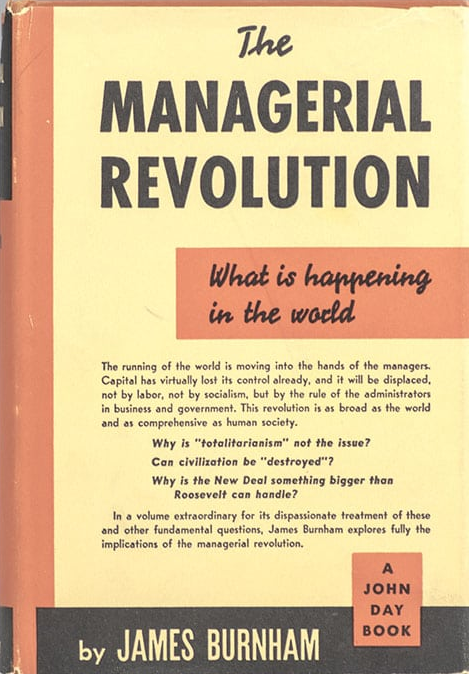
The idea’s intellectual history begins with the political philosopher James Burnham, who argued in his seminal 1941 book, The Managerial Revolution, that the aristocratic capitalist class was in the process of being overthrown by a revolution — just not, as the Marxists predicted, by the working class.

Instead, the exponential growth of mass and scale produced by the Industrial Revolution meant that in both corporation and state it was now those people cleverest at applying techniques of mass organization, procedure and propaganda — what he called the managerial class — who effectively controlled the means of production and would increasingly come to dominate society as a new technocratic oligarchy.

The book made an especially significant impression on George Orwell, who remarked that a managerial class consisting of “scientists, technicians, teachers, journalists, broadcasters, bureaucrats, professional politicians: in general, middling people”, hungry for “more power and more prestige”, would seek to entrench “a system which eliminates the upper class, keeps the working class in its place, and hands unlimited power to people very similar to themselves”.

Orwell was particularly struck by Burnham’s observation that the major political systems of the day — fascism, Communism and New Deal-era social democracy — were fundamentally similar in their turn toward the bureaucratic management of society. He observed that everywhere “laissez-faire capitalism gives way to planning and state interference” and “the mere owner loses power as against the technician and the bureaucrat”. Believing that accelerating managerial control risked dragging every society inexorably into totalitarianism, Orwell made Burnham’s ideas the basis of his novel 1984.

While the Cold War persisted, the view that America’s government might share some traits with the Soviet Union unsurprisingly proved unpopular, especially among Washington’s conservative establishment.

Nonetheless, the managerial class continued to grow, regardless of which political party controlled the government. Cold War defense budgets drove a relentless expansion of security state bureaucracy and the military-industrial complex. The advent of Great Society welfare programs and the Civil Rights Act demanded a re-engineering of social relations, prompting a dramatic proliferation of lawyers, regulatory bureaucrats and corporate compliance officers throughout much of public and private life. An ever-greater proportion of Americans began funneling through the credentialing machinery of higher education, inflating demand for yet more upper-middle-class managerial jobs.

Day Two – Panzers Stuck in Europe‘s Biggest Traffic Jam! – Ten Days in Sedan

Filed under: France, Germany, History, Military, WW2 — Tags: , , , , , — Nicholas @ 04:00

World War Two
Published 7 Jun 2025

May 11, 1940: Our WW2 documentary continues as the Battle of France rages and German Panzers rumble through the Ardennes. The Battle of Sedan is on the horizon and Heinz Guderian has one objective: break the French defences! But all is not well for the Germans as Europe’s largest-ever traffic jam threatens to stall the Blitzkrieg.

00:00 Intro
00:51 The Ardennes Advance
08:55 The Air War
15:05 Conclusion
(more…)

“If the New York Times notices the Buddha, the enlightened one has already left town”

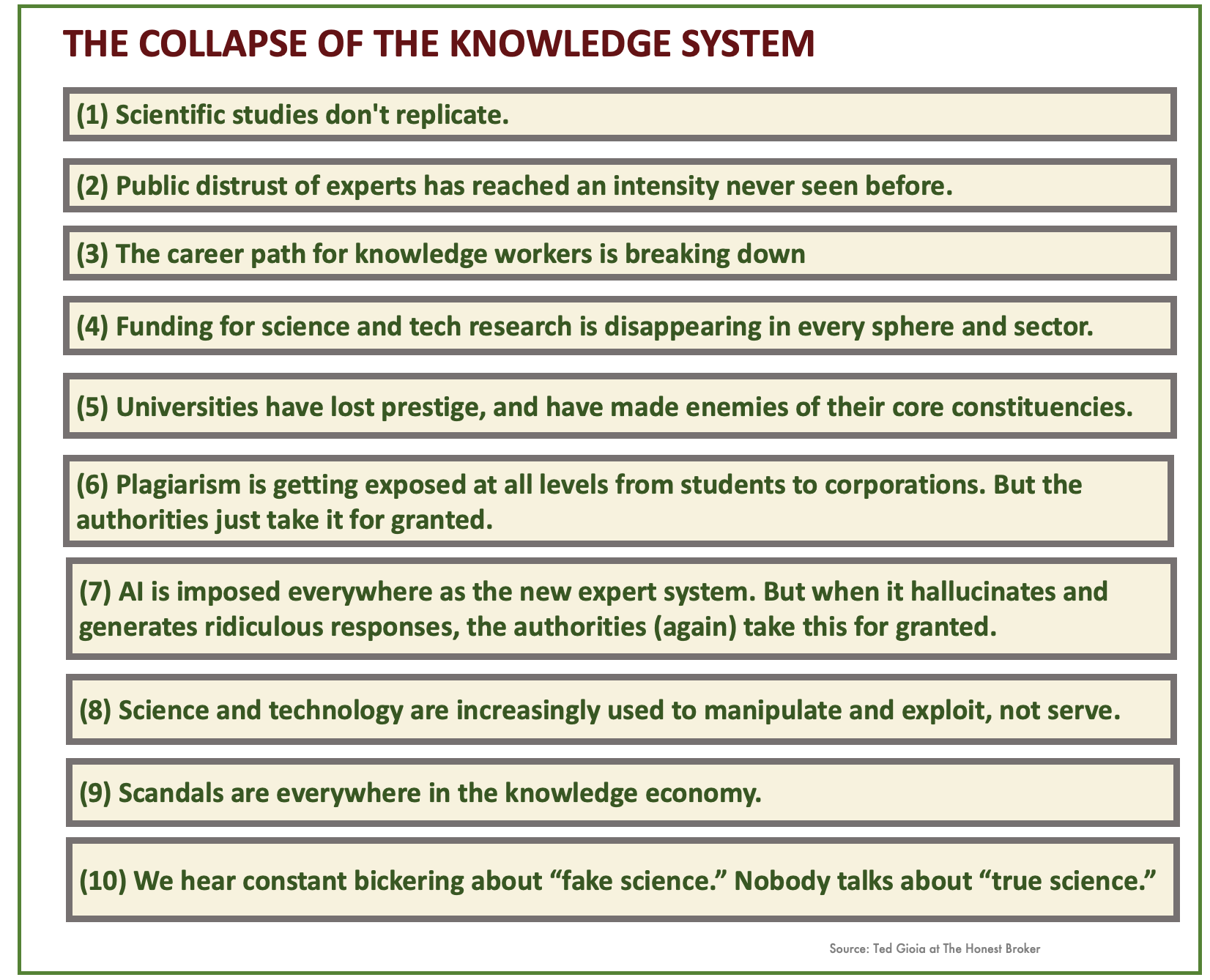
Ted Gioia points out that momentous changes in society are not often noticed until they’ve taken place, and provides ten warning signs of such a change happening right now:

Would you believe me if I told you that the biggest news story of our century is happening right now — but is never mentioned in the press?

That sounds crazy, doesn’t it?

But that is often the case when a bold new worldview appears.

  • How long did it take before the Renaissance got mentioned in the town square?
  • When did newspapers start covering the Enlightenment?
  • Or the collapse in mercantilism?
  • Or the rise of globalism?
  • Or the birth of Christianity or Islam or some other earthshaking creed?

The biggest changes often happen long before they even get a name. By the time the scribes notice, the world is already reborn.

You can take this to the bank: If the New York Times notices the Buddha, the enlightened one has already left town.

For example, the word Renaissance got introduced two hundred years after the start of the Renaissance. The game was already over.

The same is true of most major cultural movements — they are truly the elephants in the room. And the elites at the epicenter of power are absolutely the last to notice.

Tiberius may run the entire Roman Empire, but he will never hear the Good News.

There’s a general rule here — the bigger the shift, the easier it is to miss.

We are living through a situation like that right now. We are experiencing a total shift — like the magnetic poles reversing. But it doesn’t even have a name — not yet.

So let’s give it one.

Let’s call it: The Collapse of the Knowledge System.

We could also define it as the emergence of a new knowledge system.

In this regard, it resembles other massive shifts in Western history — specifically the rebirth of humanistic thinking in the early Renaissance, or the rise of Romanticism in the nineteenth century.

In these volatile situations, the whole entrenched hierarchy of truth and authority gets totally reversed. The old experts and their systems are discredited, and completely new values take their place. The newcomers bring more than just a new attitude — they turn everything on its head.

That’s happening right now.

The knowledge structure that has dominated everything for our entire lifetime — and for our parents and grandparents — is collapsing. And it’s taking place everywhere, all at once.

If this were just an isolated situation — a problem in universities, or media, or politics — the current hierarchy could possibly survive. But that isn’t the case.

The crisis has spread into every sector of society which relies on clear knowledge and respected authority.

The ten warning signs

The Canadian Retribution at Normandy | History Traveler Episode 196

Filed under: Cancon, France, Germany, History, Military, WW2 — Tags: , , , — Nicholas @ 02:00

The History Underground
Published 16 Feb 2022

Throughout the Battle of Normandy, the Canadians of the 3rd Infantry Division and the Germans of the 12th SS Panzer Division found themselves locked in a battle of attrition that would mark some of the most vicious fighting of the entire campaign. After suffering a blow at Buron and Authie (as seen in the last episode) the fight shifted over to a place that has now become legendary in Canadian military history: Bretteville-l’Orgueilleuse. In this episode, we’re joined by Paul Woodadge of ‪@WW2TV‬ to show a small part of one of the most epic fights in the battle to take Normandy.
(more…)

QotD: The ratchet effect

It’s well known that the people at the tippy top are raging SJWs, of course, but as anyone who has ever even tangentially worked for a GloboHomoCorp knows, the Big Bosses don’t know jack shit about even very high level stuff going on in their own companies. Big Boss, and several layers of management below Big Boss, are mainly concerned with greasing politicians and other CEOs. They have absolutely no idea what’s even going on with the North American Branch of the Customer Service Division, let alone what any individual person is up to … so those flunkies and fart catchers and butt boys way down the chain have to kiss ass on their own.

What ends up happening is a kind of “ratchet effect” on steroids. The “ratchet effect”, you’ll recall, was Margaret Thatcher’s explanation for how the Left kept winning on policy even though the Right kept winning at the polls (ah, God love ya, Maggie, and give you peace). When the Left is in power, they get whatever they want. When the Right is in power, they consolidate the Left’s gains, as this is now “the new normal”. Since The Right exists only to twiddle the knobs and levers of the Leviathan State in a more efficient, cost-effective, low-tax way, the “right-wing” “reformers” find jury-rigged quasi-solutions to the problems the Left’s insanity creates.

In a very real way, then, the “ratchet effect” means the so-called “Right” ends up doing the Left’s job for them, much better than they themselves could’ve.

Same deal inside the divisions of GloboHomoCorp. Same deal inside the Third Reich, which is why “working towards the Führer” turned so murderous, so fast. Since the only way to get noticed by the next higher-up level of “management” was to be more obnoxiously ruthless than everybody else at doing what the Führer seemed to be hinting that he wanted …

In the corporate world, then, I theorize, super-aggressive, ultra-obnoxious SJW-ism is a ground-up phenomenon. Does the Big Boss really want mandatory anti-Whiteness training across all divisions? Maybe … but maybe not. And though it’s tempting to say “He’s the Big Boss, he must know at least broadly what the big divisions are up to”, do I even have to ask if you’ve ever been in a situation where that’s true? Big Bosses the world over, in any field, be they CEOs or Generals or Chief Medical Officers or what have you, don’t have the slightest clue what’s happening structurally inside their commands.

All they know is what the next-lower level of management tells them is happening.

Severian, “On Selling Out”, Founding Questions, 2021-11-26.

Powered by WordPress