
Quotulatiousness

June 4, 2025

“Asshole Britain”

Filed under: Britain, Cancon, Media, Politics, USA — Tags: , , , , — Nicholas @ 05:00

In The Line, Greg Quinn indulges in a bit of struggle sessioning about his earlier disagreements with the editors of The Line about Britain and Canada (protip: don’t search for images to go along with that particular headline, especially if you have “safe search” filters turned off):
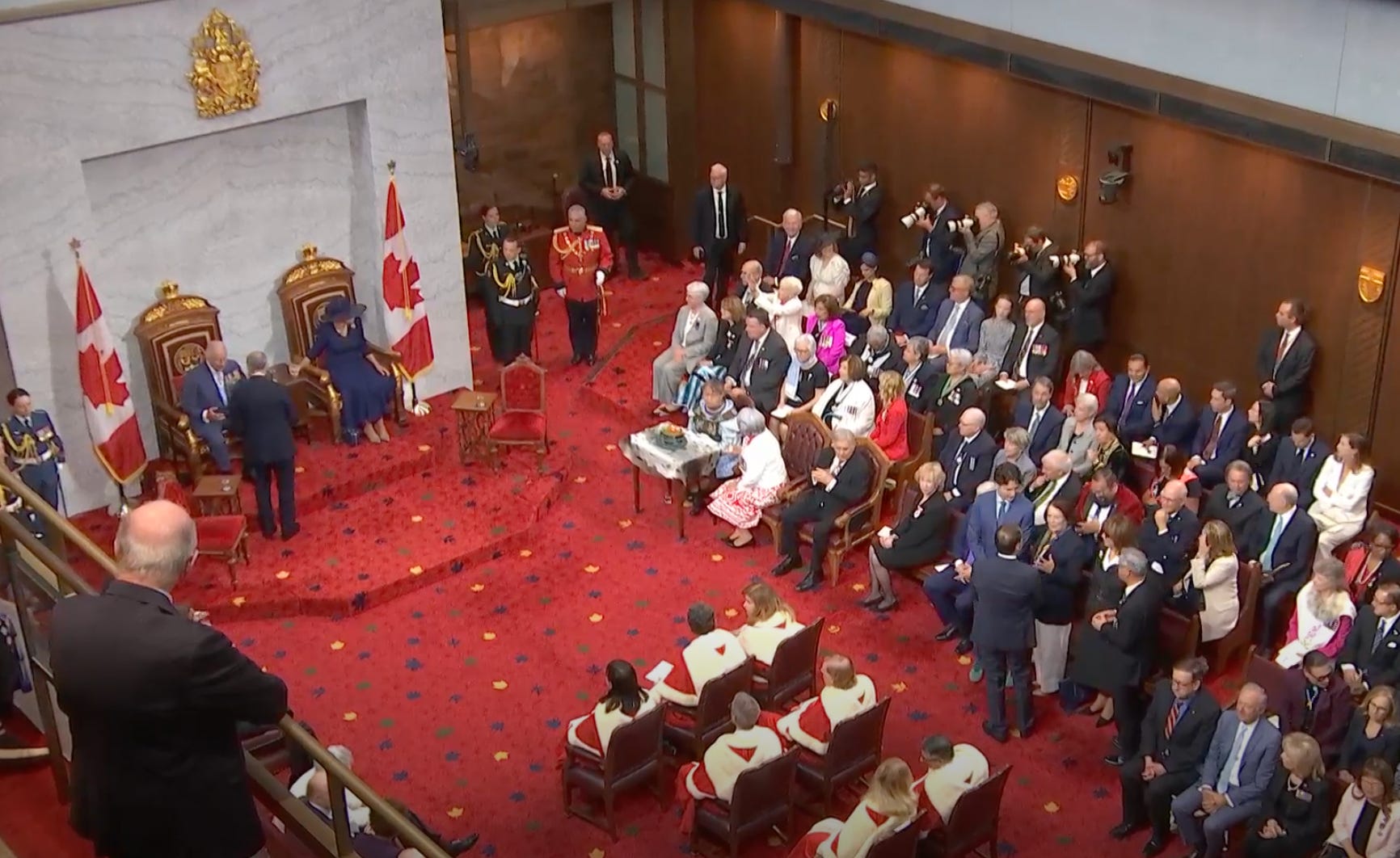
Yeah, let’s go with an inoffensive photo of His Royal Majesty and his Canadian First Minister chatting in the Senate chamber, rather than anything remotely to do with the headline of this post.
Photo by Paul Wells from his Substack

On February 12th of this year, I wrote in The Line about how my country, the United Kingdom, had “ghosted” Canada by refusing to come out strongly in reaction to U.S. President Donald Trump’s egregious attacks on the country and his calls for it to become the 51st state. In writing that piece, I didn’t beat around the bush — I called the U.K.’s actions what they were at the time: cowardice and sycophancy.

Since February, there have been a few (many?!) developments in Canada’s — and the world’s — relationship with President Trump.

Not least among these are Matt Gurney and Jen Gerson’s depiction (or technically, implication) of the U.K. as “Asshole Britain”. As other regular Line readers will know, “Asshole Canada” or “Maximum Canada” is an idea the editors floated here some months ago, where they asserted that Canada should abandon its typical desire to be seen as a global do-gooder and simply assert its national interests, vigorously and unapologetically, and if other countries, even allies, object, well, to hell with them. Editor Gurney, in a recent podcast, cited the just-concluded visit of His Majesty the King to Canada to deliver the Throne Speech — the first time a monarch has done so since 1977 — as an example of that. Prime Minister Mark Carney issued the invite to the King despite obvious discomfort with the idea among senior officials in my government.

Carney didn’t care. The King is the sovereign of Canada, too, and Carney didn’t let British discomfort deter him.

I have to say that HM the King’s speech was a blinder and (in its own royal diplomatic way) left no doubt as to where His Majesty’s sympathies lie and how he supports Canada’s sovereignty and independence. Whether you are a royalist or a republican, the fact that HM the King made the trip and read the speech should be welcomed. And I entirely agree with the editors here — Canadians should and must ignore the comments from the U.K. Who cares? HM the King was acting in his capacity as Canada‘s monarch — the views of anyone in the U.K. (government or otherwise) are irrelevant.

I wish I could condemn Jen and Matt for their (again, implied) characterization of the U.K. — Britain has needed no urging to unapologetically assert its own interests in this revived era of Trump. But I can’t. They are absolutely correct. And every day that passes, I’m sorry to say that the U.K. becomes more and more “Asshole Britain” when it comes to its relationship with Canada and the U.S.

The reasons remain much the same as I identified before: cowardice and sycophancy. To that, I’d now like to add venality. We think we have a special relationship with the U.S., as demonstrated by our recent trade agreement — except the impact of that agreement is open to some question. We seem to be afraid of saying anything that might upset President Trump, in case he reacts. Although we fail to understand that upsetting the President does not follow a rational process. He could (and does) get upset and react extremely easily at the simplest and most unexpected of things.

The President continues to make unacceptable claims against Canada, including reiterating his call for it to become the 51st state shortly after the King’s visit concluded. His latest iteration of this includes claims that Canada could save U.S.$61 billion it “should” be charged for the so-called Golden Dome (what is it with adjectives and this President?) if it joins the U.S. This, of course, fails to grasp the simple strategic fact that if you want a defence shield like this over North America, then you’re going to have to use sensors and other infrastructure on Canadian soil. Is he expecting to be provided that land for free?

By continuing to refuse to stand up to President Trump and clearly express our support for Canada, we are submitting to his attempts to divide and rule those of us who remain like-minded. At its worst, we are now venal — selling out to the president.

Instead, we should be standing true to our roots — as defenders of the free market and democracy. We should be leading the way, and we should be building an alliance of those who continue to share our values.

That is what we should be doing. That we aren’t is nothing short of a disgrace.

Update: Fixed broken link to Greg Quinn’s article. Doh!
The Korean War Week 50 – Trapped in the Triangle: Korea’s Killing Zone – June 3, 1951

Filed under: Britain, China, History, Military, USA — Tags: , , , , , — Nicholas @ 04:00

The Korean War by Indy Neidell
Published 3 Jun 2025

The MacArthur Senate Hearings continue this week, with US Secretary of State Dean Acheson now in the hot seat. He takes a rather confusing barrage of questions, and yet manages to signal to the world at large, i.e. the Chinese, that the US is open to negotiations to end the war. The war still continues in the field, of course, with the UN forces’ Operation Piledriver in action, driving into the “Iron Triangle” and trying to trap as much of the enemy as possible.

Chapters
00:00 Intro
01:07 Recap
01:35 Acheson Speaks
05:44 Operation Piledriver
09:10 Attacks Begin
10:53 A Unifying JCS Directive
16:54 Summary
(more…)

Arch-statist Mark Carney believes that Canadians “must earn their freedom everyday”

Filed under: Cancon, Government, Media, Politics — Tags: , , , , — Nicholas @ 03:00

At The Intrepid Viking, Roxanne Halverson examines what Prime Minister Mark Carney means when he tosses off comments like “Freedom is something you earn everyday”:

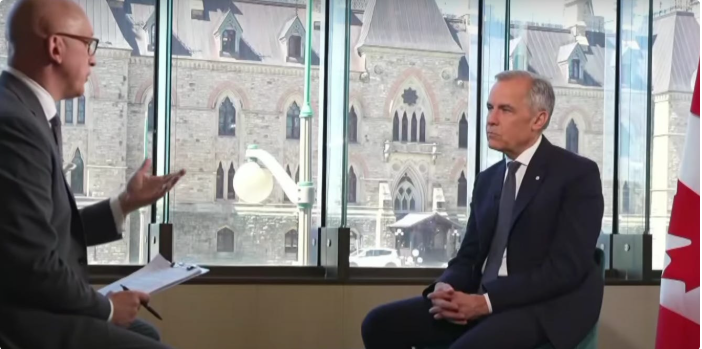
CBC’s David Cochrane interviewing Prime Minister Mark Carney in Ottawa.

It is surprising and disconcerting that so few pundits, commentators or even members of the Conservative Party, and for that matter are, not taking issue with a recent statement from our new Prime Minister in which he asserted, when talking about Canadians, that, “Freedom is something you earn everyday“.

Has anyone asked Mark Carney, this globalist World Economic Forum (WEF) acolyte, who is now Canada’s Prime Minister, what he meant when he made that statement? He made it during an interview with David Cochrane on CBC’s Power and Politics following on King Charles delivering the throne speech. He made the statement while talking about the great “crisis” Canada is and how his government has to get moving on major projects and our economy and solving the housing calamity. Of course he forget to mention that these problems are due to the policies of the previous Liberal government, for whom he was the financial advisor. He also does not explain that why, in the middle of such a crisis, his government has decided to take the summer off and not release of budget of any type, any time soon, but that’s another story.

Now, back to his claim that Canadians “must earn their freedom everyday”. Of course, Cochrane, being one of Carney’s main fanboys at CBC, didn’t probe any deeper to ask him what he meant by that statement. But it is a strange statement coming from the Prime Minister of a country where its constitution essentially says that individual freedom is a God given right. And given that Carney, with his recent visit to Rome to see the new pope, has made it clear that he is a devout practising Catholic, his belief in the Almighty is obviously not an issue. So again, what did he mean by that remark? Strange again, because just six weeks ago, before he was the Prime Minister, Carney posted the following statement on X.

    The Charter of Rights and Freedoms is the embodiment of our principles and our aspirations as Canadians. It must be protected — not wielded for political gain. Forty-three years on, the Charter remains strong — and it’s on all of us to defend it.

This apparently was in response to Conservative Leader Pierre Poilievre’s assertion that he would use the notwithstanding clause to override a judicial ruling against imposing consecutive life sentences on murderers, rather than concurrent sentences.

So given that, it would seem that Mr. Carney believes our rights regarding freedom are enshrined in the Charter. Carney, in his interview with Cochrane also maintained that Canada was still “the true north strong and free”. So then which is it when it comes to freedom from his perspective? Is it enshrined in the Charter, are we the true north “strong and free”, or must freedom be earned, and in what way?

Remarkable Victory – The Bomber War Episode 5 – Jan to June 1944

Filed under: Britain, Germany, History, Military, USA, WW2 — Tags: , , , — Nicholas @ 02:00

HardThrasher
Published 28 Feb 2024

In which the USAAF and RAF finally start to Get Good at their jobs and tie up their respective campaigns for literally the first time.

00:00 – 04:01 – Introduction
04:06 – 08:12 – Forward Operating Base
08:15 – 11:30 – Changes in Command
11:32 – 16:16 – Doolittle’s Plan
16:20 – 22:25 – Big Week
22:34 – 29:32 – Aftermath
29:35 – 32:06 – Berlin
32:09 – 33:59 – Overlord
34:02 – Survivor’s Club
(more…)

QotD: Conquest empires

Empires can turn to becoming conquest empires on any scale only with the development of technologies that can overcome sheer numbers.

Specifically, metal.

Soft metals are not for conquest empire. Gold, silver, copper, tin, etc, may be used for plates or posts or jewellery or skin scrapers, but they are not war fighting metals. Even the lightest leather armour or layers of feather padding makes them practically valueless for war fighting. Metal only becomes an imperial material when it can be made hard enough for combat purposes.

The first such metal is Bronze, which is made by combining different metals in compounds. Copper compounded with enough tin (usually 5-10 percent) makes Bronze. Bronze can make armour and weapons and even axles and bearings. But copper (mined in mountains) and tin (usually from swamps) and the charcoal needed to melt them (from forests) combined in sufficient quantities for mass production (cities supported by taxed farmers), require extensive trade routes, and probably a stable currency of some sort. But once these elements can be combined, empires can give up on mere Security, and enter Conquest.

All the early Sumerian, Egyptian, Hittite, Persian, Greek, Roman, Indian and Chinese empires that we now scrawl across maps with lines to show how they conquered the territories of other empires are based on this simple concept. The Hittites with their Bronze, Egyptians with their chariots, and Romans with their Steel: being only different developments from the same basic “metal technology” roots.

Yet this is where motive becomes uncertain. All these empires got into conquest, but in many cases they did it either to continue their security (by pushing the dangerous boundaries ever further), or to protect the trade that made their system work. Conquest for the sake of conquest was certainly an element — particularly with rulers like Alexander the Great — but the original reason why Phillip of Macedon and his predecessors had developed the world’s most efficient fighting machine had more to do with constant threats from Persians and Greeks and other “barbarians” than with any desire to get into the conquest game itself. Sometimes things done for security lead to expanded boundaries for security, which then lead to expanding further for conquest. (Often because the system developed for paying those fighting for security requires conquest to pay them off … see Julius and many later Caesars!)

Nigel Davies, “Types of Empires: Security, Conquest, and Trade”, rethinking history, 2020-05-02.

Powered by WordPress



