
Quotulatiousness

May 30, 2025

Progressives are still putting their faith in doxxing and cancellations … do they still work?

Filed under: Media, Politics — Tags: , , — Nicholas @ 04:00

Spaceman Spiff calls our attention to the latest attempt to un-person a writer who has managed to outrage progressives:

The popular pseudonymous Substack writer, Morgoth, has been doxxed. Outed by an organization dedicated to tackling extremism and online harm.

You can read about his ordeal here:

They produced an article to unmask Morgoth’s real-world identity against his wishes, including photographs. It is replete with incendiary accusations we have grown accustomed to seeing in these attempts to discredit writers who challenge the status quo.

The impression presented is one of a bigoted figure, someone dangerously unhinged. It bears little relation to reality as Morgoth’s readers will confirm. But that hardly matters.

Doxxing exercises exist so the laptop class can efficiently file people into a convenient extremist bucket. All the hard work has been done so the distracted can skim the article and take what they need. Fascism, white supremacy, hate, racism, bigotry; take your pick.

Doxxing is not about facts, it is about keywords. More accurately it is about “hate crimes”. Those who transgress these ever-changing taboos are unfit to live among us.

Even better the piece can be exploited by others. Fascist influencer Morgoth, online hatemonger Morgoth, disgraced racist Morgoth. The current obsession with speech controls can make good use of an incestuous network of activists posing as reporters. Since the material now exists journalists can reference it to further discredit should this be needed in future.

The shrill nature of these denouncements is the giveaway all is not well in the world of perception management. No plan survives contact with the enemy, and the desire to corral all dissidents into one big extremist bucket sounds fine on paper. But much of what Morgoth writes about is widely discussed by the public at large, even if ignored by the traditional media or the political world. If Morgoth is a racist hate-driven genocidal monster then so are most of the population, which of course they are not.

This kind of thing used to work well. But as Morgoth’s own articles allude to, their enemy is reality not Substackers.

The curiously suicidal ideas the educated classes cling to are largely based on magical thinking. We can change the weather by blowing up power stations and levying taxes; we can successfully assimilate millions of hostile foreigners who dislike us and our culture; women will be happier if they work longer hours and don’t have children.

The degree of propaganda needed to maintain today’s narratives is considerable. Less advertised is how brittle it has become. Challenges to these narratives, and the theoretical foundations upon which they rest, are therefore feared by their promoters, and rightly so.

From this perspective people writing online and criticizing today’s sacred cows are worth targeting and smearing. Hence the exposure, the denouncements, the dredging up of comments from a decade ago, out of context and out of time. They know their audience don’t really care. They just need the satisfying feeling they are on the right side of history.

Senate to once again try to pass internet age verification and website blocking

Filed under: Cancon, Government, Liberty, Politics, Technology — Tags: , , , , , , — Nicholas @ 03:00

Some ideas are so horrible that they never, ever die. The Canadian Senate nearly got an age verification and website blocking ban into law during the last Parliament, and as Michael Geist discusses, they’re not giving up now:

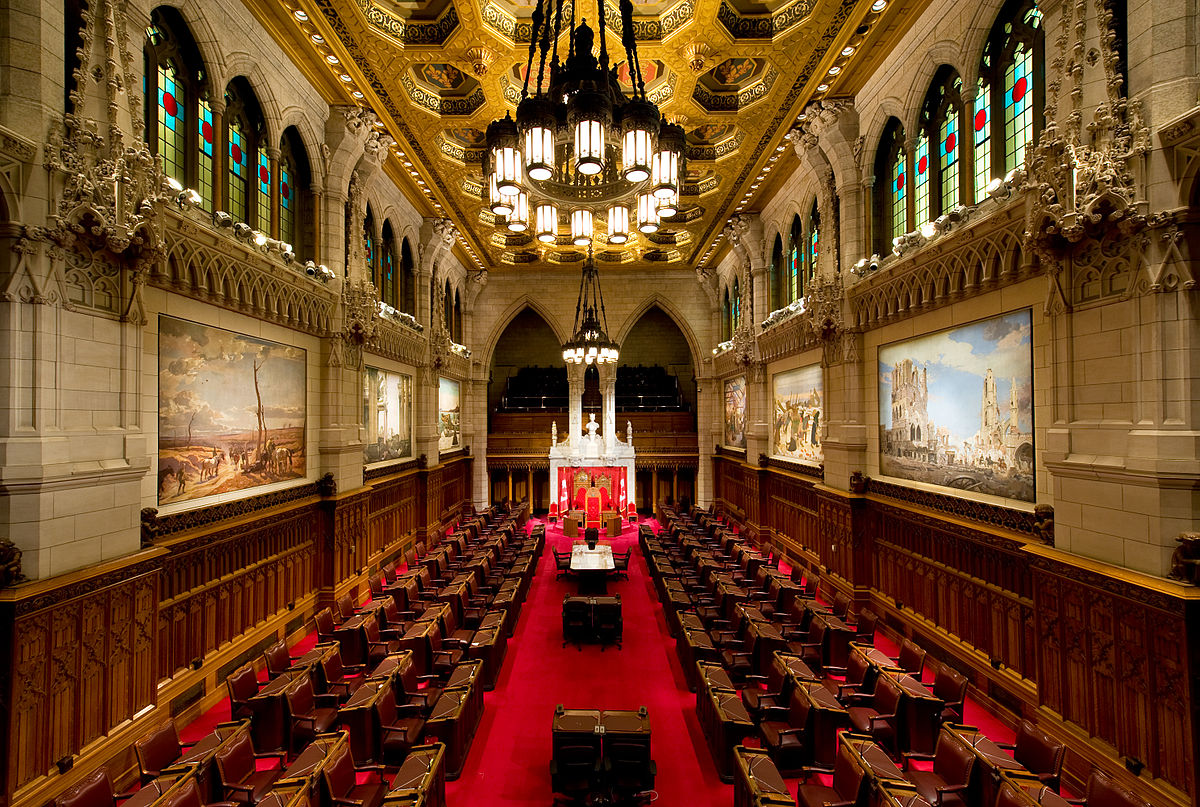
“In the east wing of the Centre Block is the Senate chamber, in which are the thrones for the Canadian monarch and consort, or for the federal viceroy and his or her consort, and from which either the sovereign or the governor general gives the Speech from the Throne and grants Royal Assent to bills passed by parliament. The senators themselves sit in the chamber, arranged so that those belonging to the governing party are to the right of the Speaker of the Senate and the opposition to the speaker’s left. The overall colour in the Senate chamber is red, seen in the upholstery, carpeting, and draperies, and reflecting the colour scheme of the House of Lords in the United Kingdom; red was a more royal colour, associated with the Crown and hereditary peers. Capping the room is a gilt ceiling with deep octagonal coffers, each filled with heraldic symbols, including maple leafs, fleur-de-lis, lions rampant, clàrsach, Welsh Dragons, and lions passant. On the east and west walls of the chamber are eight murals depicting scenes from the First World War; painted in between 1916 and 1920.”
Photo and description by Saffron Blaze via Wikimedia Commons.

The last Parliament featured debate over several contentious Internet-related bills, notably streaming and news laws (Bills C-11 and C-18), online harms (Bill C-63) and Internet age verification and website blocking (Bill S-210). Bill S-210 fell below the radar screen for many months as it started in the Senate and received only cursory review in the House. The bill faced only a final vote in the House but it died with the election call. This week, the bill’s sponsor, Senator Julie Miville-Dechêne, wasted no time in bringing it back. Now Bill S-209, the bill starts from scratch in the Senate with the same basic framework but with some notable changes that address at least some of the concerns raised by the prior bill (a fulsome review of those concerns can be heard in a Law Bytes podcast I conducted with Senator Miville-Dechêne).

Bill S-209 creates an offence for any organization making available pornographic material to anyone under the age of 18 for commercial purposes. The penalty for doing so is $250,000 for the first offence and up to $500,000 for any subsequent offences. The previous bill used the term “sexually explicit material”, borrowing from the Criminal Code provision. This raised concerns as the definition in the Criminal Code is used in conjunction with other sexual crimes. The bill now features its own definition for pornographic material, which is defined as

    any photographic, film, video or other visual representation, whether or not it was made by electronic or mechanical means, the dominant characteristic of which is the depiction, for a sexual purpose, of a person’s genital organs or anal region or, if the person is female, her breasts, but does not include child pornography as defined in subsection 163.1(1) of the Criminal Code.

Organizations can rely on three potential defences:

  1. The organization instituted a government-approved “prescribed age-verification or age estimation method” to limit access. There is a major global business of vendors that sell these technologies and who are vocal proponents of this kind of legislation.
  2. The organization can make the case that there is “legitimate purpose related to science, medicine, education or the arts”.
  3. The organization took steps required to limit access after having received a notification from the enforcement agency (likely the CRTC).

Note that Bill S-209 has expanded the scope of available technologies for implementation: while S-210 only included age verification, S-209 adds age estimation technologies. Age estimation may benefit from limiting the amount of data that needs to be collected from an individual, but it also suffers from inaccuracies. For example, using estimation to distinguish between a 17 and 18 year old is difficult for both humans and computers, yet the law depends upon it. Given the standard for highly effective technologies, age estimation technologies may not receive government approvals, leaving only age verification in place.

Was Germany Really Starved Into Surrender in WW1?

Filed under: Britain, Economics, Germany, History, Military, USA, WW1 — Tags: , , , , , , — Nicholas @ 02:00

The Great War
Published 10 Jan 2025

From 1914 to 1919, Allied warships in the Atlantic and Mediterranean controlled maritime trade to and from the Central Powers – stopping shipments of weapons and raw materials, but also food, from reaching their enemies. At the same time, hundreds of thousands of German civilians died of hunger-related causes. Often, these deaths and even the outcome of the war are attributed to the naval blockade – but did the British really starve Germany into surrender in WW1?
(more…)

QotD: “Have fun storming the castle!”

… the expected threat is going to shape the calculation of what margin of security is acceptable, which brings us back to our besieger’s playbook. You may recall when we looked at the Assyrian siege toolkit, that many of the most effective techniques assumed a large, well-coordinated army which could dispose of a lot of labor (from the soldiers) on many different projects at once while also having enough troops ready to fight to keep the enemy bottled up and enough logistic support to keep the army in the field for however long all of that took. In short, this is a playbook that strong, well-organized states (with strong, well-organized armies) are going to excel at. But, as we’ve just noted, the castle emerges in the context of fragmentation which produces a lot of little polities (it would be premature to call them states) with generally quite limited administrative and military capacity; the “big army” siege playbook which demands a lot of coordination, labor and expertise is, for the most part, out of reach.

Clifford Rogers has already laid out a pretty lay-person accessible account of the medieval siege playbook (in Soldiers’ Lives Through History: The Middle Ages (2007), 111-143; the book is pricey, so consider your local library), so I won’t re-invent the wheel here but merely note some general features. Rogers distinguishes between hasty assaults using mostly ladders launched as soon as possible as a gamble with a small number of troops to try to avoid a long siege, and deliberate assaults made after considerable preparation, often using towers, sapping, moveable shelters designed to resist arrow fire and possibly even catapults. We’ve already discussed hasty assaults here, so let’s focus on deliberate assaults.

While sapping (tunneling under and collapsing fortifications) remained in use, apart from filling in ditches, the mole-and-ramp style assaults of the ancient world are far less common, precisely because most armies (due to the aforementioned fragmentation combined with the increasing importance in warfare of a fairly small mounted elite) lacked both the organizational capacity and the raw numbers to do them. The nature of these armies as retinues of retinues also made coordination between army elements difficult. The Siege of Antioch (1097-8) [during] the First Crusade is instructive; though the siege lasted nine months, the crusaders struggled to even effectively blockade the city until a shipment of siege materials (lumber, mostly) arrived in March of 1098 (five months after the beginning of the siege). Meanwhile, coordinating so that part of the army guarded the exits of the city (to prevent raids by the garrison) while the other part of the army foraged supplies had proved mostly too difficult, leading to bitter supply shortages among the crusaders. Even with materials delivered to them, the crusaders used them to build a pair of fortified towers blocking exits from the city, rather than the sort of elaborate sapping and ramps; the city was taken not by assault but by treachery – a very common outcome to a siege! – when Bohemond of Taranto bribed a guard within the city to let the crusaders sneak a small force in. All of this despite the fact that the crusader army was uncommonly large by medieval European standards, numbering perhaps 45,000.

Crucially, in both hasty and deliberate assaults, the emphasis for the small army toolkit tends to be on escalade (going over the walls) using ladders or moveable wooden towers, rather than the complex systems of earthworks favored by the “big army” siege system or breaching – a task which medieval (or ancient!) artillery was generally not capable of. The latter, of course, is a much more certain method of assault – give a Roman army a few months and almost any fortress could be taken with near certainty – but it was a much more demanding method in terms of the required labor and coordination. Thwarting escalade is mostly a question of the height of defenses (because a taller wall requires a taller ladder, tower or ramp) and good fields of fire for the defenders (particularly the ability to fire at attackers directly up against the wall, since that’s where the ladders are likely to be).

The other major threat to castle walls (apart from the ever-present threat of sapping) was catapults, but I want to deal with those next time for reasons that I suspect will make sense then. For now it is worth simply noting that catapults, even the mighty trebuchets of the 14th century were generally used to degrade defenses (smashing towers, destroying crenellation, damaging gatehouses) rather than to produce breaches. They could in some cases do that, but only with tremendous effort and a lot of time (and sometimes not even then). Consequently, for most castles the greatest threat remained escalade, followed by treachery or starvation, followed by sapping, followed by artillery.

Bret Devereaux, “Collections: Fortification, Part III: Castling”, A Collection of Unmitigated Pedantry, 2021-12-10.

Powered by WordPress



