
The Korean War by Indy Neidell
Published 27 May 2025The Chinese Spring Offensive continues this week, but comes to its end — it has cost the Communist forces tens of thousands of men, but even as it ends, the UN counteroffensive begins — and costs them tens of thousands more! And in Washington the MacArthur hearings continue, and it is obvious by now to all and sundry that General Douglas MacArthur had been very much out of line and President Truman was within his authority for firing him.
Chapters
00:00 Intro
00:41 Recap
01:12 More PVA and KPA Attacks
03:41 The Counterattack Begins
07:14 Advances Everywhere
13:07 NSC 48/5
17:45 End of the Hearings?
19:05 Summary
19:18 Conclusion
(more…)
May 28, 2025
The Korean War Week 49 – Race to Trap 70,000 Soldiers – May 27, 1951
Comments Off on The Korean War Week 49 – Race to Trap 70,000 Soldiers – May 27, 1951
The Throne Speech
On his Substack, Paul Wells reports on the first Throne Speech delivered by the reigning monarch since the 1970s:
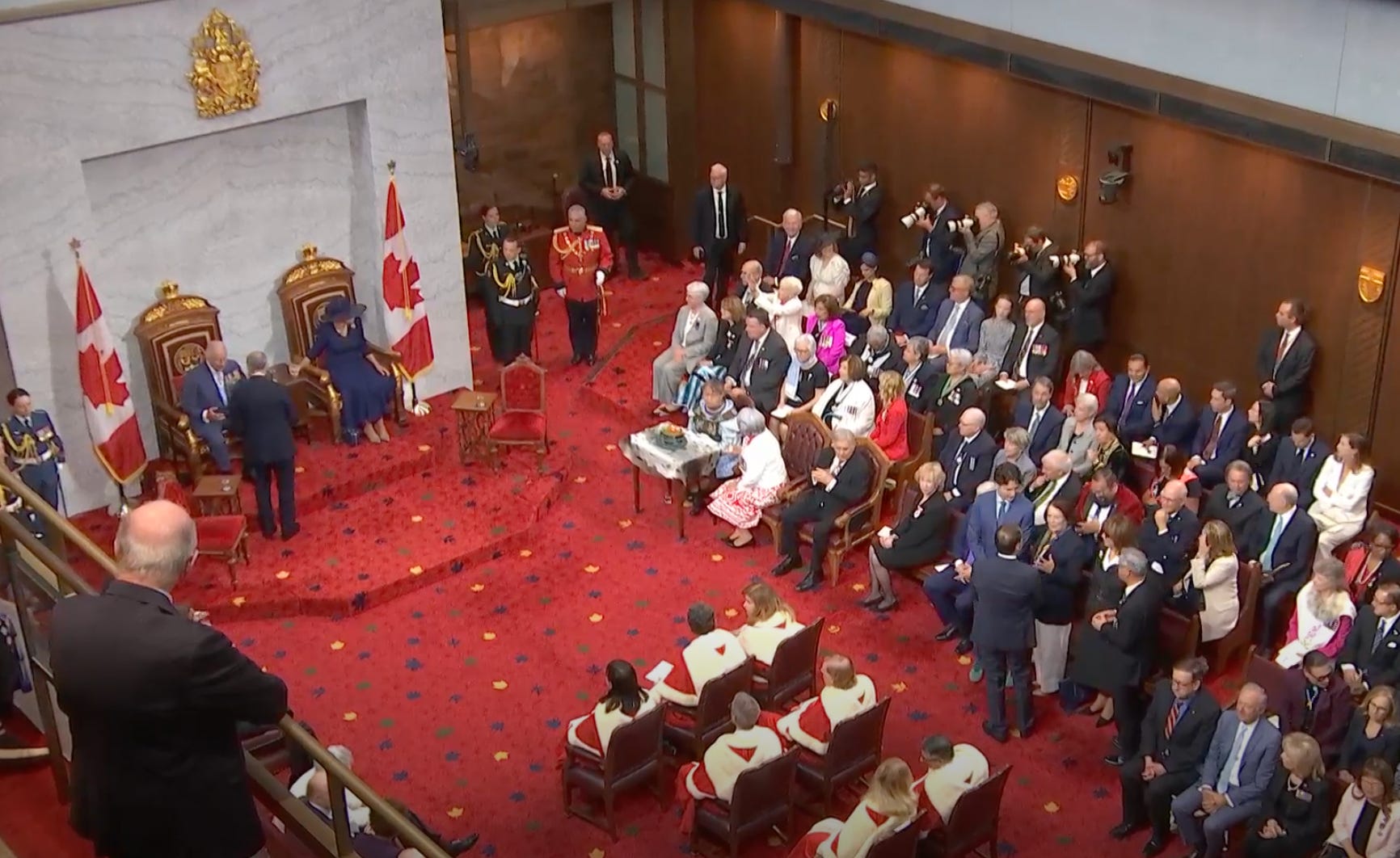
Mark Carney joins our visiting King in the traditional Making of the Small Talk.
Photo by Paul Wells from his Substack
We’re like Charlie Brown with Lucy’s football, or I guess, since the new PM is said to prefer British spellings, Charlye Brownne with Lewsey’s Foote Ball. Each generation of Canadian leadership tries to find a new way to make throne speeches exciting. These attempts are forever doomed, because no generation of Canadian leadership is exciting and because the format — a statement of intent from a dignitary who is forbidden to harbour autonomous intent — tends to short-circuit the delivery.
This time the delivery mechanism was the King of Canada, Charles Philip Arthur George, popping over from his secondary residence at Buckingham. His French tops Mary Simon’s, though his Inuktitut is shaky. He did his best to sound excited, or resolute, about the CBSA’s “new powers to examine goods”.
A quarter-century ago the reliably impish John Fraser told me he was preparing a book called Eminent Canadians that would survey recent developments in four Canadian institutions. The institutions he’d selected were the office of the Prime Minister; the Globe and Mail; the Anglican Church; — and here Fraser urged me to guess the fourth. Canadian institution? I dunno, the armed forces? The NHL? “The Crown”, Fraser said with a twinkle. Thus was I prepped for this week’s extended round of you-know-he’s-really-the-king-of-Canada browbeating.
This throne speech was like many before it, though out of deference for the deliverer it was on the short side, 21 pages tucked inside wide margins. In substance it was a paraphrase of Mark Carney’s already-semi-legendary Single Mandate Letter for cabinet ministers. There were sections on redefining Canada’s relationship with the United States; on internal trade; on crimefighting and national defence; and on “spending less and investing more”, which, I mean, we’ll see.
The mandate letter seems to have supplanted the Liberal election platform as the main blueprint for Carney’s action. The two aren’t wildly incompatible, but the mandate letter/throne speech is streamlined and puts stuff in different order.
I saw two surprises big enough to make me write today, but first I want to point to a few elements that are worth noting in the less-surprising stuff. That’s right, I’m trying to be useful, not just smart-assed, so here’s a way to thank me. […]
First, Carney (through His Majesty) makes claims for the “new economic and security relationship with the United States” that seem unrealistic. He expects “transformational benefits for both sovereign nations”. But surely any cross-border negotiation can only be, at best, an exercise in damage control? Any security costs that would be newly borne by Canada would represent a net cost. Trade arrangements short of the substantially free trade we’ve enjoyed for 40 years will also represent a net cost. The point of seeking “one Canadian economy” and taking relations with third countries more seriously is to offset the cost of a degraded Canada-US relationship, no?
Under “more affordable”, the throne speech repeats campaign promises for income-tax cuts and cuts to GST on new homes. The list of tangible financial benefits to individuals doesn’t go much past that. “The Government will protect the programs that are already saving families thousands of dollars every year. These include child care and pharmacare.” “Protect” is an old Ottawa word meaning “not extend”.
The goals for the “one Canadian economy” now include “free trade across the nation”, at both federal and provincial levels of government, “by Canada Day”. Which is 34 days away. The staffing and mandate of another new entity, a single-wicket “Major Federal Project Office”, may end up mattering more to this government’s success and Canada’s prosperity than the name of the PM’s next chief of staff, so put an asterisk next to that.
The government repeats a mysterious claim I’ve found shaky since Carney became a Liberal leadership candidate. It “will take a series of measures to catalyse new investment to create better jobs and higher incomes for Canadians. The scale of the Government’s initiative will match the challenges of our times and the ambitions of Canadians.” The challenges of our times, at least, are large.
So again: if the Canada Infrastructure Bank, the Canada Growth Fund and the Freeland-Sabia investment tax credits are sufficient to catalyse (British spelling) new investment, why duplicate them?
And if they haven’t worked, why keep them?
Comments Off on The Throne Speech
Masters of the Air – The Bomber War Episode 4 – 8th Air Force 1942-1943
HardThrasher
Published 6 Jan 2024If you’d like to be a cool kid, then become a Patreon or if you’d like to email me send a message to lordhardthrasher@gmail.com
0:00 Intro
4:30 We’re Going to North Africa 1st
8:36 But you’re not doing it properly
16:16 Play it Again Ira
22:30 Mid 1943 – The Crisis Begins
26:53 The Black Summer
28:03 Operation Tidal Wave
34:21 Into The Valley of Death – Schweinfurt
41:34 What Now?
48:37 Survivors Club
(more…)
Comments Off on Masters of the Air – The Bomber War Episode 4 – 8th Air Force 1942-1943
QotD: Communitarianism
Communitarianism is on the rise. The Left has its “Blue Labour” project, and writers like Giles Fraser and Paul Embery. The Right has its “One Nation Conservatism” project, and writers like Nick Timothy and Tim Montgomery. They differ in emphasis, but the commonalities outweigh the differences. It appeals to both right-wingers looking for an alternative to economic liberalism, and to left-wingers looking for an alternative to “woke” hyper-moralism.
What is communitarianism? Communitarians would probably define themselves as people who recognise the importance of community and social relations, but that is a bit like saying that environmentalists are people who care about the environment, or that feminists are people who believe in gender equality. Defining a political outlook in motherhood-and-apple-pie terms, so that you could not disagree with it without coming across like a complete psychopath, is not particularly useful. Apart from Britain’s four or five Randians, everybody recognises the importance of community and social relations. (And presumably, Britain’s four or five Randians tacitly recognise it too.)
In practice, communitarianism is little else but a knee-jerk anti-liberalism. Communitarians define themselves in opposition to an imaginary hyper-materialistic, hyper-individualistic liberal, who sees life as no more than a long string of financial transactions, and society as no more than a bunch of isolated individuals who happen to live side by side. Communitarians never identify any specific person who actually holds that view, which is not too surprising, because, apart from Britain’s aforementioned four or five Randians (who, on a bad day, might come a little bit close to that caricature), no such person exists.
Kristian Niemietz, “Communitarianism: the art of passing off trivial clichés as profound wisdoms”, Institute of Economic Affairs, 2020-02-14.
Comments Off on QotD: Communitarianism


