
Quotulatiousness

May 23, 2025

Yasukuni-jinja, Japan’s most controversial historical site

Filed under: Asia, China, History, Japan, Military, Railways, Religion, WW2 — Tags: , , , , , — Nicholas @ 05:00

Nigel Biggar on the Yasukuni-jinja in the Imperial Gardens in Toyko, where the Japanese shrine to their war dead also celebrates fourteen convicted WW2 war criminals:
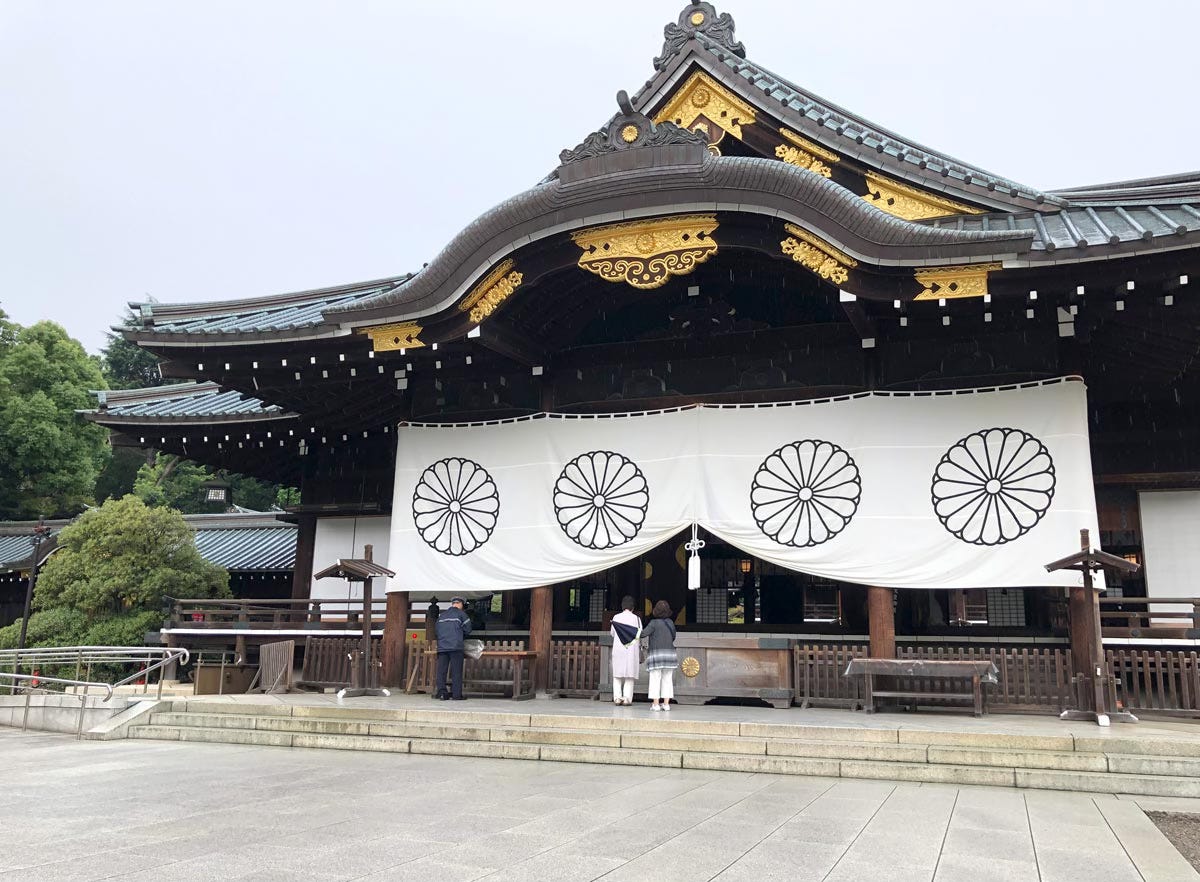
The Yasukuni Shrine in the Imperial Gardens, Tokyo.
Photo by Pierre Hazan

If ever you find yourself in the centre of Tokyo, make your way to the north-west corner of the Imperial Gardens, and turn left. A few minutes will bring you to the Yasukuni-jinja, Japan’s most controversial site. This is the national shrine to the war-dead, whose two and half million resident “glorious souls” include fourteen Class A war criminals.

A hundred yards to the right of the main shrine stands a museum, the Yushukan. Upon entering it, a visitor finds himself immediately face to face with a locomotive.

Now, when an Anglo-Saxon puts together Japan, Second World War, and locomotive, he arrives at one thing only: the “Burma Railway”. This is the railway that was hacked through the Burmese jungle partly by Allied prisoners-of-war, who were treated as slave labour and perished in their thousands. Over 12,000 Westerners died — about one in five — alongside perhaps 90,000 Asians.

So our Anglo-Saxon visitor beholds the locomotive with a mixture of disbelief, rising horror, and curiosity. He approaches the machine, looking for an explanatory text. Finding it, he learns that this locomotive is one of ninety that ran along the Burma Railway. He also learns the name of the military unit responsible for the railway’s construction. But of the Allied prisoners, the slave-labour, and the number of their deaths he learns nothing at all.

The Burma Railway wasn’t Auschwitz, either in genocidal intent or in murderous scale. But it was similar in its cruel contempt for human life. So the experience of confronting this Tokyo locomotive is analogous to stepping into a museum in Berlin and being confronted by one of the trains that shipped Jews to Auschwitz, and then reading an explanation that omits any mention of its cargo or the nature of its destination. If there were such a museum in Berlin, I’d have found it.

When our Anglo-Saxon ventures deeper into the Yushukan, he eventually discovers the exhibition on the 1930s and World War Two in the Far East. And here he learns that Japan’s imperial expansion was in fact a war of liberation, waged on behalf of subjugated Asian peoples, against Western colonial domination. And he learns that, even though Japan lost the war militarily, she won it politically, since the example of her early victories over the French in Vietnam, the Americans at Pearl Harbor, and the British at Singapore helped to inspire anti-colonial movements worldwide and so succeeded in ridding the world of European empires.

He also learns that what is known outside Japan as “the Rape of Nanking” (1937-8) is referred to demurely in the museum as “the Chinese incident”. And that whereas the “Rape of Nanking” is reckoned to have involved the indiscriminate massacre by Japanese troops of about 300,000 Chinese civilians, “the Chinese incident” only involved the severe treatment of Chinese troops who had violated the laws of war by disguising themselves in civilian clothes.

Did Germany Just Choose a King? – Rise of Hitler 17, May 1931

Filed under: Germany, History — Tags: , , , , , — Nicholas @ 04:00

World War Two
Published 22 May 2025

May 1931: 150,000 Stahlhelm men parade through Breslau before Crown Prince Wilhelm and other imperial relics, reviving monarchist hopes. Hitler hails his SA and calls for eastern expansion. But it’s economic collapse that dominates — Austria’s top bank nears default, threatening Germany’s own system. As Berlin pushes for a reparations pause and clings to its customs union with Vienna, France stands firm. And in Oldenburg, the Nazis take their first Landtag.
(more…)

“‘[D]isrupting traditional ideas’ of what a ‘triumphant figure’ is”

Filed under: Media, Politics, USA — Tags: , , , , , , — Nicholas @ 03:00

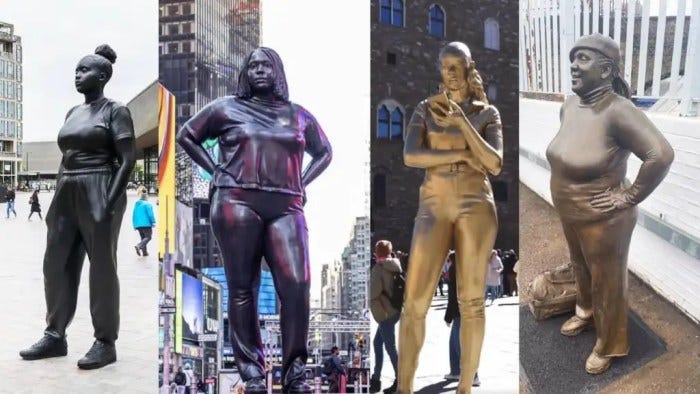
William M. Briggs uses the most recent installation of a statue of a black woman in highly public spaces to explore the idea that even black people “have Black Fatigue”:

Statues of fat ugly lumpen surly ill-kempt statues of black women, all in poses to accentuate their quarrelsome uselessness, are being placed in prominent places in the West. The Latest, rising like a creature in a 1960s Japanese monster movie, is in Times Square. The person who created these blots of bad taste said they were “a way of ‘disrupting traditional ideas’ of what a ‘triumphant figure’ is”.

He’s right. These figures do represent triumph. DIE requires elevating the least and representing them as the best, and forcing all to pretend the charade is real. Indeed, it is difficult to think of a more perfect representation of the true spirit of DIE than these misshapen piles of metal. They demand you say they are equivalent to great men whose statues we are no longer allowed to have.

If it were only statues, there would be no story. But everybody knows that bad black behavior of all kind is being ignored, excused or outright celebrated.

One example will suffice. After the lifelong thug and criminal lowlife George Floyd met his expected end — poisoning himself with drugs and engaging in all manner of misbehavior — our rulers and “elites” fell to their knees, even in Congress itself, to show their adoration of black criminality. Not to mention Floyd’s own statues which cropped up like poisonous mushrooms, each encouraging emulation of Floyd’s exasperating antics.

It’s so bad now that parents of white kids murdered by blacks rush out to forgive or excuse the killers, lest anybody dare to think they would condemn bad black behavior.

The question is why.

Before you answer, understand this is not only your “racist” Uncle Sergeant Briggs asking this question. Blacks themselves are asking.

There is an entire growing genre of YouTube videos of blacks telling us they grow weary of the constant misadventure of “ratchet blacks” (their word, not mine) and our culture’s welcoming attitude toward them. Take “Why Black Fatigue Is On The Rise“. Black fatigue is the natural exhaustion from having to deal routinely with with misbehaving blacks, where “dealing with” means having to pretend, while in polite society, we are not seeing what we are all seeing.

Watch just the first two minutes if you haven’t the time for more. The man in the inset quite rightly points out that blacks are now, as everybody always wanted, being judged by the content of their character, and not the color of their skin. The problem is the content of their character, or at least the character of those who are celebrated for misdeeds. As one commenter to the video said, the problem are blacks who are “Offended by everything. Ashamed of nothing. Entitled to everything. Responsible for nothing.”

The natural desire for separation, and to be with ones’ own, leads blacks to label blacks not confirming to expected behavior as “acting white”. The natural solution would be a formal separation: you go your way, we go ours. That, of course, would never be countenanced, and is anyway not desired by the majority. One thing absolutely demanded by our elites is “diversity”, by which they mean strict uniformity of belief. Our betters weep fake tears over things like colonization, which we know are fake because when we ask them to let us go our own way they say no.

If we can’t separate, then we have to find a way to get along with each other. Whatever this way is, it can’t have a basis in transparent lies.

Bill Bailey – The Doctor Who theme re-imagined as Belgian jazz

Filed under: Europe, Humour, Media — Tags: , , , , — Nicholas @ 02:00

Royal Ballet and Opera
Published 29 Jul 2021

Comedian Bill Bailey re-imagines the Doctor Who theme as Jacques Brel-esque Belgian jazz. Taken from his DVD Bill Bailey’s Remarkable Guide to the Orchestra.

QotD: The decline of the photography business

Filed under: Business, Media, Quotations, Technology — Tags: , — Nicholas @ 01:00

… photographers work in a hard-fought, competitive market. The ubiquity of camera phones means there are now few full-time newspaper photographers, for example. Television killed the photo magazines where the “greats” of photography mostly earned their crusts. The rise of Getty Images and the like has destroyed residual income from stock photography. More images are being generated than ever, but less money is being earned for making them. Their main problem is like that of actors, however. It’s a fun, creative job that many people want to do but there are too few customers to pay more than a minority of them. If they were not so disdainful about economics, both professions would find the outcome of that predictable. Mostly they just see it as “wrong” however.

There are playful souls among them but they tend to be more than averagely earnest. There’s an historical reason for that. In the early days of photography it was derided by fine artists as mere mechanical trickery. Painters and sculptors thought of photographers as the Church had once thought of them — as low class artisans unworthy of respect and to be cheated of their pay wherever possible. In consequence photographic pioneers longed to be seen as artists too and paid a lot of attention to “serious” subjects and “social” issues.

[…]

In amateur photography, the comfortable pensions of teachers and university lecturers mean there are far too many of them in a leisure field that requires a certain amount of investment in kit — adding further layers of pseudo-intellectual pomposity, musty from a lifetime of never being challenged. I am a member of the Royal Photographic Society, but though I enjoy a few of its workshops from time to time, mostly find its members smug and insufferable. I hesitate every year before renewing. Its beautifully produced magazine, for example, unquestioningly peddles the conventional thinking of the BBC class. I have learned to appreciate the images while ignoring the priggish text around them.

Tom Paine, “Where we are and what we see”, The Last Ditch, 2020-05-20.

Powered by WordPress


