First, Sabine Beppler-Spahl points out how difficult it was for the new ruling coalition to get their candidate for Chancellor actually installed:

German Chancellor Friedrich Merz, 5 May 2025.
Photo by Sandro Halank for Wikimedia Commons.
The spectacle in the Bundestag this week sent shockwaves through Germany’s political establishment. For the first time in modern German history, a chancellor candidate – Christian Democratic Union (CDU) leader Friedrich Merz – failed to get elected by parliament. In the first round of voting, he received just 310 out of 621 votes – six votes short of the necessary majority. A total of 18 members of his own coalition brazenly refused to support him.
A second round of voting was then called and Merz managed to scrape through with 325 votes. But this was a stinging embarrassment for both Merz himself and the new coalition government more broadly. “Never before has there been a political car crash on such a scale”, wrote Berthold Kohler, editor of the conservative FAZ.
In hindsight, Merz’s failure shouldn’t have been such a surprise. From the beginning, the new government was always going to be in for a rough ride. For a start, it is made up of two parties that both received phenomenally bad results in February’s federal elections. The CDU suffered its second-worst result since its founding. Meanwhile, the CDU’s coalition partner, the Social Democrats (SPD), received its worst result ever.
Worse still, the coalition was losing even more support in the polls in the weeks running up to the chancellor vote. At times, the governing parties barely managed 40 per cent between them. Hermann Binkert, head of the INSA polling institute, described this as a “loss of approval like never before in the period between a federal election and the formation of a new government”.
Many commentators are now questioning whether Merz and his coalition will ever truly recover from this humiliation. The fiasco certainly confirms that Germany is in a deep political crisis, which isn’t going anywhere. It also undermines the smug assertions of Europe’s anti-populist establishment, which has been claiming, against all evidence to the contrary, that German politics is less prone to populist upheavals than those of other Western democracies.
Outside parliamentary machinations, the move to declare the largest opposition party to be a formal threat to German democracy isn’t going smoothly either:
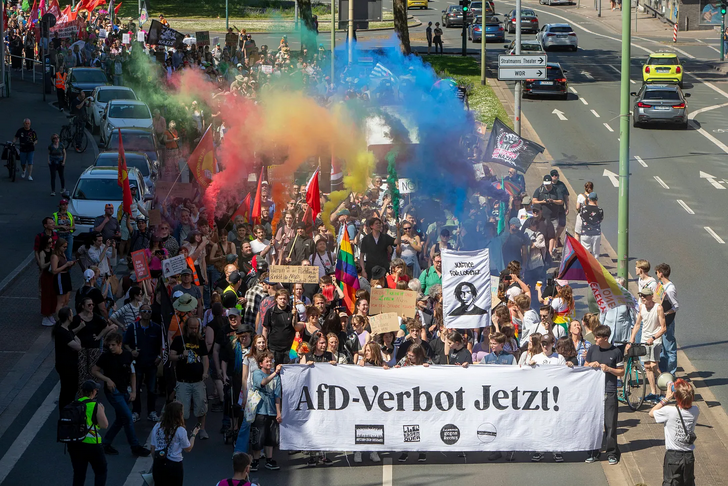
The anti-AfD protest in Essen on Sunday, photographed carefully lest the viewer see how small it was.
On 2 May, the Federal Office for the Protection of the Constitution (BfV) yielded to intense pressure from their boss, Interior Minister Nancy Faeser, and declared Alternative für Deutschland to be a “confirmed right-wing extremist organisation“. The media filled with hit pieces and leftoids began a new round of shouting and morally hyperventilating about the evil fascist Nazi Hitler party. I thought we might be seeing the beginning of an earnest campaign to prohibit the AfD and that over the coming weeks the momentum would just build and build.
Instead it’s kind of fizzled out.
One thing that went wrong, was the roll-out. The AfD immediately filed suit with the Cologne Administrative Court to have their extremist status lifted, and the BfV ended up temporarily suspending their assessment for tactical reasons – above all, to avoid a temporary court injunction that the AfD could portray as a victory. I’ve said many times that a lot of the media pressure against the AfD seems to be coordinated by the constitutional protectors themselves. Now that they’re no longer agitating behind the scenes, the steady drumbeat of pearl-clutching news stories has ground to a halt.
The second thing that has gone wrong, is the publicity campaign. You may remember that the constitutional protectors have produced a 1,100-page assessment documenting the right-wing extremism of the AfD. This dossier, however, remains entirely secret, and so journalists have been leaking choice passages from its pages instead. Their leaks strongly suggest that this document is little more than a vast assemblage of public statements by AfD politicians and functionaries that people in the BfV find untoward.
First we had the three leaks in Welt, which I covered in my first post on this topic. These featured people saying such benign things as “There is more to being German than simply holding citizenship papers” and “Failed migration policy and asylum abuse have led to the importation of 100,000 people from deeply backward and misogynistic cultures”.
That did not impress anybody, so Der Spiegel rushed out a new round of leaks. This piece tells us, breathlessly, that “politicians from the party have been ‘continuously’ agitating against refugees and migrants”, that “they have made xenophobic and Islamophobic statements” and that they have an “ethnic-ancestral understanding” of human descent groups that “is not compatible with the free democratic basic order”. They particularly deplore the use of terms like “knife migrants” (“Messermigranten“) which “attribute an ‘ethnocultural propensity for violence to entire groups'”. They say that the party does not consider Germans “with a migrant background from Muslim-influenced countries” to be equal citizens and that the AfD thus “devalues entire population groups in Germany”, violating their human dignity.