
The Great War
Published on 12 Mar 2018The German Spring Offensive in 1918, the so called Kaiserschlacht or Operation Michael, was the biggest German offensive of World War 1 and Quartermaster-general Erich Ludendorff prepared his troops for this battle by incorporating everything the German Army had learned in this war until now. Hutier Infiltration Tactics, Georg Bruchmüller’s artillery targeting and more lessons from the Eastern Front mean the Entente was facing a different army than before.
March 13, 2018
German Tactics For 1918 Spring Offensive I THE GREAT WAR Special
Comments Off on German Tactics For 1918 Spring Offensive I THE GREAT WAR Special
From slavery to Jim Crow to the civil rights movement
In the latest Libertarian Enterprise, Sean Gabb discusses the role of international affairs in reducing racial inequality in the United States from 1877 to 1981:
The year 1877 is significant in America history, as this was the year in which the Federal Government ceased to interfere in the affairs of its Southern States, and these States began to construct the system of white racial supremacy known as “Jim Crow.” It is also a useful starting point for charting the rise of America to world supremacy. In the years before 1914, the Americans regarded opposition to European colonial rule as a prime foreign policy objective. They resented British/Indian control of the far East and they were strongly opposed to any division of China between the European colonial powers. They preached an ’Open Door Policy’ for China in which none of the white powers would have political control.
Again, this concern for the independence and self-determination of others was inconsistent with their own internal policies. As put by Paul Gilroy in the introduction of The Autobiography of Malcolm X, “the American civil war did not end in 1865.” Until the 1960s and even later blacks remained systematically at a legal and social and economic disadvantage in America. In most of the Southern States, blacks were not allowed to vote or to sit on juries, public and most private services were racially segregated, racial intermarriage was made illegal.
[…]
In the end America did not sign the treaty of Versailles and did not join the League of Nations. American domestic affairs remained insulated from foreign affairs. Wilson himself did much to keep them so. The early twentieth century saw a grown of racial consciousness among American blacks, and a number of charismatic leaders emerged to press the case for black equality. These included intellectual activist W. E. B. Du Bois, entrepreneur C. J. Walker, National Equal Rights League founder William Monroe Trotter, and activist Wells-Barnett, and Marcus Garvey, founder of The Universal Negro Improvement Association. These men wanted to attend and address the Paris Peace Conference in 1919. Wilson ensured that they were kept out.
By the 1930s, we see a growing realisation of the conflict between foreign and domestic policy. Look, for example, at chapter 26 of Harper Lee’s classic novel To Kill A Mockingbird. It is the 1930s and a teacher in the protagonists’ school denounces Nazi mistreatment of the Jews in Germany. She seems completely unaware that the Nuremburg decrees may have compared rather well with the ‘Jim Crow’ system in which she lived.
[…]
What matters about the Cold war for America is that its race relations became a serious embarrassment to its foreign policy. In order to oppose Communism the Americans had to preach their own versions of human rights which included all the usual liberal freedoms – i.e. freedom of speech, freedom of association, equality before the law, and so forth. It also needed the cooperation of an increasing number of non-white post-colonial governments. At every opportunity the Soviets tried to embarrass the Americans by drawing attention to their internal race relations.
Take, for example, the memorandum written in June 1963 by Thomas Hughes, Assistant Secretary of State for Intelligence and Research at the State Department. He summarises some of the main themes of Soviet broadcasts to the Third World: Capitalism provides a natural environment for racism, which will never end so long as the American system needs cheap labour; the federal government’s policy of limited intervention in Southern conflicts is tantamount to support of Southern racism; the United States cannot claim to be the leader of the free world while hypocritically refusing to support civil rights within its own borders.
Hughes adds that, most politically damaging, Soviet broadcasters were arguing that American domestic policy toward its black citizens was ‘indicative of its policy toward peoples of color throughout the world.’ Emerging African, Asian, and South American nations, in other words, should not count on Americans to support their independence.
The journalist Walter Lippmann had noted in 1957 that
the work of the American propagandist is not at present a happy one…. [Segregation] mocks us and haunts us whenever we become eloquent and indignant in the United Nations…The caste system in this country, particularly when as in Little Rock it is maintained by troops, is an enormous, indeed an almost insuperable, obstacle to our leadership in the cause of freedom and human equality.
We can write the history of the American civil rights movement purely in terms of domestic politics. We can for example write about the Brown decision and ’Massive Resistance’ and the crisis in Little Rock. Of course this is entirely legitimate. The struggle for racial equality has deep roots in American history and may well have triumphed even had there been no other countries in the world. However it does seem reasonable to see an international dimension in the rapid progress of racial equality after the 1940s.
Comments Off on From slavery to Jim Crow to the civil rights movement
The Queen of Lesbos – Poetess Sappho l THE HISTORY OF SEX
IT’S HISTORY
Published on 16 Sep 2015The Greek poetess Sappho from the Isle of Lesbos is the most important female lyricist of the classical age. She worshipped women and often addressed her work to beautiful ladies. Although her definite sexuality will remain a mystery, it is almost as widely discussed as her work itself. The constant myth that Sappho was gay remains which is why the term “lesbian” dates back to Sappho’s erotic poetry. Learn all about the great Sappho and what the term “doing it like the ladies of Lesbos” actually means, on IT’S HISTORY.
Comments Off on The Queen of Lesbos – Poetess Sappho l THE HISTORY OF SEX
March 12, 2018
Sarah Hoyt on women’s advantages and disadvantages
A recent post at According to Hoyt:
I did not ask to be born a woman. At least presumably I didn’t ask. If we look too closely at this, we get into all sorts of things about pre-existing souls, reincarnation and what not. Neither fit into my system of belief, but neither am I absolutely sure of what happens after you die, or before you’re born, because how can I be? Eventually I’ll find the one out, the other also if my system is wrong. And in either case it matters very little to here and now.
However, I do know being born a woman wasn’t some sort of achievement, like I just won a race and deserve a medal. I am a woman, and that’s fine. My little tomboy self didn’t always think it was a good idea, this being a woman thing, but I’ve come to enjoy it. I can still slay dragons and drink but I can also wear bitching shoes while doing it, and no one looks at me sideways.
Or to put things another way: I have my limitations, my sticking points, and things I do that make people look at me oddly. The limitations and sticking points have bloody nothing to do with being female. Even in Portugal, where I was presumed to be dumber than most males (it’s a cultural thing) I never found that to be an impairment, because I wasn’t and I’d eventually show it. Also, because I’m that kind of person, I enjoyed the look of shock on their faces when I showed it. The sticking points: I’ve gone to pot, physically for various reasons, mostly having to do with hypothyroidism and asthma, and true, I was never as strong as most males. So in a test of strength, I’d have failed. But I was quite strong enough when I was young to carry furniture as heavy as the movers did, and for as long (I never had to tell my husband “I can’t lift this” until my fifties. And in a fight I just had to be twice as low-minded and nasty. Because a fight isn’t won on a straight up context of strength.
I never found being a woman an impairment. I did take shameless advantage of it a time or twenty. It’s easier to get out of a ticket, if you act the ditsy woman. It’s easier to diffuse a situation that for a male would end in a fight by smiling and talking in a “little girl lost” voice.
Do I feel bad about using the advantage that the evolutionary triggers against hurting females gives me? Oh, please. You are born who you are born. You use ALL your weapons. All of them. Why not? There are disadvantages that come with your advantages. There are disadvantages for everyone. You use all your advantages. They’re yours. Why wouldn’t you use them?
Comments Off on Sarah Hoyt on women’s advantages and disadvantages
The pesky and persistent gap between what men earn and what women earn
Tim Worstall responds to yet another Guardian article decrying the difference in earnings for men and women:
There is a gender earnings gap in British – as with all others – society. The interesting question is what is causing it, the important one what we do about it. The answers being, in turn, children and nothing.
This is not, you will note, the general direction of the political conversation. It does have the merit of being true on both counts.
Take this finding that there are lots more highly paid men out there:
There are almost four times more men than women in Britain’s highest-paid posts, according to “scandalous” figures that show the extent of the glass ceiling blocking women from top jobs.
Government data reveals the huge disparity in the number of men and women with a six-figure income, fuelling concerns over the gender pay gap in the City and other professions.
There were 681,000 men earning £100,000 or more in 2015-16, according to new HMRC data. It compares with only 179,000 women. The latest figures show that 17,000 men earned £1m in 2015-16, while only 2,000 women did so.
Those numbers are true. There are more men earning higher incomes than there are women. This is the entire and whole driver of that gender pay gap – or what it actually is, a gender earnings gap. And what is the cause of this? As the TUC has pointed out [PDF]:
There is an overall gender pay gap of 34 per cent for this cohort of full-time workers who were born in 1970. This gap is largely due to the impact of parenthood on earnings – the women earning less and the men earning more after having children.
That really is just about all there is to it. It’s illegal, and has been for decades, to pay people differently based solely upon their gender. People doing the same job get the same pay by gender – there’re fortunes to be made dobbing in employers where this isn’t the case and we don’t see such dobbing in happening.
[…]
We can also point out that the true answer here is entirely in womens’ hands. Granny knew how to manage G-Pops, Lysistrata shows the Ancient Greeks got the point. If the only way men got nookie and or children was by being house husbands then there wouldn’t be a gender earnings gap, or it would run the other way. That women don’t strike for this – perhaps that not enough do – shows that this might well not be what women actually want.
OK, maybe not in womens’ hands but certainly in their control….
Comments Off on The pesky and persistent gap between what men earn and what women earn
Genghis Khan – Khan of All Mongols – Extra History – #4
Extra Credits
Published on 10 Mar 2018Temüjin had a plan: a set of strategies to keep amassing wealth and followers for himself while keeping unity between all the disparate Mongol tribes he was collecting. But Jamukha and Ong Khan had other plans…
Comments Off on Genghis Khan – Khan of All Mongols – Extra History – #4
And the next premier of Ontario is likely to be … Doug Ford?
Saturday’s Ontario Progressive Conservative leadership contest went down to the wire … and beyond, as voting glitches pushed the announcement of a winner beyond the time the party had rented the facility in Markham, so attendees had to go elsewhere to wait for the final result. In a disturbingly similar way to the last US presidential election, Christine Elliot won the popular vote, but the result hinged on the number of constituencies won, which went to Ford. Several of my (Liberal or NDP) friends on Facebook, who’d announced they’d joined the PCs explicitly to vote against Ford, were aghast at the result.
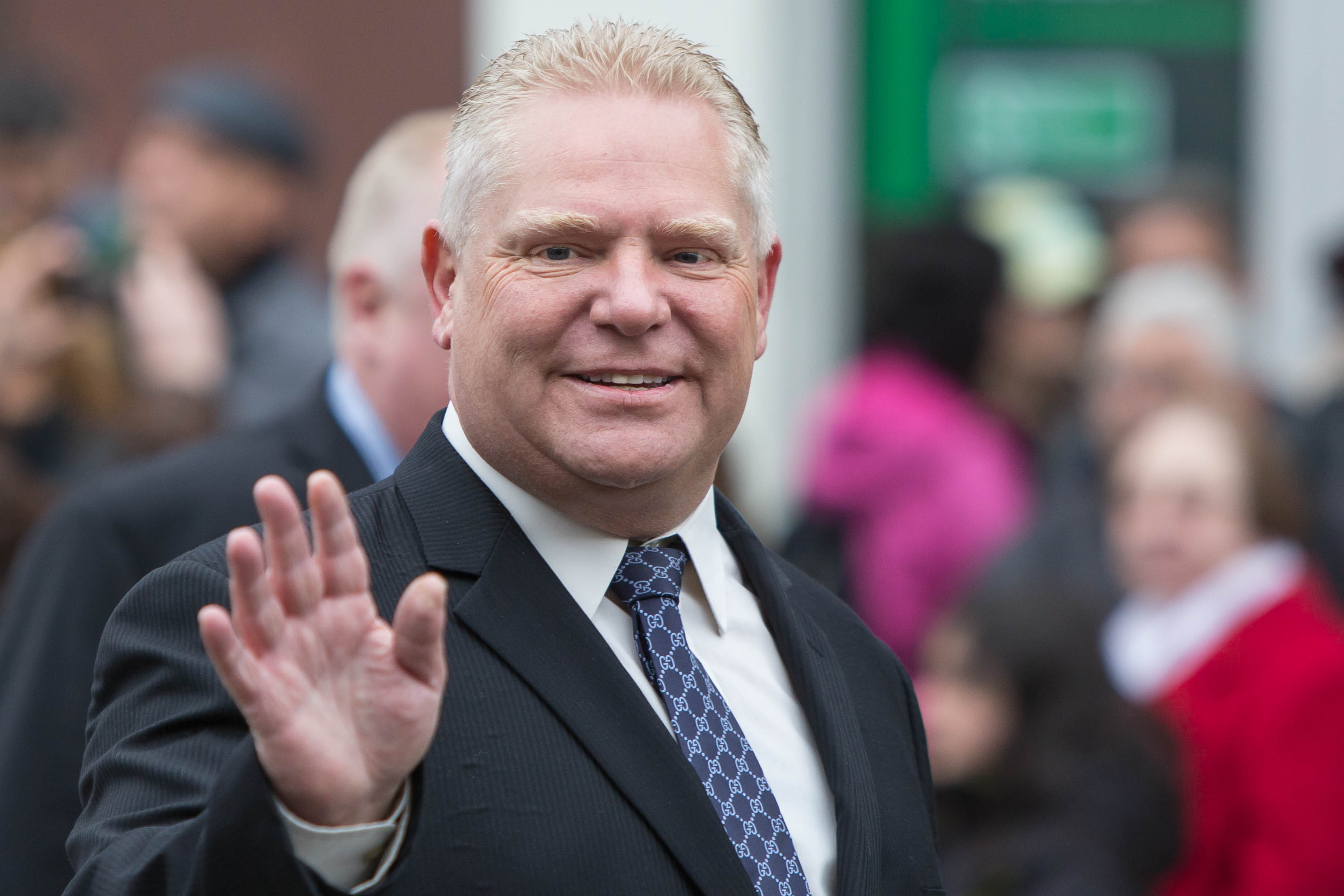
New Ontario Progressive Conservative leader Doug Ford at the 2014 Good Friday procession in East York.
Photo via Wikimedia.
In the National Post, Chris Selley reports on the three-ring circus:
In the end, maybe caucus had it right. If more than anything else Ontario’s Progressive Conservatives wanted to win on June 7 then maybe they should have stuck with interim leader Vic Fedeli. If the ultra-folksy MPP for Nipissing wasn’t the most compelling imaginable premier-in-waiting, he would certainly have cut a less divisive figure than Doug Ford, who was announced as the party’s new leader late Saturday night in a small room at a Markham conference centre.
“To the party members I say thank you. To the people of Ontario I say relief is on its way,” Ford told reporters and campaign workers. “And to Kathleen Wynne, I say your days as premier are numbered.”
That got a massive cheer, of course, but this is an outcome that many in the party consider a worst-case scenario. An Angus Reid poll released this week asked “soft” Tory voters whether each candidate would make them more or less likely to support the party: Ford’s net score (more likely minus less likely) was minus 27 per cent; Christine Elliott, who finished a very narrow second Saturday — her third failed shot at the position — was at plus 20.
Sticking with Fedeli would also have spared the party the hideous embarrassment of Saturday’s botched convention. Vote-counting dragged on for hours thanks to a chunk of ballots that had been allocated to the wrong ridings. A packed crowd of partisans was left in the dark for three hours, then told to hang tight for another 30 minutes, and then sent away into the night with no result. In lieu of a cascade of balloons, there was booing and hollering. Various Ford supporters, citing ostensibly conclusive media reports earlier in the day that Ford had won, alleged party elites were trying to steal it.
These were not the ideal circumstances in which to build unity, which was the stated purpose of the event. “You’ve been through a very tough couple of months — perhaps the toughest times in the history of the Progressive Conservative Party of Ontario,” Alberta United Conservative Party leader Jason Kenney told the crowd. “You’ve gone through weeks of anxiety and adversity. But I am certain that you will overcome this time of trial, and that this afternoon, with the election of your leader, you will emerge stronger, united and victorious in the election.”
“This afternoon,” he said. We were so young then.
CORRECTED: 2018 Ontario PC leadership electoral point flow. #onpcldr pic.twitter.com/0w89PK9Er2
— Paul Fairie (@paulisci) March 11, 2018
The flow of votes from Allen to Ford was expected, but what I didn’t expect was the proportion of Mulroney votes that flowed to Ford instead of Elliot (I’d expected roughly 100% to Elliot, but a significant number went to Ford instead).
Perhaps the most surprising thing about the leadership campaign was how well Ford managed to stick to his talking points and not be baited into the kind of media spectacle his late brother seemed to specialize in. A tougher test awaits in the June provincial election, however. The Liberals and NDP have been gifted a full warehouse of attack ads, based on the Ford brothers’ chaotic and at times incoherent term in office in Toronto, but there may be a limit to the overall usefulness of this arsenal: rather like the US media attacking Trump during the last US election, we’ve probably heard it all before.
The circus may not be over yet, however, as reports on Sunday indicated that Christine Elliot is demanding an investigation into the election.
How to Make Mead at Home
This Old House
Published on 22 Jan 2017Ask This Old House host Kevin O’Connor learns about the centuries-old art of making mead.
Time: A few hours of work, 1 year of aging
Cost: under $100
Tools:
FunnelShopping List:
Yeast
2x One-gallon jug
3 pounds of honey
Air lock cap
Marbles
Siphon tube
Home brewing sanitizerSteps:
1. Before beginning the home brew process, ensure the gallon jug, funnel, and siphon tube have been properly sanitized.
2. Fill up the gallon jug about a third of the way up with either tap or bottled water (don’t use distilled water).
3. Add 3 pounds of honey, then cap the solution and mix it up by shaking the jug.
4. Heat up water to 104 degrees in a pan and add yeast to dissolve it.
5. While the yeast is dissolving, you can add optional yeast nutrients to get a cleaner ferment.
6. Once the yeast is dissolved, use a funnel to pour the yeast solution into the jug.
7. Pour more water into the jug and top it off until you reach the neck of the jug.
8. Place air lock cap on top of the jug and pour a little bit of water into it to form a seal. This will prevent oxygen from getting in but will allow carbon dioxide to escape.
9. After a several weeks, once carbon dioxide has stopped releasing from the jug and fermentation is complete, it’s time to siphon the solution into a new, clean jug.
10. Ensure the siphon tub and second jug have been properly sanitized, then place the older jug higher than the new jug. Fill the siphon tube with water and gravity will pull the mead from one jug to the next. Ensure you only siphon liquid, leaving behind any solids at the bottom of the jug.
11. To fill up the void left behind from one jug to the next and limit exposure to oxygen, place a number of sanitized marbles into the new jug.
12. Place the air lock on the new jug. Leave that on for about a month and then place a regular cap onto the jug once bubbles no longer appear.
13. Leave the solution in a dark spot, like the basement for about a year for the mead to age properly.
Comments Off on How to Make Mead at Home
QotD: Punctuation
The rules [of punctuation] we’re taught in school are the syntactic ones; in these, punctuation is a part of the grammar of written English and the rules for where you put it are derived from grammatical phrase structure and pretty strict. Lynne Truss of Eats, Shoots & Leaves fame is an exponent of this school. But there is another…
Punctuation marks originated from notations used to mark pauses for breath in oral recitations, but 17-to-19th-century grammarians tied them ever more tightly to grammar. There remains a minority position that language pedants call “elocutionary” – that punctuation is properly viewed as markers of speech cadence and intonation. Top-flight copy editors know this: the best one I ever worked with was a syntactic punctuationist on her own hook who noted that I’m an elocutionary punctuationist and then copy-edited in my preferred style rather than hers. (That, my friends, is real professionalism.)
And why am I an elocutionary punctuationist? Because I pay careful attention to speech rhythm and try to convey it in my prose. Not all skilled writers do this, but elocutionary punctuation survives in English because it keeps getting rediscovered for stylistic reasons. Consider Rudyard Kipling or Damon Runyon – two masters of conveying the cadences of spoken English in written form; both used elocutionary punctuation, though perhaps not as a conscious choice.
To an elocutionary punctuationist, the common marks represent speech pauses of increasing length in roughly this order: comma, semicolon, colon, dash, ellipsis, period. Parentheses suggest a vocal aside at lower volume; exclamation point is a volume/emphasis indicator, and question mark means rising tone.
In normal usage, most of the differences between the schools show up in comma placement. But in less usual circumstances, elocutionary punctuationists will cheerfully countenance written utterances that a grammarian would consider technically ill-formed. Here’s an example: “Stop – right – now!” The dashes don’t correspond to phrase boundaries, they’re purely vocal pause markers.
Eric S. Raymond, “Extreme punctuation pedantry”, Armed and Dangerous,
Comments Off on QotD: Punctuation
March 11, 2018
Savage Division – Displaced People – Sexual Relations I OUT OF THE TRENCHES
The Great War
Published on 10 Mar 2018Chair of Wisdom time!
Comments Off on Savage Division – Displaced People – Sexual Relations I OUT OF THE TRENCHES
Soviet Leaders in 7 Minutes (History)
Austin Olney
Published on 19 Apr 2016Learn about the leaders of the Soviet Union.
Vladimir Lenin
1917-1922
Joseph Stalin
1922- 1953
Georgy Malenkov
1953-1955
Nikita Khrushchev
1953 – 1964
Leonid Brezhnev
1964 – 1982
Yuri Andropov
1982 – 1984
Konstantin Chernenko
1984 – 1985
Mikhail Gorbachev
1985 – 1991Music – Goldeneye 64 Menu
Comments Off on Soviet Leaders in 7 Minutes (History)
Polls begin to reflect public disillusionment with Trudeau after gaffe-filled India trip
After all the PR blunders, it’s amazing that the Liberals are still riding as high in public opinion polls as they are:
By now it is clear the federal Liberals are in some difficulty with the public. Much excitement attended that Ipsos poll earlier this week showing them trailing the Conservatives for the first time, and by a not inconsequential margin: 38 to 33. But it’s not just Ipsos.
Forum Research, which gives the Tories a 12-point lead, may be an outlier, but Nanos’s latest four-week rolling poll shows the Liberal lead has shrunk to less than four points from eight points in December; Abacus Data, similarly, now has them just three points ahead, the narrowest margin they have found since the election.
Overall, the CBC’s Poll Tracker website now puts the two parties more or less level, based on a weighted average of the polls, at 36 per cent. Contrast that with the Liberals’ first year in office, when they maintained a lead of as much as 20 points, or even their second, when they led by eight to 10. Something is clearly up.
The reason is not hard to find, nor is it unusual: the prime minister’s personal approval rating has declined markedly. To be sure, he remains the Liberals’ chief asset: Nanos still shows 40 per cent of Canadians put Justin Trudeau as their preferred prime minister. Sixty per cent say he “has the qualities of a good political leader.”
[…]
The immediate explanation for the prime minister’s cratering appeal is the recent official visit to India, conceded on all sides to have been a disaster. There’s no doubt this has taken its toll — Ipsos finds more than twice as many Canadians of the view that the visit was “negative for Canada-India relations” than the contrary.
But if the India visit accelerated the decline, it is also true that the prime minister’s appeal has been fading for some time. The India trip may have crystallized certain perceptions of him, but the ingredients have been evident for a while. People do not form impressions of a leader’s character and abilities instantaneously, but only as the result of an accumulation of incidents and impressions.
The Tories’ pre-election attempts to discredit Trudeau as “just not ready” failed in the light of a long campaign in which he persuaded increasing numbers of Canadians that he was. I don’t imagine many would have said he was much of a deep thinker — his worst moments are almost always when he tries to pretend he is — but people gave him credit for sincerity, personal decency, idealism, and a native political ability that seemed to grow throughout the campaign.
But now? Asked to name the first quality that came to mind, I suspect increasing numbers might be more inclined to mention his cynicism.
Comments Off on Polls begin to reflect public disillusionment with Trudeau after gaffe-filled India trip
QotD: The value of education
Men are born ignorant, not stupid; they are made stupid by education.
Bertrand Russell, A History of Western Philosophy, 1945.
Comments Off on QotD: The value of education
March 10, 2018
Jacob Rees-Mogg versus the Tory establishment
In the Continental Telegraph, Hector Drummond describes the rise of Jeremy Corbyn despite the bitter resistance of the Labour party establishment and says that the mistake Labour made was allowing Corbyn on the ballot in the first place — the party rank and file were far more ideologically “left” than the MPs and party officials. “When Corbyn was elected leader, it looked like Labour had shot itself through the foot. It now looks like what actually happened was that New Labour shot itself through the heart.”
On the other side, the closest equivalent threat to the Tory party establishment appears to be Jacob Rees-Mogg:
It’s clear that the wet Tory establishment is not keen on Jacob Rees-Mogg. On the surface that appears to be because he holds robust views that are at odds with theirs: he’s an actual Conservative, and they are, of course, anything but. But I wonder if there’s a deeper fear there as well: do they worry that if Rees-Mogg becomes leader then the party will slip out of their grasp in the way that Labour was taken over by hard-left, Momentum commies?
[…]
So I suspect the Tory establishment think that at all costs Rees-Mogg must be kept off a leadership ballot, because there’s a good chance he would win: he constantly tops the polls among party members for preferred leader. You see how the thinking would go after that. He’ll appoint a dry Cabinet. The likes of Gove and Johnson would be given a freer rein. Maybe even John Redwood would come into cabinet. All the disgruntled right-wingers who’ve quit the party in recent decades would come flocking back, including all the racists. We’d have a proper Brexit. The new members would get involved in choosing more right-wing candidates in local constituencies, which the central office would now be okay with. Some centrist MPs and councillors would quit the party, and The Guardian and the BBC will big up their huffy resignation letters. Anna Soubry, having left the party, will do wall-to-wall TV interviews telling the BBC and CNN how bad the Tories are under Rees-Mogg. And so the Tories would lose voters from the middle as they come to be seen as another bunch of UKIP-style golf-club bores, and Jeremy Corbyn will win the election (which the Tory establishment will think is a horrible outcome, but not quite as horrible as Rees-Mogg winning the election).
However, such fears are a bit overblown. True, Anna Soubry probably would quit, but that’s a good thing. Disgruntled right-wingers may come back into the fold, but that’s a good thing as long for the Tories (as long as overt racists are kicked out) – the Tories need those people back voting for them, and working for them.
But I can’t see Rees-Mogg upturning the Conservative establishment. Maggie Thatcher couldn’t do it, she remained a outlier for her entire career despite being PM for years, so I doubt Rees-Mogg could either (although I hope he can). And although there’s a lot of energy on the right at the moment, there’s nothing like Momentum, with its quasi-religious fervour, and its Stalinist-style fanaticism. Plus the wider establishment, like the BBC, the civil service and the Universities are virulently anti-right, and they have a vice-like grip on power, and they’ll harry the Conservatives under Rees-Mogg. So the party would go right to some degree, but not to any great extent. And eventually the squishy MPs will kill off Rees-Mogg once he makes a mistake.
But it should be good while it lasts, as long the Establishment fails to prevent him getting onto the leadership ballot paper.
Comments Off on Jacob Rees-Mogg versus the Tory establishment


