Quotulatiousness

September 4, 2014

How post-Prohibition restrictions still plague many states

Filed under: Law, USA — Tags: , , , , — Nicholas @ 17:07

The American craft beer boom continues, but making the beer is only the start of the process of getting the beer into the hands of eager consumers. CEI’s Michelle Minton explains how rules crafted for the end of Prohibition now artificially restrict the craft beer marketplace, reduce consumer choice, and add unearned profits to favoured corporations:

After Prohibition ended, Americans could sell, produce, import, and transport alcoholic beverages, but home-brewing was still illegal until 1978 when then President Jimmy Carter signed legislation to legalize brewing in the home for personal or family use. In that year, the number of breweries was at its lowest point after the repeal of Prohibition. But in the 1980s, after states began to legalize brewpubs, the number of brewers began to rise. This development, along with easy access to capital in the 1990s and 2000s, aided efforts of modern craft breweries to change the laws in their home states so that they could brew more, self-distribute, and start the microbrew revolution.

[…]

Another hindrance for craft brewers are franchise laws, enacted among the states in the 1970s and 80s due to fears of brewers’ market power. With less than 50 brewers in the nation at the time — most of them large — there was a fear the big brewers could hold wholesalers hostage by threatening to walk away unless distributors bowed to the brewers’ demands. Since then, however, the landscape has completely shifted.

Although the number of wholesalers nationwide has declined, those remaining are larger and more powerful than almost all of the breweries in the nation. Yet, the laws remain, giving the wholesalers “virtual carte blanche to decide how the beer is sold and placed in stores and bars,” according to Brooklyn Brewery founder Steve Hindy.

In almost every other industry, a manufacturer unhappy with a distributor’s performance or price can terminate a contract in search of a better fit. This is not the case for beer manufacturers. Brewers wishing to switch from one distributor to another must go through long and costly legal battles. Hindy, for example, paid $300,000 to get out of a contract with a New York wholesaler. Yuengling COO Dave Casinelli’s experience was similar. In a phone interview, he noted that in his 24 years with the company, he couldn’t recall any attempt to switch wholesalers that didn’t end up with some legal ramifications.

Most state franchise laws not only make leaving a wholesaler hard, but they also create regional monopolies, known as “exclusive territories,” where a brewer is prohibited from selling through more than one distributor within a given area. This undermines incentives for wholesalers to compete by improving performance, increasing efficiency, or lowering prices. After all, distributors have little or no fear that a brewer will leave — because most of them can’t. As for consumers, they end up paying more because of this lack of competition.

Orwellian newspaper editing as a game

Filed under: Gaming, Liberty — Tags: , , , — Nicholas @ 16:22

John Ryan linked to this article about The Westport Independent, which puts you in the position of a newspaper editor in an Orwellian world:

The Westport Independent, a self-described “censorship simulator,” places that editorial power in the hands of players during a time of political unrest in the city of Westport. It’s 1948, and rising rebellions against the government lead to a new bill banning any news outlets that do not comply with the Loyalist Government Guidelines. You play as the editor in chief of an independent newspaper entering its final weeks before the ban.

As editor, you control the censorship of articles, pick headlines, and arrange the layout to tell the truth of your choosing. As with Orwell’s 1984, “in a time of universal deceit, telling the truth becomes a revolutionary act.” Will you abide by rules and force-feed your readers the government’s narrative? Or will you defy their guidelines, and print the rebellion’s perspective instead? The city, divided into class-based districts, dynamically responds to everything you print. By shaping public opinion with the stories you choose, you shape the current events that unfold. And by shaping the events, you affect the stories you can cover.

The very essence of government is a monopoly on violence

Filed under: Government, History, Middle East — Tags: , — Nicholas @ 09:19

Matt Ridley on how governments came about historically and how ISIS is trying to do exactly the same thing:

Nobody seems to agree whether Islamic State is best described as a gang of criminals, a terrorist organisation or a religious movement. It clearly has a bit of all three. But don’t forget that it aspires, for better or worse, to be a government. A brutal, bigoted and murderous government, its appeal is at least partly that it seems capable of imposing its version of “order” on the territory it controls, however briefly. It reminds us that the origin and defining characteristic of all government is that it is an organisation with a monopoly on violence.

The deal implicit in being governed is at root a simple one: we allow the people who govern us to have an exclusive right to commit violence, so long as they direct it at other countries and at criminals. In almost every nation, if you go back far enough, government began as a group of thugs who, as Pope Gregory VII put it in 1081, “raised themselves up above their fellows by pride, plunder, treachery, murder — in short by every kind of crime”.

Was Canute, or William the Conqueror, or Oliver Cromwell really much different from the Islamic State? They got to the top by violence and then violently dealt with anybody who rebelled. The American writer Albert Jay Nock in 1939 observed: “The idea that the state originated to serve any kind of social purpose is completely unhistorical. It originated in conquest and confiscation — that is to say, in crime … No state known to history originated in any other manner, or for any other purpose.”

Henry VII, the monarch who managed, after a century of gang warfare, to establish a monopolistic central government in England, funded his administration largely by extorting money from rich merchants with the threat of violence. That is to say, he ran a protection racket as blatant as any mafia don or IRA commander: pay up or lose your kneecaps.

The new absolutism

Filed under: Environment, Liberty, Media, Science — Tags: , , , — Nicholas @ 09:12

Brendan O’Neill on the rise of the absolutist mindset in science:

Who do you think said the following: “I always regret it when knowledge becomes controversial. It’s clearly a bad thing, for knowledge to be controversial.” A severe man of the cloth, perhaps, keen to erect a forcefield around his way of thinking? A censorious academic rankled when anyone criticises his work? Actually, it was Brian Cox, Britain’s best-known scientist and the BBC’s go-to guy for wide-eyed documentaries about space. Yes, terrifyingly, this nation’s most recognisable scientist thinks it is a bad thing when knowledge becomes the subject of controversy, which is the opposite of what every man of reason in modern times has said about knowledge.

Mr Cox made his comments in an interview with the Guardian. Discussing climate change, he accused “nonsensical sceptics” of playing politics with scientific fact. He helpfully pointed out what us non-scientific plebs are permitted to say about climate change. “You’re allowed to say, well I think we should do nothing. But what you’re not allowed to do is to claim there’s a better estimate of the way that the climate will change, other than the one that comes out of the computer models.” Well, we are allowed to say that, even if we’re completely wrong, because of a little thing called freedom of speech. Mr Cox admits that his decree about what people are allowed to say on climate change springs from an absolutist position. “The scientific view at the time is the best, there’s nothing you can do that’s better than that. So there’s an absolutism. It’s absolutely the best advice.”

It’s genuinely concerning to hear a scientist — who is meant to keep himself always open to the process of falsifiabilty — describe his position as absolutist, a word more commonly associated with intolerant religious leaders. But then comes Mr Cox’s real blow against full-on debate. “It’s clearly a bad thing, for knowledge to be controversial”, he says. This is shocking, and the opposite of the truth. For pretty much the entire Enlightenment, the reasoned believed that actually it was good — essential, in fact — for knowledge to be treated as controversial and open to the most stinging questioning.

“David Cameron mouths foolish nothings” while “Obama … resembles a spineless invertebrate”

Filed under: Britain, Europe, Middle East, Russia, USA — Tags: , , , — Nicholas @ 07:25

Historian Max Hastings pours out the scorn toward British PM David Cameron and American President Barack Obama for their dithering and unwillingness to grapple with real world problems like the invasion of Ukraine and the rise of ISIS:

Suddenly, the world seems a frightening place. The beheading of a second American hostage by jihadist fanatics and the threat that a British aid worker will suffer the same fate has shocked the peoples of the West, as have few events since the Cold War.

We are uncertain how the Western Powers should respond.

At such moments, we turn to our national leaders for wisdom, reassurance and decision. Instead, we get posturing, dithering and waffle.

David Cameron mouths foolish nothings, proclaiming that Britain would commit ‘all the assets we have’, including our ‘military prowess’ against the Muslim extremists.

More serious, the President of the United States seems supine in the face of the gravest threats to international order in a generation.

Barack Obama boldly strides golf course fairways, while apparently washing his hands of the job the American people — and, by association, the civilised world — pay him for: to strive to lead us into the paths of righteousness.

To borrow P. G. Wodehouse’s phrase, however intelligent Obama may be, he resembles a spineless invertebrate.

Update: Speaking of scorn, here’s Jonah Goldberg yesterday (H/T to Jim Geraghty for the link).

This was always nonsense, but then again so much of the hype about Obama in the early days of his presidency was nonsensical. Still it does contribute to the poignancy of the moment. I’m referring specifically to the Islamic State and their celebration of slavery. MEMRI has excerpts of Facebook chats between British and French supporters of the group as they discuss the great news that you can buy Yazidi women as sex slaves.

[…]

It’s also worth noting that the president has done everything he can to claim that his domestic political opponents are engaged in a “war on women.” He won an election largely because he convinced enough women — and pliant journalists — to take this bilge seriously. Just this week the head of his party went on at great length to claim that the Republican governor of Wisconsin has been “giving women the back of his hand.”

Oh, and let us not forget, the president and his supporters work very hard to paint their domestic political opponents as religious extremists because some private businesses and religious groups don’t want to pay for procedures that violate their conscience.

Now compare this to the people who are celebrating the fact their faith allows them to enslave women.

Just think about it for a moment. The president surely knows about this. His administration surely knows about this. And yet, the president — this modern incarnation of Lincoln, protector of women and opponent of domestic religious extremism — defines his goal for the Islamic State as reducing it to a “manageable problem.” Does this mean that if the group renounces any designs on attacking the U.S. homeland (an impossibility given the tenets of their faith and ambition for a global caliphate) he will stand by as they continue to barter women as sex slaves and breeders? This is the same man who campaigned in Berlin as a “citizen of the world” and champion of global community.

Forgive me, but the term, “Lincolnesque” doesn’t immediately spring to mind.

A deluge of public domain images

Filed under: Business, Cancon, History, Media — Tags: , , — Nicholas @ 00:02

Techdirt‘s Mike Masnick alerted me to a new source of old images:

Here’s some nice news. Kalev Leetaru has been liberating a ton of public domain images from books and putting them all on Flickr. He’s been going through Internet Archive scans of old, public domain books, isolating the images, and turning them into individual images. Because, while the books and images are all public domain, very few of the images have been separated from the books and released in a digital format.

There are all sorts of images in this stream, so you never know what you’ll find when you dive in. Here, for example is an image used in Canadian grocer January-June 1908:

Crown illustration from Canadian Grocer 1908

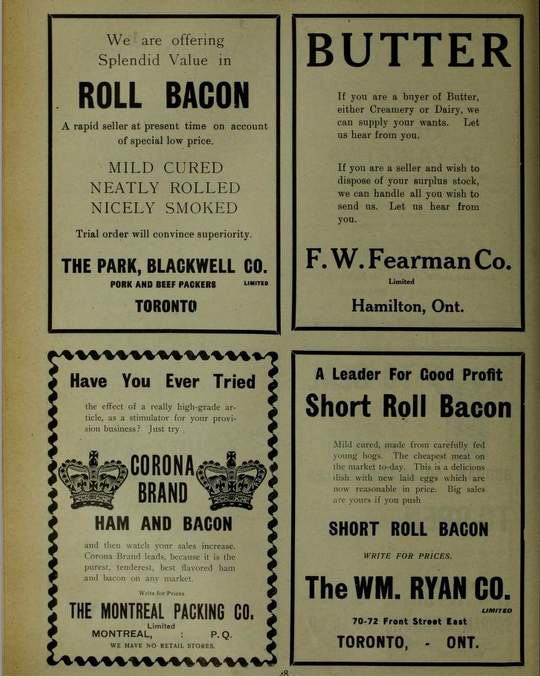
Which, if you follow the link to the original publication, was isolated from this page of ads:

Full page from Canadian Grocer 1908

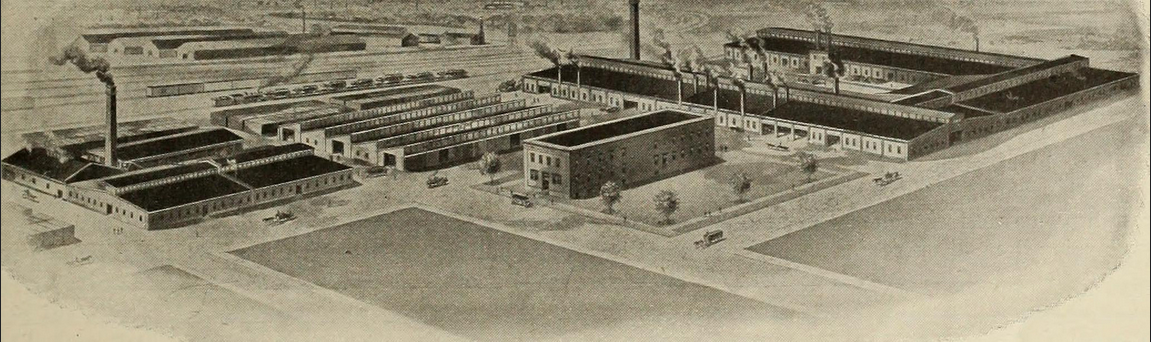
Or the rather impressive works of George White & Sons in London, Ontario:

George White and Sons, London Ontario 1913

This image appeared in Canadian Machinery and Manufacturing News (January-June 1913), illustrating a “Staff article” about the company:

A description of the works of an old established firm building threshing machinery, traction engines, etc. The plant has been gradually built up to its present size, the foundry being the latest addition. The company maintain two branches in the West and have agencies in all the principal cities and towns in the grain growing districts of Canada.

QotD: Freedom of speech

Filed under: Liberty, Quotations — Tags: , — Nicholas @ 00:01

I’ve always been in favor of freedom of expression, but lately I’ve become a free-speech absolutist. It takes all sorts to make a world and I’ve met a lot of them over the years, and I can stand pretty much anything anyone says about anything — until someone says to me, “You can’t say that.” At which point my inclination is to punch his lights out. I do this not just because I’m a violent psychopath with a hair-trigger temper, but to make the important point that in societies where you’re not free to speak your mind — to argue and debate — the only way to express disagreement is through violence.

Mark Steyn, “Yes, We Can (Say That)”, SteynOnline, 2014-02-08

September 3, 2014

Economic growth as a language extinction factor

Filed under: Economics, History — Tags: — Nicholas @ 10:01

In Forbes, Tim Worstall talks about a recent paper in the Proceedings of the Royal Society which notes that minority languages are at greater threat of extinction as the speakers of that language experience economic prosperity:

Here’s an interesting little economic finding: the extinction of minority languages seems to be largely driven by economic growth and success. It’s perhaps not one of those explanations that we would immediately think of but once it has been brought to our attention it seems obvious enough given what is actually economic growth. In terms of public policy this perhaps means that we shouldn’t worry too much about languages disappearing: because that is a signal that economic development is happening, people are becoming less poor. But people ceasing to use a language because it no longer fits their needs is one thing: we should still study, analyse and record those languages as they’re all part of our shared human experience.

The paper is in the Proceedings of the Royal Society B and can be found here:

    By contrast, recent speaker declines have mainly occurred at high latitudes and are strongly linked to high economic growth. Threatened languages are numerous in the tropics, the Himalayas and northwestern North America. These results indicate that small-population languages remaining in economically developed regions are seriously threatened by continued speaker declines. However, risks of future language losses are especially high in the tropics and in the Himalayas, as these regions harbour many small-population languages and are undergoing rapid economic growth.

Worth thinking through the different types of economic growth that we traditionally identify. The first is Malthusian growth. Here an advance in technology (say, a new, higher productivity, farming method) leads to there being more resources to support the new generation. More of them survive to then have their own children and the population increases. At some point in the future living standards return to where they were given that larger population. This is a reasonable description of near all economic growth before 1750 or so (and made the Rev. Malthus correct in his gloomy predictions about economic growth for pretty much all of history before he sat down to write had indeed been like this). Malthusian growth is likely to increase the population speaking whatever language it is that that society speaks. For the obvious reason that the growth is morphing into more people to speak that language.

The second form of growth is Smithian growth. Here, growth is coming from the division and specialisation of labour and the resultant trade in the increased production this enables. Almost by definition this requires that the network of people that one is trading with, dividing labour with, expands. To the point that one is, at some point, going to start doing so with people outside one’s clan, tribe or language. The cooperation of trade requires that there be some ability to converse and therefore there’s pressure to adopt some language which is mutually compatible. As large groups meet large groups then we might find some synthesis of language going on: as say English is an obvious synthesis of Romance and Germanic languages. Where small groups are meeting larger and trading with them then we’re more likely to see the adoption of the larger group language and the extinction of the smaller.

A full agenda at this weekend’s NATO summit

Filed under: Britain, Cancon, Europe, Military, Russia — Tags: , , , — Nicholas @ 08:58

In the Guardian, Patrick Wintour says that the upcoming NATO summit is a sign that with all the tension around the world, this is the most relevant the organization has been in decades:

The last time the UK hosted a Nato summit was in 1990, when Margaret Thatcher was prime minister, the cold war was coming to an end, and the alliance was questioning its relevance in a multipolar world where soft power might count more than hard power. The old chestnut about Nato’s purpose voiced by the first Nato secretary general, Lord Ismay — “to keep the Russians out, the Americans in” — looked hopelessly anachronistic. Russia famously had become a country with which the west felt it could do business.

A quarter of a century later, Putin’s actions, and the ever more grisly new threats posed by Islamic militants, has given Nato a new lease of life. Indeed, Nato is now so relevant that David Cameron’s chief task as host to this week’s summit in Wales has been to ensure that the agenda does not burst at the seams. Discussions will range across the Russian advance in Ukraine and expansionist threat to the Baltics, the Nato withdrawal from Afghanistan next year, the possibility of wider alliance air strikes in northern Iraq against Islamic State (Isis), the need for Nato to produce a viable rapid reaction force in Europe as well as respond to the threats of hybrid warfare and terrorism.

Cameron has ensured that the crisis posed by Isis — made even more pertinent by the latest beheading and the threat to a British citizen — will be discussed both at a working dinner on Thursday evening, and then again on Friday as the 28 members discuss asymmetric warfare, and how to respond to threat of terrorism.

Diplomatic efforts in advance of the summit may help the Canadian government save a bit of face, too:

A face-saving compromise may be on the way for reluctant allies, including Canada, who are unwilling to boost defence spending to meet the NATO standard.

A spokesman for Prime Minister Stephen Harper says the final statement at the Wales Summit later this week will describe the long-standing expectation that members nations spend at least two per cent of their gross domestic product on defence as an “aspirational target.”

That seems enough to satisfy the Harper government, which has balked at pressure from both the United States and Britain to substantially boost the military’s budget slashed in the drive towards next year’s balanced budget and anticipated election.

Jason MacDonald, the prime minister’s director of communications, said late Tuesday that the government is willing to spend more “on measures that meet actual operational needs, in response to global issues.”

He says Canada is not prepared to meet “an arbitrary target.”

The language not only puts out an embarrassing political fire, given the prime minister’s harsh condemnation of Russia, but it may also be enough to placate the Americans.

Canada has taken a tough rhetorical line toward the Soviets Russians lately, but Stephen Harper’s government has reduced military spending to such a degree that he risks being seen as “All hat and no cattle” as the Texan saying has it.

Britain’s shrinking armed forces

Filed under: Britain, Military — Tags: , , — Nicholas @ 08:30

The Secretary of State for Defence was asked in Parliament for a breakdown of the members of the British army, Royal Navy and Royal Air Force. The detailed reply shows some significant changes:

Royal Navy/Royal Marines

Year Total, all ranks
2010 38,730
2011 37,660
2012 35,540
2013 33,960
2014 33,330

Army

Year Total, all ranks
2010 108,920
2011 106,240
2012 104,250
2013 99,730
2014 91,070

Royal Air Force

Year Total, all ranks
2010 44,050
2011 42,460
2012 40,000
2013 37,030
2014 35,230

This may be the only part of British government spending that would actually meet the definition of “austerity”. For reference, the Canadian Armed Forces have about 43,500 regulars across the Canadian Army, Royal Canadian Navy, and Royal Canadian Air Force.

Hand-to-hand combat is “viciously sexist”

Filed under: History, Science, Weapons — Tags: , , , , — Nicholas @ 07:55

In many video games, especially MMOs, you can do the same kind of combat with a male or female avatar (in other words, from a gaming perspective, the differences are literally cosmetic). This is not a reflection of physical reality, although it is a nod to sexual equality in other areas. That being said, it is silly to pretend that before gunpowder came along to diminish the advantages that upper body strength confers in hand-to-hand combat, women could be equally effective in combat. ESR calls bullshit on a recent article that goes out of its way to imply that half of Viking warriors were actually female:

Better Identification of Viking Corpses Reveals: Half of the Warriors Were Female insists an article at tor.com. It’s complete bullshit.

What you find when you read the linked article is an obvious, though as it turns out a superficial problem. The linked research doesn’t say what the article claims. What it establishes is that a hair less than half of Viking migrants were female, which is no surprise to anyone who’s been paying attention. The leap from that to “half the warriors were female” is unjustified and quite large.

There’s a deeper problem the article is trying to ignore or gaslight out of existence: reality is, at least where pre-gunpowder weapons are involved, viciously sexist.

[…]

Supporting this, there is only very scant archeological evidence for female warriors (burials with weapons). There is almost no such evidence from Viking cultures, and what little we have is disputed; the Scythians and earlier Germanics from the Migration period have substantially more burials that might have been warrior women. Tellingly, they are almost always archers.

I’m excluding personal daggers for self-defense here and speaking of the battlefield contact weapons that go with the shieldmaidens of myth and legend. I also acknowledge that a very few exceptionally able women can fight on equal terms with men. My circle of friends contains several such exceptional women; alas, this tells us nothing about woman as a class but much about how I select my friends.

But it is a very few. And if a pre-industrial culture has chosen to train more than a tiny fraction of its women as shieldmaidens, it would have lost out to a culture that protected and used their reproductive capacity to birth more male warriors. Brynhilde may be a sexy idea, but she’s a bioenergetic gamble that is near certain to be a net waste.

Firearms changes all this, of course – some of the physiological differences that make them inferior with contact weapons are actual advantages at shooting (again I speak from experience, as I teach women to shoot). So much so that anyone who wants to suppress personal firearms is objectively anti-female and automatically oppressive of women.

QotD: The relative size of the Chinese economy, historically speaking

Filed under: China, Economics, History, Quotations — Tags: , , — Nicholas @ 00:01

People seem to want to get freaked out about China passing the US in terms of the size of its economy. But in the history of Civilization there have probably been barely 200 years in the last 4000 that China hasn’t been the largest economy in the world. It probably only lost that title in the early 19th century and is just now getting it back. We are in some senses ending an unusual period, not starting one.

Warren Meyer, “It is Historically Unusual for China NOT to be the Largest Economy on Earth”, Coyote Blog, 2014-08-30.

September 2, 2014

Sharpening woodworking tools

Filed under: Technology, Tools, Woodworking — Tags: , , — Nicholas @ 16:23

I’m an occasional woodworker, but I’m always aware I don’t sharpen my tools as often as I should. One of the reasons I don’t is that it’s such a hassle to sharpen them properly: it’s not as simple as sharpening a kitchen knife, and you need to spend time to work through from a coarse grit (250 or so), through medium grit (1000) and into fine (4000) or even superfine (15000 and higher). This video by Paul Sellers has persuaded me that it doesn’t have to be that way for most of the woodworking hand tools I’m likely to use:

Published on 8 Nov 2013

In this video Paul Sellers shows that you don’t need to sharpen to 15,000+ grit on you planes, chisels and other woodworking tools. 250-grit works just fine for most of our woodwork. Paul addresses the myths and misinformation put forward, and challenges what we think about sharpening.

To find out more about Paul Sellers and the work he is involved with visit http://paulsellers.com

Tsar Vladimir I

Filed under: Europe, Russia — Tags: , , — Nicholas @ 15:44

One of the problems that Western politicians have in dealing with Vladimir Putin is that they can’t decide what he wants or even why he wants them. They’re struggling because they keep misreading individual actions as being either nationalistic or ethnic, when they should really be described as “imperialistic”. Putin is trying to recreate the old USSR, but without the Communist Party running things — he’s trying to recreate Imperial Russia:

Americans have been grasping to find explanations for Russian President Vladimir Putin’s serial aggressions in Europe. We keep searching for bumper stickers we can understand, so we gravitate to simple explanations like “geopolitics” or “nationalism,” not least because such notions promise solutions. (If it’s about geopolitics, cutting a deal with Putin will stop this; if it’s about nationalism, it’ll burn itself out when Putin has recaptured enough ethnic Russians around his borders.)

And, of course, there’s always “realism.” In this month’s Foreign Affairs, John Mearsheimer argues the Russo-Ukraine war is basically the West’s fault. (We expanded NATO, we supported the Maidan protesters, we were generally just mean to Russia, etc.) It’s a classic Mearsheimer piece: a beautifully-written, attention-seeking exercise that insists on the brilliance of realists while bucking the innate moral sense of most normal human beings. (Consider, for example, his 1993 Deep Thoughts about how maybe it would be good for Ukraine and Germany to develop active nuclear weapons programs.)

That doesn’t mean I disagree with the overall evaluation that America’s Russia policy since 1992 — insofar as we’ve had one — has been remarkably obtuse. (That pretty much describes most of our foreign policy since the end of the Cold War, but I will not digress here.) I, too, objected to expanding NATO, deplored the arrogance of people like Madeleine Albright, and lamented the repeated lost opportunities to bring Moscow closer to the Western family to which it belongs by both heritage and history.

Very little of what’s happened in the past 20 years, however, has much to do with what’s going on in Ukraine right now. And nothing excuses Russia’s war against a peaceful neighbor, especially not arid theories of realism or flawed historical analogies.

Putin is not a realist: very few national leaders are. Realism is much loved by political scientists, but actual nations almost never practice it. Nor is Putin a nationalist: indeed, he hardly seems to understand the concept, or he would not have embarked on his current path.

The suddenly unsettled science of nutrition

Filed under: Food, Government, Health, USA — Tags: , — Nicholas @ 14:58

After all the salt uproar over the last year or so, perhaps it was inevitable that other public health consensus items would also come under scrutiny. Here’s Ace having a bit of fun with the latest New York Times report on fat and carbohydrates in the modern diet:

One day there will be a book written about this all — how a “Consensus of Experts” decided, against all previous wisdom and with virtually no evidence whatsoever, that Fat Makes You Fat and you can Eat All the Carbohydrates You Like Because Carbohydrates Are Healthy.

This never made a lick of sense to me, even before I heard of the Atkins diet.

Sugar is a carbohydrate. Indeed, it’s the carbohydrate, the one that makes up the others (such as starches, which are just long lines of sugar molecules arranged into sheets and folded over each other).

How the hell could it possibly be that Fat was Forbidden but SUGAR was Sacred?

It made no sense. A long time ago I tried to get a nutritionist to explain this to me. “Eat more fruit,” the nutritionist said.

“Fruit,” I answered, “is sugar in a ball.”

But the nutritionist had an answer. “That is fruit sugar,” the she told me.

“Fruit sugar,” I responded, “is yet sugar.”

“But it’s not cane sugar.”

“I don’t think the body really cares much about which particular plant the sugar comes from.”

“Sugar from a fruit,” the nutritionist now gambited, “is more natural than processed sugar.”

“They’re both natural, you know. We don’t synthesize sucrose in a lab. There are no beakers involved.”

“Well, you burn fruit sugar up quicker, so it actually gives you energy, instead of turning into fat!”

“Both sugars are converted into glycogen in the body. There can be no difference in how they produce ‘energy’ in the body because both wind up as glycogen. I have no idea where you’re getting any of this. It sounds like you’re making it all up as you go.”

This is Science,” the nutritionist closed the argument.

Eh. It’s all nonsense. Even cane sugar contains, yes, fructose, or fruit sugar, and fruits contain sucrose, or cane sugar.

« Newer PostsOlder Posts »
September 2014
S M T W T F S
 123456
78910111213
14151617181920
21222324252627
282930  
  • Recent Comments
  • Red Ensign Brigade
    RedEnsign.gif
  • Categories
  • Most frequently used tags
  • Archives
  • Powered by WordPress