
Quotulatiousness

September 7, 2014

ISIS and its local and regional enemies

Filed under: Middle East, Religion — Tags: , , , , , — Nicholas @ 11:27

Strategy Page looks at the various forces and factions opposed to the rise of the Caliphate of ISIS:

In the Middle East Islamic radicalism, and its murderous offshoot Islamic terrorism, comes in many different flavors. Most groups are mutually antagonistic and will often kill each other as eagerly as they go after kaffirs (non-Moslems.) Nearly all these radical movements now condemn ISIL (al Qaeda in Iraq and the Levant) and condemn ISIL for being too extreme. To the West these seems absurd, and many Moslems agree. But radical Islam is what Islam began as and to this day there are always Moslems who embrace the concept of extreme Islamic radicalism and Islamic terrorism as being the ultimate form of Islam. Thus while Saudi Arabia bans all other religions in its territories and regularly beheads people accused of sorcery and other religious offenses, the Saudis condemn ISIL. One reason for this is that ISIL considers the Saudi government weak and not Islamic enough and worthy of being replaced (after a righteous bloodbath of the current Saudi royal family) by someone more suitable (like ISIL). Al Qaeda also condemns ISIL, initially for not ignoring al Qaeda orders to tone down the barbaric treatment (mass murder and torture) of the enemy because al Qaeda realized that this eventually triggers a backlash from other Moslems. Iran condemns ISIL because all Shia (meaning all Iranians) are heretics and deserving of summary execution. Iran-backed Hezbollah is now using that ISIL threat to justify Hezbollah grabbing more power in Lebanon, where Shia are a third of the population but far more powerful politically because Iranian cash, weapons and training have made Hezbollah too strong for the elected Lebanese government to suppress or even oppose. In Syria, the minority (more Shia) Assad government, fighting a Sunni rebellion since 2011, now calls on their current Sunni enemies (Saudi Arabia and other Gulf Arabs, plus the Sunni majority in Syria) to join with them in destroying ISIL.

Whatever else ISIL has done it has united many other Sunni faction and the Shia in the region into an uneasy anti-ISIL coalition. But even after ISIL is gone, Islamic radicalism will still be there. For most Moslems this radicalism is like the weather; every Moslem talks about but Moslems cannot seem to do anything to eliminate or even control it.

Islamic terrorism has long been trapped in a self-destructive cycle of its own making. It works like this. Islamic radicals obtain their popularity and power by proclaiming that they are defending Islam from non-believers and sinners (within Islam, often local Moslem dictators). In order to maintain this moral superiority, the Islamic radicals must be better Moslems, and insist that others do as they do. Since Islam is a religion that dictates how one lives, in considerable detail, as well as how one plays, this business of being a “good Moslem” can get tricky. And it is. There’s a race underway by Islamic radicals, and the clergy that provide theological support, to issue, and enforce, more and more rules on how a good Moslem should live.

Hong Kong’s chief executive – you can vote for anyone we nominate

Filed under: China — Tags: , , — Nicholas @ 11:20

Sara Hsu reports on the Chinese government’s plans for how Hong Kong’s chief executive will be elected:

Hong Kong is at a political crossroads, as the National People’s Congress (NPC) in Mainland China has proposed to allow universal suffrage in final selection of the Chief Executive, as long as a nominating committee chooses candidates approved by the Communist Party. The proposal is to be voted upon by the Legislative Council; if rejected, the 2017 will be by committee, as in the last election (of Chun-ying Leung). Mainland China’s involvement in Hong Kong’s elections has reduced the ability of Hong Kong residents to freely run for and elect a candidate of their choice for the most powerful government position of this Special Administrative Region. Does this constraint negatively or positively impact the economy?

Hong Kong’s market economy is to be maintained at least through 2047 according to the Basic Law. China and Hong Kong have strong interests in upholding their mutual economies, as Hong Kong is the largest source of inward investment for Mainland China, and also the largest recipient of foreign direct investment from the Mainland. The economies are intricately intertwined through trade and investment, so in these respects, interests are intertwined.

Nor has the movement against Beijing political involvement gained widespread popularity from an economic perspective. Hong Kong’s pro-democracy movement, Occupy Central with Love and Peace, has in fact been accused by some of putting Hong Kong’s economy at risk. Even though the movement has had little direct impact on the economy thus far, pro-Beijing groups worry that the pro-democracy movement will give rise to political instability and jeopardize the economic well-being of Hong Kong residents.

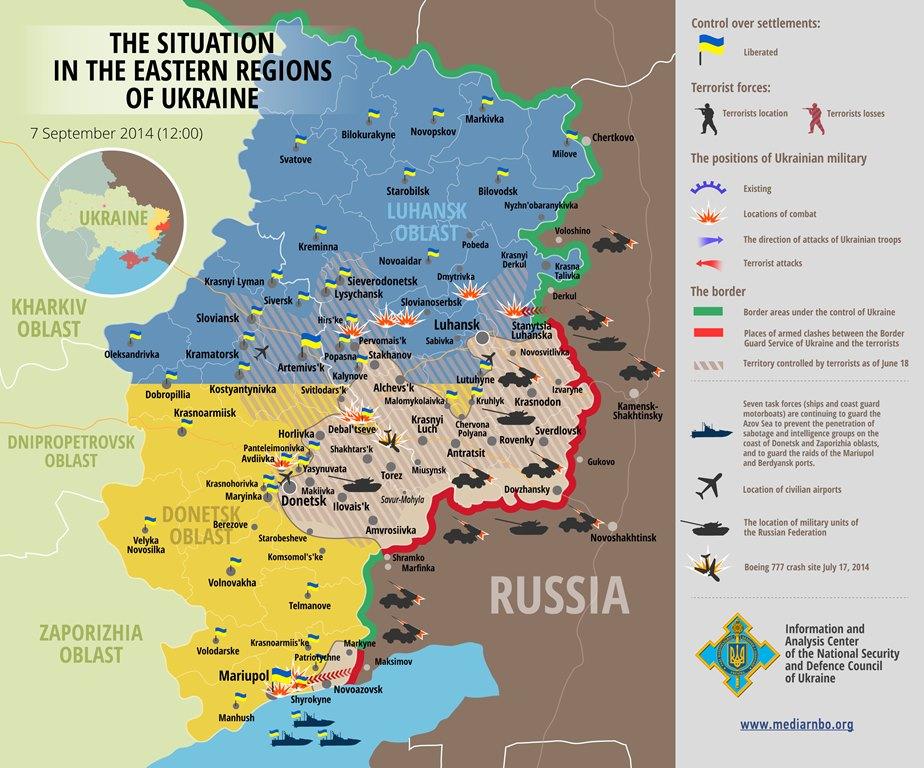
Combat situation in Ukraine

Filed under: Europe, Military, Russia — Tags: — Nicholas @ 11:13

Current situation map released on Twitter by the Ministry of Foreign Affairs of Ukraine:

Ukraine situation 20140907

QotD: Love in later life

Filed under: Humour, Quotations — Tags: , , — Nicholas @ 00:01

It is my conviction that no normal man ever fell in love, within the ordinary meaning of the word, after the age of thirty. He may, at forty, pursue the female of his species with great assiduity, and he may, at fifty, sixty or even seventy, “woo” and marry a more or less fair one in due form of law, but the impulse that moves him in these follies at such ages is never the complex of outlandish illusions and hallucinations that poets describe as love. This complex is quite natural to all males between adolescence and the age of, say, twenty-five, when the kidneys begin to disintegrate. For a youth to reach twenty-one without having fallen in love in an abject and preposterous manner would be for doubts to be raised as to his normalcy. But if he does it after his wisdom teeth are cut, it is no more than a sign that they have been cut in vain — that he is still in his teens, whatever his biological and legal age. Love, so-called, is based upon a view of women that is impossible to any man who has any experience of them. Such a man may, to the end of his life, enjoy the charm of their society, and even respect them and admire them, but, however much he respects and admires them, he nevertheless sees them more or less clearly, and seeing them clearly is fatal to true romance. Find a man of forty-five who heaves and moans over a woman, however amiable and lovely, in the manner of a poet and you will behold either a man who ceased to develop intellectually at twenty-four or thereabout, or a fraud who has his eye on the lands, tenements and hereditaments of the lady’s deceased first husband. Or upon her talents as nurse, or cook, amanuesis and audience. This, no doubt, is what George Bernard Shaw meant when he said that every man over forty is a scoundrel.

H.L. Mencken, “The Nature of Faith”, Prejudices, Fourth Series, 1924.

September 6, 2014

P.J. O’Rourke on what’s wrong with modern rocket ships

Filed under: Humour, Space, Technology — Tags: , — Nicholas @ 12:10

From his post at The Daily Beast:

I was in the passenger seat of a small rocket ship when I realized what’s wrong space travel these days: I can’t do it yet. I’m still flying on pokey old Boeings for six hours from Boston to LA. The trip would take 15 minutes at 17,500 mph low earth orbit speed.

Also, rocket ships don’t fly. Or they don’t properly fly the way the rocket ships of Buck Rogers and Captain Video did. Buck and the Captain could use a hayfield with a windsock. A modern rocket blast-off produces so much shockwave commotion that the nearest safe viewpoint at Cape Canaveral is eight miles from the launch pad. That puts the Starbucks a long way from the gate when your rocket ship’s final boarding announcement is made.

Plus current rockets lack anything resembling Buck Rogers’ style. They look like evil corn silos or upright storm sewers or a trio of escaped steroidal church organ pipes wearing party hats.

Furthermore, at the moment, there’s no such thing as a small rocket ship.

The first rocket to reach space, the Nazi V-2 (which transported people only in the sense of transporting them to the next life) was 45 feet high and weighed 27,600 pounds. The 363-foot Saturn V used for the Apollo moon landing was 52 feet taller than the Statue of Liberty and almost 15 times her weight. And Lady L, tipping the scales at 225 tons, is no Mary-Kate Olsen. Now NASA is building a new Space Launch System (SLS) that’s even bigger.

All my rocket ship disappointments are the result of there not being enough private companies like XCOR Aerospace. I learned this at the Space Foundation’s annual Colorado Springs Space Symposium exhibit hall, where there was a full-scale mock-up of XCOR’s Lynx that I sat in.

The Lynx’s 30-foot fuselage and 24-foot wingspan would fit in a McMansion garage. And it’s as prettier than anything a rich car collector has in there now.

Feschuk debriefing – Tim Hortons is not a national treasure

Filed under: Business, Cancon, Food, Humour — Nicholas @ 11:27

In Maclean’s Scott Feschuk attempts to win the title of “most hated man in Canada” by explaining to Canadians that the Tim Hortons on the corner is not a national shrine:

Have a seat, Canada. Are you comfortable? Good, that’s good.

I noticed you’ve been in a downward spiral since Burger King announced its plan to buy Tim Hortons for $12 billion — or roughly $1 for every Tims on Yonge Street in Toronto.

You’re worried about what the takeover will mean for your morning coffee — and for the corporation that is traditionally depicted in our media as adored, iconic and able to cure hepatitis with its doughnut glaze. (I’m paraphrasing.)

I’m here to help. This is a safe place, Canada. I want to see you get through this. Which is why I need you to listen to me closely. These words will be painful, but it’s important you hear them:

Tim Hortons is not a defining national institution. Rather, it is a chain of thousands of doughnut shops, several of which have working toilets.

Tim Hortons is not an indispensable part of the Canadian experience. Rather, it is a place that sells a breakfast sandwich that tastes like a dishcloth soaked in egg yolk and left out overnight on top of a radiator.

[…]

Canada, you sure do like your double-double — or, as it is by law referred to in news reports, the “beloved double-double.” But here’s a newsflash for you: If you drink your coffee with two creams and two sugars, the quality of the coffee itself is of little consequence. You’d might as well pour a mug of instant coffee or sip the urine of a house cat mixed with a clump of dirt from your golf spikes. It’s all basically the same thing once you bombard it with sweet and dairy. You’re really just wasting your …

I see from your reaction that I’ve crossed a line. I hereby withdraw my defamatory comments about the double-double and kindly ask that you return that handful of my chest hair.

Estonian intelligence official kidnapped by Russian FSB

Filed under: Europe, Military, Russia — Tags: , , — Nicholas @ 11:14

Russia appears to be willing to test the patience of all of its European neighbours, as Estonia lodges a formal complaint that one of their intelligence officers has been captured by Russian FSB troops on Estonian territory:

A strange incident near the Russian-Estonian border on Friday ended with an Estonian intelligence officer in Russian custody and the two countries trading sharply contradictory allegations about what happened.

Estonia’s president and prime minister, among other officials, said the officer had been kidnapped at gunpoint from their territory and forced across the border in a blatant violation of sovereignty. The Russian Federal Security Service said the officer was in Russia and engaged in a clandestine operation when he was detained.

The episode threatened to heighten tensions between Russia and the NATO alliance, to which Estonia belongs, at a time when relations are already severely strained over the conflict in Ukraine. It came just two days after President Obama gave a speech in Tallinn, the Estonian capital, pledging that NATO would defend the Baltics against Russian aggression and suggesting that any attack on them would lead to war with the West.

Although the intelligence officer was apparently detained around 9 a.m., the Russian security service, known as the F.S.B., did not acknowledge the incident until Friday evening, when it issued a statement to three Russian news agencies.

Senior Estonian officials, including the director of the country’s Internal Security Service, held a news conference in the late afternoon, saying the officer had been abducted after unknown assailants set off a stun grenade and jammed communication signals. At the time of his capture, the officer was investigating a criminal case in the area of Luhamaa, Estonia, a little more than a mile from the border with Russia, officials said, according to Estonian news reports.

Update, 7 September: The Interpreter‘s Ukraine Liveblog included this information today.

Eston Kohver, an Estonian intelligence officer who was, according to Estonia, abducted and taken across the border to Russia yesterday, has appeared in Moscow, where he is being detained. The Estonian authorities reported that smoke grenades were used and that there were signs of a violent struggle. In addition, it was reported that communications signals in the area were jammed at the time of the reported abduction.

Meanwhile the FSB claimed yesterday that Kohver had been arrested on Russian territory, in the Pskov region.

Interfax reports that Russia’s state-owned Channel One announced today that the Lefortovo Court has approved Kohver’s detention on suspicion of espionage.

Here is video from Russia’s Ruptly news agency showing Kohver being taken out of a car and into a pre-trial detention centre (known in Russia as SIZO). The footage also shows a display of the items that the FSB has claimed that were found on Kohver including 5,000 euros in cash and a Taurus pistol.

HMS Prince of Wales will join the fleet after all

Filed under: Britain, Military — Tags: , , — Nicholas @ 11:03

British PM David Cameron announced that the under-construction aircraft carrier HMS Prince of Wales will be active after completion, reversing the decision from the SDSR in 2010:

HMS Queen Elizabeth and HMS Prince of Wales

At the close of the NATO summit in Wales this week David Cameron delivered the good news that the Royal Navy will be allowed to retain the second aircraft carrier HMS Prince of Wales. This was another U-turn, reversing one of the many mistaken decisions of Cameron’s 2010 Defence Review that stated the ship would be mothballed or sold. Although undoubtedly good news for the navy, and more importantly the defence of the UK, it is difficult not to be cynical about the entire situation and timing of the announcement.

[…]

The announcement was not accompanied by much detail and leaves a lot of unanswered questions. The RN and its major procurement projects must successfully navigate a general election and the 2015 Defence Review before we can be really certain about HMS Prince of Wales’ future. The biggest unknown is how will the costs of the second carrier be carried by the RN, have the additional costs been found by cuts elsewhere or has this been funded by new money?

The photo above is a computer generated fantasy, apart from the fact carriers would rarely sail in such close formation, it is highly unlikely the RN will ever have the resources to field both carriers simultaneously. Generating the extra crew that the second carrier needs will be one of the first challenges for the RN, already in the throes of a manpower crisis. Although the carrier in refit or maintenance will not require anything like a full crew, it will still require an overlap of manning.

As noted earlier this week, the Royal Navy has shrunk from 38,730 to 33,330 since 2010. It’s going to be a scramble to train (and retain) enough skilled personnel to crew even HMS Queen Elizabeth, never mind at least a cadre for the second aircraft carrier.

Update, 7 September: An interesting, but not surprising revelation from Ali Kefford (retweeted by @NavyLookout).

QotD: Rafting

Filed under: Humour, Quotations — Tags: , — Nicholas @ 00:01

We got to chatting about our rowing experiences this morning, and to recounting stories of our first efforts in the art of oarsmanship. My own earliest boating recollection is of five of us contributing threepence each and taking out a curiously constructed craft on the Regent’s Park lake, drying ourselves subsequently, in the park-keeper’s lodge.

After that, having acquired a taste for the water, I did a good deal of rafting in various suburban brickfields — an exercise providing more interest and excitement than might be imagined, especially when you are in the middle of the pond and the proprietor of the materials of which the raft is constructed suddenly appears on the bank, with a big stick in his hand.

Your first sensation on seeing this gentleman is that, somehow or other, you don’t feel equal to company and conversation, and that, if you could do so without appearing rude, you would rather avoid meeting him; and your object is, therefore, to get off on the opposite side of the pond to which he is, and to go home quietly and quickly, pretending not to see him. He, on the contrary is yearning to take you by the hand, and talk to you.

It appears that he knows your father, and is intimately acquainted with yourself, but this does not draw you towards him. He says he’ll teach you to take his boards and make a raft of them; but, seeing that you know how to do this pretty well already, the offer, though doubtless kindly meant, seems a superfluous one on his part, and you are reluctant to put him to any trouble by accepting it.

His anxiety to meet you, however, is proof against all your coolness, and the energetic manner in which he dodges up and down the pond so as to be on the spot to greet you when you land is really quite flattering.

If he be of a stout and short-winded build, you can easily avoid his advances; but, when he is of the youthful and long-legged type, a meeting is inevitable. The interview is, however, extremely brief, most of the conversation being on his part, your remarks being mostly of an exclamatory and mono-syllabic order, and as soon as you can tear yourself away you do so.

Jerome K. Jerome, Three Men in a Boat (to say nothing of the dog), 1889.

September 5, 2014

Casting blame over Rotherham

At Samizdata, Perry de Havilland unflinchingly points the finger of blame:

The English ‘fascist‘ movement is a bit like a bowel movement, smelly but easily disposed of. In truth they are so trivial in terms of their support or intellectual influence that I cannot escape the notion they get as much publicity as they do primarily to keep them as a boogieman to be pointed at by their equally irrelevant confrères on the loony left.

The Rotherham scandal is not about comically half witted and pleasingly unphotogenic fascists (sorry Ed Temple). It is not about Islam or Pakistanis (sorry BNP, EDL et al.). It is not even about immigration (sorry UKIP). It is entirely about how the political culture pushed unfailingly by the BBC and Guardian (and the increasingly indistinguishable Telegraph and other formerly ‘Tory’ papers) for decades has so completely enervated British institutions along with all the mainstream political parties, that such thugs could not be dealt with. We do not need more laws, we have more than enough to deal with what happened. What we need is the preposterous culture of political correctness and its obsession with race to be flushed down the toilet.

So my caring sharing multicultural leftie chums… Rotherham? That is entirely down to you. Yes, YOU

In international affairs, perceptions matter a lot

Filed under: Europe, Russia, USA — Tags: , , — Nicholas @ 14:07

In today’s Goldberg File email (update: now available online here), Jonah Goldberg talks about the problem President Obama faces on the international stage:

… the Obama administration has wittingly or unwittingly sent the signal that our reign as the enforcer of the Pax Americana is over. Or, less starkly, we have sent the signal that it might be over. This is an important distinction. When it comes to power politics, perception matters as much as reality. Vladimir Putin, the Chinese Politburo, the Islamic State, Assad, the Iranians, Solomon Grundy, the stinking Diaz Brothers, Simon Bar Sinister, and that sweet-smelling cloud that steals your hemoglobin are all going to test America and the system around it to see how much they can get away with. It’s like Gandhi’s famous advice about going to prison. “On the first day, find the biggest, meanest-looking MoFo you can and beat the crap out of him. That will send the signal no one should mess with you.” (“Um, are you sure that was Gandhi? Remember Aristotle’s warning: ‘Some quotations on the Internet are unreliable.'” — The Couch).

The reason this is such a dangerous moment is that the mere act of testing the system encourages others to test it as well. In prison, when you’re a pushover for one guy, everyone gets the idea that they can take the apple brown betty off your lunch tray. It’s also how riots and lootings start. One person smashes a window on the hunch he can get away with it. Others watch. When nothing happens to the smasher, the idea becomes contagious.

This gets us to the heart of the damage Barack Obama has done. A superpower can cruise on perception for a very long time. Perception is relatively inexpensive. Sure, you gotta float some ships around. Yeah, you might have to run some military exercises. But as long as people think you’re sustaining a Pax Americana you are, in fact, sustaining a Pax Americana. But once you let that perception waver, you’re suddenly faced with a terrible set of choices. You can’t tell the world you’re still in charge, you have to show them. If you just talk about red lines and then do nothing to enforce them, further talk becomes worse than useless, it becomes provocative. If you opt to demonstrate your power, you risk failing and confirming weakness. You also risk a horrible escalation as the bad actors respond not with surrender but with even more testing. Does anyone think Putin would be the first to blink at this point if Obama sent troops to Ukraine?

Obama could do everything right starting today (Stop laughing!) and in a sense it would still be too late. It’s always more expensive to put down a riot than to prevent it. And it’s not entirely clear to me that the American people are willing to pay that price right now. It’s much clearer that this president has no interest in asking them to.

This week in Guild Wars 2

Filed under: Gaming — Tags: , — Nicholas @ 11:09

My weekly Guild Wars 2 community round-up at GuildMag is now online. This week ArenaNet has been adding more information about what will be coming in the September Feature Pack to be released next week. The Feature Pack will revamp existing systems and introduce new quality-of-life items, but it doesn’t have any new playable content. A few days after the Feature Pack is released, we’ll see the start of the next World versus World tournament. In addition, there’s the usual assortment of blog posts, videos, podcasts, and fan fiction from around the GW2 community.

GuildMag logo

NATO – “they spent all their money on buying Ferraris and now they have no gas money”

Filed under: Europe, Military, Russia, USA — Tags: , , — Nicholas @ 08:34

Philip Ewing reports on the chances of improved military “readiness” among the NATO allies:

With President Barack Obama in Europe this week for a major NATO summit, the White House hopes the growl of the Russian bear on Europe’s eastern flank means the moment is right for some long-sought reforms to the alliance. But the outlook appears dim for anything beyond incremental steps at best.

The major reason is one that has frustrated policymakers over the past several administrations: Most European nations would love a stouter defense structure — so long as they don’t have to pay for it.

The North Atlantic Treaty Organization requires that member nations devote at least 2 percent of their economies to defense spending, yet today only four do: the U.S., Britain, Greece and Estonia. Although this week’s summit in Wales appears likely to yield a “pledge” in support of increased spending in the wake of Russia’s invasion of Ukraine, no one expects a serious effort from members other than those most directly threatened, including Latvia, Lithuania and Poland.

[…]

Obama and U.S. officials also are focused on bolstering European military “readiness,” particularly as U.S. spending declines. NATO relies on the U.S. for critical military capabilities such as surveillance, in-flight refueling and transportation. European militaries field top-rate troops, ships and aircraft but keep only weeks’ or even days’ worth of munitions on hand. In NATO’s 2011 campaign against Libya, many nations ran out of munitions and the French began dropping concrete bombs.

“It’s sort of like they spent all their money on buying Ferraris and now they have no gas money,” Benitez said. “There are many allies that literally aren’t flying their planes because they can’t afford to. They have very advanced fleets, but their fleets aren’t leaving port because they can’t afford to.”

Tracey Thorn describes the performance of Kate Bush

Filed under: Britain, Media — Tags: , , — Nicholas @ 00:02

In the New Statesman, Tracey Thorn laments that she’s lost an excuse for not doing live performances herself and loses herself in the performance at the Hammersmith Apollo in London:

Six straight songs and then, just as we are relaxing, the stage transforms, and the drama begins: a multi-sensory performance of “The Ninth Wave”, the suite of songs that forms side two of The Hounds of Love (1985). There’s Kate on screen in a life jacket, apparently slipping away from us, singing “And Dream of Sheep”, one of her most beautiful songs.

I should probably write this somewhere more formal – my will, perhaps – but in case I forget, let me say here that I would be happy for you to play this song at my funeral. I weep as she sings it, partly because I’m imagining my own funeral, but also because we are witnessing a struggle between life and death, where a drowning woman yearns to be saved, to return to her beloved family. “Let me live!” she cries a few songs later. Overwhelming and exhilarating as they are, all the special effects – Kate in a tank, a helicopter search beam strafing the audience – are in the service of the songs and the story.

Why is it so moving? Well, because when finally she is brought back it is not just the fictional heroine, but Kate herself who has survived the years, and those cold seas, and returned to us. The two strands, family love and audience love, intertwine as she shows us how both mean so much to her. “D’you know what?/I love you better now,” she sings, as the first half ends and we wipe our tears.

Part two is calmer, more reflective, consisting of one side of the recent album Aerial (2005). Reprieved from death, she now revels in the simple, sensuous pleasures of life. Birdsong on a summer afternoon. The setting of the sun and the rising of the moon. In more conventional hands this could be merely decorous and pastoral, even a little twee, but somehow she has found a way to transform contentment into euphoria. The mood is hypnotic, rhythmic and trancey, and the stage dazzles with images of light and flight; less genteel garden party, more full-on midsummer rave, it could be the ultimate blissed-out headliner of a blistering, sunny Glastonbury.

And her singing voice, which I so worried about? It is a thing of wonder, any youthful shrillness replaced by a richer, occasionally gravelly tone, and with a full-throated power unbelievable in someone who has so rarely sung live. All I can think is that she must have been practising, on her own in a barn somewhere, for the past 35 years. Practising, planning, waiting for all the stars to align – her own desire, the cast of collaborators, the right time and place – in order for this to happen. And it is an ecstatic triumph, a truly extraordinary achievement.

QotD: TV documentaries

Filed under: Britain, Humour, Media, Quotations — Tags: — Nicholas @ 00:01

Is it just me or are almost all TV documentaries completely unwatchable these days? I remember when I first started this job I’d review one almost every fortnight. Always there’d be something worth watching: on the horrors of the Pacific or the Eastern Front, say; or castles; or Churchill; or medieval sword techniques. But now it’s all crap like The Hidden World of Georgian Needlecraft or In The Footsteps of Twelve Forgotten South American Civilisations Which All Look The Same or A Brooding, Long-Haired Scottish Geographer Shouts From Inside A Volcano Why Climate Change Is Worse Than Ever.

The presenters have got more annoying too. I mean, I’m not saying some of the old ones weren’t infuriating with their hand-waving and tics and mannerisms and wheezings. But the new ones are just vacuous, unformed squits. They make you yearn for a reverse Logan’s Run world, where everyone under 30 is executed for being so tiresome. A lot of them are women, obviously, chosen mainly for their simpering looks and charming speech impediments and unerring knack for fronting the dullest imaginable subject matter.

No doubt the people responsible for commissioning this drivel think they’re redressing the balance, in much the same way progressive historians do when they demand we empathise with medieval peasants rather than learning about what Edward I did to the Welsh and the Scots. Well, I can’t speak for all oppressed women here, but I think I can for my wife. They’re not going, ‘Oh, good. Finally a documentary with my name on it, about what it was like to be a woman’s maidservant in Elizabethan York.’ They’re going, ‘Who is that irritating little cow? Why is she on the screen putting on that little-girl-lost voice for my husband? And why the hell isn’t this documentary about something actually interesting, like, say, castles, or Churchill or medieval sword techniques?’

James Delingpole, “The glories of John Betjeman. And why we need more English eccentrics – eg me – on TV”, JamesDelingpole.com, 2014-09-04.

« Newer PostsOlder Posts »

Powered by WordPress



