
Quotulatiousness

July 13, 2013

TV station pranked

Filed under: Humour, Media — Tags: , , , — Nicholas @ 00:01

TV station KTVU actually reported that the flight crew on board crash-landed Asiana flight 214 were:
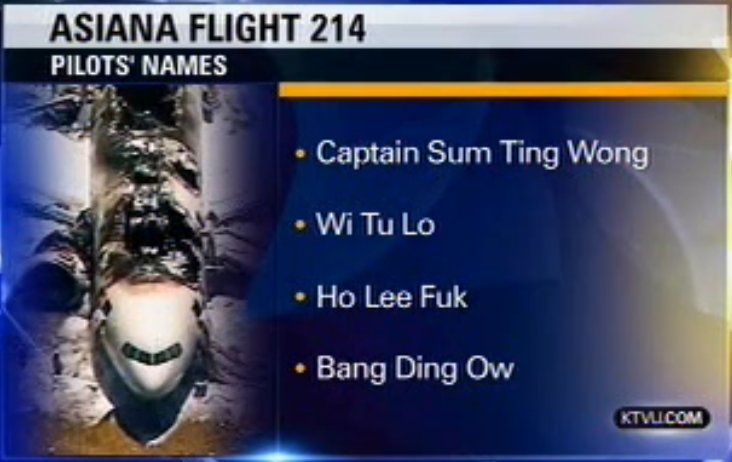
TV station pranked

Deadspin has more, including the video clip:

Bay Area Fox affiliate KTVU purportedly learned the names of the flight crew of Asiana flight 214, which crashed last Saturday at San Francisco International Airport, killing two. These — “Sum Ting Wong,” “Wi Tu Lo,” “Ho Lee Fuk,” and “Bang Ding Ow” — are not their names. The newscaster’s credulous reading puts it over the top.

H/T to Doug Mataconis for the link.

Update: Dave Owens offered the following explanation on one of my mailing lists:

What’s even more awful is that an intern at the NTSB gave them the names.

I imagine he’s a former intern now.

NTSB has apologized.

Update, 15 July: Asiana Airlines has lawyered up over the incident.

Asiana is suing KTVU-TV to ‘strongly respond to its racially discriminatory report’, Asiana spokeswoman Lee Hyomin said.

She said the airline will likely file suit in U.S. courts. KTVU-TV did not immediately reply to emails sent by The Associated Press seeking comment.

The station was quick to correct the gaffe after an ad break following the humiliating broadcast, clarifying the names were clearly wrong and blaming the NTSB for the incorrect information.

Update, 29 July: Korean newscasters get a bit of revenge:

It looks like a Korean news agency is having some fun at KTVU’s expense. After the landing gear failure of the Southwest flight at LGA they showed this graphic with American pilot names “Captain Kent Parker Wright”, “Co-Captain Wyatt Wooden Workman”.

They even went as far as making up fake names for people to interview. Flight instructor “Heywood U. Flye-Moore” and skeptical passenger “Macy Lawyers”.

H/T to Tabatha Southey for the link.

July 12, 2013

Mapping the latest British defence “disgrace”

Filed under: Britain, Germany, Military — Tags: , , — Nicholas @ 14:06

Sir Humphrey on the mapping uproar:

Several UK newspapers reported this week the findings of the UK Parliaments Intelligence & Security Committee report that during OP ELLAMY, the UK had relied on Germany to provide mapping for the RAF to conduct its missions. This was apparently a disgraceful sign of a nation in decline and that we should all be jolly ashamed of ourselves.

The reality (as ever!) is a little different and one worth thinking about. Maps are something that we all take for granted in our daily lives, and they are an utterly indispensable part of modern military operations (even in the hands of a newly appointed young officer). We perhaps take for granted the information on them, without considering how it is obtained. In the UK the Ordnance Survey has over many hundreds of years done a phenomenal job of providing accurate information almost down to the last manhole cover about what lies where. At sea the Hydrographic Service has similarly spent many hundreds of years charting the oceans and waters of the planet — it is not an exaggeration to say that in some of the more remote parts of the globe, the only charts in use date back to the surveys done by Captain Cook or other explorers. As a national asset the Hydrographic Office in particular is absolutely priceless — very few nations run credible hydrographic programmes beyond the UK, US, Russia and China. The Royal Navy, with its extremely effective and very hard worked survey fleet has been able to become a global leader in providing accurate chart information to the world — indeed many countries are enormously reliant on the UK for providing charts for their warships.

But, to put a map or chart together is an enormously complicated piece of work which takes a lot of time and effort. No country on earth currently has the resources to provide a truly global and accurate mapping capability of all the nations and areas that it may need military mapping for. Its not just a case of putting down some generic top level mapping and hoping that’s enough — modern military operations require a lot of detail, and to be able to work effectively, mapping is needed at a very high level of detail. When it comes to targeting, knowing whether a particular target is located at grid reference 123456, or 12345678 can make a huge difference — precision weapons nowadays mean that the chances of hitting the intended spot are much higher than ever before. This means you can destroy a critical node or facility without necessarily doing much in the way of wider damage, which makes rebuilding efforts easier, and also reduces the risk of civilian casualties.

[. . .]

The irony is that amidst the anguish over using German maps, the article skims over the wider point that Defence Intelligence appears to be losing several hundred posts. It is not commonly realised that the DI is responsible for the provision of geographic information to the military, currently via the Defence Geographic Centre in Feltham (for more information see LINK HERE). This sort of service is crucial to help the MOD maintain an edge on operations — it isn’t just about having a good set of weapons, but the ability to know where you are, where you are going and how you can have the best possible military effect that matters. Ironically the papers that got the most irate about the news the UK was relying on the Germans were also the same papers that call the most loudly for ever more civil servants to be fired. The problem is that the people working at the DGC are exactly the sort of civil servants who are not pen pushers, who make a massive, near immeasurable difference to UK security, and who face considerable uncertainty in the future. We perhaps forget at our peril that just because someone doesn’t wear uniform, it doesn’t mean that they don’t play a major role in helping the defence of the UK.

This week in Guild Wars 2

Filed under: Gaming — Tags: , — Nicholas @ 11:36

My weekly Guild Wars 2 community round-up at GuildMag is now online. This week’s release — the Bazaar of the Four Winds — has been greeted with much praise and thanks (except for stick-in-the-mud types like me who don’t like jumping puzzles). There’s also the usual assortment of blog posts, videos, podcasts, and fan fiction from around the GW2 community.

Satanists and the Texas abortion debate

Filed under: Media, Politics, Religion, USA — Tags: , , , , — Nicholas @ 09:03

Kathy Shaidle finds the Satanists aren’t at all what she expected them to be:

At the height of all the #HailSatan hilarity on the left side of Twitter, a single thunderclap of a Tweet shut down the party pronto:

    Unfortunate to see Satan’s name used in such a diabolical manner. Another example of what ‘Satanism’ doesn’t represent. #HailSatan”—@UKChurchofSatan

It was that utterly breathtaking inclusion of the word “diabolical” that got me thinking like a liberal: that is, that the @UKChurchofSatan Twitter account had to be fake, set up specifically to mock the proceedings, in the tradition of “Clint’s Empty Chair.”

My suspicions were confirmed when I saw that, according to their profile, @UKChurchofSatan was following precisely 666 others on Twitter. Cute.

Their profile didn’t display the address of an official website, either. Not a good sign.

But I kept scrolling down. @UKChurchofSatan had sent out over 150 Tweets — wishing followers happy bank holiday weekends and re-Tweeting Richard Dawkins and Ricky Gervais — dating back through March.

It was legit.

Unlike messages regularly spewed out by the right and the left, the Church’s Tweets were models of old-fashioned decorum even when they were responding to critics, written in that anachronistic, typing-with-a-quill-pen style typical of earnest, fairly well-read males:

    Why wouldn’t Satanism be pro-life? What else is there? We are all free to make choices. Agreeable or not. Everyone is entitled to choice.

At least in this online iteration, Satanism comes across as a kind of Goth objectivism but manages to express itself without the average Ayn Rand follower’s pompous, unearned sense of superiority.

Thanks to its disapproving July 3 Tweet, which was re-Tweeted over one hundred times and gleefully reported all over the Web and a few newspapers such as the Telegraph, the @UKChurchofSatan is getting lots of positive attention, much of it from a most unlikely source: conservative Christian bloggers in the US, who’ve joked that “Hail Satan!” would make a fine Democratic campaign slogan for the 2014 midterms.

The flaw in the idea of “smarter government”

Filed under: Bureaucracy, Government — Tags: , — Nicholas @ 08:39

Jonah Goldberg finds a brief passing point of consensus before it disappears:

President Obama wants to make government “smarter.” Who could disagree with that? After all, it’s unlikely that even the biggest fans of big government believe the way government does what it does is the very best, very smartest way imaginable. Whether you’re an anarchist, a Leninist, or somewhere in between, everyone can agree that Uncle Sam could afford a few more IQ points.

Let’s put it another way. If government is going to do X, it should do X the smartest way possible. On that proposition both Occupy Wall Street and the Tea Party agree.

Alas, this momentary flash of consensus disappears before our eyes like a shooting star the moment we ask a related but very different question: Is it smart for the government to do X in the first place? For instance: I think it’s a dumb idea to tickle a grizzly-bear cub while it’s napping on its mother’s belly. But if I’m given no choice but to do it, I’ll eagerly inquire about what’s the smartest way to do a very dumb thing. And if I’m told there is no smart way to do such a dumb thing (which I assume is true), I’ll at least ask for tips on the least dumb way to do it.

QotD: Canada as mirror-America

Filed under: Cancon, Humour, Quotations — Tags: , , — Nicholas @ 00:01

Have you heard about this place called Canada? It’s like some weird parallel America where they never had a revolution. There’s some other differences too: It’s colder, for instance, and they call their Seattle “Vancouver.” Also, they keep their Louisiana in the north instead of the south, and every now and then it threatens to leave. Apparently, if you change just a few little variables like that, history comes out differently: You get socialized medicine, and a lot of signs and stuff are in French, and instead of Saturday Night Live there was a show called SCTV which was funnier but didn’t last as long.

Legend has it that if you journey to the far, far north, you can pass through a portal to this alternate America. Unless you live in Alaska, in which case I gather you have to drive west. (*)

(* Or maybe east. The legends are cloudy.)

Jesse Walker, “Canada Repeals Restriction on Online ‘Hate Speech'”, Hit and Run, 2013-07-11

July 11, 2013

Who will background-check the watchers?

Filed under: Bureaucracy, Government, USA — Tags: , , , — Nicholas @ 11:11

Apparently, the folks who have been doing background checks for US government agencies have special abilities, including psychic powers:

The fallout from Ed Snowden’s leaks has taken many forms, one of which is the NSA taking a long look at its contractors’ hiring processes. Snowden claims to have taken the job solely to gathering damning info. This revelation, combined with some inconsistencies in his educational history, have placed the companies who perform background and credit checks under the microscope.

What these agencies are now discovering can’t be making them happy, including the news that one contractor’s investigative work apparently involved a seance.

    Anthony J. Domico, a former contractor hired to check the backgrounds of U.S. government workers, filed a 2006 report with the results of an investigation.

    There was just one snag: A person he claimed to have interviewed had been dead for more than a decade. Domico, who had worked for contractors CACI International Inc. (CACI) and Systems Application & Technologies Inc., found himself the subject of a federal probe.

It’s not as if Domico’s case is an anomaly.

    Domico is among 20 investigators who have pleaded guilty or have been convicted of falsifying such reports since 2006. Half of them worked for companies such as Altegrity Inc., which performed a background check on national-security contractor Edward Snowden. The cases may represent a fraction of the fabrications in a government vetting process with little oversight, according to lawmakers and U.S. watchdog officials.

Who watches the watchers’ watchers? It appears as if that crucial link in the chain has been ignored. Give any number of people a job to do and, no matter how important that position is, a certain percentage will cut so many corners their cubicles will start resembling spheres.

These are the people entrusted to help ensure our nation’s harvested data remains in safe hands, or at least, less abusive ones. Those defending the NSA claim this data is well-protected and surrounded by safeguards against abuse. Those claims were always a tad hollow, but this information shows them to be complete artifice. The NSA, along with several other government agencies, cannot positively say that they have taken the proper steps vetting their personnel.

Police militarization at a faster pace

Filed under: Government, Law, USA — Tags: , , , , — Nicholas @ 10:05

Radley Balko on seven ways the Obama administration has enabled further militarization of the police:

There were signs that President Barack Obama might rein in the mass militarization of America’s police forces after he won the White House. Policing is primarily a local issue, overseen by local authorities. But beginning in the late 1960s with President Richard Nixon, the federal government began instituting policies that gave federal authorities more power to fight the drug trade, and to lure state and local policymakers into the anti-crime agenda of the administration in charge. These policies got a boost during Ronald Reagan’s presidency, and then another during President Bill Clinton’s years. Under President George W. Bush, all of those anti-drug policies continued, but were supplemented by new war on terrorism endeavors — yet more efforts to make America’s cops look, act and fight like soldiers.

But Obama might have been different. This, after all, was the man who, as a candidate for the U.S. Senate in 2004, declared the war on drugs an utter failure. As Reason magazine’s Jacob Sullum wrote in a 2011 critique of Obama’s drug policy:

    Obama stood apart from hard-line prohibitionists even when he began running for president. In 2007 and 2008, he bemoaned America’s high incarceration rate, warned that the racially disproportionate impact of drug prohibition undermines legal equality, advocated a “public health” approach to drugs emphasizing treatment and training instead of prison, repeatedly indicated that he would take a more tolerant position regarding medical marijuana than George W. Bush, and criticized the Bush administration for twisting science to support policy — a tendency that is nowhere more blatant than in the government’s arbitrary distinctions among psychoactive substances.

Indeed, in his first interview after taking office, Obama’s drug czar, Gil Kerlikowske, said that the administration would be toning down the martial rhetoric that had dominated federal drug policy since the Nixon years. “Regardless of how you try to explain to people it’s a ‘war on drugs’ or a ‘war on a product,’ people see a war as a war on them,” Kerlikowske told The Wall Street Journal. “We’re not at war with people in this country.”

This was an notable break from previous administrations. Rhetoric does matter, and for a generation in the U.S., cops had incessantly been told that they were in a war with drug offenders — this, in a country where about half the adult population admits to having smoked marijuana.

Unfortunately, while not insignificant, the change in rhetoric has largely been only that. The Obama administration may no longer call it a “war,” but there’s no question that the White House is continuing to fight one. Here’s a quick rundown of where and how Obama’s policies have perpetuated the garrison state

Call it what you like, it’s still (petty) abuse of power and position

Filed under: Bureaucracy, Government — Tags: , , , , — Nicholas @ 09:18

BBC News Magazine collects a few euphemisms for bribes:

If you are stopped by traffic police in North Africa the officer may well ask you to sponsor his next cup of “kahwe“, or coffee. In Kenya you might be stopped by traffic policemen and asked to contribute to “tea for the elders” (“chai ya wazee” in Swahili). But in Turkey, the police would rather you give them “cash for soup”, or “chorba parasi” — soup is traditionally eaten at the end of a night of heavy drinking.

[. . .]

The phrase “a fish starts to stink at the head” (balik bashtan kokar) comes from Turkey, reminding us that petty bribes at street-level are often matched by greater corruption at the top of organisations and institutions. Mexican officials looking to earn a kickback for arranging a business deal will demand they are given “a bite” (una mordida), while their Columbian counterparts are said to “saw” (serrucho) off a part of a government contract for themselves.

[. . .]

Large-scale corruption has its own vocabulary, often created by the media. The “cash for questions” scandal involving British politicians comes to mind, as well as the Italian “tangentopoli” (“bribesville”) scandal in the early 1990s. Combining “tangente” meaning kickback, and “-poli” meaning city, the term referred to kickbacks given to politicians for awarding public works contracts.

Inane new “measurement” claims 1978 was the “best year ever”

Filed under: Economics, History — Tags: , , , , — Nicholas @ 08:39

An editorial in New Scientist (which I can’t quote from due to copyright concerns) claims that using a new “measurement” called the Genuine Progress Indicator (GPI), human progress peaked in 1978 and it’s all been downhill since then. Anyone who actually lived through 1978 might struggle to recall just what — if anything — was better about 1978 than following years, but the NS editors do point out that the GDP measurement generally used to compare national economies doesn’t capture all the relevant details, while GPI includes what they refer to as social factors and economic costs, making it a better measuring tool for certain comparisons.

I can only assume that most of the economists who believe that 1978 was a peak year for the environment hadn’t been born at that time: pollution was a much more visible issue in North America and western Europe than at almost any time afterwards (and eastern Europe was far worse). Industry and government were taking steps to cut back some of the worst pollutants, but that process was really only just in its early stages: it took several years for the effects to start to show.

In the late 1970s, the world was a much dirtier, poorer, less egalitarian place than even a decade later: China and India were both much more authoritarian and had still not mastered the art of ensuring that there was enough food to feed everyone. Behind the Iron Curtain, Soviets and citizens of their client states in Europe were falling further and further behind the material well-being of westerners (and becoming much more aware of the deficit).

No matter how much emphasis you put on nebulous “social factors”, the fact that the world poverty rate — regardless of how you measure it — has been cut in half over the last twenty years, lifting literally billions of people out of near-starvation makes an incredibly strong case that the world is doing better now than at any time since 1978. You can prattle on all you like about “rising inequality”, but for my money it’s a better world where the risk of people literally starving to death is that much closer to being eliminated. Give me an “unequal” world where even the poorest have enough food and clean water over an egalitarian world where billions starve, thanks very much.

Rupert “Emmanuel Goldstein” Murdoch

Filed under: Britain, Business, Liberty, Media — Tags: , , , , — Nicholas @ 07:57

James Delingpole on the quick march to government control over the British media:

I was listening to Radio 4 news yesterday as with salivating glee it reported the recall of Rupert Murdoch to the Culture Media and Sport Select Committee and I thought to myself, not for the first time: “Britain is losing the battle for press freedom.”

What worries me most is that so few of us seem capable of comprehending a) how we’re losing it and b) why it might be a problem. The default assumption behind the BBC’s reportage — and unfortunately, probably, an accurate one — is that most normal people think that Murdoch is the very type of low-down reptilian evil, that he is primarily responsible for dumbing down our culture and abasing standards within our media, and that every time he gets his comeuppance it’s a jolly good thing.

Needless to say, I disagree totally with this analysis — and not purely because I’d love it if he plucked me from obscurity and gave me an incredibly well paid job, writing, say, the James Delingpole Tells It Like It Is column in the Sun. No, I say it because I sincerely believe it. Tabloid media moguls like Murdoch do not create public taste: they reflect it. And if, like me, you believe in free markets and freedom of choice then we should applaud the farsightedness and tenacity with which he broke the print unions at Wapping, and the way he pioneered satellite viewing in Britain with Sky and the way in the US his Fox channel and his Wall Street Journal fight such a heroic and inspiring battle against the liberal consensus. Sure, I’ve no doubt he’s very good at drowning kittens — he’s a ruthless billionaire businessman, for heaven’s sake — but the benefits this buccaneer has brought to our world economically and socially far, far outweigh any he damage he might have done.

Yet you’d never guess this from his treatment in the media nor from the way he’s represented in public debate. Really, he’s like our very own Emmanuel Goldstein — the all-purpose hate-figure created by Big Brother in Nineteen Eighty-Four in order to channel the people’s discontent in the “correct” direction.

July 10, 2013

Operation Husky, 1943

Filed under: Britain, Cancon, History, Italy, Military, USA, WW2 — Tags: , — Nicholas @ 09:11

Was the invasion of Sicily by the allies in 1943 a strategic error?

Seventy years ago this week, U.S. and British Commonwealth troops began Operation Husky, the invasion of Sicily. Foreshadowing D-Day 1944, Gen. Dwight Eisenhower served as overall Allied commander. Like D-Day, Allied airborne soldiers led the Husky assault by parachuting (on the night of July 9, 1943) into olive groves and rock-strewn fields along the island’s southeastern shores. On July 10, seven divisions — three U.S., three British and the 1st Canadian Infantry Division — launched an amphibious attack on a 100-mile long front. Despite several successful Axis air attacks on ships and a brazen Italian tank attack on U.S. positions near Gela, by midnight July 10 all seven divisions were ashore.

Putting seven divisions ashore so swiftly was an extraordinary coup. Oh, grievous errors occurred as the buildup proceeded, the most notorious being the July 11 downing of 23 U.S. transports by Allied anti-aircraft fire. The planes were ferrying paratroop reinforcements. Yet in its initial phases Husky demonstrated that the Anglo-American team had learned a great deal since the Operation Torch landings in November 1942. Planning and coordination had improved. North African combat had honed the skills of American forces.

[. . .]

The Sicily campaign placed Allied troops less than 10 miles (the strait’s width) from mainland Italy.

The oh-so-close proximity of large Allied forces to Italy was enticing. And that enticement leads to the biggest historical question tagging Operation Husky: Was taking Sicily the best strategic choice, since it made an invasion of Italy inevitable? From south of Naples to the Po Valley, Italy’s rugged and rocky terrain is a defender’s delight and attacker’s sorrow.

Winston Churchill had sold Sicily as the next logical step. Sicily was the classical route to Rome from North Africa, and knocking fascist Italy out of the war would deal Adolf Hitler’s Axis a heavy political loss.

Sicily geographically dominates the central Mediterranean. Husky’s advocates noted that for three millennia the island served as the stepping stone of to-and-fro commerce and war between North Africa and Europe.

American military leaders were not convinced. The decisive route to Berlin goes through France — make the all-out effort there. Churchill also claimed Europe had a “soft underbelly.” Italian and Balkan terrain is not soft. Several senior U.S. planners thought Churchill was really trying to defend British imperial interests.

Axis-controlled Sicily had served as a big aircraft carrier for attacking Allied shipping. Under Allied control, those bases would extend air cover to northern Italy and Sardinia. U.S. planners agreed that Husky made operational sense if the goal was securing air bases. But can we stop there, at the strait? Sicily’s hard slog was costly. A strategic thrust up Italy’s mountainous spine will be as just slow and deadly.

And indeed it was.

“Neocon” as an all-purpose term of abuse

Filed under: Humour, Politics, USA — Tags: — Nicholas @ 09:02

Next up on our agenda of things to panic about is “peak water”

Filed under: Economics, Environment, Technology — Tags: , , , , — Nicholas @ 00:02

sp!ked editor Rob Lyons explains that “peak water” just isn’t something to worry too much about:

Disappointed by the failure of the peak-oil disaster to come to fruition, our doom-mongering, Malthusian friends have alighted on other scary narratives to confirm their suspicions of humanity as a rapacious blight on the planet. Their latest is ‘peak water’.

On the face of it, peak water is a boneheaded concept on a planet where two thirds of the surface is covered in, er, water. According to the US Geological Survey, there are 332 million cubic miles of water on Earth. What we tend to need, however, is not sea water but fresh water, of which there is much less: nearer 2.5 million cubic miles. And much of that is too deep underground to be accessed. Surface water in rivers and lakes is a small fraction of overall fresh water: 22,339 cubic miles. Handily, though, natural processes cause sea water to evaporate and form clouds, which then dump their contents on to land — so in most populated parts of the world there is currently sufficient water to supply our needs in an endlessly renewable way. As for the future, it is clear there is no shortage of H2O on the planet. What we really have is a shortage of cheap energy and the necessary technology to take advantage of the salinated stuff.

The ‘peak water’ theorists focus on groundwater supplies that are either being used faster than they are replenished, or supplies that are not replenished at all: so-called ‘fossil water’. According to leading environmentalist Lester Brown, writing in the Guardian last weekend, the rapid exhaustion of these supplies in some parts of the world is leading to the decline of food production. And at a time of fast-growing populations, this apparently promises disaster for these countries.

But often, the problem is a political rather than a practical one. [. . .]

In reality, all of the fixes that apply to peak oil also apply to peak water. New technology may make water desalination far cheaper than it is now, a claim being made for new water filtration methods based on nanotechnology. Better use of water in irrigation, through careful management of when and how water is applied to crops, could cut usage dramatically — something that is already happening in dry countries such as Israel and Australia and in parts of the US. Current uses of water, like flush toilets, may be superseded in places where water is in high demand. Through civil engineering projects, water can be shifted from places where it is plentiful to places where it is needed most, something societies have been doing for thousands of years.

How Avro salvaged a bad design to create the Lancaster bomber

Filed under: Britain, History, Technology, WW2 — Tags: , — Nicholas @ 00:01

In Samizdata, Brian Micklethwait goes back to his Airfix modelling days to rediscover his admiration for Avro’s Lancaster bomber. In the process, he discovers just how strange the evolution of that aircraft actually was:

In the late 1930s, believing that bombers would always get through and that they therefore had to have lots of bombers or lose the war, British Air Officialdom had two ideas about how to build a bomber. They accordingly announced two specifications, which different potential bomber-makers were invited to meet with their designs. They wanted a two engined bomber, like those that the Germans bombed Britain with in 1940 but better, or like the Wellington but better. And they wanted a much bigger four engined bomber, such as the Germans never got around to building, and like … well, like the Avro Lancaster.

So, the Lancaster was Avro’s answer to the second requirement? Actually, no. Or, not at first. Britain ended up with three four-engine heavy bombers, the Short Stirling, the Handley Page Halifax, and the Lancaster. But strangely, by far the worst of these three, the Short Stirling, was the only one of the three that was all along intended to be a four-engine bomber. Both the Halifax and the Lancaster started out as answers to the two-engine specification rather than the four-engine one.

[. . .]

In particular, all the work that Avro had done improving, as they had hoped, the fuselage of the Manchester, which had done nothing to improve the Manchester, suddenly came into its own in the new configuration. Ever since I built my Airfix Lancaster as a child, I have wondered about the oddity of that Lancaster fuselage. Simply, this fuselage seemed too small for the airplane as whole. And the wings seemed too big. Not ugly exactly, in fact not ugly at all, but nevertheless a bit like the arms of one of those misshapen body builders with excessive biceps. My Lancaster photo (above) even shows how the wings between the fuselage and the inner two engines go straight out rather than tapering, as if these wings were only widened late on in the design process. Now, all that makes sense. The Lancaster’s fuselage began life as the fuselage of a smaller airplane. No wonder it looked to me too small. It was too small. The Lancaster’s wings look stretched because they were stretched. It is only now, after half a century and more of gazing at the Lancaster, that one looks at the Manchester, and sees its fuselage as too big and its wings as too small.

The birth of the Lancaster illustrates a general point about making airplanes, which explains why successful airplanes often fly on for so long. Consider the airborne WW2 mega-hit, the DC-3 (aka the Dakota), and then later the big Boeings, the B-52 and the 747. The Lancaster didn’t last as long as those hardy perennials, because propeller driven heavy bombers were soon replaced by jet bombers (like the B-52) and by intercontinental ballistic missiles. But even the Lancaster flew on for many decades, in the only slightly altered form of its close cousin, the Avro Shackleton, which only went out of service in 1991!

« Newer PostsOlder Posts »

Powered by WordPress


