Quotulatiousness

August 21, 2020

British Deserters, Sword Fights, and Poison Gas – WW2 – OOTF 016

Filed under: Britain, China, Germany, History, Japan, Military, Weapons, WW2 — Tags: , , , , — Nicholas @ 06:00

World War Two
Published 20 Aug 2020

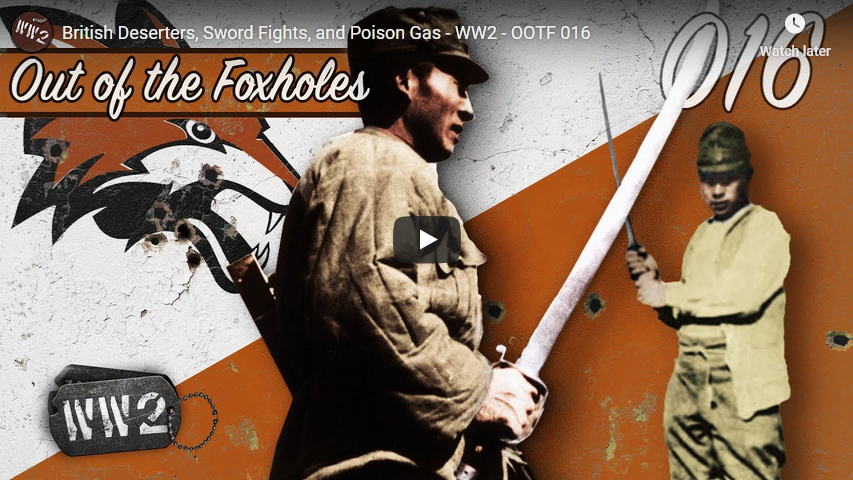
What happened to deserters in the British Army? Did Chinese and Japanese troops ever engage in sword to sword combat? Why didn’t Germany use poison gas on the battlefield? Find out the answers to all these questions in today’s Out of the Foxholes!

Join us on Patreon: https://www.patreon.com/TimeGhostHistory
Or join The TimeGhost Army directly at: https://timeghost.tv

Follow WW2 day by day on Instagram @World_war_two_realtime https://www.instagram.com/world_war_two_realtime
Between 2 Wars: https://www.youtube.com/playlist?list…
Source list: http://bit.ly/WW2sources

Hosted by: Indy Neidell
Written by: Rune Væver Hartvig
Director: Astrid Deinhard
Producers: Astrid Deinhard and Spartacus Olsson
Executive Producers: Astrid Deinhard, Indy Neidell, Spartacus Olsson, Bodo Rittenauer
Creative Producer: Joram Appel
Post-Production Director: Wieke Kapteijns
Research by: Rune Væver Hartvig
Edited by: Jakub Janiec
Sound design: Marek Kamiński

Colorizations:
Mikołaj Uchman

Visual Sources:
Imperial War Museums: HU 762498, Q 79508, El Alamein 1942, E 18542, B5114, MH 26392, F2845,
Library of Congress
Antoine from Flickr.com
National Archives NARA
Bundesarchive
Narodowe Archiwum Cyfrowe
The icons from Noun Project by: Milinda Courey, Arthur Shlain, Delwar Hossain, ahmad, Muhamad Ulum, Rooty, Simon Child, carlotta zampini, Wonmo Kang, Vectors Point, Eucalyp

Music:
“Break Free” – Fabien Tell
“Ancient Saga” – Max Anson
“Defeated” – Wendel Scherer

Archive by Screenocean/Reuters https://www.screenocean.com.

A TimeGhost chronological documentary produced by OnLion Entertainment GmbH.
February 7, 2020

Did WW2 Start in 1937? – The Rape of China | BETWEEN 2 WARS I 1937 Part 1 of 2

Filed under: China, History, Japan, Military — Tags: , , , , , — Nicholas @ 06:00

TimeGhost History
Published 6 Feb 2020

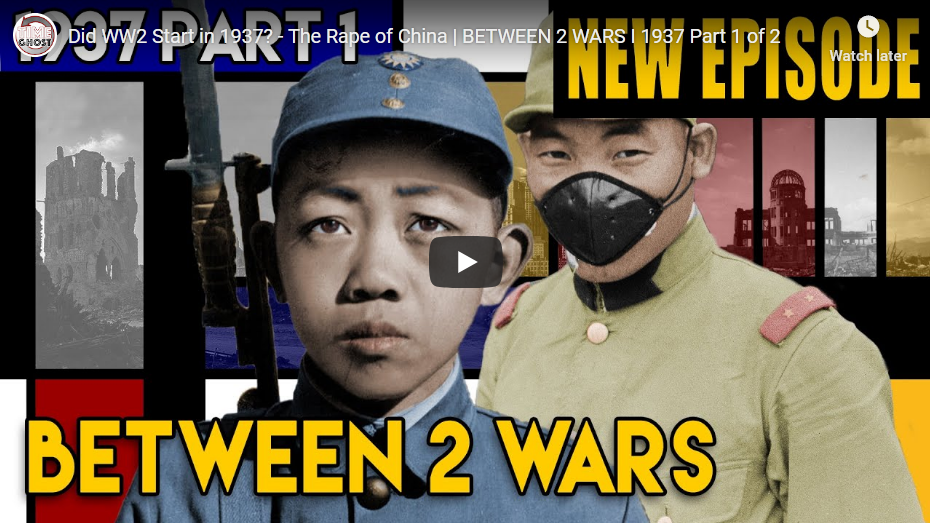
1937 marks the beginning of the Second Sino-Japanese War. And whether or not this is the “actual” starting point of World War Two, it definitely was a devastating conflict which led to the deaths of hundreds of thousands and the displacement of millions.

Join us on Patreon: https://www.patreon.com/TimeGhostHistory

Subscribe to our World War Two series: https://www.youtube.com/c/worldwartwo…

Hosted by: Indy Neidell
Written by: Francis van Berkel
Directed by: Spartacus Olsson and Astrid Deinhard
Executive Producers: Bodo Rittenauer, Astrid Deinhard, Indy Neidell, Spartacus Olsson
Creative Producer: Joram Appel
Post-Production Director: Wieke Kapteijns
Research by: Francis van Berkel
Edited by: Daniel Weiss
Sound design: Marek Kaminski
Research and Writing Assistance: Rune Vaever Hartvig

Sources:
Photo of Shanghai 1932. from 2013 Adrienne Livesey, Elaine Ryder and Irene Brien

Colorizations by Daniel Weiss

Soundtracks from Epidemic Sound:
– “The Beast” – Dream Cave
– “Split Decision” – Rannar Sillard
– “March Of The Brave 10” – Rannar Sillard – Test
– “Disciples of Sun Tzu” – Christian Andersen
– “The Inspector 4” – Johannes Bornlöf
– “Death And Glory 1” – Johannes Bornlöf
– “Magnificent March 3” – Johannes Bornlöf
– “Trapped in a Maze” – Philip Ayers
– “Last Man Standing 3” – Johannes Bornlöf
– “Not Safe Yet” – Gunnar Johnsen
– “Under the Dome” – Philip Ayers
– “First Responders” – Skrya
– “The Charleston 3” – Håkan Eriksson

A TimeGhost chronological documentary produced by OnLion Entertainment GmbH.
From the comments:

TimeGhost History
1 day ago (edited)
Okay, so we’re not actually telling you unequivocally that World War Two started in 1937. Technically things only got global when the European powers became involved with the backing of their colonies (and in Britain’s case, the Commonwealth). What we are trying to tell you here is that how you periodize or define a historical event depends on whose perspective you are writing from. The people of Eastern Asia experienced World War Two as the progressive escalation from 1937 (or even 1931), to 1941, to 1945. In the same way the German invasion of Poland in September 1939 marks for many in Europe the outbreak of war, the Marco Polo Bridge Incident in July 1937 marks for many in Eastern Asia the start of the very same event. Let us know what you think of this in the comments. Does it make you think differently about the war?
Cheers, Francis.

January 24, 2020

“The Attack of the Dead Men” – Gas Warfare on the Eastern Front – Sabaton History 051 [Official]

Filed under: Germany, History, Media, Military, Russia, WW1 — Tags: , , , — Nicholas @ 04:00

Sabaton History
Published 23 Jan 2020

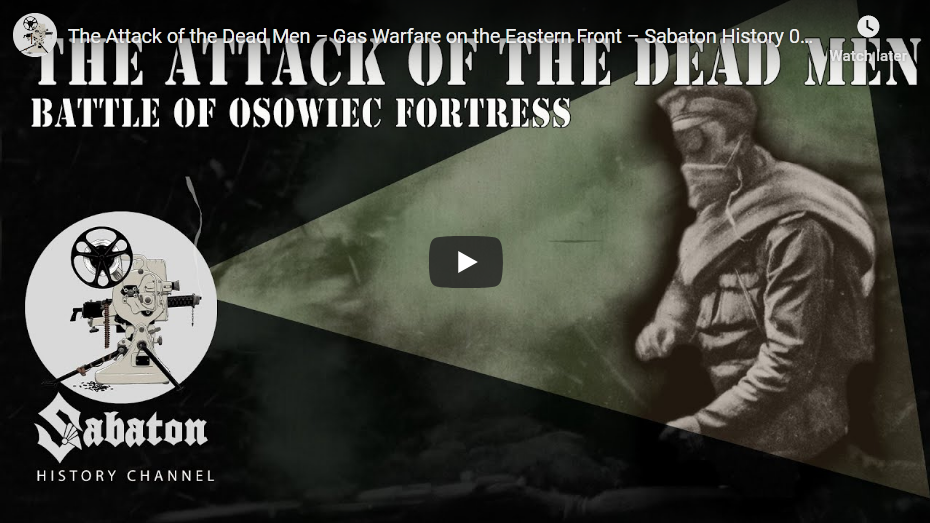
This episode is about the “Attack of the Dead Men”. During the third battle for Osowiec Fortress in July 1915 during the Great War, German artillery was bombarding the defending Russian soldiers with a new deadly weapon: Poison Gas. The fatal mixture of chlorine and bromine descended like a green fog over the Russian trenches. Without adequate gas-masks to protect themselves, the defenders were believed to all have died in agony. However, as the German infantry advanced, they did not only march right into a Russian counterattack but also encountered the dead, seemingly rising from their graves.

Support Sabaton History on Patreon: https://www.patreon.com/sabatonhistory

Listen to The Great War (where “The Attack of the Dead Men” is featured):
CD: http://nblast.de/SabatonTheGreatWar
Spotify: https://sabat.one/TheGreatWarSpotify
Apple Music: https://sabat.one/TheGreatWarAppleMusic
iTunes: https://sabat.one/TheGreatWarItunes
Amazon: https://sabat.one/TheGreatWarAmazon
Google Play: https://sabat.one/TheGreatWarGooglePlay

Check out the trailer for Sabaton’s new album The Great War right here: https://www.youtube.com/watch?v=HCZP1…

Listen to Sabaton on Spotify: http://smarturl.it/SabatonSpotify
Official Sabaton Merchandise Shop: http://bit.ly/SabatonOfficialShop

Hosted by: Indy Neidell
Written by: Markus Linke and Indy Neidell
Directed by: Astrid Deinhard and Wieke Kapteijns
Produced by: Pär Sundström, Astrid Deinhard and Spartacus Olsson
Creative Producer: Joram Appel
Executive Producers: Pär Sundström, Joakim Broden, Tomas Sunmo, Indy Neidell, Astrid Deinhard, and Spartacus Olsson
Post-Production Director: Wieke Kapteijns
Edited by: Iryna Dulka
Sound Editing by: Marek Kaminski
Maps by: Eastory – https://www.youtube.com/c/eastory

Archive by: Reuters/Screenocean https://www.screenocean.com
Music by Sabaton.

Sources:
– IWM: Q 78100, Q 86635
– The New York Public Library
– Narodowe Archiwum Cyfrowe

An OnLion Entertainment GmbH and Raging Beaver Publishing AB co-Production.

© Raging Beaver Publishing AB, 2019 – all rights reserved.

March 16, 2018

Allied Unified Command On The Horizon I THE GREAT WAR Week 190

Filed under: Germany, History, Military, Russia, WW1 — Tags: , , , , — Nicholas @ 06:00

The Great War
Published on 15 Mar 2018

While Germany is occupying a territory from the Baltics to the Black Sea and planning its huge spring offensive, the Allies are still trying to get behind the idea of a unified command.

March 13, 2018

German Tactics For 1918 Spring Offensive I THE GREAT WAR Special

Filed under: Germany, History, Military, WW1 — Tags: , , , , , — Nicholas @ 04:00

The Great War
Published on 12 Mar 2018

The German Spring Offensive in 1918, the so called Kaiserschlacht or Operation Michael, was the biggest German offensive of World War 1 and Quartermaster-general Erich Ludendorff prepared his troops for this battle by incorporating everything the German Army had learned in this war until now. Hutier Infiltration Tactics, Georg Bruchmüller’s artillery targeting and more lessons from the Eastern Front mean the Entente was facing a different army than before.

August 13, 2017

War-Weariness I THE GREAT WAR Summary Part 10

Filed under: Britain, Europe, France, Germany, History, Italy, Military, Russia, WW1 — Tags: , , , — Nicholas @ 04:00

Published on 12 Aug 2017

In this special Recap Episode we summarize the events from May to July 1917. Two major Allied spring offensives at Arras and on the Aisne come to an end with mixed results. The Macedonian Front flares up again as does the 10th Battle of the Isonzo. Mutiny in the French army. A stunning British victory at the Battle of Messines. A vicious battle on the heights of Mount Ontigara. The first American troops are landing in France. July sees the great strides of the Kerensky offensive featuring the Russian Women´s Battalion of Death. A showdown between the Bolsheviks and the Provisional Government. The first usage of the dreaded Mustard Gas.

July 14, 2017

Operation Beach Party – Mustard Gas Unleashed I THE GREAT WAR Week 155

Filed under: Europe, Germany, History, Military, WW1 — Tags: , , — Nicholas @ 06:00

Published on 13 Jul 2017

British Commander Sir Douglas Haig is still convinced of his coming offensive in Flanders. But the Germans now that something is afoot and launch a spoiling attack at the Yser River – the name of the operation is Strandfest or Beach Party. They use blue cross gas for the first time there and two days later also use another new chemical agent which will be known as mustard gas.

April 8, 2017

Trump’s Syria Strike Won’t Solve Any Problems But Could Make Everything Worse

Filed under: Middle East, Military, USA — Tags: , , , — Nicholas @ 04:00

Published on 7 Apr 2017

“It is in the vital national security interest of the United States to prevent and deter the use of deadly chemical weapons,” said President Donald Trump in explaining a U.S.-missile strike on a Syrian airbase. That might sound good and even noble in theory, explains Emma Ashford of the Cato Institute, but the plain truth is that he’s wrong. What’s worse, it’s far from clear what either the United States or other countries in the region will do next.

The essential lesson that George W. Bush, Barack Obama, and now Donald Trump keep forgetting is that military interventions, especially in other countries’ civil wars, often makes things worse, Ashford tells Nick Gillespie.

Produced by Austin Bragg. Cameras by Todd Krainin and Mark McDaniel.

December 4, 2016

WW1 Archaeologists At The Site Of The First German Gas Attack I THE GREAT WAR Special

Filed under: Europe, History, Military, Science, WW1 — Tags: , , , — Nicholas @ 04:00

Published on 3 Dec 2016

A big thank you to the project team: Archaeological Revival of Memory of World War I: Material Remains of the Life and Death in Trenches of the Eastern Front and the Condition of the Ever-changing Battlescape in the Region of the Rawka and Bzura (1914–2014).

The project is funded by the Polish National Centre of Science and implemented by the Institute of Archaeology and Ethnology, Polish Academy of Sciences.

This is the first big video from our trip to Poland. In Bolimow, Polish archaeologists are digging in the former trenches of the Eastern Front. Here, the Germans used gas on a big scale for the first time. Polish soldiers were fighting each other on both sides of the front.

June 6, 2016

Verdun Fortress Design – Gas Development Sights I OUT OF THE ETHER

Filed under: Europe, History, Military, WW1 — Tags: , , , — Nicholas @ 03:00

Published on 5 Jun 2016

Since you all liked our first test of OUT OF THE ETHER so much, we decided to bring in some new episodes occasionally. In this episode we talk about the design behind the forts at Verdun and gas development sights in Washington.

February 7, 2016

Did Germany and Britain Trade Rubber And Optics in WW1? I OUT OF THE TRENCHES

Filed under: Britain, Europe, Germany, History, Military, WW1 — Tags: , , — Nicholas @ 04:00

Published on 6 Feb 2016

Check out War History Online and their excellent coverage: http://warhistoryonline.com

Indy sits in the Chair of Wisdom again and this week we talk about a strange story in which Germany and Britain actually traded goods during wartime.

October 23, 2015

The Crime That Shook the World – The Execution of Edith Cavell I THE GREAT WAR Week 65

Filed under: Europe, Germany, History, Military, WW1 — Tags: , , , — Nicholas @ 05:00

Published on 22 Oct 2015

Edith Cavell was a British nurse serving in a nursing school in occupied Belgium. She was executed by the Germans for treason and espionage in Brussels. Her death and the surrounding atrocity propaganda caused a public outcry all over the world. At the same time the First World War continued like never before. The Third Battle of the Isonzo didn’t bring a decision between Austria-Hungary and Italy, in Gallipoli the troops were slowly withdrawn and the the Champagne offensive of the French army was still in full swing.

October 2, 2015

The Battle of Loos – New Offensives On The Western Front I THE GREAT WAR – Week 62

Filed under: Britain, Europe, France, Germany, History, Military, Russia, WW1 — Tags: , — Nicholas @ 05:00

Published on 1 Oct 2015

After weeks of preparation the French and British Armies unleash a new offensive on the Western Front. Not only is it supposed to relieve pressure on the Russians on the Eastern Front but the Entente wants to achieve the decisive breakthrough. The French actually break through German trenches only to realise that they have a second line of trenches completely intact right behind the first line. The British attack at Loos also turns into carnage even though the British use gas for the first time.

June 23, 2015

A Genius and A Madman – Fritz Haber I WHO DID WHAT IN WW1?

Filed under: Europe, Germany, History, Military, Science, WW1 — Tags: , , , , — Nicholas @ 05:00

Published on 22 Jun 2015

Fritz Haber is one of the most famous German scientists. His inventions made it possible to feed an ever growing human population and influence us till this day. But Fritz Haber had a dark side too: His research made the weaponization of gas and the increased production of explosives possible. Find out more about the life of Fritz Haber in our biography.

April 24, 2015

Gas On The Western Front – Baptism of Fire for Canada I THE GREAT WAR Week 39

Filed under: Cancon, Germany, History, Military, WW1 — Tags: , , , — Nicholas @ 05:00

Published on 23 Apr 2015

After experiments on the Eastern Front, the German Army is using poison gas for the first time on the Western Front. At the beginning of the 2nd Battle of Ypres, the wind blows in a favourable direction; the wide spread use of chlorine gas has a devastating effect on the French troops. Even the Germans are surprised by it. The incredible sacrifice of the Canadian troops make it possible to defend Hill 60 in the end.

« Newer PostsOlder Posts »

Powered by WordPress