Forgotten Weapons
Published 12 Aug 2021http://www.patreon.com/ForgottenWeapons
https://www.floatplane.com/channel/Fo…
Cool Forgotten Weapons merch! http://shop.forgottenweapons.com
The Colt Model 1847 Walker is one of the most valuable of all US military handguns in the collecting community, with examples sometimes breaking seven figures. However, the Walker was in many ways a remarkable failure as a service sidearm, mostly because it tended to explode. By today’s standards, it exploded quite a lot.
Why?
Basically, a combination of several factors:
– The Walker was made of wrought iron, and not always the best quality wrought iron. Cylinders had internal flaws that became weak points and failed upon firing.
– The Walker had a huge powder capacity in its chambers, between 50 and 60 grains depending on the projectile used. This was basically rifle size, and it left the cylinder design with a very small margin of safety.
– Powder composition and grain size was less standardized in the 1840s than it is today, making overpressure loads more likely than today.
– The Walker was designed for a conical “Pickett” bullet that was tricky to load correctly (point forward). Loading it backward could increase the powder volume in a chamber.Of nearly 400 Walkers issued for the Mexican-American War, only 191 were returned after a year’s service, and only 82 of those were serviceable. Some of those missing guns were lost and stolen, but a substantial number — generally accepted to be 20%-30% — suffered burst barrels, burst cylinders, and broken cylinder arbors. Whoops!
Contact:
Forgotten Weapons
6281 N. Oracle 36270
Tucson, AZ 85740
November 25, 2021
Why The Most Expensive US Martial Pistol Exploded A Lot
September 21, 2021
A little New York City tale
Jim Treacher found the twists and turns in this NYC local story to be disturbing his sleep:
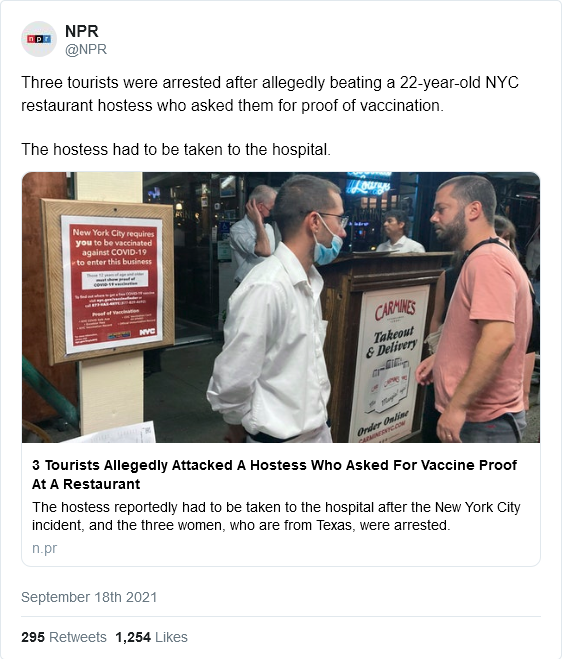
An odd little news story got stuck in my brain over the weekend, so I tried to figure out why. Last week, three Texas women attacked a hostess at a restaurant in New York City because the hostess asked them for proof that they’re vaccinated:
Seems like an overreaction, no? It’s not like a restaurant hostess is responsible for state and local laws. She was just doing her job.
In the initial NPR story I read, the women were described only as being “from Texas”. Which immediately tells a certain audience, NPR’s audience, everything they need to hear. Everyone knows what those Texans are like, right? Yeeeeeee-haw! Them inbred redneck anti-vax science-denyin’ hayseeds prob’ly voted for Trump, didn’t they? Yer darn tootin’!
It just goes to show how evil those dirty Republicans really are. They’d rather beat up a woman in public than surrender a little bit of their freedom for the greater good. I’ll bet they weren’t even wearing masks. Tsk, tsk, tsk. And another tsk for good measure!
But when you read past the headline, you learn a bit more about these three lovely ladies:
Police arrested three women — 21-year-old Tyonnie Keshay Rankin, 44-year-old Kaeita Nkeenge Rankin and 49-year-old Sally Rechelle Lewis — and they have since been charged with misdemeanor assault and criminal mischief …
Now, at the risk of being branded a racist — the most damning yet ubiquitous accusation in the modern world — I saw those names and I assumed those women are African-American.
I know. I know! I’m not proud of it, but that’s just how deeply my white privilege has taken root in my soul.
The headline doesn’t mention their race (“3 Tourists Allegedly Attacked A Hostess Who Asked For Vaccine Proof At A Restaurant”). There’s no mention of race in the story at all, so according to National Public Radio, race had nothing to do with it.
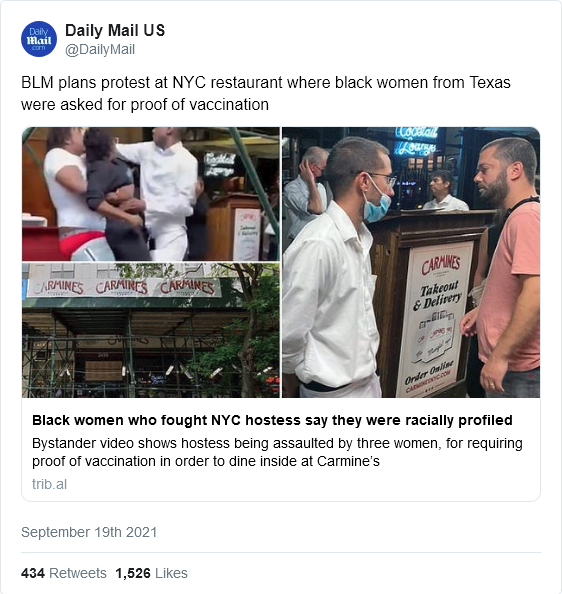
Well, race is about to have something to do with it:
Presto! In the blink of an eye, this story just magically transformed from “Stupid Anti-Vax Texans Literally Punch Science in the Face” to “Black Women in NYC Restaurant Latest Victims of Racial Profiling.” (Remember that Starbucks incident? Remember how the whole company shut down for an entire afternoon to do “anti-racial bias” training?)
And if those dueling narratives aren’t confusing enough for the average liberal mind, it gets even better: The hostess is Asian. So, here’s yet another victim of the anti-Asian violence we’ve been hearing about for the past 18 months. #StopAsianHate, anyone?
Anyone? Hello?
No, that’s not the narrative this time. Which is what this is all about: narratives, not facts.
May 10, 2021
They don’t make politicians like Lyndon Johnson anymore … thank goodness
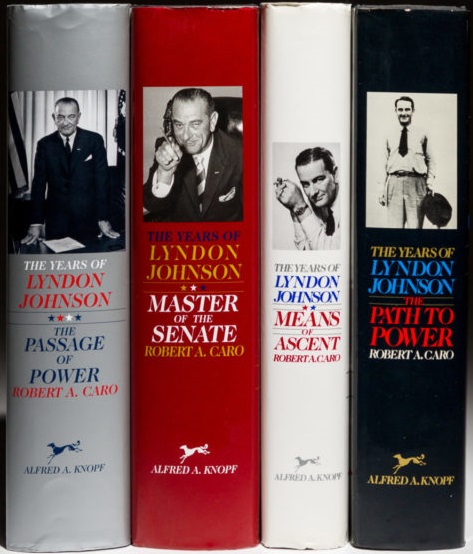
Another of the reader-contributed book reviews at Astral Codex Ten considers the personal history and astounding political career of LBJ, as told by biographer Robert Caro:
2: LBJ’s guide to amassing power
(i) Seduce older men
(Eww, not like that.) LBJ had a gift for becoming a “professional son” to any powerful man. At college, LBJ sat at professors’ feet and stared at them as if they were God’s gift to the educational system. LBJ constantly ran errands for the college president, Prexy Evans, and wrote glowing editorials about him.
LBJ’s fellow students were not amused. One said:
“Words won’t come to describe how Lyndon acted toward the faculty — how kowtowing he was, how suck-assing he was, how brown-nosing he was.”
But this flattery paid off. Evans put LBJ in charge of the financial aid program. Yes, really. And when other students wrote nasty comments about LBJ in the yearbook (e.g. the time he stole the Student Council elections), Evans ordered professors to cut out those pages with razors.
LBJ would repeat this flattery with President (Franklin) Roosevelt, Speaker Rayburn, and Senator Russell.
(ii) Treat your employees like dirt
LBJ wanted his staff to be absolutely loyal, so he could direct them like chess pieces. He found their weak points — their weight, their divorce — and mercilessly taunted them. I’m not going to describe the crude things he did.
Before his marriage, LBJ treated Lady Bird like an angel; once they were married, he treated her like one of his employees.
[…]
(v) Use money in new and exciting ways
LBJ funneled government contracts to Brown & Root, a construction company. In return, they gave his campaign gobs of money. During the 1948 election, two of his campaign staff ate at a cafe and then accidentally left behind a brown paper bag containing $50,000 in cash (more than $500,000 in today’s money). Luckily no one stole it.
Using all of this money, LBJ was able to make the media say whatever he wanted about his opponent, Coke Stevenson. He hired “missionaries” to hang out in bars and spread rumors about Stevenson. Thousands of federal workers also repeated LBJ’s talking points.
(vi) Cheat
But Stevenson was a storybook character, so money couldn’t defeat him. He simply told the people of Texas that he would continue to do the right thing, and they believed him. LBJ had lost the 1941 Senate election because Pappy O’Daniel had cheated better than he did. Now LBJ would cheat, and he would cheat big.
In 1940s Texas, basically every type of election fraud was real: Dead people voting, county bosses writing down whatever numbers they wanted, Mexicans being hired to cross the border and vote, etc. By buying tens of thousands of votes, LBJ was almost able to close the gap between him and Coke Stevenson. That wasn’t enough, so six days after the election, Luis Salas “found” 200 more votes for LBJ, giving him a margin of victory of 0.01%.
October 2, 2020
QotD: Price “gouging” in emergencies
Consider price fixing on goods as necessary as water. During the Texas floods of last year, the price of water rose to heights of $99 per case, from the average of $5 per case. The cruelty of a store owner to do this during a time of emergency offends us all, but to people that think empathetically, it’s especially offensive. This was counterbalanced by Puerto Rico that had strict price controls on water.
In spite of the fact that per capita, there were more emergency responders sent to Puerto Rico and more funds sent to Puerto Rico than Texas, their problem persisted while the Texans very quickly received aid. The answer to the question why is: because of price fixing.
The free market, in seeing the price jump recognized the shortage of supply and responded quickly supplying Texans with an abundance of water cases because of the excessive profit margins – the increased supply eventually caused market competition and the price quickly dwindled to a more reasonable price.
Meanwhile, the market ignored Puerto Rico because the market was asked to ignore them by their own leaders through price fixing. Texans received water, quickly, and at reasonable prices, while Puerto Ricans didn’t.
If water is selling for $99/case, by the end of the day someone will have airlifted water into the region at $50/case, and the next morning water will be selling for $30/case. This will go on for a day or so, and the water crisis is quickly resolved. This was never permitted to happen in Puerto Rico.
Brandon Kirby, “Why Women Generally Aren’t Libertarian”, Being Libertarian, 2018-06-27.
June 4, 2020
Fallen flag — the Texas & Pacific Railway
This month’s fallen flag article for Classic Trains is the story of the Texas & Pacific Railway by J. Parker Lamb:

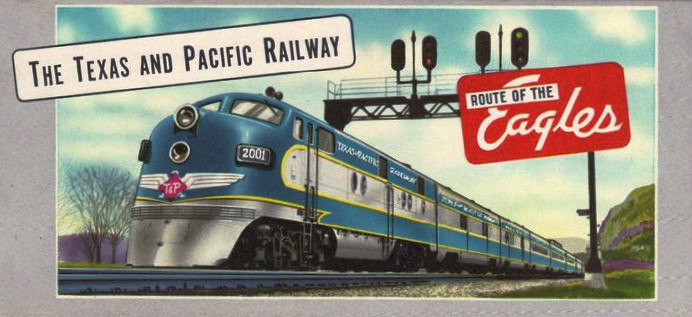
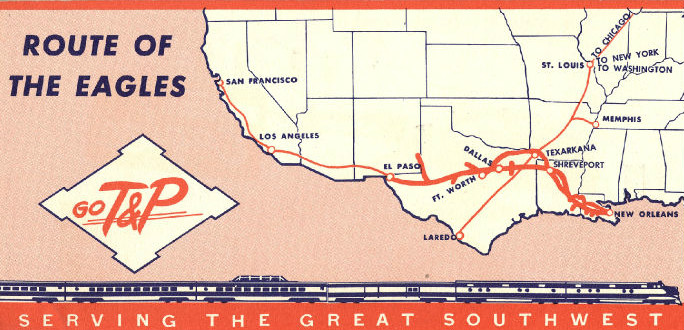
Decorative ticket cover for a Texas & Pacific passenger train. T&P passenger trains were called “Eagles”, as in the Texas Eagle.
Image via Wikimedia Commons.
What grew to become the 20th century’s Texas & Pacific Railway sprouted from some of Texas’s earliest railroads. The Lone Star State’s pre-Civil War network included 11 operating companies. One of the earliest was the Texas Western Railroad, chartered in 1850 and soon renamed Vicksburg & El Paso. In 1856 its name changed again, to Southern Pacific Railroad Company. Of course, this SP had no relation to the Southern Pacific incorporated in 1865 in California, although the convoluted histories of their successors later would intersect.
Backers of this railroad envisioned it as part of a southern transcontinental route from the Mississippi River to San Diego. By 1860, construction of 27 miles was completed between Waskom, on the Louisiana border, and Marshall. The eastern connection was planned as the Vicksburg, Shreveport & Pacific, which already stretched from Waskom across Louisiana to the west bank of the Mississippi at Vicksburg (later part of Illinois Central, it is now part of Kansas City Southern’s “Meridian Speedway”).
The Memphis, El Paso & Pacific, chartered in 1856, planned to start at the Red River near Texarkana and build to a connection with the SP near Dallas, thereby bringing Midwestern traffic into the transcontinental route. Little progress was made before the Civil War, however, with only 5 miles of track built, near Jefferson.Within a decade after the war, these two lines would be fused into one company. In 1870 the Memphis road was renamed Southern Transcontinental Railroad, and in 1872 Congress issued a charter for the Texas & Pacific Railway, which soon acquired both the ST and SP. The new charter approved a route from Marshall to El Paso and San Diego, and required 100 consecutive miles of construction by 1882. Backers hired Gen. Grenville Dodge, who had been chief engineer of Union Pacific’s recently completed transcontinental line to Utah.
In 1880, the infamous “Robber Baron” Jay Gould joined the board and quickly became the president, and the T&P became a key part of his corporate empire (he already controlled the Union Pacific after 1873 and the Missouri Pacific from 1879):

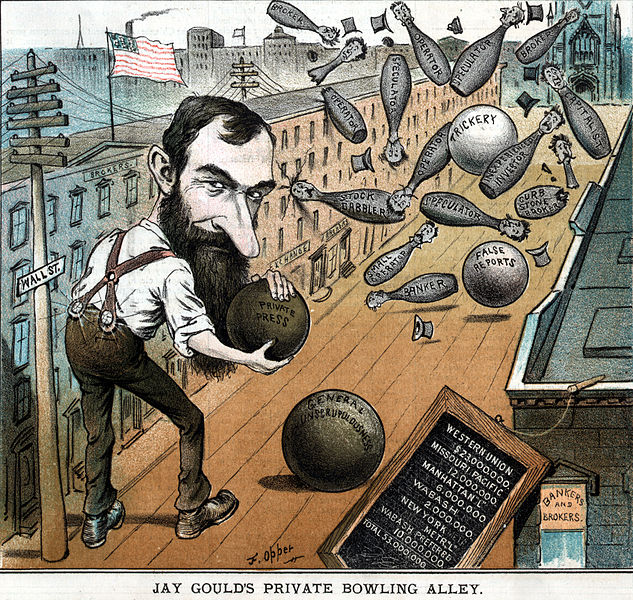
“Jay Gould’s Private Bowling Alley.” Financier and stock speculator Jay Gould is depicted on Wall Street, using bowling balls titled “trickery,” “false reports,” “private press” and “general unscrupulousness” to knock down bowling pins labeled as “operator,” “broker,” “banker,” “inexperienced investor,” etc. A slate shows Gould’s controlling holdings in various corporations, including Western Union, Missouri Pacific Railroad, and the Wabash Railroad.
From the cover of Puck magazine Vol. XI, No 264 via Wikimedia Commons.
Meantime, Gould directed Chief Engineer Dodge to begin an all-out effort to lay rails through the vast and nearly uninhabited desert of west Texas. Construction crews reached Big Spring, 267 miles, in April 1881 and Sierra Blanca (522) on December 16, 1881. However, it was at Sierra Blanca where Gould’s dream of a transcontinental railroad evaporated. He had been bested by Collis P. Huntington, another determined and ruthless railroad tycoon. Huntington’s eastward construction crews had passed through Sierra Blanca three weeks earlier, on November 25, en route to their own “last spike” ceremony of the Sunset Route at the Pecos River (west of Del Rio) in January 1883.
Under the banner of the Galveston, Harrisburg & San Antonio, controlled by Huntington and T. W. Pierce, construction crews had left El Paso in June 1881. When it was clear that Huntington was winning the race for a transcontinental line, a series of court battles ensued, followed by nefarious delaying tactics (including sabotage) by each construction crew, and finally by personal negotiation between the two principals. Gould’s legal case was based on T&P’s 1870 charter to build to San Diego, whereas Huntington’s Southern Pacific charter allowed him to meet the T&P at the Colorado River (between California and Arizona).
Wikipedia provides this sketch of Gould’s railway activities after his involvement in the Erie War:
After being forced out of the Erie Railroad, Gould started to build up a system of railroads in the midwest and west. He took control of the Union Pacific in 1873 when its stock was depressed by the Panic of 1873, and he built a viable railroad that depended on shipments from farmers and ranchers. He immersed himself in every operational and financial detail of the Union Pacific system, building an encyclopedic knowledge and acting decisively to shape its destiny. Biographer Maury Klein states that “he revised its financial structure, waged its competitive struggles, captained its political battles, revamped its administration, formulated its rate policies, and promoted the development of resources along its lines.”
By 1879, Gould gained control of three more important western railroads, including the Missouri Pacific Railroad. He controlled 10,000 miles (16,000 km) of railway, about one-ninth of the rail in the United States at that time, and he had controlling interest in 15 percent of the country’s railway tracks by 1882. The railroads were making profits and set their own rates, and his wealth increased dramatically. He withdrew from management of the Union Pacific in 1883 amid political controversy over its debts to the federal government, but he realized a large profit for himself. He obtained a controlling interest in the Western Union telegraph company and in the elevated railways in New York City after 1881. In 1889, he organized the Terminal Railroad Association of St. Louis which acquired a bottleneck in east–west railroad traffic at St. Louis, but the government brought an antitrust suit to eliminate the bottleneck control after Gould died.
September 11, 2017
Harvey, Irma, and Frédéric – the “Broken Window Fallacy” returns
Jon Gabriel tries to set the record straight on what a natural disaster means for the economy (hint, ignore anyone who says the GDP will rise due to the recovery efforts):
Ever since Hurricane Harvey slammed into Texas two weeks ago, we’ve seen countless images of heroic rescues, flooded interstates and damaged buildings.
As awful as the human toll was, it was not as bad as many of us feared. But it will take months to repair the homes, businesses and infrastructure of Houston and the surrounding area. The same will be true in Florida after Hurricane Irma.
The economic impact could be felt for years, but many economists and financial experts think there’s a silver lining.
The Los Angeles Times crowed that Harvey’s destruction is expected to boost auto sales. CNBC reported that Harvey “could be a slight negative for U.S. growth in the third quarter, but economists say it may ultimately provide a tiny boost to the national economy because of the rebuilding in the Houston area.”
Even Goldman Sachs is looking at the bright side, noting that there could be an increase in economic activity, “reflecting a boost from rebuilding efforts and a catchup in economic activity displaced during the hurricane.”
Economically speaking, it’s great news that all this damage in Texas and Florida needs to be fixed, right? Not only does this mean big bucks for cleanup crews, but think of all the money that street sweepers, construction workers and Home Depots will rake in.
And what about all those windows broken by the high winds? This will be the Golden Age of Texas Glaziery!
Not so fast.
All of this is based on a misunderstanding of what the GDP actually measures. It’s a statistic that often gets mentioned in the newspapers and on TV, but it is almost always used in a way that misleads people about what is happening in the economy. GDP — Gross Domestic Product — is intended to show the approximate total of goods and services produced in a national economy. Thus, when the GDP goes up, it means that the current period being measured recorded more goods and services produced than in the previous period.
When a natural disaster like a hurricane, earthquake, flood, or tornado strikes a city, state or region, all the work required to fix the damage will artificially boost the recorded GDP for that year. But the affected area isn’t that much richer than it was before, despite the GDP going up, because the GDP does not measure the losses suffered during the natural disaster.
This is where Frédéric comes in. I’m referring to the French economist and author Frédéric Bastiat, who brilliantly illustrated the GDP misunderstanding in his essay “What Is Seen and What Is Not Seen“:
In the economic sphere an act, a habit, an institution, a law produces not only one effect, but a series of effects. Of these effects, the first alone is immediate; it appears simultaneously with its cause; it is seen. The other effects emerge only subsequently; they are not seen; we are fortunate if we foresee them.
There is only one difference between a bad economist and a good one: the bad economist confines himself to the visible effect; the good economist takes into account both the effect that can be seen and those effects that must be foreseen.
Yet this difference is tremendous; for it almost always happens that when the immediate consequence is favorable, the later consequences are disastrous, and vice versa. Whence it follows that the bad economist pursues a small present good that will be followed by a great evil to come, while the good economist pursues a great good to come, at the risk of a small present evil.
The GDP problem I identified at the start of this post is a general case of what Bastiat called the “Broken Window Fallacy”:
Have you ever been witness to the fury of that solid citizen, James Goodfellow, when his incorrigible son has happened to break a pane of glass? If you have been present at this spectacle, certainly you must also have observed that the onlookers, even if there are as many as thirty of them, seem with one accord to offer the unfortunate owner the selfsame consolation: “It’s an ill wind that blows nobody some good. Such accidents keep industry going. Everybody has to make a living. What would become of the glaziers if no one ever broke a window?”
Now, this formula of condolence contains a whole theory that it is a good idea for us to expose, flagrante delicto, in this very simple case, since it is exactly the same as that which, unfortunately, underlies most of our economic institutions.
Suppose that it will cost six francs to repair the damage. If you mean that the accident gives six francs’ worth of encouragement to the aforesaid industry, I agree. I do not contest it in any way; your reasoning is correct. The glazier will come, do his job, receive six francs, congratulate himself, and bless in his heart the careless child. That is what is seen.
But if, by way of deduction, you conclude, as happens only too often, that it is good to break windows, that it helps to circulate money, that it results in encouraging industry in general, I am obliged to cry out: That will never do! Your theory stops at what is seen. It does not take account of what is not seen.
It is not seen that, since our citizen has spent six francs for one thing, he will not be able to spend them for another. It is not seen that if he had not had a windowpane to replace, he would have replaced, for example, his worn-out shoes or added another book to his library. In brief, he would have put his six francs to some use or other for which he will not now have them.
Let us next consider industry in general. The window having been broken, the glass industry gets six francs’ worth of encouragement; that is what is seen.
If the window had not been broken, the shoe industry (or some other) would have received six francs’ worth of encouragement; that is what is not seen.
And if we were to take into consideration what is not seen, because it is a negative factor, as well as what is seen, because it is a positive factor, we should understand that there is no benefit to industry in general or to national employment as a whole, whether windows are broken or not broken.
Now let us consider James Goodfellow.
On the first hypothesis, that of the broken window, he spends six francs and has, neither more nor less than before, the enjoyment of one window.
On the second, that in which the accident did not happen, he would have spent six francs for new shoes and would have had the enjoyment of a pair of shoes as well as of a window.
Now, if James Goodfellow is part of society, we must conclude that society, considering its labors and its enjoyments, has lost the value of the broken window.
From which, by generalizing, we arrive at this unexpected conclusion: “Society loses the value of objects unnecessarily destroyed,” and at this aphorism, which will make the hair of the protectionists stand on end: “To break, to destroy, to dissipate is not to encourage national employment,” or more briefly: “Destruction is not profitable.”
Related: Shared by Thomas Forsyth on Facebook:

September 1, 2017
The complex dance of supply, demand, scarcity, and price
Tim Worstall explains why laws against “price gouging” are denials of economic fact and actually work against getting urgently needed items to the people who require them:
Those little diagrams at the start of the Econ 101 class (supply, demand, price) are not optional extras to our universe, they are instead accurate descriptions of how we humans interact with it. If and when demand rises then price rises, this in turn encouraging an expansion of supply. Thus why we desire to have price flexibility in the face of either changes in supply or demand.
Consider Houston right now in the wake of Hurricane Harvey. It seems a good bet that the tapwater supply is disrupted — flooding has a tendency to do that. We would therefore assume the demand for bottled water has risen – the sensible who normally hydrate from that wondrous invention, the municipal water supply, will not be able to do so, thus increasing the demand for the bottled stuff. Equally, on the other side, there’s going to be a certain difficulty with supply at present — roads 5 feet underwater don’t exactly help trucking.
We thus desire to do two things simultaneously. We want to restrain demand to only the really important things and we want to incentivize greater supply.
Which is exactly what a price rise does for us.
With water at (just to make up a price) $99 a case, people are only going to buy it for drinking water, perhaps only in sippy cups. Which is excellent — we want whatever limited supply of potable water (we’ve really plenty of non-potable around, that’s the basic problem) there is in place to be used for that most valuable use, being potable. We’ve achieved one of our goals therefore, by allocating that scarce resource to its most valuable use: keeping people alive.
We also want to increase supply, though, and being able to sell in Houston for $99 something bought for $9.99 in Beaumont (again, just to invent an example) might well get a few boats carrying loads in – although quite possibly not from Beaumont. Thus, by allowing prices to rise, we’ve at least potentially increased supply.
Our price system, operating without constraint, is thus achieving the two things we desire, a curtailing of demand through rationing to only truly important uses, and a rise in supply.
“But,” goes the cry, “this isn’t fair!”
Indeed it isn’t, and ain’t that a shame, fairness not being a notable feature of this universe we’re struggling to inhabit. All we can do is the best we can. Which is, again, why I insist that there should be variable prices, why there should be no laws against price-gouging. Because this really is a disaster, there really are significant shortages in Houston right now, we really do want to solve them. Which means that we should be using all of the tools at our disposal.
August 31, 2017
“Harvey is not Katrina”
Nicole Gelinas on the crucial differences between the situation faced by New Orleans during Hurricane Katrina and that currently faced by Houston after being inundated by Hurricane Harvey:
The Houston region has received record rain, more falling in less than a week than it usually does in a year, and at least 30 people, including a Houston police officer, have died. Harvey, however, is not Katrina. One measure of this difference is in electricity provision. After Katrina, New Orleans was almost entirely without power for weeks. In Houston, by contrast, 94 percent of customers still had power as of early Wednesday.
Though we won’t know for sure for a while, the fact that Houston has kept the power on is likely in part a legacy of infrastructure investment after previous storms. Five years ago, Hurricane Ike actually cut power to 95 percent of Houston. But, as NPR reported after the storm, the city’s power company, CenterPoint, took steps after Ike, as well as after Tropical Storm Allison in 2001, to upgrade the grid, spending $400 million. Houston, helped by $50 million in federal money, cut down tens of thousands of trees along power lines and outfitted poles with the ability to re-route electricity away from damaged routes toward undamaged ones.
With power, hospitals can continue to operate; even Ben Taub Hospital, surrounded by water, kept the power on. Stores, too, have quickly begun to reopen. Power also means that people whose homes didn’t flood can stay put, lessening the burden on police to keep neighborhoods safe from looters. If the power stays on — as it should, now that worst of the storm is over — Houston should do well. If it goes out, the city will have far more serious problems.
[…]
Empty neighborhoods and business districts invite looting. Houston had already arrested 15 people as of late Tuesday for allegedly trying to steal everything from liquor to an ATM, and for attempted robbery, as well. These arrests, plus a nighttime curfew, are a good sign; after Katrina, New Orleans police officers failed to keep control over the city, both because of the severity of the damage, which left most of the city empty and dark, but also due to their longstanding poor performance. Harris County district attorney Kim Ogg and Houston police chief Art Acevado have already set the right tone to deter wrongdoing. Ogg said Tuesday that thieves “are going to feel the full weight of the law,” and Acevedo said he would push for tough sentences for people convicted. In New Orleans, by contrast, state and local officials’ apocalyptic invocation of “martial law,” rather than calm reliance on the rule of normal law, only exacerbated the sense of chaos.
With some, though not most, Houston neighborhoods now deserted, state law enforcement have a role to play here, as well, with federal support. A competent local police force will be busy, after a storm, in helping still-populated areas. In turn, state police and the National Guard, who have less experience interacting with people on a neighborhood level, can help by patrolling and securing empty areas. To that end, Texas has already activated the National Guard, adding 12,000 people to safety efforts, as well as for rescue and food distribution.
Oh, and as Caroline Baum points out, don’t be misled by idiotic claims that hurricane damage is somehow good for the economy:
You will no doubt hear assertions that the rebuilding effort will provide a boost to contractors, manufacturers and GDP in general. But before these claims turn into predictable nonsense about all the good that comes from natural disasters, I thought it might be useful to provide some context for these sorts of events.
The destruction wrought by a hurricane and flooding qualifies as a negative supply shock. Normal production and distribution channels are destroyed or disrupted. Producers have to find less-efficient (i.e. more expensive) ways to transport their goods. The net effect is lost output and income, and higher prices.
Over the years, I’ve observed a tendency among economists and traders to view such events through a demand-side prism. They see lost income translating into reduced spending on goods and services, which might even warrant some largesse from the central bank.
Of course, that is precisely the wrong medicine. Supply shocks reduce output and raise prices. The Federal Reserve’s interest-rate medicine affects demand. Lower interest rates will increase the demand for gasoline, among other goods and services, but they have no effect on supply. An easing of monetary policy under such circumstances would increase demand for already curtailed supply, raising prices even more.
But wait. What about all the new construction and investment necessitated by the devastation? Homeowners will have to rebuild. Businesses will have to replace destroyed or damaged plants and equipment. Pretty soon, we should start to hear about a boost to GDP growth.
In the short run, yes. But focus on the prefix, “re,” as in re-building and re-placing. After a natural disaster, housing starts are bound to increase, but there will be no net addition to the supply of homes. Capital spending will increase as well, but it will not expand the nation’s capital stock.
She also provides a link to this very topical essay by Frédéric Bastiat: That Which Is Seen and That Which Is Unseen. In short, we see the spending caused by the need to repair damages (in this case from the flooding), but we don’t see what might have been done if the money hadn’t needed to be spent just to replace existing stock.
June 18, 2017
Meet the Texas Lawmaker Fighting Trump on Civil Asset Forfeiture
Published on 7 Jun 2017
Konni Burton has emerged as the state’s fiercest opponent of civil asset forfeiture.
When the White House hosted a meeting of sheriffs from across the country last February, President Donald Trump joked about destroying the career of a Texas state senator who supported reforms to civil asset forfeiture laws — a controversial practice where police can seize cash and property of people suspected — but in most cases never convicted or charged with a crime.
Though Trump’s comments were meant to support police, they’ve had the opposite of their intended impact — it’s re-energized the push for reform.
Texas state senator Konni Burton was one of many local lawmakers outraged by Trump’s comments. She’s a tea party leader from the Dallas-Fort Worth area who also happens to be pro-life and pro-borders. Burton isn’t the unnamed state senator Trump offered to destroy, but she’s emerged as the state’s fiercest opponent of civil asset forfeiture.
“When you give law enforcement the ability to take your property without a conviction that’s big government,” Burton says.
Last December, Burton filed legislation that would repeal civil asset forfeiture in the state and replace it with criminal asset forfeiture.
“Police can still seize property that they think has been involved in a crime,” says Burton, “but for them to keep it … you have to be convicted of a crime.”
Texas has tried for years to reform civil asset forfeiture laws after horror stories began to emerge about the practice.
One of the most horrifying cases occurred in 2005, when cops seized $10,000 from Javier Gonzales who was driving from Austin to the border town of Brownsville to make funeral arrangements for his dying aunt. The cops didn’t find any drugs or contraband in his car, but they pressured Gonzales to sign away his rights to the cash under the threat of a felony money laundering charge.
Gonzales took the case to court and eventually won his money back in April of 2008.
And in 2012 the ACLU settled a class action lawsuit against the city of Tenaha where cops illegally seized nearly $3 million from traffic stops involving mostly Black and Latino drivers. Victims were told that they could either sign their cash over to the city or go to jail.
Cases like this have earned Texas a D+ from the Institute for Justice for forfeiture laws. Data from the libertarian legal organization shows that the state takes in an average of $41.6 million dollars a year to local law enforcement agencies as a result of these seizures.
Burton’s bill has bipartisan support, but it faces an uphill battle in the Texas legislature where it’s faced opposition from “tough on crime” lawmakers and law enforcement agencies. Burton says her legislation isn’t about stopping police from doing their job, but protecting the property rights of all Texans.
“Everybody is ready for this to be reformed,” Burton says. “You know it’s just upside down and antithetical to what our country should stand for.”
Produced by Alexis Garcia. Camera by Paul Detrick, Austin Bragg, and Meredith Bragg. Music by the Unicorn Heads.
February 19, 2017
March 22, 2016
QotD: Barbecue, properly considered
I was on the road in Texas last week, addressing Linux user groups in Dallas and Austin. I always enjoy visiting Texas. It’s a big, wide-open place full of generous people who cultivate a proper appreciation of some of my favorite things in life — firearms, blues guitar, and pepper sauces.
And, of course, one of the biggest things Texas has going for it is barbecue. And not the pallid imitation served up by us pasty-faced Yankees here where I live (near Philadelphia, PA) but the real thing. Barbecue, dammit. Red meat with enough fat on it to panic a health-foodist right out of his pantywaist, slow-cooked in a marinade sweeter than a mother’s kiss and eaten with sauces hot enough to peel paint. Garnish with a few extra jalapenos and coleslaw and wash it down with cheap soda, lemonade, or beer. Food of the gods.
I swear your testosterone level goes up just smelling this stuff. After a few mouthfuls of Rudy’s carnivoral bliss you’ll be hankerin’ to cultivate a drawl, wear a Stetson and drive a pickup truck with a gun rack. (I draw the line at country music, though. A man’s got to have some standards.)
Eric S. Raymond, “The Non-Portability of Barbecue”, Armed and Dangerous, 2002-07-18.
October 19, 2015
Dildos versus guns – Sarah Hoyt on a modern version of magical thinking
In case the title isn’t clear enough, there’s a protest started recently at the University of Texas in Austin where students upset at a recent court ruling allowing concealed weapons to be carried on campus came up with what they thought was a perfect counterpoint: they’d open carry dildos instead. Sarah Hoyt comments:
… I have no idea what Ms. Jin majored in, but I can sort of follow the tracks of her thought. Logically, carrying sex toys to campus to protest guns makes absolutely NO sense. I could see carrying signs, or … I don’t know, police whistles, if you’re convinced you’re completely safe if you can just call the police. I can even see, in a more sane way, wearing a protective vest and claiming this is better than guns for defense. I mean, at least they are in the same general kind of thing and sort of kind of address the problem in different ways.
BUT no. Because this is not reasoning. This is magical thinking. WORSE. This is magical thinking based on a world that doesn’t exist, a world that was sold to Ms. Jin (literally. College is expensive) by academics so divorced from reality that they can’t find it with two hands, a cane and a seeing eye dog.
In this world, you see, conservatives love guns and hate sex. This is all “explained” with pseudo Freudian patter about how guns are a substitute for the penis. This is total nonsense and old nonsense at that, stuff we LAUGHED at for being pseudo profound way back in the seventies.
But they absolutely believe that we defend the second amendment not because we want to be responsible for our own self-defense, not because we believe power derives from the individual and that therefore an individual must be capable of reining in the government when it gets out of control. No. They think we want guns because that’s the way we express our sexual repression. (Actually now I think about it, my gun obsessed friends are also the most sex-positive, so their idea not only is wrong, it’s bizarrely wrong.)
Since Ms. Jin has never considered that these stories she was sold are in fact stories with no relation to reality, her reasoning went something like “They’re carrying guns and that upsets me. I must carry something that upsets them. Ahah! Dildos.”
In an even mildly sane world, the press would have made her a laughing stock, because that reasoning makes no sense whatsoever.
But the press buys into the same imaginary world in which somehow the belief in guns for defense is a Freudian thing and so the “gun” value can be countered with the “dildo” value.
This is not grown up thinking. It’s magical thinking, in which complex issues get reduced to amulets and symbols, countered by other amulets and symbols.
Again, this is sort of the human default. And believing absurd things about those you believe to be the enemy is also completely normal. The left calls it “othering” and is completely oblivious to the fact that they do it. A lot.
But it’s still human-normal.
May 29, 2015
The legacy of the great satanic sex abuse panic still resonates today
Radley Balko reports on the recent release of two former Austin, Texas daycare owners … who’ve been in prison since 1992 on the testimony of a toddler and “expert evidence” from a satanic ritual expert and how the moral panic of the day made it impossible for the courts to see how utterly unlikely the case actually was:
The panic actually began in the 1980s. It was instigated and perpetuated mostly by groups of fundamentalist Christians who saw Satan in every heavy metal album, “Smurfs” episode, and Dungeons & Dragons game, along with a quack cadre of psychotherapists who were convinced they could dig up buried memories through hypnosis. What they did instead was shed some light on just how potent the power of suggestion can be. Remarkably, children were convinced to testify about horrifying — and entirely fictional — violations perpetrated on them by care workers and, in some cases, by their own parents.
But it wasn’t just children. As the Kellers’ conviction shows, the panic was so overwhelming, it could convince trained medical professionals to see abuse where there was none. Some defendants were convicted of gruesome crimes such as the aforementioned dismembering of babies despite the fact that there were no corpses and no babies missing from the immediate area.
[…]
That the highest court in Texas still can’t bring itself to declare the couple innocent, in spite of all that we know now, shows just how difficult it can be to undo the damage caused by a moral panic and junk science in the courtroom.
[…]
Here’s an observation from the panic that I don’t think has been fully explored: These kids didn’t make up these stories. In this case and dozens of others, the kids were telling tales with details about geography, history and current events about which kids of their age couldn’t have known. That’s likely what made their stories seem somewhat credible. But the fact that it all was fictitious reveals a particularly unsettling truth: These sick, lurid, unimaginable abuses could only have been a product of the imaginations of the therapists, social workers, cops and/or prosecutors who interviewed the children. If the memories were implanted, those are the only people who could have implanted them. That means that the same people entrusted to protect these kids, and in whom these communities trusted to police the streets, prosecute crimes and administer therapy, were ultimately the ones capable of dreaming up detailed sexual fantasies that put children in bizarre rituals involving violence, animals, corpses and so on.
There’s a lot to be learned from these cases. For one, there are lessons about professional accountability: Not only were the vast majority of the prosecutors who put these innocent people in prison in these cases never sanctioned, but also most went on to great professional success, sometimes because of their role in these high-profile cases, and sometimes even after it was widely known that the people they prosecuted were innocent. There are other lessons here about how we screen “expert” witnesses, and how bad science gets into the courtroom. There are lessons about the power of suggestion that could be applied to eyewitness testimony and how we conduct police lineups.
But the drawing of lessons is something we typically do once a crisis is over. This one still isn’t. There are still people in prison awaiting exoneration in these cases.
May 5, 2015
The DEA don’t pay
At Techdirt, Tim Cushing carefully explains that the US Drug Enforcement Agency takes on no responsibility when they hijack your company’s equipment and set you up as a drug gang “competitor”, even when one of your employees dies in the resulting gunfight:
Craig Patty runs a tiny trucking company in Texas. He has only two trucks in his “fleet.” One of them was being taken to Houston for repairs by his employee, Lawrence Chapa. Or so he thought.
In reality, Chapa was working with the DEA, which had paid him to load up Patty’s truck with marijuana and haul it back to Houston so the DEA could bust the prospective buyers. That’s when everything went completely, horribly wrong.
[A]s the truck entered northwest Houston under the watch of approximately two dozen law enforcement officers, several heavily armed Los Zetas cartel-connected soldiers in sport utility vehicles converged on Patty’s truck.
In the ensuing firefight, Patty’s truck was wrecked and riddled with bullet holes, and a plainclothes Houston police officer shot and wounded a plainclothes Harris County Sheriff’s Office deputy who was mistaken for a gangster.
The truck’s driver was killed and four attackers were arrested and charged with capital murder.
Until Patty received a call notifying him that his employee had been killed, he was completely unaware of the DEA’s operations involving both his truck and his driver. Unbelievably, things got even worse for Patty after this discovery.
Patty’s truck was impounded by the DEA. After it was released to him, it was out of service for several months as it underwent more than $100,000-worth of repairs. The DEA offered him no financial assistance for the truck it helped fill with bullet holes nor did it offer to make up for the revenue Patty lost while his truck was out of commission. His insurance company likewise turned down his claim, citing his truck’s use in a law enforcement operation.
Nor did the DEA offer to do something to repair his newly-acquired reputation as a drug runner and/or DEA informant — something that makes Patty’s life a little bit more dangerous.
November 5, 2014
Adrian Peterson’s legal situation now clear … NFL disciplinary situation less so
Yesterday, Adrian Peterson agreed to a plea deal that would reduce the charges he faced from a felony to a misdemeanor (thereby also reducing the maximum punishment from jail time to a fine, probation, and community service). He pleaded no contest to the lesser charges and if he completes the probation without incident, he won’t have a criminal record. He will also be subject to random drug testing but no travel restrictions. Despite this, his situation with the NFL is still up in the air — he’s been on the commissioner’s exempt list since week two, getting paid but not being allowed to practice with the team — and the only way he’ll be allowed back on the field is after Roger Goodell decides on what league discipline is now called for.


Adrian Peterson's updated court checklist:
✔ Actual court
_ Goodell's court
_ Court of public opinion
— Eric Thompson (@eric_j_thompson) November 4, 2014
The NFL issued the following statement regarding the Adrian Peterson case. pic.twitter.com/U8FCxHe3rN
— NFL on ESPN (@ESPNNFL) November 4, 2014