
Quotulatiousness

January 25, 2012

A unanimous Supreme Court decision against GPS tracking that still leaves wiggle room for the police

Filed under: Law, Liberty, Technology — Tags: , , , , , — Nicholas @ 11:08

Jacob Sullum on the very narrow grounds used by the majority to decide US v. Jones:

“If you win this case,” Supreme Court Justice Stephen Breyer told Deputy Solicitor General Michael Dreeben during oral argument in U.S. v. Jones last fall, “there is nothing to prevent the police or the government from monitoring 24 hours a day the public movement of every citizen of the United States.” That prospect, Breyer said, “sounds like 1984.”

Fortunately, the government did not win the case. But the Court’s unanimous decision, announced on Monday, may not delay Breyer’s 1984 scenario for long. Unless the Court moves more boldly to restrain government use of new surveillance technologies, the Framers’ notion of a private sphere protected from “unreasonable searches and seizures” will become increasingly quaint.

[. . .]

The majority therefore concluded that it was unnecessary to resolve the question of whether Jones had a “reasonable expectation of privacy” regarding his travels on public roads. By contrast, the four other justices, in an opinion by Samuel Alito, said he did, given that investigators tracked all his movements for a month — a kind of surveillance that can reveal a great deal of information about sensitive subjects such as medical appointments, psychiatric treatment, and political, religious, or sexual activities.

While Scalia’s approach draws a clear line that cops may not cross without a warrant, it does not address surveillance technologies that involve no physical intrusion, such as camera networks, satellites, drone aircraft, and GPS features in cars and smart phones. If police had tracked Jones by activating an anti-theft beacon or following his cell phone signal, they could have obtained the same evidence without touching his property.
January 17, 2012

The new face of battlefield surveillance

Filed under: Military, Technology — Tags: , , , — Nicholas @ 09:51

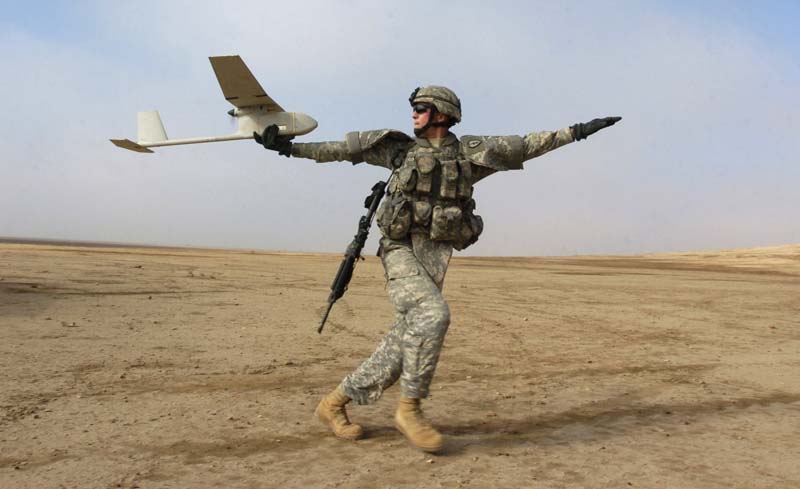
Strategy Page discusses the Raven UAV, which has become a very popular tool with US troops in Afghanistan:

Just as the first recon aircraft a century ago changed the way armies fought, the micro-UAVs have changed the way small units of soldiers fight. A century ago the aerial observers reported to generals and their staffs. UAV video goes to platoon or company commanders, or the leader of a small Special Forces team.

The lightweight, hand launched Raven UAV can only stay airborne about an hour per sortie, but troops have found that this is enough time to do all sorts of useful work, even when there’s no fighting going on. This is most of the time.

[. . .]

The current model, the Raven B (RQ-11B), was introduced five years ago, a year after the original Raven entered service in large numbers. This UAV is inexpensive ($35,000 each) and can stay in the air for 80 minutes at a time. The Raven is battery powered (and largely silent unless flown close to the ground). It carries a color day vidcam, or a two color infrared night camera. It can also carry a laser designator. Both cameras broadcast real time video back to the operator, who controls the Raven via a handheld controller, which uses a hood to shield the display from direct sunlight (thus allowing the operator to clearly see what is down there). The Raven can go as fast as 90 kilometers an hour, but usually cruises at between 40 and 50. It can go as far as 15 kilometers from its controller, and usually flies a preprogrammed route, using GPS for navigation.

The Raven is made of Kevlar, the same material used in helmets and protective vests. On average, Raven can survive about 200 landings before it breaks something. While some Ravens have been shot down, the most common cause of loss is losing the communications link (as the aircraft flies out of range) or a software/hardware failure on the aircraft. Combat losses have been high, as nearly 20,000 have been built and most of those have been lost in training or the battlefield.

From the very beginning, the Raven changed the way troops fight. With the bird’s eye view of the battlefield, commanders can move their troops more quickly, confident that they won’t be ambushed, and often with certain knowledge of where the unseen enemy is. The big advantage with Raven is that it’s simple, reliable, and it just works. A complete system (controller, spare parts and three UAVs) costs $250,000. The UAV can be quickly taken apart and put into a backpack. It takes off by having the operator start the motor, and then throwing it. This can be done from a moving vehicle, and the Raven is a popular recon tool for convoys. It lands by coming in low and then turning the motor off. Special Forces troops like to use it at night, because the enemy can’t see it, and often can’t hear it either.

A soldier with the 25th Infantry Division prepares to launch a Raven unmanned aerial vehicle in Paktika province, Iraq.

(Photo by Sgt. 1st Class Michael Guillory / Army)

« Newer Posts

Powered by WordPress

