
The 1890s were […] a period of deepening German isolation. A commitment from Britain remained elusive and the Franco-Russian Alliance seemed to narrow considerably the room for movement on the continent. Yet Germany’s statesmen were extraordinarily slow to see the scale of the problem, mainly because they believed that the continuing tension between the world empires was in itself a guarantee that these would never combine against Germany. Far from countering their isolation through a policy of rapprochement, German policy-makers raised the quest for self-reliance to the status of a guiding principle. The most consequential manifestation of this development was the decision to build a large navy.
In the mid-1890s, after a long period of stagnation and relative decline, naval construction and strategy came to occupy a central place in German security and foreign policy. Public opinion played a role here — in Germany, as in Britain, big ships were the fetish of the quality press and its educated middle-class readers. The immensely fashionable “navalism” of the American writer Alfred Thayer Mahan also played a part. Mahan foretold in The Influence of Sea Power upon History (1890) a struggle for global power that would be decided by vast fleets of heavy battleships and cruisers. Kaiser Wilhelm II, who supported the naval programme, was a keen nautical hobbyist and an avid reader of Mahan; in the sketchbooks of the young Wilhelm we find many battleships — lovingly pencilled floating fortresses bristling with enormous guns. But the international dimension was also crucial: it was above all the sequence of peripheral clashes with Britain that triggered the decision to acquire a more formidable naval weapon. After the Transvaal episode, the Kaiser became obsessed with the need for ships, to the point where he began to see virtually every international crisis as a lesson in the primacy of naval power.
Christopher Clark, The Sleepwalkers: How Europe Went To War In 1914, 2012.
July 20, 2014
QotD: The Kaiser and the genesis of the High Seas Fleet
June 9, 2014
Australia gets sensible about military shipbuilding
Australia has similar military issues to the ones Canada faces, but unlike our own government (who view military spending primarily as the regional economic development variant of crony capitalism), Australia is amenable to economic sense when it comes to building the new support ships for the Royal Australian Navy:
The RAN is about to bring 3 large Hobart Class destroyers into service, but it’s the new LPD HMAS Choules and 2 Canberra Class 27,500t LHD amphibious assault ships that are going to put a real strain on the RAN’s support fleet. Liberal Party defense minister Sen. Johnson didn’t mince words when he announced the competition, early in their governing term:
“With the large LHD’s [sic] – 28,000 tonnes each – we must have a suitable replenishment ship to supply and support those vessels going forward, the planning for this should have been done a long, long time ago.”
The Australian government is explicit about needing “fuel, aviation fuel, supplies, provisions and munitions on these ships,” and they’ve short-listed 2 main competitors to build the ships outside of Australia:
Cantabria Class. The Cantabrias are an enlarged 19,500t version of the Patino Class replenishment ship. Fuel capacity rises to 8,920 m3 ship fuel and 1,585 m3 of JP-5 naval aviation fuel. Throw in 470t of general cargo, 280t of secured ammunition, and 215 m3 of fresh water to round out its wet/dry capabilities. These ships also carry a crew medical center with 10 beds, including operating facilities equipped for telemedicine by videoconference, an X-ray room, dental surgery, sterilization laboratory, and gas containment.Spain already uses this ship type, and Navantia S.A. is already building the Hobart Class and Canberra Class, giving them a deep relationship with Australian industry and the Navy.
Aegir Class. The government named Daewoo Shipbuilding and Marine Engineering (DSME), who are currently building Britain’s MARS 37,000t oiler/support ships based on BMT’s Aegir design. The concept is scalable, and Australia’s government sized the variant they’ve shortlisted at around 26,000t. BMT’s Aegir 26 design offers up to 19,000 m3 of cargo fuel, and 2-5 replenishment at sea stations for hoses and transfer lines. The design itself is somewhat customizable, so it will be interesting to see what the offer’s final specifications and features are.
Recall that HMAS Sirius was also built in South Korea, albeit in a different dockyard. That isn’t surprising, because South Korea arguably has the world’s best shipbuilding industry. Norway and Britain have each purchased customized versions of the Aegir Class ships.
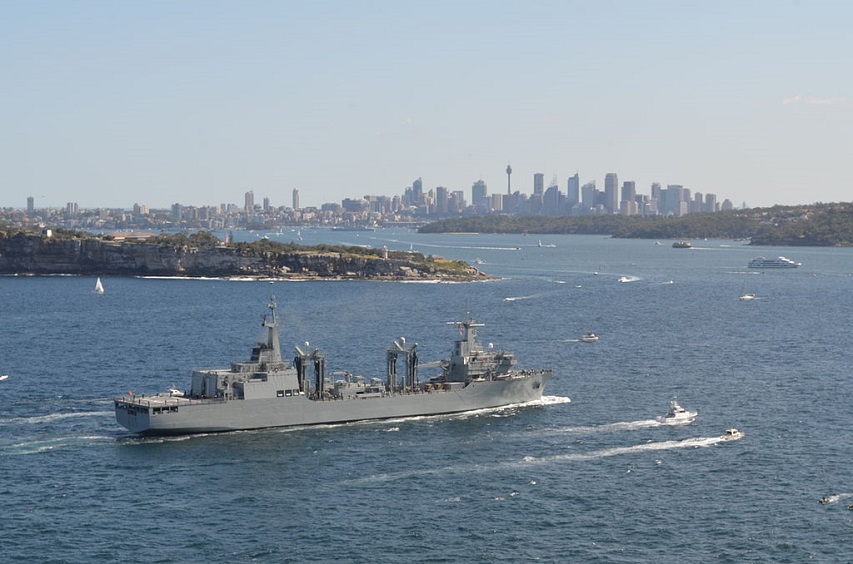
Both the Royal Navy and the Royal Australian Navy are willing to buy ships from Korea. Why not the Royal Canadian Navy’s next ships? Because the government would rather spend many times more money and get smaller, less capable ships as long as they get to spread the money around to cronies:
They won’t be built in Australia, because the government doesn’t believe that the industrial infrastructure and experience is in place to build 20,000+ tonne ships locally. Britain has made a similar calculation, while Canada provides a cautionary example by building smaller supply ships locally at over 5x Britain’s cost.
H/T to Mark Collins for the link. Mark also posted this back in 2013:
To add insult to injury, the Royal Fleet Auxiliary, the civilian-manned support ships for the Royal Navy, are purchasing 4 replenishment vessels under the MARS tanker program to be built in South Korea by Daewoo (arguably the foremost shipbuilder in the world). These ships are slightly larger than the Berlin-class. What is the British government paying for these 4 vessels? £452M or about $686M USD. Not per ship but for all four. The per unit cost is around $170M. If we somehow manage to keep the cost for the JSS at $1.3B per unit, that will still be over 7.5x what the British are paying. If the cost goes up to ~$2B per JSS, we’re looking at almost 12x the cost [though the RCN’s JSS is supposed to have some additional capabilities (already much reduced from 2006 to now, and see the very optimistic timeline here) — but how many of them can the government afford?].
June 2, 2014
The naval revolution and HMS Dreadnought
BBC News Magazine looks back on the launch of the first modern all-big-gun battleship, HMS Dreadnought, in 1906.

HMS Dreadnought underway, circa 1906-07
[HMS Dreadnought] “really transformed naval warfare rather like the tank did on land warfare. In fact Dreadnought was described at the time as ‘the most deadly fighting machine ever launched in the history of the world'”.
Dreadnought brought together for the first time a series of technologies which had been developing over several years. Most important was her firepower. She was the first all big-gun battleship — with ten 12-inch guns. Each gun fired half-ton shells over 4ft tall and packed with high explosive. They weighed as much as a small car. Standing next to one today, it is easy to see how a single broadside could destroy an opponent — and do so at 10 miles’ distance.
These great distances caused problems of their own — in controlling and directing the fire — and Dreadnought was one of the first ships fitted with new equipment to electrically transmit information to the gun turrets.
For potential enemies on the receiving end this was a terrifying prospect. Admiral Lord West, a former head of the Royal Navy, calls Dreadnought “a most devastating weapon of war, the most powerful thing in the world”.
Potential adversaries would also have trouble outrunning her. New steam turbine engines gave her a maximum speed of about 25mph. They made her more reliable than previous ships, and able to sustain a higher speed for much longer.
But there was something else, too. Dreadnought had been built in just one year — a demonstration of British military-industrial might at a time when major battleships generally took several years to build. This, says Roberts, was an “enormous achievement which made the Germans sit up because their shipbuilding capability just could not match that”.

Despite the Royal Navy’s reputation for being tradition-bound and stodgy, they had quite an interesting history of experimentation and innovation in ship design. The launch of HMS Dreadnought was a good example of the navy being willing to take risks — specifically the risk of making the rest of the battlefleet obsolete overnight.
Update, 18 February, 2018: A recent post at Naval Gazing provides more information on the evolution of the Dreadnought design.
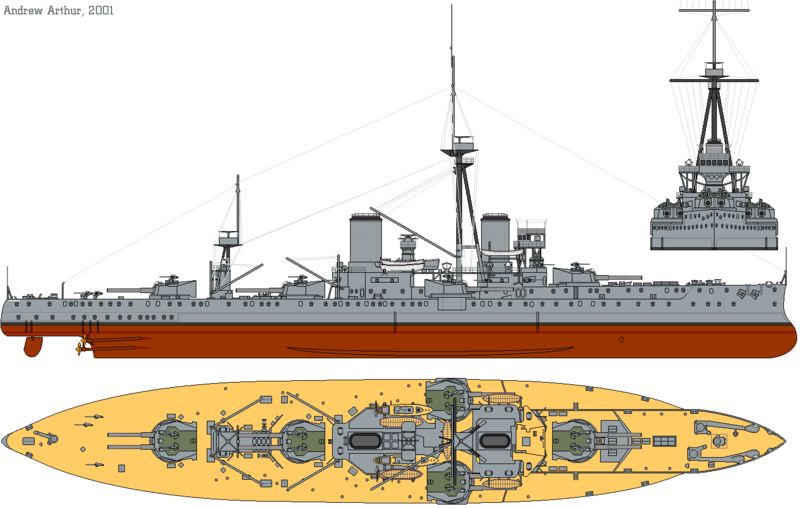
HMS Dreadnought in 1911
[Admiral Sir John “Jackie”] Fisher established a committee, including John Jellicoe and Reginald Bacon, who settled on the characteristics that would define Dreadnought. Bacon, later Dreadnought’s first captain – regarded by Fisher as “the cleverest officer in the Navy” – was the man who convinced Fisher to switch from all-10″ to all-12″. Reports of the effectiveness of the 12″ gun during the Russo-Japanese war helped confirmed this decision.
The second major change that Dreadnought brought is less obvious but in many ways more important. Dreadnought was the first large warship to use steam turbines instead of reciprocating engines. This increased her speed from the previous standard of 18 kts to 21 kts, saved 1000 tons, and most importantly allowed her to maintain high speed for much longer without the risk of mechanical failure. This was a vital component of Fisher’s other innovation, what we now call net-centric warfare. The high sustained speed of the new ships allowed them to cover greater areas, based on the improved information gathering and dissemination system that Fisher set up.
Dreadnought broke new ground in other areas, too. Her hull was about 18% lighter by volume than that of the proceeding Lord Nelson class, and she set a new standard for watertight integrity, removing most doors below the waterline. The only area without major improvement was armor, which was actually slightly less than in the Lord Nelson.
The design process began in November of 1905, initially with plans for 6 turrets. The first set of designs included the obvious (a hexagonal layout), the slightly less obvious (three superfiring turrets on each end) and the weird (a triangle at each end, with two turrets abreast and a superfiring turret above them). Eventually, it was decided that muzzle blast made the later two designs infeasible. Blast interference between the wing turrets meant that the aft pair was replaced by a single centerline turret, producing the arrangement used in Dreadnought.
The final result was a ship of 18,000 tons and 527 ft. With an 8-gun broadside, she matched the long-range firepower of almost any two ship afloat, and she set a new standard for speed in battleships. She was laid down on October 2nd, 1905, and launched only 5 months later, on February 10th, 1905. The 14 months exactly from laying down to commissioning set a record that has never been broken for capital ships, and was intended by Fisher to send a message to the world.
He also references the Dreadnought Hoax, which I’d never heard of … I’m surprised Cole wasn’t prosecuted as a spy, given the popular anxieties about foreign espionage and worries about an invasion.
May 19, 2014
South Korean coast guard to be “dismantled” after ferry disaster
K.J. Kwon, Paula Hancocks and Jethro Mullen report for CNN:
South Korea’s President made an emotional apology Monday over the ferry disaster that killed close to 300 people last month and said she would dismantle the country’s coast guard.
“As the President who should be responsible for people’s life and security, I am sincerely apologizing to the people for having to suffer pain,” said President Park Geun-hye in a televised speech. “The final responsibility for not being able to respond properly lies on me.”
The Sewol ferry sank en route to the resort island of Jeju on April 16, leaving more than 304 people dead or missing. Most of the passengers were high school students on a field trip.
“As a President, I feel a sense of sorrow for not being able to protect them during their family trip,” said Park, whose approval ratings have dropped significantly in the weeks since the sinking.
The Sewol disaster caused widespread outrage in South Korea over lax safety standards and the failure to rescue more people as the ship foundered.
[…]
“After serious consideration, I’ve decided to dismantle the coast guard,” Park said. “The investigation and information roles will be transferred to the police while the rescue and salvage operation and ocean security roles will be transferred to the department for national safety which will be newly established.”
April 22, 2014
Half the fleet is in for repair
As I’ve pointed out before, navies require more ships to do certain jobs because naval vessels require extensive service, repair, and upgrade work such that up to a third of a given ship’s working life will be spent in port and out of service. The Royal Canadian Navy is at a very low point in vessel availability right now:
Of a total of 33 main ships and submarines, 15 are being repaired or undergoing upgrades, while another four are at a lesser state of readiness as they conduct tests on recently installed and modernized systems.
“This is our most challenging year but we have a plan to make sure we have ships available all the time,” Commodore Brian Santarpia, director general, navy strategic readiness, said in an interview with the Citizen. “We’re still quite confident we can fill all the tasks given to us.”
The navy’s 12 frigates are being upgraded as part of the Halifax-class modernization program. Involving $5 billion worth of work, the project will see engineering, radar and weapon systems upgrades, as well as other improvements made to the vessels, Santarpia said.
As part of that process, five frigates are unavailable for operations because they are either in dry-dock or being prepared for the upgrade process.
The Halifax-class frigates are considered the backbone of the navy.
As vessels come out of the modernization process, they go through various stages of readiness as the new systems are being verified and tested and the crew conducts training. “They are available for operations, just not at the very highest levels,” Santarpia explained.
Defence analyst Martin Shadwick said the situation is a result of having a “compact” maritime force and a large number of aging vessels that had to be modernized.
“The navy has known this period was approaching but in the short term they don’t have much choice but to live with it,” said Shadwick, a strategic studies professor at York University in Toronto.
He said a further crunch time for the maritime force will come in the next four years. That is when three aging destroyers, which provide command and control as well as overall air defence for naval task groups, are removed from service.
At that point, the navy goes from the 15 frigates and destroyers, which are the mainstays of the service, down to 12 frigates. In addition, the navy will be without supply ships to provide fuel and provisions at sea. Those two aging ships are to be retired before 2019 and their replacements will not be ready in time.
Under normal circumstances, the RCN would have about 10 frigates and two destroyers available, with the other ships in varying stages of refit, maintenance, and repair. With the recent engine room fire on board HMCS Protecteur, the navy is far more restricted in the kinds of activities it can undertake (only one support ship, HMCS Preserver is available). And let’s just not talk about the state of the RCN’s submarines.

Halifax-class frigate HMCS Vancouver (FFH 331) and Iroquois-class destroyer HMCS Algonquin (DDH 283). Tugboats assist HMCS Vancouver (FFH 331) in departing from Pearl Harbor to participate in exercise Rim of the Pacific (RIMPAC) 2006.
April 10, 2014
Chiles, peppers, and world trade before globalization
ESR linked to an interesting discussion of the spread of chile peppers and other exotic spices from the Roman empire onwards:
Can you imagine a world without salsa? Or Tabasco sauce, harissa, sriracha, paprika or chili powder?
I asked myself that question after I found a 700-year-old recipe for one of my favorite foods, merguez — North Africa’s beloved lamb sausage that is positively crimson with chiles. The medieval version was softly seasoned with such warm spices as black pepper, coriander and cinnamon instead of the brash heat of capsicum chile peppers — the signature flavor of the dish today.
The cuisines of China, Indonesia, India, Bhutan, Korea, Hungary and much of Africa and the Middle East would be radically different from what they are today if chiles hadn’t returned across the ocean with Columbus. Barely 50 years after the discovery of the New World, chiles were warming much of the Old World. How did they spread so far, so fast? The answers may surprise you — they did me!
I learned that Mamluk and Ottoman Muslims were nearly as responsible for the discovery of New World peppers as Columbus — but I’m getting ahead of myself.
The global pepper saga begins in the first millennium bce with the combustible career of another pepper — black pepper (Piper nigrum) and its cousins, Indian long pepper and Javanese cubeb. Although Piper nigrum was first grown on the Malabar Coast in India, the taste for it enflamed the ancient world: No matter what the cost — and it was very high — people were mad for pepper. The Romans, for example, first tasted it in Egypt, and the demand for it drove them to sail to India to buy it. In the first century, Pliny complained about the cost: “There is no year in which India does not drain the Roman Empire of fifty million sesterces.”
In one sense, the whole global system of trade — the sea and land routes throughout the known world that spread culture and cuisine through commerce — was engaged with the appetite for pepper, in its growth, distribution and consumption.

Dried chiles shipped well worldwide. From top-left: New World Capsicum annuum varieties include guajillo, ancho and New Mexico; a smaller Capsicum frutescens variety called “birdseye” chiles spread wild in Africa after birds spread their seeds from early gardens, and they are now common also in Southeast Asia; “Indian” chiles are among the most common varieties in India, which today grows and exports more chiles than any other nation. Bottom-left: Three popular capsicum peppers that took root in the Middle East — Maraş, Urfa and Aleppo, shown below in their flaked form — are used in dishes throughout the region. Bottom-right: Fresh serrano, poblano and ripe jalapeño peppers.
ESR said in his brief G+ posting:
More about the early and very rapid spread of capsicum peppers in the Old World than I’ve ever seen in one place before.
I also didn’t know they were such a nutritional boon. It appears one reason they became so entrenched is they’re a good source of Vitamin C in peasant cuisines centered around a starch like rice. My thought is that moderns may tend to miss this point because we have so much better access to citrus fruits and other very high-quality C sources.
The bit about paprika having been introduced to Hungary by the Ottomans was also particularly interesting to me. This was less than 30 years after they had reached the Old World.
March 8, 2014
RCN’s Joint Support Ships behind schedule and over budget
Terry Milewski reports on the state of Canada’s shipbuilding program for the Royal Canadian Navy, and it’s not pretty:
An internal government memo obtained by CBC News shows that all four parts of the government’s huge shipbuilding program are either over budget, behind schedule, or both.
Written Oct. 7 last year by the deputy minister of national defence, Richard Fadden, the memo shows that three of those four programs also face “major challenges” of a technical nature, as well as difficulties lining up skilled manpower to get the ships built at all.
The memo, released to the CBC following an Access to Information request, leaves little doubt that Canada’s crippled supply ship, HMCS Protecteur, won’t be replaced before the year 2020.
The spectacle of the 46-year-old Protecteur, Canada’s only supply ship in the Pacific, being towed into Honolulu after an engine-room fire has thrown the lack of a replacement into sharp focus. Although there’s a plan to build two new supply ships, there’s no sign the work will even begin until late 2016. That means a new one won’t enter service until the end of the decade.
A chart summarizing the state of the shipbuilding effort uses green and yellow squares to indicate where those problems are — the green meaning, on track, and yellow meaning, trouble — and there’s a lot of yellow.
For the Joint Support Ships — that’s the pair of supply ships — the chart shows trouble with both the schedule and the price. The memo explains that this means the program is up to 20 per cent behind schedule and up to 10 per cent over budget.
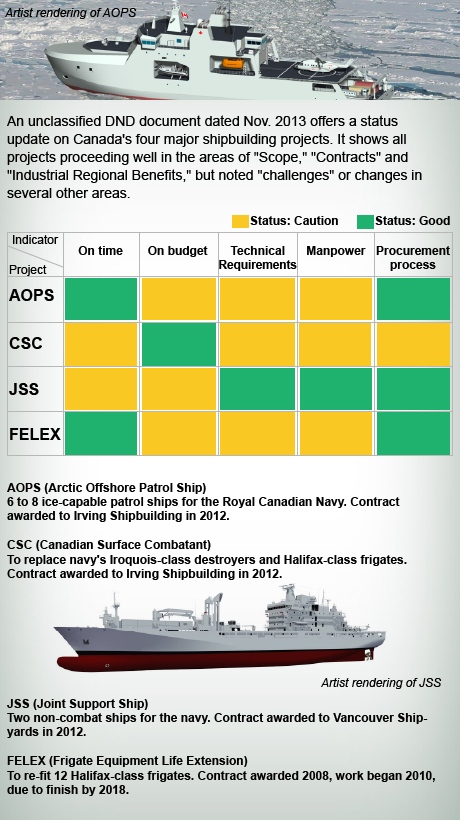
As I’ve said many times before, the Canadian government is managing to get the least possible bang for the buck on shipbuilding because they view the shipbuilding program as a regional economic development scheme (and a way of funneling money to marginal constituencies) rather than as an essential part of keeping the RCN properly equipped. It’s pretty obvious in this case:
Take the supply ships. “Yellow” suggests they’re over budget, but doesn’t indicate what the budget should be. But comparisons with Canada’s allies could raise eyebrows even further.
Britain, for example, opted to build its four new naval supply ships much more cheaply, at the Daewoo shipyard in South Korea. The contract is for roughly $1.1 billion Cdn. That’s for all four. By contrast, Canada plans to build just two ships, in Vancouver, for $1.3 billion each. So Canada’s ships will be roughly five times more costly than the British ones.
But there’s a twist. Canada’s supply ships will also carry less fuel and other supplies, because they’ll be smaller — about 20,000 tonnes. The U.K. ships are nearly twice as big — 37,000 tonnes. Canadians will lay out a lot more cash for a lot less ship.
February 16, 2014
Winter ice approaching modern record on the Great Lakes
In USA Today, Eric Lawrence talks about the ongoing cold weather’s impact on the Great Lakes:
“In the last one to two weeks, we’ve seen rapid accumulations on Lakes Superior, Huron and Michigan,” said Jeff Andresen, an associate professor in Michigan State University’s geography department who also is the state climatologist.
The ice cover on the lakes increased from 79.7% to 88.4% just in the past week, putting the region close to the record of almost 95% set in February 1979, according to data compiled by the National Oceanic and Atmospheric Administration’s Great Lakes Environmental Research Laboratory in Ann Arbor.
The extensive ice cover has had some interesting and positive effects, like shutting off lake-effect snow, making it sunnier in portions of states near the lakes and limiting evaporation, which could help boost lake levels.
And the ice cover could help delay the spring warm-up — good news for farmers as it helps keep certain crops, like fruit trees, dormant longer and less susceptible to freezing early in the growing season — Andresen said.
Conversely, it’s bad news for the shipping industry, whose vessels can’t go anywhere when the ports are frozen solid.
The winter of 2013-14 also is shaping up to be one of the five coldest, at least in Michigan’s recorded history, Andresen said, although it’s still early to say for certain.
“We haven’t seen many winters like this that are cold from beginning to end,” he said, noting that this is the fourth consecutive month that is colder than normal. “It has been an extraordinary winter, and the ice cover is a manifestation of that unusually cold winter.”
He cautioned that temperatures forecast in the 40s next week could hurt the chances to break an ice-cover record.
January 24, 2014
A Danish solution to the high cost of modern warships
Developments like this should be of great interest to the Royal Canadian Navy:
… constrained budgets in America and Europe are prompting leading nations to reconsider future needs and explore whether new ships should be tailored for what they do every day, rather than what they might have to do once over decades.
The solution: extreme flexibility at an affordable price for construction and operation.
Here the Danes have emerged as a clear leader by developing two classes of highly innovative ships designed to operate as how they will be used: carrying out coalition operations while equipped to swing from high-end to low-end missions.
The three Iver Huitfeldt frigates and two Absalon flexible support ships share a common, large, highly efficient hull to yield long-range, efficient but highly flexible ships that come equipped with considerable capabilities — from large cargo and troop volumes and ample helo decks for sea strike and anti-submarine warfare — in a package that’s cheap to buy and operate. The ships come with built-in guns, launch tubes for self-defense and strike weapons, and hull-mounted sonar gear, and they can accept mission modules in hours to expand or tailor capabilities. The three Huitfeldts cost less than $1 billion.
The ships also are coveted during coalition operations for their 9,000-mile range at 15 knots, excellent sea-keeping qualities and command-and-control gear, plus spacious accommodations for command staffs. That’s why the Esbern Snare, the second of two Absalon support ships, is commanding the international flotilla in the Eastern Mediterranean that will destroy Syria’s chemical weapons.
Wikipedia has this image of the HDMS Iver Huitfeldt:

HDMS Iver Huitfeldt during a port visit in Århus, 20 January 2012
The class is built on the experience gained from the Absalon-class support ships, and by reusing the basic hull design of the Absalon class the Royal Danish Navy have been able to construct the Iver Huitfeldt class considerably cheaper than comparable ships. The frigates are compatible with the Danish Navy’s StanFlex modular mission payload system used in the Absalons, and are designed with slots for six modules. Each of the four Stanflex positions on the missile deck is able to accommodate either the Mark 141 8-cell Harpoon launcher module, or the 12-cell Mark 56 ESSM VLS.
While the Absalon-class ships are primarily designed for command and support roles, with a large ro-ro deck, the three new Iver Huitfeldt-class frigates will be equipped for an air defence role with Standard Missiles, and the potential to use Tomahawk cruise missiles, a first for the Danish Navy.
For contrast here is the HDMS Esbern Snare, the second ship in the Absalom class:

Danish Navy Combat Support Ship HDMS Esbern Snare in the port of Gdynia, prior to exercise US BALTOPS 2010.
That’s not to say that these particular ships would be a good fit for the RCN, but that the approach does seem to be viable (sharing common hull configurations and swappable mission modules). However, the efficiencies that could be achieved by following this practice would almost certainly be swamped by the political considerations to spread the money out over as many federal ridings as possible…
H/T to The Armourer for the link.
January 7, 2014
Fortunate wind shift helps free trapped Antarctic vessels
 BBC News updates us on the situation:
The Russian research ship Akademik Shokalskiy and Chinese icebreaker Xue Long have broken free from Antarctic ice where they had been stranded for several days.
The Russian ship’s captain said a crack had appeared in the ice after a change in wind direction.
The Akademik Shokalskiy got stuck on 25 December. It has a Russian crew of 22.
On Thursday, the Xue Long‘s helicopter ferried 52 passengers from the stranded Russian ship to an Australian vessel.
The Xue Long then became stuck itself on Friday.
[…]
A US Coastguard icebreaker, Polar Star, is heading towards the two ships, responding to an earlier request for help. It left Sydney, Australia, on Sunday and will take a week to get there.
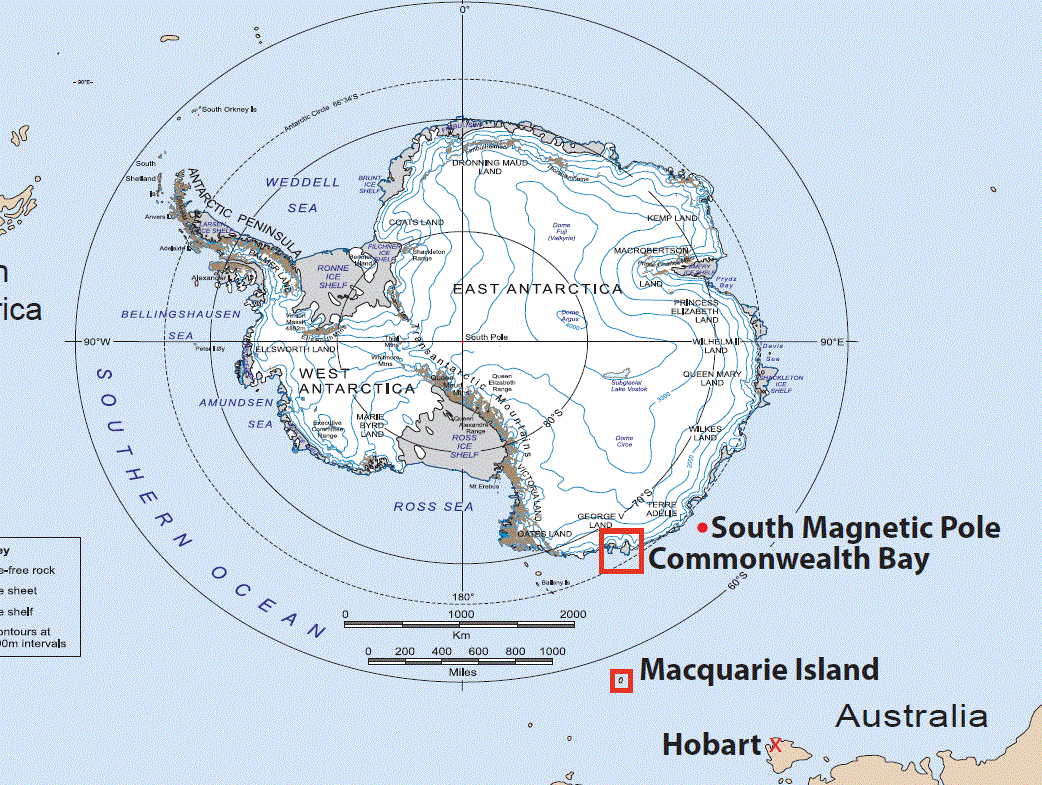
The Akademik Shokalskiy got trapped by thick floes of ice driven by strong winds about 1,500 nautical miles south of Hobart in Tasmania. It was being used by the Australasian Antarctic Expedition (AAE) 2013 to follow the route explorer Douglas Mawson travelled a century ago.
January 6, 2014
US icebreaker dispatched to assist Chinese icebreaker in Antarctic
The Australian is reporting that the US Coast Guard’s Polar Star is enroute to assist the Chinese icebreaker Xue Long and the chartered Russian ship Akademik Shokalskiy:
The US Coast Guard’s Polar Star accepted a request from the Australian Maritime Safety Authority (AMSA) to help the Russian ship Akademik Shokalskiy, which has been marooned since Christmas Eve.
It will also aid the Chinese icebreaker Xue Long, which was involved in a dramatic helicopter rescue of the Shokalskiy’s 52 passengers last Thursday before also becoming beset by ice.
AMSA confirmed the Polar Star, which was on its way from Seattle for an Antarctic mission, had diverted course and was on its way to help.
It will take about seven days for the icebreaker, with a crew of 140 people, to reach Commonwealth Bay after collecting supplies from Sydney today.
The AMSA spokeswoman said the Polar Star had greater capabilities than the Russian and Chinese vessels.
“It can break ice over six metres thick, while those vessels can break one-metre ice,” she told AAP on Sunday.
“The idea is to break them out, but they will make a decision once they arrive on scene on the best way to do this.” AMSA will be in regular contact with the US Coast Guard and the captain of the Polar Star during its journey to Antarctica.
Twenty-two crew remain on board the Shokalskiy, which sparked a rescue mission after a blizzard pushed sea ice around the ship and froze it in place on December 24.

A U.S. Coast Guard HH-52A Seaguard helicopter landing on the icebreaker USCGC Polar Star (WAGB-10).
January 4, 2014
Antarctic climate researchers still not home-free
Remember the story about the Australian climate researchers trapped in the Antarctic ice? The good news from a few days back — that all the passengers of the MS Akademik Shokalskiy (including researchers, tourists, and journalists, but not the crew) had been successfully transferred to the Australian icebreaker Aurora Australis is now overshadowed because the Chinese icebreaker Xue Long which also responded to the SOS call is now itself also trapped in the ice:
The saga just keeps going. The Chinese Icebreaker is now also stuck, and has asked for help so the Aurora Australis with 52 extra passengers rescued from the Russian Charter boat have to stay nearby to help. Twenty two Russian sailors are still trapped on board the Russian boat — the Akademik Sholaskiy. Plus other scientists in Antarctica still don’t have their equipment. Costs for everyone involved are continuing to rise.
In The Australian, Graham Lloyd‘s paywalled article begins with this:
TAXPAYERS will foot a $400,000 bill for the rescue of a group of climate scientists, tourists and journalists from a stranded Russian research vessel — an operation that has blown the contingency budget of Australia’s Antarctic program and disrupted its scientific work. The Antarctic Division in Hobart said it was revising plans and considering airlifting urgently needed scientific equipment that could not be unloaded from Aurora Australis before the ship was diverted from the Casey base to rescue the novice ice explorers just before Christmas.
The Sydney Morning Herald posted this short video earlier in the week, before the Aurora Australis had gotten close enough to take on the passengers from the Akademik Sholaskiy:
Update: The head of French antarctic research is unhappy with the tourists’ disruption to actual science work:
The head of France’s polar science institute voiced fury on Friday at the misadventures of a Russian ship trapped in Antarctic ice, deriding what he called a tourists’ trip that had diverted resources from real science.
In an interview with AFP, Yves Frenot, director of the French Polar Institute, said he had no issue at all with rescuing those aboard the stricken vessel.
But, he said, the trip itself was a “pseudo-scientific expedition” that, because it had run into difficulties, had drained resources from the French, Chinese and Australian scientific missions in Antarctica. “There’s no reason to place Antarctica off-limits and to keep it just for scientists, but this tourism has to be monitored and regulated so that operators can be sure of getting help if need be,” he said.
January 1, 2014
The hazards facing the Australasian Antarctic Expedition
The Australasian Antarctic Expedition (AAE) has run into far harsher sea and ice conditions than they’d banked on, and it raises questions about the scientific validity of the expedition:
The purpose of the AAE expedition was to take a science team of 36 women and men south to discover just how much change has taken place at Mawson Station over 100 years. The expedition was also intended to replicate the original AAE led by explorer Sir Douglas Mawson a century ago, in 1913. The new expedition was to be led by Prof. Chris Turney, a publicity-hungry professor of climate change at Australia’s University of New South Wales.
Also the expedition was designed to generate lots of publicity. Along the scientists and ship’s crew were 4 journalists from leading media outlets who would feed news regularly, and later report extensively on the results and findings. All this in turn would bring loads of attention to a region that is said to be threatened by global warming. The AAE’s donation website even states that the expedition’s purpose is to collect data and that the findings are “to reach the public and policy makers as soon as possible“.
But expeditions of this type are expensive and funding is not always easy to come by. Costs can run in the millions as special equipment is needed to handle the extremely harsh conditions of the South Pole. Downplaying the conditions to justify cost-cutting by using lower grade equipment rapidly jeopardizes safety.
Inadequate, bargain-price research vessel
The first error expedition leaders made was under-estimating the prevailing sea ice conditions at Mawson Station, their destination. The scientists seemed to be convinced that Antarctica was a warmer place today than it had been 100 years earlier, and thus perhaps they could expect less sea ice there. This in turn would allow them to charter a lighter, cheaper vessel.
This seems to be the case judging by their choice of seafaring vessel. They chartered a Russian vessel MS Akademik Shokalskiy, an ice-strengthened ship built in Finland in 1982. According to Wikipedia the ship has two passenger decks, with dining rooms, a bar, a library, and a sauna, and accommodates 54 passengers and a crew of up to 30. Though it is ice-reinforced, it is not an ice-breaker. This is a rather surprising selection for an expedition to Antarctica, especially in view that the AAE website itself expected to travel through areas that even icebreakers at times are unable to penetrate, as we are now vividly witnessing. Perhaps the price for chartering the Russian vessel was too good to pass up.
Luring naïve tourists as a source of cash
What made the expedition even more dubious is that Turney and his team brought on paying tourists in what appears to have been an attempt to help defray the expedition’s costs and to be a source of cheap labor. According to the AAE website, the expedition was costed at US$1.5 million, which included the charter of the Akademik Shokalskiy to access the remote locations. “The site berths on board are available for purchase.” Prices start at $8000!
The expedition brought with it 4 journalists, 26 paying tourists.
Update, 2 January: An editorial in The Australian after news came out that all of the 52 passengers had been rescued from the ice-bound Akademik Shokalskiy:
YOU have to feel a touch of sympathy for the global warming scientists, journalists and other hangers-on aboard the Russian ship stuck in impenetrable ice in Antarctica, the mission they so confidently embarked on to establish solid evidence of melting ice caps resulting from climate change embarrassingly abandoned because the ice is, in fact, so impossibly thick.
[…]
Professor Turney’s expedition was supposed to repeat scientific investigations made by Douglas Mawson a century ago and to compare then and now. Not unreasonably, it has been pointed out Mawson’s ship was never icebound. Sea ice has been steadily increasing, despite the Intergovernmental Panel on Climate Change’s gloomy forecasts. Had the expedition found the slightest evidence to confirm its expectation of melting ice caps and thin ice, a major new scare about the plight of the planet would have followed. As they are transferred to sanctuary aboard the icebreaker Aurora Australis, Professor Turney and his fellow evacuees must accept the embarrassing failure of their mission shows how uncertain the science of climate change really is. They cannot reasonably do otherwise.
The 22 crew members will stay on board the vessel until it can be released from the ice (or until another rescue effort needs to be mounted).
December 2, 2013
Sea level changes during recorded history
Some interesting points in this guest post by Robert W. Endlich:
Sea level changes over relatively recent geologic and human history demonstrate that alarmist claims do not withstand scrutiny. Sea levels rose significantly after the last ice age, fell during the Little Ice Age, and have been rising again since the LIA ended around 1850. In fact, Roman Empire and Medieval port cities are now miles from the Mediterranean, because sea levels actually fell during the Little Ice Age.
[…]
Those rising oceans created new ports for Greek and Roman naval and trade vessels. But today many of those structures and ruins are inland, out in the open, making them popular tourist destinations. How did that happen? The Little Ice Age once again turned substantial ocean water into ice, lowering sea levels, and leaving former ports stranded. Not enough ice has melted since 1850 to make them harbors again.
The ancient city of Ephesus was an important port city and commercial hub from the Bronze Age to the Minoan Warm period, and continuing through the Roman Empire. An historic map shows its location right on the sea. But today, in modern-day Turkey, Ephesus is 5 km from the Mediterranean. Some historians erroneously claim “river silting” caused the change, but the real “culprit” was sea level change.
Ruins of the old Roman port Ostia Antica, are extremely well preserved – with intact frescoes, maps and plans. Maps from the time show the port located at the mouth of the Tiber River, where it emptied into the Tyrrhenian Sea. The Battle of Ostia in 849, depicted in a painting attributed to Raphael, shows sea level high enough for warships to assemble at the mouth of the Tiber. However, today this modern-day tourist destination is two miles up-river from the mouth of the Tiber. Sea level was significantly higher in the Roman Warm Period than today.
An important turning point in British history occurred in 1066, when William the Conqueror defeated King Harold II at the Battle of Hastings. Less well-known is that, when William landed, he occupied an old Roman fort now known as Pevensey Castle, which at the time was located on a small island in a harbor on England’s south coast. A draw bridge connected it to the mainland. Pevensey is infamous because unfortunate prisoners were thrown into this “Sea Gate,” so that their bodies would be washed away by the tide. Pevensey Castle is now a mile from the coast – further proof of a much higher sea level fewer than 1000 years ago.
November 28, 2013
Poking holes in the proposed Scottish defence plans
Sir Humphrey says he’s neutral on the political issue of Scottish separatism, but he has a few professional criticisms of the fleet plan contained within the white paper:
At a most basic level, the paper appears to fall foul of what can be described as the ‘fantasy fleet’ syndrome so often found on the internet. In other words, people have taken an order of battle, hived of a reasonable sounding level of equipment and assumed that this would make a good defence force. That’s a great theory, but in reality its likely to be far more complicated than this.
For starters, the British Armed Forces are the product of hundreds of years of evolution, procurement and support. They operate a closely integrated set of equipment, underpinned by a well developed training network, and supported by a very complex set of support contracts to ensure availability. Due to the numbers and amounts of equipment in service, costs can be calculated using economies of scale, and planned workflow, in a way that smaller sized support cannot.
A nascent SDF would find itself operating a truly eclectic collection of units which are not necessarily the most appropriate for its situation. For instance, the proposal that the Navy takes on two Type 23 frigates seems a little odd. The Type 23 is one of the worlds most advanced anti-submarine warfare escorts, and designed to be a submarine killer par excellence. To use it to best effect requires a well trained crew, who have a range of extremely specialised skills. Assuming that no one is forced at independence to join the SDF, the challenge will be recruiting and retaining a core of niche skills to actually employ the vessel in her intended manner. This includes the engineers, weapon systems maintainers, the warfare department and those with the skills and experience at all ranks and rates to use the vessel in its intended manner.
[…]
Similarly, the issue of maintenance will be a complex one. There are no T23s based in Scotland, which means that a great deal of money will be spent creating a permanent support facility for the class in Scotland. In these circumstances the SDF will need to negotiate and establish support contracts, similar to the ones used by the RN, and pay to put in place the complex web of support arrangements in order to keep the vessels available for service. In a small procurement and support budget, it is hard to see where the money will come from for this sort of activity.
The sheer running costs of the vessels will also be a challenge — on average it costs about £20 million per year (source THEY WORK FOR YOU) to keep a Type 23 at sea, and about £3 million for MCMVs and patrol craft. To keep the Scottish Navy afloat, you are looking at an annual running cost of around £60 million — before you consider salary costs of the crew and the shore support infrastructure to go with it. On a relatively small budget of £2.5 billion, it is easy to see how much of a cost it would be just to keep the ships at sea, let alone deploy them.
In a sense, the white paper’s defence plan does appear to have been drawn up with an eye toward “order of battle” and “table of equipment” that would create — on paper, anyway — a scaled-down version of the RN, RAF, and British army. That isn’t the sensible approach for an independent Scotland’s defence needs. The first thing they should have done is analyze what practical tasks their defence forces would be required to undertake, then consider the most cost-effective way to build and equip an organization to accomplish those tasks.
When I was a child, I was obsessed with toy soldiers. I had hundreds and hundreds of them from various eras from Roman versus Celt down to 8th Army versus Afrika Korps. When setting up my “battles”, it was always the soldiers with the cool kit who got to be the heroes: stirring combat poses and cooler weapons were my selection criteria. When I moved on to building models, the same characteristics dictated the particular models I built: more heavily armed ships, bigger tanks, more weapon-studded aircraft. The authors of this portion of the white paper appear to have had similar childhoods … and they’re still influenced by the same selection criteria. What sense does it make for Scotland’s defence forces to operate Type 23 frigates and Typhoon aircraft? They’re cool kit, but do they accomplish the primary protective duties for Scotland cost-effectively? Almost certainly not.
Scotland has a large coastline and significant offshore assets to protect, but it isn’t likely to need the hugely expensive (and admittedly very capable) kit that the Royal Navy and the Royal Air Force need to accomplish their wider tasks. Scotland’s navy is much more likely to end up resembling a strong coastguard than a battle fleet, and their air force will probably not be equipped with top-of-the-line fighter aircraft (especially not F-35 or Typhoon fighters) as they would eat a hugely disproportional share of the defence budget for capabilities the Scots don’t actually need.
I strongly suspect the best course of action for Scotland (in the event of a successful independence vote) would be to negotiate a short-to-medium term deal with the rest of the UK to provide military units to Scotland as an interim solution while a sensible Scottish organization was built-up to take on those roles. It might sting the pride of nationalists to admit that they can’t afford to take on the full trappings of an independent state immediately, but it would be far more practical (and far less expensive) than carving off “their share” of the UK’s existing military.


