Like other Americans, however, many libertarians think of political parties like sports teams. They want their own team to root for and cannot root for the other teams. Voting Libertarian gives them psychological satisfaction, while in the aggregate diminishing their political impact.
Libertarians should stop thinking of parties as teams and think of them instead as the playoffs. In NFL football terms, The Democrats are the AFC and the Republicans the NFC. To get into the Superbowl, you have to survive the season and the playoffs in your respective conference. In effect, Libertarians want to form their own league which no one but themselves is interested in watching. And they assure themselves of never making the playoffs much less the Superbowl.
Randy Barnett, “Parties Are Not Sports Teams — Parties are the Playoffs”, The Volokh Conspiracy, 2005-02-24
December 7, 2020
QotD: American politics as “the playoffs”
November 12, 2020
The party of the Lucky Winners
Brian Micklethwait sends some thoughts from his sick-bed on the (still in question) outcome of the US election:

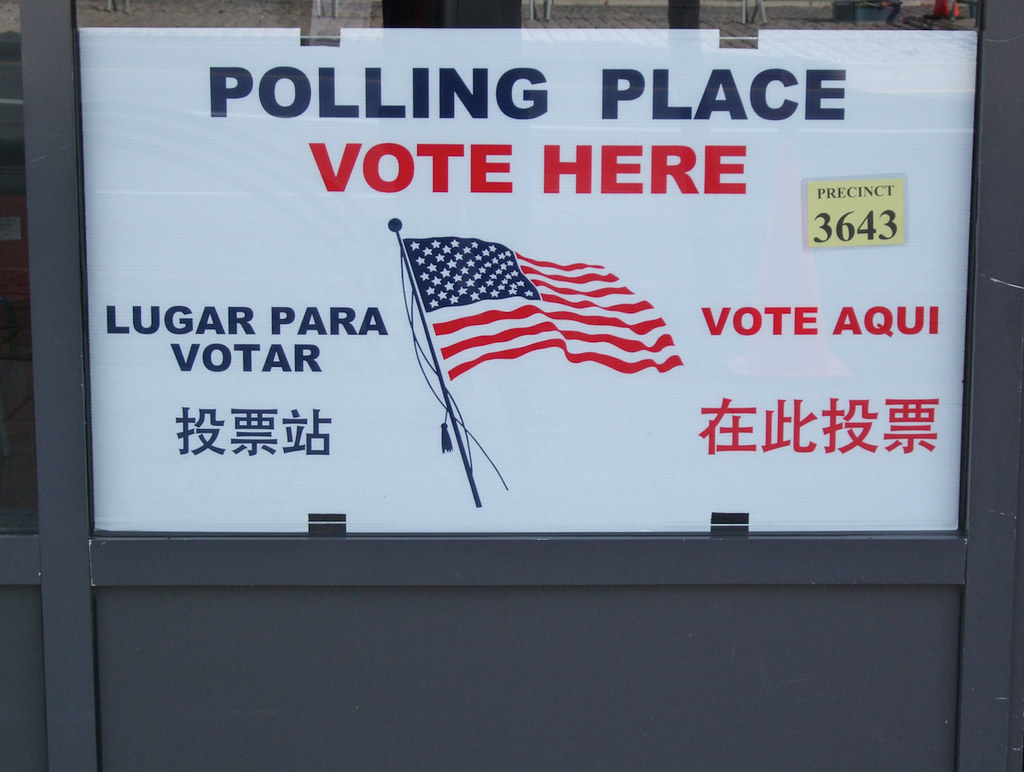
“Polling Place Vote Here” by Scott Beale is licensed under CC BY-NC-ND 2.0
Democrat electoral cheating is not a new story. I’ve been reading stuff about America and American politics all my life, off and on and mostly off, and like a thread through it all is the fact that in big cities that they run and are determined to go on running, Democrats cheat in elections. So Democrats cheating in elections this time around is not the big change.
The big change is a Republican refusing to retreat in the face of it. Why? Why is Trump being so unpresidential, so undignified, so … just so ghastly? The answer is that the big political picture has been transformed, partly by him, but partly by him responding to the fact that it has already changed so much.
Time was when Republicans were the party of the Lucky Winners. Country clubbers, corporate executives, yacht owners, owners of houses with several garages, presided over by perfectly manicured wives, in charge of several well behaved children and subservient servants. The Democrats, meanwhile, were the party of the workers, of people struggling to do work or even to get work. Any plutocrats who were attached to the Democrats, like the Kennedys or (FD) Roosevelt, were numerically insignificant oddities. (Whether that was true, I don’t know. But this was the dominant narrative, as people say now.)
But that’s all changed. The Democrats are now the party of the Lucky Winners, and also of the unlucky losers at the very bottom of the heap who can only now depend on the crumbs of comfort bestowed upon them by the Lucky Winner class. The Republicans have become the party of the workers in the middle, the middle class, as Americans accurately describe them. The Republicans are the party of the people who still struggle to work and to stay working, and who hate the whole idea of giving up and becoming dependant upon the Lucky Winners.
Not all “workers” voted for Trump. A lot of workers, especially in things like IT, are still solidly Democrat. But the heart of the Trump vote was workers of a certain sort. The heart of the Trump vote was no longer the Lucky Winners class. They have migrated over to the Democrats.
Okay, now for the key bit of what I’m saying.
In olden times, if you were a member of the Lucky Winners class, and your guy lost an election, complaining about cheating was frankly a bit, well, undignified. You and your pals controlled almost all the levers of power in society. You owned the big corporations. Your children were creaming off most of the expensive education. The world was yours. Were you going to bitch about electoral corner-cutting by a few machine politician Democrats in big cities who had enough clout to say boo to you, every once in a while? This was not a good look. And on the whole, Republicans took their defeats, and if Democrat cheating cost them a win or two, well, that was how it crumbled, cookie-wise. Legally, that may not have been the rule, but actually, that was the rule. Noblesse oblige. Let the people picked by the struggling class have their turn. Suck it up. Go play golf.
But now? Now, what is happening is that the Lucky Winners class is telling the class definitely below it in the pecking order that this subordinate class now has to just lie back and let it happen, when the electoral cheating happens all over them.
This is not a good look either, but it’s what the Lucky Winner class now think they can do, and get away with. Maybe they can, in the sense that they may well get their guy over the line this time around. But if they do, but if it then becomes clear that they did this by cheating on a large scale in this election, then the words “reap” and “whirlwind” spring to mind.
September 29, 2020
July 6, 2020
Time to end US military deployments to Afghanistan?
Brad Polumbo reports on the split between Republican voters and Republican Senators on ending the US military involvement in Afghanistan:
Applied to the Middle East, the America First framework is intuitive — our military misadventures in countries like Iraq, Libya, and Afghanistan have cost the U.S. tremendously yet failed to further our interests. Once the party of hawks and idealists, Republican voters are now firmly in the America First camp. According to The Intercept, 81% of 2016 Trump voters support removing troops from Afghanistan.
Unfortunately, this shift in views has not been represented in Congress. Most Senate Republicans just explicitly voted against ending the war in Afghanistan.
On Wednesday evening, Sen. Rand Paul, a libertarian-leaning Kentucky Republican, introduced an amendment to the National Defense Authorization Act that would have brought our troops home from Afghanistan, given those soldiers who served a bonus, and repealed the authorization of force Congress passed in 2001. But in a 60 to 33 vote, the Senate shot it down, with only three Republicans in addition to Paul — Sens. Mike Lee, Mike Braun, and Steve Daines — backing the amendment.
“Our amendment [would] finally and completely end the War in Afghanistan,” Paul said on the Senate floor. “Over 4,000 Americans have died in Afghanistan and over 20,000 have been wounded. It’s time to bring our soldiers home.”
“It is not sustainable to keep fighting in Afghanistan generation after generation,” he continued. “In fact, we now have soldiers who were born after 9/11 serving in Afghanistan.”
“We’ve been there for 20 years,” the senator said. “How can we characterize withdrawal after 20 years, after we defeated the enemy, as ‘precipitous’? It’s crazy. The American people say, ‘Come home,’ and this is your chance.”

“Afghanistan 2010 43” by david_axe is licensed under CC BY-NC 2.0
February 22, 2020
February 4, 2020
Andrew Sullivan – “Our fate was almost certainly cast as long ago as 1964 and 1965”
In his most recent New York magazine column, Andrew Sullivan reviews two new books on the same issues from different perspectives: Ezra Klein’s Why We’re Polarized and Christopher Caldwell’s The Age of Entitlement.
… both books agree on one central thing: Our fate was almost certainly cast as long ago as 1964 and 1965. Those years, in the wake of the Kennedy assassination, saw the Civil Rights Act upend the Constitution of a uniquely liberal country in order to tackle the legacy of slavery and racism, and the Immigration and Nationality Act set in motion the creation of a far more racially and ethnically diverse and integrated society than anyone in human history had previously thought possible. Still, at the time, few believed that either shift would have huge, deep consequences in the long term. They were merely a modernization of American ideals: inclusivity, expansiveness, hope.
As someone who was born just before these two changes were instigated, I regarded those tectonic shifts as simply part of the landscape — something that seemed always to have been here. And what could be questioned about either? One was reversing a profound moral evil; the other was banishing racism from the immigration laws. No-brainers. The strongest resistance to civil rights came from former segregationists or obvious racists, and there was little resistance to the Immigration Act, because most in the congressional debate seemed to think it wouldn’t change anything much at all. (The House sponsor of the Immigration Act, as Caldwell notes, promised that “quota immigration under the bill is likely to be more than 80 percent European,” while Ted Kennedy insisted: “The ethnic mix of this country will not be upset.”) There were a few dissenters to the 1964 Act, such as Robert Bork, who identified a significant erosion in the freedom of association. And there were southern senators who worried about immigrants from the developing world. But the resisters were easily dismissed on both counts, in the wake of LBJ’s 1964 landslide.
In fact, as Klein shows, a pivotal moment had arrived. The civil-rights movement quickly broke apart the old Democratic party, which had for decades combined the interests of blacks and southern whites into a single multiracial coalition. The result was a sorting of the two political parties into much purer vessels for their diverging ideologies, and into groupings that were also increasingly racially distinct. The GOP became whiter and whiter; the Democrats more and more became the party of the marginalized nonwhites as the years rolled by. Blacks and southern whites ceased to communicate directly within a single party, where compromises could be hammered out through internal wrangling. In the aggregate this was, as Klein emphasizes, a good thing — because blacks kept coming out the losers in those intraparty conversations, and with civil rights, they had a chance of winning in a clearer, less rigged, debate.
But it was also problematic because human beings are tribal, psychologically primed to recognize in-group and out-group before the frontal cortex gets a look-in. And so the whiter the GOP became, the whiter it got, and the more diverse the Democrats got. Simultaneously, the economy took a brutal toll on the very whites who were alienated by the culture’s shift toward racial equality, and then racial equity. Klein recognizes that this racial polarization, is, objectively, a problem for liberal democracy: “Our brains reflect deep evolutionary time, while our lives, for better and worse, are lived right now, in this moment.” So he can see the depth of the problem of tribalism — and its merging with partisanship, which goes on to create a megatribalism.
If humans simply cannot help their tribal instincts, then a truly multicultural democracy has a big challenge ahead of it. The emotions triggered are so primal, that conflict, rather than any form of common ground, can spiral into a grinding cold civil war. And you can’t legislate or educate this away. One fascinating study Klein quotes found that “priming white college students to think about the concept of white privilege led them to express more racial resentment in subsequent surveys.” Anti-racist indoctrination actually feeds racism. So tribalism deepens.
Klein sees this spiral more clearly than most on the left. He acknowledges the truth that in a period of extraordinary demographic and racial change — the U.S. is the first majority-white nation that will become majority nonwhite in human history — every group begins to feel like an oppressed minority. Including whites: “To the extent that it’s true that a loss of privilege feels like oppression, that feeling needs to be taken seriously, both because it’s real, and because, left to fester, it can be weaponized by demagogues and reactionaries.” And the truth is: It was left to fester. Whenever whites resisted ever-expanding concepts of civil rights or mass illegal and legal immigration, they were cast outside the arena of permissible disagreement, deemed racists, and stigmatized. Even the GOP scorned them. Eventually, Hillary Clinton named them: the deplorables. By 2016, plenty of Americans decided to embrace the label, and voted for Trump.
January 27, 2020
QotD: The radicalization of the Republican Party
When the Democrats ran the House of Representatives for almost all of six decades, before 1995, they did not treat the Republican minority particularly well. So I can understand Newt Gingrich’s desire for revenge when he took over as Speaker of the House in 1995. But many of the changes he made polarized the Congress, made bipartisan cooperation more difficult, and took us into a new era of outrage and conflict in Washington. One change stands out to me, speaking as a social psychologist: he changed the legislative calendar so that all business was done Tuesday through Thursday, and he encouraged his incoming freshmen not to move to the District. He did not want them to develop personal friendships with Democrats. He did not want their spouses to serve on the same charitable boards. But personal relationships among legislators and their families in Washington had long been a massive centripetal force. Gingrich deliberately weakened it.
And this all happened along with the rise of Fox News. Many political scientists have noted that Fox News and the right-wing media ecosystem had an effect on the Republican Party that is unlike anything that happened on the left. It rewards more extreme statements, more grandstanding, more outrage. Many people will point out that the media leans left overall, and that the Democrats did some polarizing things, too. Fair enough. But it is clear that Gingrich set out to create a more partisan, zero-sum Congress, and he succeeded. This more combative culture then filtered up to the Senate, and out to the rest of the Republican Party.
Jonathan Haidt, “The Age of Outrage: What the current political climate is doing to our country and our universities”, City Journal, 2017-12-17.
December 24, 2019
Remy: “The First Noel” (Ballot Access Parody)
ReasonTV
Published 23 Dec 2019Remy is creeped out by restrictive ballot access measures. Also by Prince Andrew.
——————
Follow us on Twitter: https://twitter.com/reason
Subscribe to our podcast at Apple Podcasts: https://goo.gl/az3a7aReason is the planet’s leading source of news, politics, and culture from a libertarian perspective. Go to reason.com for a point of view you won’t get from legacy media and old left-right opinion magazines.
—————-
Written and performed by Remy.
Produced and edited by Austin Bragg.
Music tracks and mastering by Ben Karlstrom.LYRICS:
The first Noel I heard early one day
As I tried to run as a new candidate
My cheeks were wetter than Prince Andrew’s shirt
When the man spoke to me and he told me these words:No “L,” no “L”
No “L,” no “L”
No room for me on the ballot, oh wellI looked up a party wherein
I could join but was told “There’s no room at the inn”
No bed to lay and I heard “take a hike”
Like the time I bought my wife an exercise bikeNo “L,” no “L”
No “L,” no “L”
No room for me in the parties, oh wellMy wish this year is to feel content
At the ballot and not—to be frank—incensed
Must it be so hard to boot folks we don’t like
But they claim it is lawful and I think that’s right, but …No “L,” no “L”
No “L,” no “L”
Seriously, how creepy is Prince Andrew?
December 10, 2019
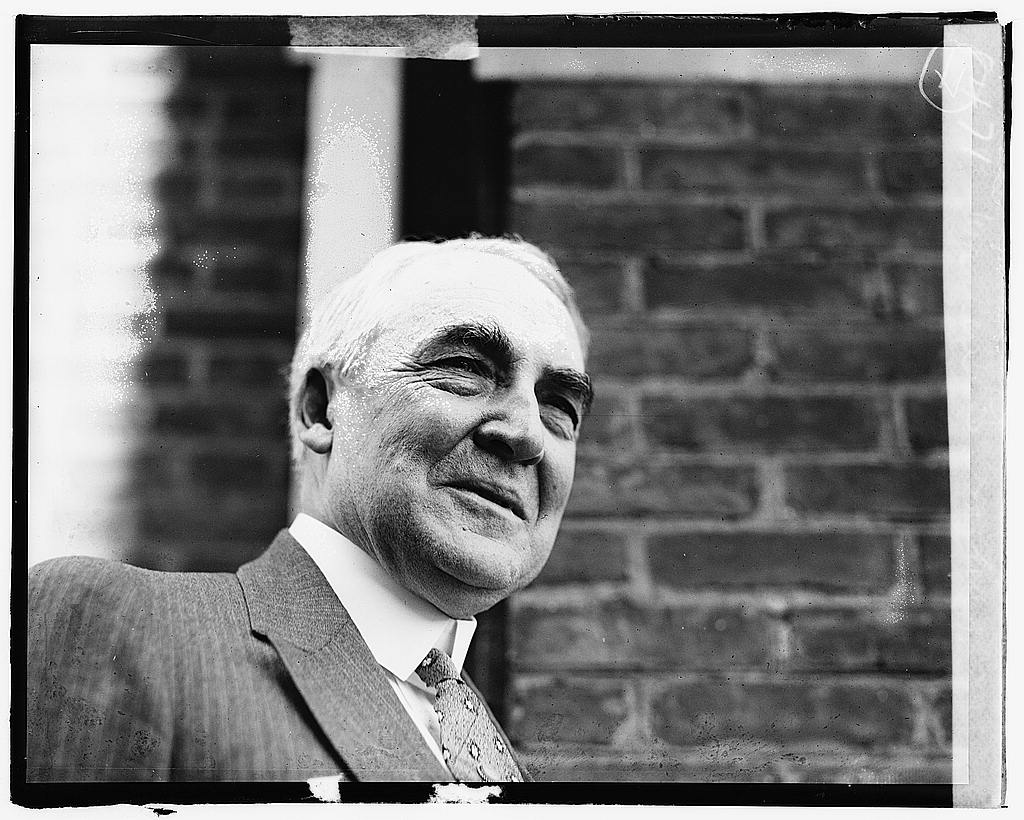
In praise of Warren Gamaliel Harding
At Essays in Idleness, David Warren says nice things about an American president who rarely gets any love from historians:
Like most politicians, W. G. Harding was only semi-literate, yet well above the average. The Ivy League types are still querying his use of “normalcy,” which the Natted States president used during his election campaign of 1920. Harding himself ranks low in the polls of “Great American Presidents,” though he was quite popular until his death. That mistake, committed after a heart attack in San Francisco, anno 1923, was the first of several. It was discovered that his administration had been rather corrupt, and himself guilty of an adultery. One might say he was “impeached,” posthumously. Today, they impeach Republican presidents for breathing.
Warren Gamaliel Harding is naturally among my favourite presidents. This has something to do with his “return to normalcy.” For the better part of a decade, his countrymen had suffered under the ministrations of progressive Democrats, such as the unspeakable Woodrow Wilson, and from such foreign entanglements as the First World War. The federal budget was being blown to heck, and society was on the verge of the Jazz Age.
Harding, who stayed home in Marion, Ohio, for most of his presidential campaign — rather than “pressing the flesh” and risking the influenza — won by a landslide, promising: “Not heroics, but healing; … not revolution, but restoration; not agitation, but adjustment; not surgery, but serenity; not the dramatic, but the dispassionate; not experiment, but equipoise; not submergence in internationality, but sustainment in triumphant nationality.”
Oh yes and, “not nostrums, but normalcy.”
The quote, which I have filched from the Wicked Paedia, is semi-literate throughout. Harding was a man who had an unhealthy relationship with a dictionary, and to his other sins, we must add an addiction to semi-colons. Still, “The Peeple” could guess what he meant. He wanted America to move backwards. He thought the whole country should forget about recent lunatic adventures, and return to her wonted calm.
Al Stewart wrote a song called “Warren Harding” (lyrics here):
August 25, 2019
QotD: Bipartisan authoritarianism
Hey, remember how Bill Clinton doubled down on the War on Drugs, perfecting Reagan’s haphazard and shoddily made race-war into a well-oiled incarceration machine that turned America into the world’s greatest incarcerator, a nation that imprisoned black people at a rate that exceeded Apartheid-era South Africa?
Some Democrats want to double down on their party’s shameful Drug War history. Massachusetts Rep. Stephan Hay [D-Fitchfield] has introduced House Bill 1266, which treats the existence of “a hidden compartment” in a vehicle as “prima facie evidence that the conveyance was used intended for use in and for the business of unlawfully manufacturing, dispensing, or distributing controlled substances.”
This means that if a cop stops you and finds no drugs or other contraband, but decides that part of your car is a “hidden compartment,” that cop can subject your car to civil asset forfeiture — that is, they can steal it, and force you to sue them to get it back.
The role of the Democratic Party is often to take the Republicans’ stupidest, red-meat-for-the-base policies, sloppily designed and doomed to collapse under their own weight, and operationalize them, putting them on the kind of sound bureaucratic footing that they need to have real staying power. Exhibit A is the drug war, but see also Obama’s perfection of GWB’s mess of a mass-surveillance apparatus, turning it into an immortal and pluripotent weapon that Donald Trump now gets to wield.
Cory Doctorow, “Proposed Massachusetts law would let cops steal your car if it had a ‘hidden compartment'”, Boing Boing, 2017-07-16.
July 27, 2019
“[T]he more educated a Democrat is … the less he or she understands the Republican worldview”
Last week in the Guardian, Arlie Hochschild explained some of the mutual incomprehension of US Democrats and Republicans based on a recent study:
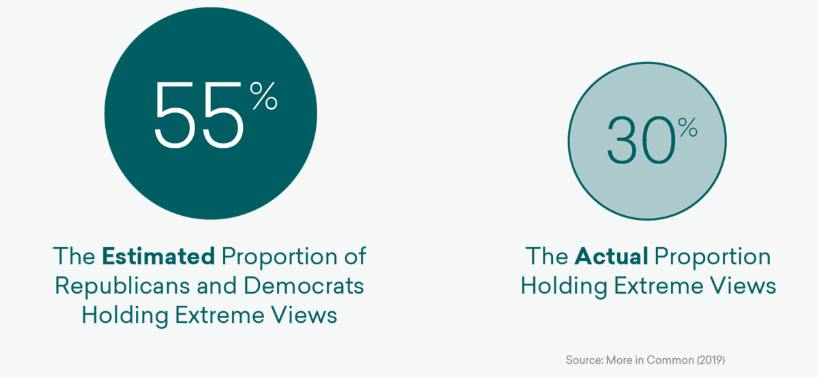
In a surprising new national survey, members of each major American political party were asked what they imagined to be the beliefs held by members of the other. The survey asked Democrats: “How many Republicans believe that racism is still a problem in America today?” Democrats guessed 50%. It’s actually 79%. The survey asked Republicans how many Democrats believe “most police are bad people”. Republicans estimated half; it’s really 15%.
The survey, published by the thinktank More in Common as part of its Hidden Tribes of America project, was based on a sample of more than 2,000 people. One of the study’s findings: the wilder a person’s guess as to what the other party is thinking, the more likely they are to also personally disparage members of the opposite party as mean, selfish or bad. Not only do the two parties diverge on a great many issues, they also disagree on what they disagree on.
This much we might guess. But what’s startling is the further finding that higher education does not improve a person’s perceptions – and sometimes even hurts it. In their survey answers, highly educated Republicans were no more accurate in their ideas about Democratic opinion than poorly educated Republicans. For Democrats, the education effect was even worse: the more educated a Democrat is, according to the study, the less he or she understands the Republican worldview.
“This effect,” the report says, “is so strong that Democrats without a high school diploma are three times more accurate than those with a postgraduate degree.” And the more politically engaged a person is, the greater the distortion.
What could be going on? Bubble-ism, the report suggests. Even more than their Republican counterparts, highly educated Democrats tend to live in exclusively Democratic enclaves. The more they report “almost all my friends hold the same political views”, the worse their guesses on what Republicans think.
So do they believe in sticking with their own? No. When asked in a Pew survey whether it’s important to live in a place “where most people share my political views”, half of conservatives and only a third of liberals agreed. Although in principle more tolerant of political diversity, highly educated – and mostly urban – Democrats live, ironically, with less of it.
Take the quiz or see more of the results here.
June 1, 2019
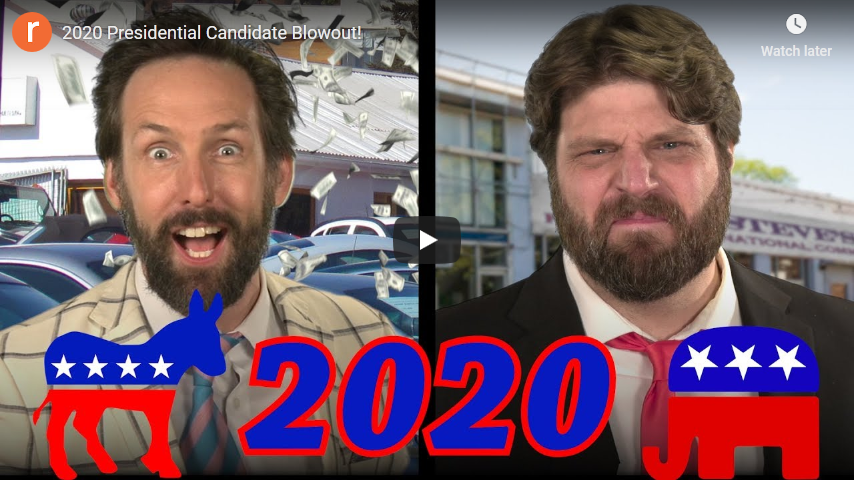
2020 Presidential Candidate Blowout!
ReasonTV
Published on 31 May 2019Election season is heating up, which means Republicans and Democrats are ready to sell you the candidate of your dreams. Whether it’s government intrusion into your private life or government intrusion into your economic life, they’ve got you covered.
——————
Subscribe to our YouTube channel: http://youtube.com/reasontv
Follow us on Twitter: https://twitter.com/reason
Subscribe to our podcast at Apple Podcasts: https://goo.gl/az3a7aReason is the planet’s leading source of news, politics, and culture from a libertarian perspective. Go to reason.com for a point of view you won’t get from legacy media and old left-right opinion magazines.
—————-Written by Austin Bragg. Starring Andrew Heaton and Austin Bragg. Video produced by Bragg.
Happy Happy Game Show Kevin MacLeod (http://incompetech.com)
Licensed under Creative Commons: By Attribution 3.0 License
http://creativecommons.org/licenses/b…Photo credit: Richard B. Levine/Newscom
Experimental social media link thumbnail thingy:
May 24, 2019
QotD: Politics and culture
… sometimes Mark Steyn seems like the only conservative you can discuss these issues with, because most Republicans think popular culture is beside the point, if not downright dangerous. Steyn, on the other hand, has performed “Kung Fu Fighting” before thousands of people in civic auditoria more accustomed to Mary Kay Cosmetics conventions, so he gets it.
“Social conservatives are always editing pop culture,” says Steyn, “and it’s completely pathetic. Conservatives play to the caricature. Mention a French movie and the crowd turns on you. It’s a reductive view of the world. There are ideological enforcers casting aside works of art because they contain bad words or uncomfortable associations. It’s one of the biggest abdications of the American right. Who gives a crap about who gets elected to the Congressional district in Ohio? — that’s not going to change the culture. It’s movies that move the culture. And if you abdicate that space, you lose. Jeb Bush spent a billion dollars to get 2.8 per cent of the vote in Iowa. Mitt Romney and people like him who have a billion dollars — don’t spend it on politics, buy a TV network! Theatre, movies, music, that’s where the battles are fought. They’ve abdicated that space in the schools. As a result, my kid had to sit through Al Gore’s lousy movie three times. All effective storytelling is inherently conservative — because your choices have consequences. For the Left, nothing has consequences. But the trends are all in the Left’s direction, because the Right got out of the game — they chose to make themselves culturally irrelevant. If you’re not in the same room, having the conversation, there’s not gonna be a solution.”
Mark Steyn, interviewed by John Bloom, “Mark Steyn, Cole Porter and Free Speech”, Quadrant, 2017-05-11.
April 9, 2019
QotD: It won’t be easy to bring back politicians’ willingness to compromise
I think the donors are a problem for both parties, in terms of driving choices that aren’t necessarily the best strategies for building the base. (Both parties completely missed the populist backlash on trade, for example. Now, as a free trader, I like the resulting policy. But they paid for it at the polls.) But the issue isn’t fundamentally the donors. The issue is that fundamentally, both sides hate each other, and both sides have an increasing “It is not enough that I win. My enemies must lose” mentality about politics. Combine that with various reforms that have empowered extremists — campaign finance reforms that empowered outside groups, yes, but also the shift to primaries from conventions, and the abolition of the earmarks and pork that used to grease legislative passage. Throw in the “Great Sort” into increasingly politically homogenous communities — those are the problems you need to fix if you want to bring back legislative compromise. And damned if I know how we get there, because you can’t tell people where to live, and anyone who suggested getting rid of primary elections and bringing back pork barrel politics would come off as a backroom sleaze.
Megan McArdle, “Ask Me Anything”, Reddit, 2017-04-10.
April 1, 2019
QotD: George H.W. Bush
Way back in the olden thymes, conservatives during the Reagan years had a real fear that the Rockefeller Republicans would not only undermine the conservative agenda, but find a way to corrupt the Reagan administration. It was an unwarranted fear. Those Progressive Republicans were a dying force in politics. Reagan was a man of his age so his conservatism does not always make sense to the modern ear, but he stuck to his guns for the most part. He was a politician, so he compromised when he had to.
Then George H. W. Bush was ready to take the reigns of the movement and the party, despite being a Rockefeller Republican. Bush was a Progressive by any measure, but he supposedly got religion in the 1980’s, and to be fair, a lot of people went through that transformation. There were even old Jewish guys, who used to support communists, that were suddenly changing teams to join the new emerging majority. Bush spent a lot of time convincing the voters he was just like Reagan and they had nothing to fear.
The ’88 election was a landslide for Bush and a lot of sensible people thought that he would be the finishing touches to the new conservative majority. He would smooth out the rough patches and put a shine on other aspects to it. His famous pledge to never raise taxes was the cornerstone of his pitch. Wiser heads, the paleocons, saw what was coming, but most did not. That’s why when Bush broke his promise, a year into his presidency, his voters were crushed. Bush was a liar.
History is written by the victors and that means the Left, so we’re always told that Bush lost in ’92 because Clinton was sent by the void where God once existed, to bring joy and bliss to the blessed and smite the wicked. The truth is, Bush lost because the core of his voters rightly saw him as a liar and a fink. Many people I know, including myself, voted third party as a protest. Yeah, it meant a degenerate would win the election, but at least we knew what we were getting. Liars like Bush always find new ways to screw you.
[…]
This brings us back to Bush. He spent the remainder of his presidency trying to rebuild his standing with conservatives. He even scored what was pitched as a stunning victory in the First Gulf War. But, you only get one shot to piss away your integrity and Bush did not miss that opportunity. He entered the general election as a weak incumbent and Clinton used his broken pledge in commercials to remind everyone that Bush was an untrustworthy liar. Imagine that. Clinton beat Bush on the integrity issue.
“The Z Man”, “Donald Herbert Walker Trump”, The Z Blog, 2017-04-07.