Over a dirty-tricks television ad of a girl picking daisies over a countdown to an atomic bomb that goes off in the background, Johnson supporters turned Goldwater’s campaign slogan — “In your heart you know he’s right” — against him: “In your guts, you know he’s nuts.”
Ginny stepped up her work for the campaign. Heinlein stepped up his work, too, but he was still conflicted — and at another meeting at Bob Laura’s house on August 1, he finally had more than he could take. Laura was temporizing over an offer of help Ginny had taken by telephone from a woman who identified herself as a Negro. He would take the matter up with his State Central Committee contact, Laura said, but his own reaction was: “Oh, they are free to go ahead and form their own committee.” Heinlein lost his temper for the first time in many years. He told Laura,
They offered to stick their necks out; we should have shown instant gratitude and warmest welcome … I can’t see anything in this behavior but Jim-Crowism … you were suggesting a Jim-Crow section in the Goldwater organization.
Mr. Goldwater would not like that. His record proves it.
Negroes are citizens, Bob … It is particularly offensive, this year and this campaign, to suggest that Negro Goldwater supporters form their own committee…
He then ticked down a list of Laura’s administrative foul-ups, concluding:
— these faults can easily lose the county … [sic] and with it the state […] and, conceivably, if the race is close, the Presidency itself.
… So I’ll try to refrain hereafter from offering you advice. But I think it’s time for you either to behave like a manager, or resign.
Laura apologized for his part in the altercation.
Ginny went into field work full time, and Heinlein agreed to handle an expansion of the county office now that the nominating convention was over and the campaign was ramping up in earnest. As Laura temporized on the Jim-Crow question, he gave Heinlein a personal criticism, not the first time he had heard it: “I know you don’t believe that anyone could consider you a “yes” man. I wonder, however, if you can conceive of another’s opinion, differing though it may be, possessing any merit.”
On this issue, no: The opinion that a Negro volunteer should be treated differently from a white volunteer possessed no merit whatsoever — and if that was “intolerant” in Bob Laura’s book, so be it. “I’m one of the most intolerant men I’ve ever met,” Heinlein noted to himself. “I had thought that, simply because I had uncustomary responses as to what I liked and what I hated that I was ‘tolerant.’ I’m not. I’m not even mildly tolerant of what I despise.”
There were things more important than party unity in the Republican Party of Colorado.
William H. Patterson Jr., Robert A. Heinlein, In Dialogue with His Century Volume 2: The Man Who Learned Better, 2014).
June 3, 2015
May 31, 2015
Jonah Goldberg – The real Republican primary contest
Jonah was taken aback by something Kevin Williamson wrote — not so much at the article itself, but at the casual assertion that his favourite presidential candidate was “the mighty Cthulhu (‘Why Vote for a Lesser Evil?’)”. Jonah explains why:
I found this curious. Kevin’s preferred candidate is Cthulhu? Don’t get me wrong, I get the appeal. Cthulhu gets things done. He doesn’t pander. He certainly seems to believe in a kind of sound-money policy (by the way, I’m using the masculine pronoun for convenience, not descriptive accuracy; Cthulhu is beyond sex and gender). But Cthulhu poses some problems as a presidential candidate. The first that comes to mind is that he is evil.
I should note that the claim that Cthulhu is evil has actually sparked some controversy on Twitter. Some of his devotees tell me that he’s beyond mortal conceptions of evil which, of course, is what evil people always say. Moreover, his campaign slogan is “Why vote for the lesser evil?” Is he lying? Will he be a flip-flopper, refusing to follow through on his platform of full-spectrum evil? The last thing this country needs is an EDINO — Evil Deity In Name Only. No, I take him at his word.
Call me old-fashioned, but even though I take a back seat to no one in appreciating the appeal of a cleansing fire that shall sanitize this corrupt husk of a planet, choosing evil still strikes me as morally problematic.
Jonah’s preferred choice? SMOD:
I suggest that for the principled conservative looking to chuck it all in and give up, there’s only one candidate with the credentials and philosophy the times require. I’m referring, of course, to the Sweet Meteor of Death, Smod to his friends.
Smod describes himself as a “pre-cambrian conservative.” He has no cultists looking to rule in his name. He doesn’t endorse evil, merely the sweet release of planetary destruction. While Cthulhu can be a bit of windbag, Smod makes no speeches, he makes no sounds at all as he glides through the cosmic ether. Calvin Coolidge looks loquacious by comparison. Meanwhile, Cthulhu’s will is unpredictable, he vows chaos and anarchy here on earth. Smod provides what the market demands: certainty, predictability, and simple rules for a complex society. Who knows what Cthulhu will do tomorrow? With Smod there is no tomorrow. He has the single-minded focus only a cold and soulless inanimate object can provide.
Last, Smod is real. We don’t know when he’ll get here, but odds are he eventually will. Sure, “Why Choose the Lesser Evil?” is a great bumper sticker, but aren’t we tired of fakes who fail to deliver? To borrow a phrase from Seinfeld, Smod is real and he’ll be spectacular (for a fraction of a second. And then silence. Sweet, sweet silence).
Kevin responds:
Jonah, I thank you for the kind words. But, hesitant as I am to disagree, I think you might need to think through this a little bit. I am second to none in my admiration for Sweet Meteor O’Death, and I pray devoutly that he arrives in one piece every time I turn on MSNBC, but there is a strong case to be made for Cthulhu in 2016.
Smod is a little bit like Rick Santorum: You may sympathize with what he stands for, but that doesn’t mean you necessarily want him to be president. Imagine the fear, the absolute terror, the despairing wails of the entire human race at the moment of his arrival: You could get all that by nominating Santorum for secretary of education and saving the presidency for surer hands.
Jonah, I think this is another case of the tension between more libertarian-leaning conservatives such as myself and the more traditional Burkeans such as you. I am perfectly comfortable with a reign of eldritch chaos on Earth, while you, in spite of your own warnings against the totalitarian temptation, present us with the ultimate one-size-fits-all solution. Yes, solving all of our problems in a blinding flash of planet-ending mass extinction is, given the current political environment, a genuine feel-good solution — but what are we, hippies?
Sure, Smod is bound to have some clever campaign ads, e.g. a big picture of the Earth over the slogan “I’d Hit That!” (Another possible Smod motto: “The End Is Near and It’s Going to Be Awesome.” You’d think he’d have thought of that.) But we cannot allow ourselves to be distracted by that kind of shallow demagoguery.
April 23, 2015
Rand Paul against the machine
Timothy Carney says that the “war on Washington” that keynotes Rand Paul’s nomination campaign is “the fight America needs”:
Rand Paul launched his presidential campaign Tuesday, skewering the “special interests that use Washington D.C. as their own private piggy bank.” His campaign home page blared the headline “Defeat the Washington Machine.”
This sort of campaign against Washington is a cliché these days, but for Paul, it’s a real thing. He’s been fighting this fight since he entered politics. And that’s why the Republican Party needs him today.
Recall how Paul won his first political race: Senate Republican Leader Mitch McConnell had handpicked Secretary of State Trey Grayson for Kentucky’s open Senate seat in 2010. Eighteen Republican senators funded Grayson in the primary. Only one funded Paul. Grayson raised half a million dollars from PACs in the primary — 20 times what Paul raised from them. The U.S. Chamber of Commerce endorsed Grayson in the primary. Paul attacked Grayson for the “AIG Lobbyists” who threw fundraisers for him, which were swarming with lobbyists.
This was the K Street/GOP Machine. Rand Paul demolished it, beating Grayson by 23 points. That victory, on May 18, 2010, was the day the dam broke in the Tea Party flood.
Since he’s come to Washington, it’s been the same story: Rand Paul against the machine.
April 19, 2015
We must reject Rand Paul for his lack of libertarian consistency
No matter what, we must ensure that Rand Paul does not get support from small-L libertarians because he has not sufficiently supported large-L libertarian issues! Purity above all electoral considerations!
Rand Paul is the Republican son of a longtime Republican House member, but let it never be said that he is not open-minded. In 2013, he confided to Sean Hannity, “I’ve been kind of disappointed, because honestly there were certain aspects of President Obama that I wanted to like.”
I know how he feels. That’s how I feel about Rand Paul.
My old friend David Boaz, author of the excellent new book The Libertarian Mind, told NPR that Paul is “the most libertarian major presidential candidate that I can remember seeing.” I’m a more moderate libertarian than Boaz — or a squishier one — but my general framework is the same. I have a strong preference for free markets, civil liberties, personal autonomy, limited government and a foreign policy of restraint.
I’ve voted for several Libertarian presidential candidates. The biggest single influence on my policy views is Milton Friedman. I absorbed Friedrich Hayek and Ayn Rand in college. My columns appear regularly on the website of Reason, the nation’s premier libertarian publication.
So I should not be a tough sell for Paul. He sounds pretty libertarian when he says, in reference to the National Security Agency, “the phone records of law-abiding citizens are none of their damn business.” He shows a refreshing open-mindedness on criminal justice by envisioning an America where “any law that disproportionately incarcerates people of color is repealed.”
Libertarians are their own worst enemies when it comes to actual political campaigns. Rand Paul probably wouldn’t win the US Libertarian Party’s nomination as he’s not “pure” enough (and his chances of winning the Republican Party nomination are thin enough as it is). Yet he’s the most prominent enunciator and exemplar of the small-L libertarian vision in the current electoral cycle. And libertarians are already denouncing him for his deviationism. Remind me again why we bother with election campaigns if appealing to a wider voting base with more freedom-oriented issues is somehow “anti-libertarian”? Rand Paul probably won’t win the Republican nomination — this isn’t exactly news. Even if he did win, the establishment GOP would probably do to Rand Paul what they did to Barry Goldwater. The raison d’etre of the party hierarchy is to ensure that the “fringe elements” don’t raise too much of a ruckus or (far worse) get their own candidates on the ballot.
I’m not an American, but given the choice of voting for Barack Obama or John McCain, I’d have voted for Obama without hesitation … McCain was almost the perfect anti-libertarian candidate for that electoral cycle. In the next presidential election, could the GOP have come up with a more inappropriate candidate than Romney? I don’t think so, unless they’d somehow nominated a Grand Dragon of the KKK (and I think Senator Byrd was dead by that point). And who does the establishment want as their presidential candidate this coming election? Jeb Bush? Ugh!
April 13, 2015
Will it be principle or will it be power?
At National Review, Kevin D. Williamson looks at the Rand Paul campaign:
The question before Senator Rand Paul is whether Republican primary voters — and voters in the general electorate, if it should come to that — are in the market for libertarianism by the bushel or measured out with coffee spoons.
For those seeking a general validation of libertarian principle as the guiding light of the Republican party and the conservative movement, there’s no improving on a man called “Rand” who launched his campaign at a hotel called “Galt.” But the fact that there is no improving on him is no guarantee that Senator Paul can count on the enthusiastic support of doctrinaire libertarians, who are a cranky bunch, extraordinarily particular and already grumbling that the gentleman from Kentucky is not ready to go the full Rothbard — or even as far as his cult-figure father did.
There are several reasons for Senator Paul’s moderation — or deviation, as the hardliners would have it, from the pure faith of his father. One is that he is not a crank; another is that he does not want to finish in third place, well behind Rick Santorum; a third is that he can tell a windmill from a marauding giant; a fourth is that he understands that in the context of a democratic republic a leader leads and is led in turn.
When my friend Ramesh Ponnuru writes that the senator seems to be “of two minds” about judicial power — and when similar, more worrisome criticisms are made of Senator Paul’s foreign-policy views — that seems to me correct, but as a purely political matter not necessarily a bad thing. The American public is of two minds about a great many things, too, and has rarely punished a candidate for lack of absolute intellectual consistency. Pandering and flip-flopping? That’s one way to put it. But only the most hopeless sort of ideologue refuses to accommodate the fact that there is a limited real range for effective political action, and that range is defined by what the electorate is willing to accept. There is much to be done, and one can hardly blame Senator Paul for fishing where they’re biting.
March 9, 2015
March 1, 2015
“The F-35 will cost more than the Manhattan Project every year for the next fifty years”
Scott Lincicome would like to point out to the contending Republicans hoping to become the GOP’s presidential candidate that defence spending is not immune to the massive overspending problem common to big government:

Over the next 20 months, a clown-car-full of Republican politicians will vie for their party’s presidential nomination. As the candidates crisscross the nation, each will undoubtedly call for smarter, leaner, and (hopefully) smaller government. However, there is one government program that, despite being a paragon of government incompetence and mind-bending fiscal incontinence, will most likely be ignored by these champions of budgetary temperance: the F-35 Joint Strike Fighter. In so doing, these Republicans will abandon their principles and continue a long, bipartisan tradition of perpetuating the broader problems with U.S. defense spending that the troubled jet symbolizes.
During the Obama years, the Republican Party magically rediscovered its commitment — at least rhetorically — to limited government and fiscal sanity. Criticizing the graft, incompetence, and cost of boondoggles like the 2009 stimulus bill, green-energy subsidies, or Obamacare, GOP politicians not only highlighted these programs’ specific failings, but also often explained how such problems were the inevitable result of an unwieldy federal government that lacked discipline and accountability and was inherently susceptible to capture by well-funded interest groups like unions or insurance companies.
They railed against massive bureaucracies, like the Department of Energy, that paid off cronies with scant congressional oversight. And, in the case of well-publicized debacles like the botched, billion-dollar Healthcare.gov roll-out, many Republicans were quick to note that the root of the problem lay not in one glitchy website, but the entire federal procurement process, and even Big Government itself
[…]
One wonders, however, if these Republicans’ philosophical understanding of Big Government’s inherent weaknesses extends to national defense and, in particular, the F-35. According to the latest (2012) estimate from the Pentagon, the total cost to develop, buy and operate the F-35 will be $1.45 trillion — yes, trillion, with a “t” — over the next 50 years, up from a measly $1 trillion estimated in 2011. For those of you keeping score at home, this means that the F-35’s lifetime cost grew about $450 billion in one year. (Who says inflation is dead?)
That number — $1.45 trillion — might be difficult to grasp, especially in the context of U.S. defense spending, so let me try to put it in perspective: the entire Manhattan Project, which took around three years and led to the development of the atom bomb, cost a total of $26 billion (2015), most of which went to “building factories and producing the fissile materials, with less than 10% for development and production of the weapons.” By contrast, the F-35 will cost $29 billion. Per year.
For the next 50 years.
February 16, 2015
January 16, 2015
It’s always a good time to cut taxes
In a column explaining why he’s terrified that the “Modern Monetary Theory” folks might get anywhere near the levers of power, Tim Worstall fits in the best reason to cut taxes:
Given that we are discussing monetary policy it seems appropriate to bring Milton Friedman in here. And he pointed out that if you ever have a chance to cut taxes just do so. On the basis that politicians, any group of politicians, will spend the bottom out of the Treasury and more however much there is. So, the only way to stop ever increasing amounts of the the entire economy flowing through government is simply to constrain the resources they can get their sticky little mits on. We could, for example, possibly imagine a Republican from the Neanderthal wing of the party arguing that what the US really needs is another 7 carrier battle groups. And one from the even more confused than usual Progressive end of the Democratic Party arguing that each college student needs her own personal carrier battle group to protect her from the microaggressions of being asked out for a coffee. You know. Sometime. Maybe. If you want to?
December 1, 2014
November 8, 2014
Republicans and the Patriot Act re-authorization in May 2015
Conor Friedersdorf on the ethical and moral challenge that will face the Republican members of the next Congress soon after they take office:
The Patriot Act substantially expires in May 2015.
When the new Congress takes up its reauthorization, mere months after convening, members will be forced to decide what to do about Section 215 of the law, the provision cited by the NSA to justify logging most every telephone call made by Americans.
With Republicans controlling both the Senate and the House, the GOP faces a stark choice. Is a party that purports to favor constitutional conservatism and limited government going to ratify mass surveillance that makes a mockery of the Fourth Amendment? Will Mitch McConnell endorse a policy wherein the Obama administration logs and stores every telephone number dialed or received by Roger Ailes of Fox News, Wayne LaPierre of the NRA, the Koch brothers, the head of every pro-life organization in America, and every member of the Tea Party? Is the GOP House going to sacrifice the privacy of all its constituents to NSA spying that embodies the generalized warrants so abhorrent to the founders?
The issue divides elected Republicans. Senator Rand Paul and Representative Justin Amash are among those wary of tracking the phone calls of millions of innocent people. Senator Richard Burr favors doing it. Republicans pondering a run for president in 2016 will be trying to figure out how mass surveillance will play in that campaign.
Many would rather not take any stand before May, as if governing — the very job citizens are paying them to do — is some sort of trap. But their preferences don’t matter. This fight is unavoidable.
Sadly, the smart money is betting that they’ll flub it and just re-authorize with little or no changes to the most offensive parts of the legislation. Because 2016.
November 6, 2014
The US midterm elections show one thing clearly
The one thing that is apparent from the results of the US federal mid-term elections is that — despite what voters tell pollsters and reporters — they’re absolutely in love with their current federal representatives:
I see that Americans are well satisfied with their politicians: over 95 percent of incumbents re-elected. Perhaps I should be more gentle in my criticism of a system that can bring such torpor and contentment, and is not so unlike monarchy after all.
For note, that in this fast-changing world, some things do not change; that some jobs stay safe, from year to year and decade to decade.
One wonders why politicians go to the trouble of awarding themselves such extravagant pensions, when they could just leave their names on the ballot, indefinitely. Retirements cost the taxpayer money: for now, instead of the one politician, we must in effect pay for two. With term limits, who knows how many we must keep, in the style to which they have become accustomed?
October 23, 2014
A lesson the Republican Party still needs to learn
Warren Meyer explains why Republicans are still seen as the Evil Party by younger Americans:
Good: A judge has ruled that Arizona’s same-sex marriage ban is unconstitutional. I suppose I am a little torn over judicial overreach here, but enough freedom-robbing stuff happens through judicial overreach that I will accept it here in my favor.
Republicans should rejoice this, at least in private. From my interactions with young people, there is nothing killing the R’s more than the gay marriage issue. Young people don’t understand squat about economics, but they are pretty sure that people fighting gay marriage are misguided (they would probably use harsher language). Given that R’s hold a position they are sure is evil (anti-gay-marriage) they assume that Progressive attacks that R’s are evil on economics must be right too, without actually understanding the issue. In short, young people reject the free market because its proponents hold what they believe to be demonstratively bad opinions on social issues.
October 10, 2014
QotD: When bashing America is just code for bashing the Red Tribe
[A]lthough liberals and conservatives live in the same area, they might as well be two totally different countries or universe as far as level of interaction were concerned.
Contra the usual idea of them being marked only by voting behavior, we described them as very different tribes with totally different cultures. You can speak of “American culture” only in the same way you can speak of “Asian culture” – that is, with a lot of interior boundaries being pushed under the rug.
The outgroup of the Red Tribe is occasionally blacks and gays and Muslims, more often the Blue Tribe.
The Blue Tribe has performed some kind of very impressive act of alchemy, and transmuted all of its outgroup hatred to the Red Tribe.
[…]
Spending your entire life insulting the other tribe and talking about how terrible they are makes you look, well, tribalistic. It is definitely not high class. So when members of the Blue Tribe decide to dedicate their entire life to yelling about how terrible the Red Tribe is, they make sure that instead of saying “the Red Tribe”, they say “America”, or “white people”, or “straight white men”. That way it’s humble self-criticism. They are so interested in justice that they are willing to critique their own beloved side, much as it pains them to do so. We know they are not exaggerating, because one might exaggerate the flaws of an enemy, but that anyone would exaggerate their own flaws fails the criterion of embarrassment.
The Blue Tribe always has an excuse at hand to persecute and crush any Red Tribers unfortunate enough to fall into its light-matter-universe by defining them as all-powerful domineering oppressors. They appeal to the fact that this is definitely the way it works in the Red Tribe’s dark-matter-universe, and that’s in the same country so it has to be the same community for all intents and purposes. As a result, every Blue Tribe institution is permanently licensed to take whatever emergency measures are necessary against the Red Tribe, however disturbing they might otherwise seem.
And so how virtuous, how noble the Blue Tribe! Perfectly tolerant of all of the different groups that just so happen to be allied with them, never intolerant unless it happen to be against intolerance itself. Never stooping to engage in petty tribal conflict like that awful Red Tribe, but always nobly criticizing their own culture and striving to make it better!
Sorry. But I hope this is at least a little convincing. The weird dynamic of outgroup-philia and ingroup-phobia isn’t anything of the sort. It’s just good old-fashioned in-group-favoritism and outgroup bashing, a little more sophisticated and a little more sneaky.
Scott Alexander, “I Can Tolerate Anything Except The Outgroup”, Slate Star Codex, 2014-09-30.
October 9, 2014
QotD: “I can tolerate anything except intolerance”
The result is exactly what we predicted would happen in the case of Islam. Bombard people with images of a far-off land they already hate and tell them to hate it more, and the result is ramping up the intolerance on the couple of dazed and marginalized representatives of that culture who have ended up stuck on your half of the divide. Sure enough, if industry or culture or community gets Blue enough, Red Tribe members start getting harassed, fired from their jobs (Brendan Eich being the obvious example) or otherwise shown the door.
Think of Brendan Eich as a member of a tiny religious minority surrounded by people who hate that minority. Suddenly firing him doesn’t seem very noble.
If you mix together Podunk, Texas and Mosul, Iraq, you can prove that Muslims are scary and very powerful people who are executing Christians all the time and have a great excuse for kicking the one remaining Muslim family, random people who never hurt anyone, out of town.
And if you mix together the open-source tech industry and the parallel universe where you can’t wear a FreeBSD t-shirt without risking someone trying to exorcise you, you can prove that Christians are scary and very powerful people who are persecuting everyone else all the time, and you have a great excuse for kicking one of the few people willing to affiliate with the Red Tribe, a guy who never hurt anyone, out of town.
When a friend of mine heard Eich got fired, she didn’t see anything wrong with it. “I can tolerate anything except intolerance,” she said.
“Intolerance” is starting to look like another one of those words like “white” and “American”.
“I can tolerate anything except the outgroup.” Doesn’t sound quite so noble now, does it?
Scott Alexander, “I Can Tolerate Anything Except The Outgroup”, Slate Star Codex, 2014-09-30.

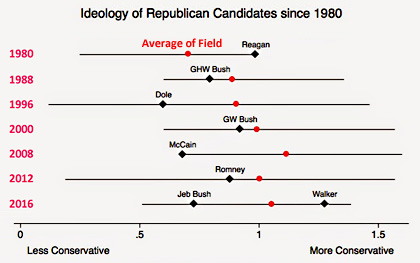
For those of us who are sort of fascinated by the rise of Scott Walker as a Republican presidential contender, here’s an interesting chart from Jason McDaniel, a political science professor at San Francisco State University. It shows the relative conservative-ness of GOP presidential nominees in the past six contested elections, and it demonstrates what an outlier Walker would be if he won next year’s primary: He’d be the first candidate since Ronald Reagan who’s more conservative than the average of the Republican field. And by McDaniel’s measure, he’d actually be the most conservative recent nominee, period —