
In modern neoclassical economics, the benchmark of analysis from which real-world markets are judged is the model of perfect competition, in which a homogenous good is bought and sold by a large group of buyers and sellers, respectively, none of whom have an influence on the price. Moreover, under such conditions, there exists free entry and exit of sellers in the marketplace, defined by perfect information.
The narrative that is constructed and logically follows from this model is that observed deviations from perfect competition in the marketplace are indicative of imperfections, also known as “market failures”, associated with the existence of monopoly power, pervasive externalities, the provision of public goods, and macroeconomic instability. According to this narrative, government intervention is the deus ex machina that saves the market from its own “imperfections” through regulations, taxes, subsides, and other public policy measures. Why? To use a quote from Frank Knight often used by James Buchanan, “to call a situation hopeless is to call it ideal”. The narrative that is constructed is one in which, outside the conditions of the ideal of perfect competition, there is no hope but for government intervention to save the market from itself. Anyone who has taken an economics course is well aware of what I’ve stated thus far, and therefore this should not be surprising.
But what is the implicit meaning of the word “imperfect” that is baked into the narrative, which is constructed into the model of perfect competition? What is implied when we postulate that markets are “imperfect” in comparison to the benchmark of perfect competition is that markets are flawed, non-ideal, or otherwise sub-optimal, and therefore in need of correction through government intervention. Who could dispute the logic of this narrative?
However, if we simply reinterpret our understanding of the word “imperfect”, not only will it reframe the narrative being told about the marketplace, but also the public policy implications that flow from this narrative. If we analyze the etymology of the word imperfect, breaking it down from its Latin origins, you will learn that “im” expresses the negation, “per” comes from the Latin word meaning “thoroughly” and “fect” comes from the Latin verb “facere“, meaning “to do”. Thus, rather than saying that something, or some state of affairs, is flawed, suboptimal, or non-ideal, another way to interpret the meaning of “imperfect” is an act or process that is not thoroughly done, or incomplete. In fact, from a quick perusal of the Merriam Webster’s Dictionary, you will find a similar definition of the word imperfect: “constituting a verb tense used to designate a continuing state or an incomplete action” (emphasis added).
Rather than regarding the market as a flawed or sub-optimal state of affairs, a better understanding of an “imperfect market” reveals that the market is a process of continuous tendency towards perfection, or completion, where are all the gains from trade are exhausted and all plans between buyers and sellers are perfectly coordinated. As Ludwig von Mises states in his magnum opus, Human Action, the “market process is the adjustment of the individual actions of the various members of the market society to the requirements of mutual cooperation” (1949 [2007]: 258).
Thus, markets will always be imperfect, but that is precisely why markets exist in the first place! Markets never conform to the “ideal” of perfect competition, but this is completely irrelevant, since under such state of affairs, markets are unnecessary and redundant, since all resources are already perfectly allocated to their most valued uses. Market processes exist precisely because to generate the information necessary to better coordinate the plans and purposes of individuals in a peaceful and productive manner. The entrepreneurial lure for profit and the discipline of loss is what guides such imperfect processes in a tendency towards the creation of more complete information between buyers and sellers.
Rosolino Candela, “Are Markets Imperfect? Of Course, But That’s The Point!”, Econlib.org, 2020-05-18.
July 7, 2025
QotD: The mythological “perfect market” and “perfect competition”
May 22, 2025
QotD: Public goods
Or, the internet was originally set up to provide a secure comms network when the bombs all went off — that routing in packets was the whole point, being able to route around the polished glass that used to be Indianapolis. GPS was funded by the Navy to have precise coordinates to lob our own bombs at. Both difficult things to profit from so government did them.
Then along came some entrepreneurs and they saw that it was good. Some use could be made of the existence of those things. And this is — it’s essential to understand this — exactly what an entrepreneur is. Someone who takes extant assets and resources, possibly combining them in new ways, and sets out to end up with hot and cold running Ferraris from having done so. We consumers then end up vastly richer than our starting point. One, wholly serious, measurement of the value of search and free email (so, roughly, Google) is $18,000 per person per year. No, there are not too many zeroes there, eighteen thousand of those big fat United States dollars per person per year.
OK. So we institute government to gain public goods. We get public goods from government. Entrepreneurs then do their job, picking up extant assets to use in novel ways that enrich all of us out there. Excellent, the system is working. The system is making us out here the richest society living highest on the hog that has ever existed.
Tim Worstall, “Mazzucato: ‘BUT WHERE IS MY SECOND DOZEN PAIRS OF LOUBOUTINS?'”, It’s all obvious or trivial except …, 2025-02-12.
May 20, 2022
High and low “state capacity” illustrated
In Law & Liberty, Helen Dale recounts a miserable experience getting out of a major US airport and says this is an example of America’s low state capacity:

“TSA Checkpoint” by phidauex is licensed under CC BY-NC-SA 2.0


At the other end, I found a stretch limo waiting for me. Getting ferried about in a limo after The Trip from Hell is something I’ve experienced before, in Damascus, before the Syrian civil war. Classic third world. Like Syrians, American hosts send limousines to the airport to pick you up because they know you flew in from JFK and will need to be appeased.
My experience is illustrative of something not confined to airports, however. Indeed, if it were only confined to airports, then the phrase I’m about to use (about the US) would be unfair (to the US). America’s dysfunctional airports are instances of widespread low state capacity. And this is bigger than airports. Low state capacity can only be used to describe a country when it is true of multiple big-ticket items, not just one.
State capacity is a term drawn from economic history and development economics. It refers to a government’s ability to achieve policy goals in reference to specific aims, collect taxes, uphold law and order, and provide public goods. Its absence at the extremes is terrifying, and often used to illustrate things like “fragile states” or “failed states”. However, denoting calamitous governance in the developing world is not its only value. State capacity allows one to draw distinctions at varying levels of granularity between developed countries, and is especially salient when it comes to healthcare, policing, and immigration. It has a knock-on effect in the private sector, too, as business responds to government in administrative kind.
Think, for example, of Covid-19. The most reliable metric — if you wish to compare different countries’ responses to the pandemic — is excess deaths per 100,000 people over the relevant period. That is, count how many extra people died beyond the pre-pandemic mortality rate on a country-by-country basis. For the sake of argument, drop the five countries leading this grim pack. Four of them are developing countries, and the fifth is Russia, which while developed, is both an autocracy and suffers from chronic low state capacity.
At the other end of the scale, ignore China, too. It may be lying about its success or, more plausibly, may have achieved it by dint of being an authoritarian state with high state capacity (notably, the latest round of draconian lockdowns in Shanghai commenced after the WHO collated that data).
The US has the worst excess death rate in the developed world (140 per 100,000). Australia has the best: –28 per 100,000. Yes, you read that right. Australia increased its life expectancy and general population health during the pandemic. So did Japan, albeit less dramatically. The rest of the developed world falls in between those two extremes: Italy and Germany are on 133 and 116 per 100,000 respectively, with the UK (109 per 100,000) doing a bit better. France and Sweden knocked it out of the park (63 and 56 per 100,000 excess deaths).
Recall, too, that not only did different countries adopt different approaches to pandemic management; sometimes there were large differences within countries. Like the US, Australia is a federal system, and as in the US, different states did things differently. Melbourne, capital of the state of Victoria, had the longest lockdown of any major city in the developed world. Other Australian states, meanwhile, locked down sparingly or not at all. In a European context, Sweden rejected most over-the-top Covid responses, the UK was somewhere in the middle, and Italy was thoroughly draconian, even barring unvaccinated people from supermarkets and groceries.
May 30, 2018
QotD: Microeconomics
… I sincerely believe – believe to the point that I can say that I know – that principles of microeconomics is the most important economics course any student can ever take. Ever. By far. If taught properly, and learned with an open and critical and attentive mind, a principles of microeconomics course will impart to the student more understanding of the operation of economies than will all other economics courses combined – and I include here even well-taught PhD econ courses.
Too many academic economists, in my experience, are bored with microeconomic principles. Such principles are so basic. No genius is required to understand them or to teach them well. Teaching microeconomic principles provides no opportunity to showcase great cleverness or to push out the frontiers of understanding. It is, instead, to repeat timeless verities – and verities the majority of which have been known and understood by wise economists for nearly 250 years, and nearly all of which have been known and understood by wise economists for the past 50 years.
[…]
My goal in teaching Principles of Microeconomics is not to launch my students on a path to earn a doctorate in the subject, or even for them to become econ majors. While I’m always pleased when a student, after taking my class, switches his or her major to economics, I teach the course as if it is the only economics course these students will ever take. (Empirically, this assumption of mine is true.) So unlike many other intro-econ courses, I do absolutely no mathematics; I even draw no cost curves. I define a handful of esoteric terms (such as the “law of diminishing marginal utility”) but never mention many others (such as “perfect competition” or “marginal rates of substitution”) that are typical fare in many other principles-of-microecon courses. I wouldn’t even dream of doing indifference-curve analysis in such a course.
I open the course with some economic history. (“Have you any idea how materially prosperous you are compared to the vast majority of your ancestors?!”) I spend a lot of time on supply and demand. I devote two whole sections to international trade, another to public choice, and one to public goods and taxation. (Each section is two-and-a-half-hours long. And I cover some other topics in addition; I mention these only to give a flavor of my course.)
My goal – by teaching basic, foundational, principles of microeconomics – is to inoculate students against the bulk of the common economic myths that they’ll encounter throughout their lives – myths such as that the great abundance of goods and services available to us denizens of modernity is the result of a process that can be easily mimicked or understood in detail by smart people or planners – that the market value of goods or services can be raised by price floors (such as a legislated minimum wage) or lowered by price ceilings (such as rent control) – that benefits can be created without costs – that government is an institution capable of rising above the realities that ensure that private institutions never perform ‘perfectly’ – that intentions are results – that destruction of property is a source of prosperity – that exchange across political boundaries differs in economically meaningful ways from exchange that takes place within political boundaries – that the only consequences that occur or that matter are those that are easily anticipated and seen.
Don Boudreaux, “Teach the Timeless Verities”, Café Hayek, 2014-08-26.
August 20, 2016
Club Goods
Published on 26 Jun 2015
In this video we discuss club goods. Club goods are nonrival and excludable. For instance, HBO is a club good, as you need to pay a monthly fee to access HBO (excludable) but more viewers does not add to costs (nonrival). Entrepreneurs are always looking for ways to turn public goods into club goods — cable TV and satellite radio being two examples. Some entrepreneurs have even figured out how to profit from providing public goods — for instance, radio and broadcast television are public goods, but, thanks to advertising, they are profitable.
July 21, 2016
A Deeper Look at Public Goods
Published on 26 Jun 2015
Description: What do we mean by “nonexcludable” and “nonrival” when talking about public goods? Public goods challenge markets because it’s difficult to charge non-payers and it’s inefficient to exclude anyone — so, how do we produce them? Public goods provide an argument for taxation and government provision. But how do we know which public goods should be provided? In this video we cover the free-rider problem and the forced-rider problem in regards to public goods. We also discuss examples of the four different categories of goods, which will be covered in future videos: private goods, commons resources, club goods, and public goods.
July 6, 2016
Public Goods and Asteroid Defense
Published on 26 Jun 2015
While the probability of an asteroid hitting the planet is very low, its effect would be disastrous for all of us. So, who should pay for asteroid protection? A good like asteroid defense — a public good, meaning it’s nonexcludable and nonrival — has some unusual properties that challenge markets. We explore the curious case of public goods in this video and others in this section.
November 19, 2015
The historical origins of the nation-state
“Samizdata Illuminatus” on the historical evolution of a bunch of armed thugs into a modern government:
… I was familiar with the hypothesis that the origin of the modern state has its roots in criminal enterprise, yet it is always amusing attempting to reconcile this with the modern state’s increasingly matronly efforts to get its subjects to behave themselves. And it is certainly far from an implausible theory, when you consider how similar the objectives of a criminal enterprise and a state can be. The major difference is, of course, that the state functions within the law — hardly surprising since it is the major source of law — while criminal organisations operate outside of the law. But honestly, how could the activity of a crime gang that defeated a local rival in a turf war be described as anything other than a spot of localised gun control — in terms of ends, if perhaps not means?
But the article got me thinking about what we can do and perhaps intend to do about what Sean Gabb would describe as “the ruling class” — the politicians and senior bureaucrats — but also the minor apparatchiks, too. In terms of the big picture stuff, the bolded part above resonates with me as particularly axiomatic, and if libertarians or classical liberals or small government conservatives or one of the very many labels we choose to call ourselves — if we stand for any one single thing, surely it is for the obliteration of this instinct, this scourge, from the human species. Yes, I am fully aware that previous efforts to change human nature for various ends have generally worked out appallingly, so maybe I should write about ‘disincentivising’ an instinct rather than ‘obliterating’ it. (I’m keeping ‘scourge’. Fair’s fair.) Although there are those amongst us who favour a muscular Ceaușescu solution to big government for those who believe they can spend our hard-earned better than we can, along with those willing to assist them in taking it off us and spending it. Others prefer an incremental strategy of rolling back government to the point that those who wish to “command economic resources” for a living find they enjoy slightly less demand for their services than a VCR repairman. I suspect both methods, perhaps working in concert at times, will be necessary at differing stages of the struggle against the statists if we are ever to be able to declare victory over them (and then leave them alone, as Glenn Reynolds is wont to say).
I do have a gripe about a distinction the author makes between paper-stamping, useless, make-work bureaucracy, and “public goods” bureaucracy, an example of which he doesn’t actually specify, although throughout the piece the inference is quite clear that he’s referring to schools and hospitals and the like — and presumably in the parts of schools and hospitals where service provision takes place; not where the (many) papers are pushed and stamped. Now, many here (rightly, I believe) probably object to the contention made that the market traditionally failed to provide such services of the “public good”, hence the state springing to the rescue to address this “market failure”. There are many people here — Paul Marks comes to mind — who will know a great deal more than I do about the patchwork of friendly societies and other private arrangements that individuals and their families paid into voluntarily and turned to for financial aid in times of illness, unemployment, or other trouble, as well as the nature of the education sector prior to the era of compulsory government schooling; the vast majority of which was crowded out by “free” state healthcare and education. However, my purpose is not wish to dwell on this now, interesting a topic as it is.
July 16, 2015
QotD: The proper role of government
Good government is a constable — it keeps the peace and protects property. Parasitic government — which is, sad to say, practically the only form known in the modern world — is at its best a middleman that takes a cut of every transaction by positioning itself as a nuisance separating you from your goals. At its worst, it is functionally identical to a goon running a protection racket.
[…]
The desire to be left alone is a powerful one, and an American one. It is not, contrary to the rhetoric proffered by the off-brand Cherokee princess currently representing the masochistic masses of Massachusetts in the Senate, an anti-social sentiment. It is not that we necessarily desire to be left alone full stop — it is that we desire to be left alone by people who intend to forcibly seize our assets for their own use. You need not be a radical to desire to live in your own home, to drive your own car, and to perform your own work without having to beg the permission of a politician — and pay them 40 percent for the privilege.
Principles are dangerous things — whiskey is for drinking, water and principles are for fighting over. The anti-ideological current in conservative thinking appreciates this: If we all seek complete and comprehensive satisfaction of our principles, then there will never be peace. This is why scale matters and why priorities matter. In a world in which the public sector consumes 5 percent of my income and uses it for such legitimate public goods as law enforcement and border security, I do not much care whether the tax system is fair or just on a theoretical level; and while I may resent it as a matter of principle, the cost of my consent is relatively low, and I have other things to think about. But in a world in which the parasites take half, and use it mainly to buy political support from an increasingly ovine and dependent electorate, then I care intensely.
Kevin D. Williamson, “Property and Peace”, National Review, 2014-07-20.
February 3, 2015
Senator Elizabeth Warren doesn’t really understand what “public goods” are
Tim Worstall on what’s wrong with Senator Warren’s most recent proposal to claw back profits that are derived from government-sponsored research:
The answer being that finding out basic knowledge is something we call a public good. This has a specific economic meaning and it really means that private actors, whether people or companies, will do too little of this whatever it is. Because it’s just simply too difficult to make money out of having done this whatever it is. That’s really what “public good” means. It doesn’t mean goods supplied to the public nor even things that it is good for the public to have.
So, given that private actors won’t do these things but we also think that it would be just great for lots of these things to be done, well, we’ve got to do something about it then. And the answer to that is government. Even the most minarchist of us (although perhaps not the anarchists) would agree that some of the public goods provided by government are pretty good. A military to defend us from the ravening Canadian hordes, a criminal justice system to protect us from crime, a Constitution to protect us from politicians. All seem pretty good to me. The answer really is government in those cases.
The argument gets extended: that basic research is a public good. It’s very difficult to make a profit from it therefore not enough of it gets done in the private sector. So we should get government to go do it for us. Excellent, so, when we get that research being done then we’re getting what we pay our taxes to get government to do. We’ve got our public good.
What both Warren and Mazzucato are arguing is that government should then come back for a second bite of the cherry. They should get some of the profits from that basic research. But there aren’t any profits from that basic research: that’s why we’re getting government to do it because you can’t make a profit from having done the research. If we can make a profit from having done this research then government shouldn’t be doing it because it’s not a public good.
January 6, 2014
Why patents were invented
In The Register, Tim Worstall explains why the notion of patents was introduced to the law and why we need to fix it now:
Having decided that the patent problem is an attempt to solve a public goods problem, as we did in part 1, let’s have a look at the specific ways that we put our oar into those perfect and competitive free markets.
It’s worth just noting that patents and copyright are not, absolutely not, the product of some fevered free market dreams. Rather, they’re an admission that “all markets all the time” does not solve all problems. That exactly why we create the patents.
Given that people find it very difficult to make money from the production of public goods, we think that we probably get too few of them. Innovation, the invention of new things for us to enjoy, is one of those public goods. It’s a hell of a lot easier to copy something you know can already be done than it is to come up with an invention yourself. So, if new inventions can be copied easily then we think that too few people will invent new things. We’re not OK with this idea. Thus we create a property right in that new invention. The inventor can now make money out of the invention and thus we get more new things.
And if it were only that simple, then of course we’d all be for patenting everything for ever. However it isn’t that simple. For not only do we want people to invent new things, we also want people to be able to adapt, extend, play with, improve those new things. Or apply them to areas the original inventor had no thought about. In the jargon, we want not just new inventions but also derivative ones. So we want to balance the ability of inventors to protect with the ability of others to do the deriving. And that’s probably what is actually wrong with our patent system today.
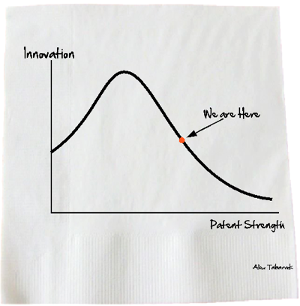
Have a look at Tabarrok’s curve:
Tabarrok’s curve (after Laffer’s curve), where economist Alex Tabarrok posits that, beyond a certain value, increased protection for intellectual property causes less innovation.
If we have no protection of originality, then we get too little innovation. But if we have too strong a protection, then we get too little of the derivative stuff. There’s a sweet spot and the argument is that we’re not at it at present and are thus missing out on some goodies as a result. Perhaps some tweaks to the system would help?
October 6, 2010
Follow up: burning the free market for government failure
The story about the fire department letting the house burn down has been used to “prove” that it’s a case of market failure and that free markets can’t provide public goods. Given that it wasn’t actually a “free market” entity, that argument doesn’t hold much promise:
National Review’s Daniel Foster jumps in to say that this is why conservatives need to curb their enthusiasm for the market economy. A colleague in the “anarcho-capitalist” camp stuck his head into Daniel’s office to explain that fire protection is not a human right, so it makes sense that the house was allowed to burn. Paul Krugman (he never goes away) adds that this is a case against the market in general. “Do you want to live in the kind of society in which this happens?”
I don’t get this debate at all. It is not even a real debate. The fire-protection services were government services. The fee in question was a government-mandated fee. The county lines in which the fee was applicable is a government-drawn line that is completely arbitrary. The policy of not putting out the fire was a government policy enforced by the mayor. As he said, in the words of a good bureaucrat, “Anybody that’s not in the city of South Fulton, it’s a service we offer, either they accept it or they don’t.”
So why is the market being criticized here? This was not a real market. Instead, this is precisely what we would expect from government. In a real market, there is no way that a free-enterprise fire service would have refused to provide the homeowner service. They would be in business to provide that service. The fire would have been put out and he would have been charged for the service. It is as simple as that. It is the same as lawn-mowing services or plumbing services or any other type of service. Can we know for sure that the market would provide such services? Well, if insurance companies have anything to say about it, such services would certainly be everywhere.
As it was, the fire burned down as a result of government policy, a refusal of service because the homeowners did not pay what amounted to a tax! The poor homeowner begged for help and offered to pay. He had paid the year before and the year before, so his credit was good. Even so, the bureaucracy refused!
April 15, 2010
Properly defining what are “public goods”
Milena Popova, guest-blogging while Charles Stross is out experiencing Japan, has a long discussion up about public goods and why content (digitally speaking) is a classic example:
There’s a theory in economics about things called “public goods”. To understand the distinction between private goods, public goods and the couple of shades of grey in between, you first need to get your head around two concepts: rival and excludable.
Rival: (Wikipedia seems to call this “rivalrous”, but when I were a young economist lass we used to call it rival so I’ll stick with that.) A good is rival if my consumption of it diminishes the amount of the good that you can consume. Say we had 10 apples, and I ate one. There would now be 9 apples left which you could eat. If we had one apple and I ate all of it, tough luck, no apples for you. Knowing whether a good is rival or not tells you whether you want to use the market (if I were a good economist that would possibly be capital-M Market 😉 to allocate access to that good. If it’s rival, then the market is an efficient way of allocating the good; if it’s not, then you might want to think about other ways of getting your good to people. Remember that scary anti-piracy clip at the start of your DVDs which says “You wouldn’t steal a handbag”? Hold that thought for a minute.
Excludable: A good is excludable if you physically have a way of stopping people from consuming it. Back to the apples: if they’re in my fridge, inside my locked house and you don’t have a key, you can’t have my apples. (Yes, yes, you could break in. The law provides additional protection here, but ultimately there’s probably a better way for you to obtain an apple than breaking into my house, right?) Knowing whether a good is excludable tells you whether you can use the market to distribute the good. If your good is excludable, go ahead and sell it on the open market; if it’s not — you might struggle because you can’t stop people from just taking it for free.
So. Most of the goods you deal with in your day-to-day life are both rival and excludable. We call them pure private goods. But there’s a few things here and there that aren’t as clear-cut, and this is where it gets a little messy.


