Quotulatiousness

June 13, 2011

Police SWAT teams under fewer restrictions than troops in Afghanistan

Filed under: Bureaucracy, Government, Law, Liberty, USA — Tags: , — Nicholas @ 12:12

John W. Whitehead recounts the ongoing militarization of police and other non-military government agencies:

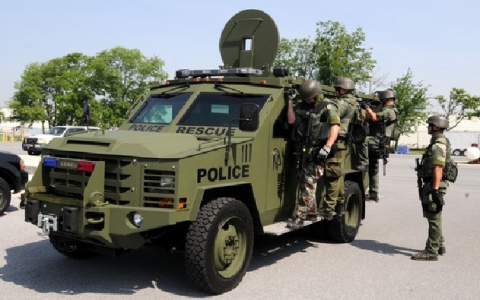
The militarization of American police — no doubt a blowback effect of the military empire — has become an unfortunate part of American life. In fact, it says something about our reliance on the military that federal agencies having nothing whatsoever to do with national defense now see the need for their own paramilitary units. Among those federal agencies laying claim to their own law enforcement divisions are the State Department, Department of Education, Department of Energy, U.S. Fish and Wildlife Service, and the National Park Service, to name just a few. These agencies have secured the services of fully armed agents — often in SWAT team attire — through a typical bureaucratic sleight-of-hand provision allowing for the creation of Offices of Inspectors General (OIG). Each OIG office is supposedly charged with not only auditing their particular agency’s actions but also uncovering possible misconduct, waste, fraud, theft, or certain types of criminal activity by individuals or groups related to the agency’s operation. At present, there are 73 such OIG offices in the federal government that, at times, perpetuate a police state aura about them.

[. . .]

How did we allow ourselves to travel so far down the road to a police state? While we are now grappling with a power-hungry police state at the federal level, the militarization of domestic American law enforcement is largely the result of the militarization of local police forces, which are increasingly militaristic in their uniforms, weaponry, language, training, and tactics and have come to rely on SWAT teams in matters that once could have been satisfactorily performed by traditional civilian officers. Even so, this transformation of law enforcement at the local level could not have been possible without substantial assistance from on high.

What’s worse than the vast increase in the use of heavily armed police SWAT teams for law enforcement is the casual way the teams are used:

Ironically, despite the fact that SWAT team members are subject to greater legal restraints than their counterparts in the military, they are often less well-trained in the use of force than are the special ops soldiers on which they model themselves. Indeed, SWAT teams frequently fail to conform to the basic precautions required in military raids. For instance, after reading about a drug raid in Missouri, an army officer currently serving in Afghanistan commented:

     My first thought on reading this story is this: Most American police SWAT teams probably have fewer restrictions on conducting forced entry raids than do US forces in Afghanistan. For our troops over here to conduct any kind of forced entry, day or night, they have to meet one of two conditions: have a bad guy (or guys) inside actively shooting at them; or obtain permission from a 2-star general, who must be convinced by available intelligence (evidence) that the person or persons they’re after is present at the location, and that it’s too dangerous to try less coercive methods.

Remember, SWAT teams originated as specialized units dedicated to defusing extremely sensitive, dangerous situations. As the role of paramilitary forces has expanded, however, to include involvement in nondescript police work targeting nonviolent suspects, the mere presence of SWAT units has actually injected a level of danger and violence into police-citizen interactions that was not present as long as these interactions were handled by traditional civilian officers.

June 10, 2011

Update on the “educational” SWAT team raid

Filed under: Education, Law, Liberty, USA — Tags: , — Nicholas @ 13:06

There’s been a bit of clarification from the authorities, although what they reveal isn’t pretty:

The Department of Education’s Office of Inspector General served a warrant on Stockton, California resident Kenneth Wright at six in the morning on Tuesday. Though the initial story gave the impression that the raid was focused on unpaid student loans, the department’s press secretary helpfully informed us this was not the case, and that the office conducts investigations of bribery, fraud, and embezzlement.

That’s little comfort. A review of the warrant reveals that the investigators were searching for financial records connected with suspected financial aid fraud, conspiracy, theft of government funds, false statements to the government, and wire fraud. Wright wasn’t the suspect — his estranged wife was and she wasn’t present for the raid — but for this list of white collar crimes the agents breached the front door, dragged Wright and his three children from the home, and kept them in a police cruiser for hours (the children for two, Wright for over six).

Kenneth Wright’s gut reaction, captured on video, largely mirrors mine. Ridiculous. Someone may have lied on student loan paperwork, so federal investigators converged to kick in a door and keep a family in the back of a cruiser for hours when they could have simply knocked and served the warrant.

Of course, the stated reason for the raid isn’t likely the real one:

This raid was a tactical dog and pony show to justify the existence of the OIG’s office, timely executed as Republicans are sharpening their fiscal knives. The same bureaucratic survival instinct motivated the ATF’s raid on the Branch Davidian compound in Waco, Texas. The ATF needed a high-profile bust to justify its existence in the face of perennial budgetary scrutiny, scrutiny that is deserved now more than ever as ATF officials knowingly let guns get shipped across the Mexican border to support the cartels. Two turned up at the scene of the shooting death of a Border Patrol agent and others shot a Mexican military helicopter and forced it to land.

Update: Some useful commentary at Popehat:

Anton Chekov (no, not the Star Trek guy) said of writing drama, “one must not put a loaded rifle on the stage if no one is thinking of firing it.”

Law enforcement training and procurement follows a similar ethos: supply creates its own demand. If you buy fancy toys for cops of any stripe, and train them to use them, then they’re going to use them. Once law enforcement is equipped and trained to wield the hammer of paramilitary raids, then every search looks like a nail. [. . .] (I suspect there’s a Napoleonic phenomenon going on as well: in my experience as a former fed and current defense lawyer, the more petty an officer’s power, and the narrower his patch, the more he itches to exercise force and authority.) That’s how they get to the place where they think it’s appropriate to use this much force against an innocent citizen with no criminal record, and his family, because his ex was committing fraud

[. . .]

Searches can be unreasonable not just in their purpose or in their supporting probable cause, but in their execution. A paramilitary raid is a grotesquely disproportionate approach to the investigation of a non-violent crime. It poses a grave risk of accidental death. It terrorizes innocents. And it conditions both police and citizens to view any law enforcement inquiry as justifying overwhelming force. Things like loan fraud and illegal milk sales should not require shock and awe.

The bottom line: we need to be vigilant for government abuse of the application for and execution of search warrants as well as erosion of the use of search warrants.

June 9, 2011

Arizona’s First Police Armoured Division goes into action

Filed under: Law, Liberty, Media, USA — Tags: , , , — Nicholas @ 11:08

Earlier this year, facing a looming threat, with ordinary police procedures considered too ineffective, Arizona teamed up with Hollywood for a solution. Rather than sending a squad car to serve the warrant, Maricopa County unleashes the awesome armoured power of the 1st SS Panzer division police plus actor Steven Seagal:

We have previously followed the feudal system created by Maricopa County Sheriff Joe Arpaio in Arizona. Arpaio’s insatiable desire for media attention has led him to turn over areas of his office to Hollywood producers. Last week, Arpaio’s unhinged administration gave the public another bizarre scene as Steven Seagal was seen attacking a home with a tank, armored cars, bomb robot, and dozens of SWAT team members. The crime? Suspected involvement in cockfighting.

The police acknowledge that there was no evidence to suggest that the man was dangerous or that he was armed. He was indeed arrested without a struggle and no guns were found in the house. Well, without a struggle on his part. The armored Seagal attack blew its windows out and caused the neighborhood to think that an invasion was afoot. The huge operations (and its attendant costs) was basically a stage set up to give Seagal good footage for his reality program, “Lawman.” Seagal is shown riding in the tank in the assault on the suspected cockfighter.

H/T to Jon, my former virtual landlord, for the link.

June 8, 2011

New tactic on delinquent student loans: SWAT teams

Filed under: Education, Law, Liberty, USA — Tags: , , , — Nicholas @ 12:32

Thinking about getting behind on paying back your student loan? Think again:

Kenneth Wright does not have a criminal record and he had no reason to believe a S.W.A.T team would be breaking down his door at 6 a.m. on Tuesday.

“I look out of my window and I see 15 police officers,” Wright said.

Wright came downstairs in his boxer shorts as a S.W.A.T team barged through his front door. Wright said an officer grabbed him by the neck and led him outside on his front lawn.

After the public humiliation, he was then handcuffed and chucked into the back of a police car for 6 hours, along with his three young children. He’ll think twice before getting behind on his student loans, right?

Perhaps not: they weren’t even his loans: the SWAT team was looking for his estranged wife.

June 7, 2011

QotD: The Bill of Rights on federal government property

Filed under: Government, Liberty, Quotations, USA — Tags: , , , , — Nicholas @ 09:36

Friends,

There’s been a hassle on FaceBook about what civilians and cops can or can’t do on “government property”, with some saying the Bill of Rights doesn’t apply there. I wrote this in response:

A little civics lesson, gentlemen, if you will allow me. The Bill of Rights is misnamed. It is not a list of things we are “allowed” to do, it is a list of things that government is not allowed to do, principally to trespass against certain natural liberties that are ours simply by virtue of our having been born.

The Bill of rights, therefore, is actively in force any time, any place that there are human beings. If it were metaphysically possible (it is not) it would apply even more on so-called government property than anyplace else, since it is specifically government that is constrained by it.

Moreover, since it is not just Americans who are human beings (contrary to what many seem to believe) it puts a whole new face on the legality — or illegality — of war, and in particular the treatment being accorded to the political prisoners at Guantanamo and similar places.

L. Neil Smith, “Letters to the Editor”, Libertarian Enterprise, 2011-06-05.

June 2, 2011

Man succeeds in suicide attempt over an hour, as police and fire rescue watch

Filed under: Bureaucracy, USA — Tags: , , , , , — Nicholas @ 12:59

A hard-to-believe story from Alameda, California:

Fire crews and police could only watch after a man waded into San Francisco Bay, stood up to his neck and waited. They wanted to do something, but a policy tied to earlier budget cuts strictly forbade them from trying to save the 50-year-old, officials said.

A witness finally pulled the apparently suicidal man’s lifeless body from the 54-degree water.

The San Jose Mercury News reported that the man, later identified as Raymond Zack, spent nearly an hour in the water before he drowned.

Perhaps they assumed that the suicidal man would get too cold and come back to shore, but it’s hard to understand how they could stand around for an hour and not do anything.

June 1, 2011

Similarities between US public schools and prisons

Filed under: Bureaucracy, Education, Government, Liberty — Tags: , , — Nicholas @ 07:49

As kids, we always used to grumble about school and it being “like a prison”. Kids today probably say the same thing, but with rather more reason:

In the United States today, our public schools are not very good at educating our students, but they sure are great training grounds for learning how to live in a Big Brother police state control grid. Sadly, life in many U.S. public schools is now essentially equivalent to life in U.S. prisons. Most parents don’t realize this, but our students have very few rights when they are in school. Our public school students are being watched, tracked, recorded, searched and controlled like never before. Back when I was in high school, it was unheard of for a police officer to come to school, but today our public school students are being handcuffed and arrested in staggering numbers. When I was young we would joke that going to school was like going to prison, but today that is actually true.

The following are 18 signs that life in our public schools is now very similar to life in our prisons….

#1 Virginia Attorney General Ken Cuccinelli has announced that school officials can search the cell phones and laptops of public school students if there are “reasonable grounds for suspecting that the search will turn up evidence that the student has violated or is violating either the law or the rules of the school.”

#2 It came out in court that one school district in Pennsylvania secretly recorded more than 66,000 images of students using webcams that were embedded in school-issued laptops that the students were using at home.

#3 If you can believe it, a “certified TSA official” was recently brought in to oversee student searches at the Santa Fe High School prom.

May 26, 2011

Reason.tv: The government’s war on cameras

Filed under: Bureaucracy, Government, Law, Liberty — Tags: , , — Nicholas @ 17:09

There is no right to privacy, unless you’re a police officer

Filed under: Law, Liberty, USA — Tags: , , , — Nicholas @ 09:24

Jon sent me a link to this post at Reason.com, discussing the odd court decisions which seem to indicate that you have no right to privacy, but that the police do:

Such incidents have led to a national conversation about the propriety of videotaping cops, even as dashboard cameras have become standard in squad cars. There seems to be some tension in the assumption that, as Graber’s lawyer put it, “the officer has a privacy expectation, but the motorist doesn’t.”

That asymmetry has been underscored by recent rulings over global positioning systems. Last year the Virginia Court of Appeals said Fairfax County police did not violate a suspect’s right to privacy when, without a warrant, they surreptitiously put a GPS device on his vehicle to track his movements. Individuals have no expectation of privacy on the public streets, the court ruled — a position also taken by the Ninth Circuit in California.

Yet this past January, Kathy Byron, a member of Virginia’s House of Delegates, introduced legislation that would have forbidden the use of GPS tracking devices for the purpose of following political candidates. People running for public office “are still entitled to some privacy,” she argued.

Even more disturbing is the steady increase in what the police are allowed to do without a warrant or even suspicion of criminal activity:

U.S. border-patrol agents often search the phones and computers of American citizens who cross the border — routinely “accessing email accounts, examining photographs and looking through personal calendars,” according to The Constitution Project, a watchdog group. “In some cases, electronic devices were confiscated for as long as a year.” And in Michigan, the State Police have high-tech forensic devices enabling them to download information from the cell phones of stopped motorists — something they have been doing without a warrant.

[. . .]

Soon Americans might have no right to expect privacy even in the privacy of their own homes. Earlier this month the U.S. Supreme Court ruled 8-1 that police officers may force their way into your domicile without your consent, without a warrant, and without what are usually referred to as “exigent circumstances” — e.g., someone inside the home yelling for help. The case, Kentucky v. King, concerned an incident in which police officers chasing a drug suspect ran into an apartment building, smelled marijuana, heard noises they thought might indicate someone was destroying evidence — and broke down the wrong door. This, said the Supremes, was perfectly fine.

May 22, 2011

The Tory “omnibus crime legislation” overview

Filed under: Cancon, Law, Liberty — Tags: , , , , — Nicholas @ 12:06

Kathryn Blaze Carlson looks at the likely form of the new federal government’s “tough on crime” omnibus bill:

The Conservative government’s omnibus crime legislation, due ‘‘within 100 days,’’ will mark a watershed moment in Canadian legal history, imposing many controversial changes to how police and the courts operate, experts say.

The bill is sweeping in scale and scope: It is expected to usher new mandatory minimum sentences for drug crimes — growing five marijuana plants to sell the drug would automatically bring six months in jail — and for certain sexual offences against children. It will expand police powers online without court orders, reintroduce controversial aspects of the Anti-Terrorism Act that expired in 2007, end house arrest for serious crimes, and impact young offenders and their privacy.

“This bundle of crime legislation represents the most comprehensive agenda for crime reform since the Criminal Code was introduced,” said Steven Skurka, a Toronto-based criminal defence lawyer.

As always, when the government bundles together a lot of bills, there are some good and some bad ideas all headed down the chute at the same time. An especially bad bit is the preventative arrest provision that expired with the original Anti-Terrorism Act, and another one is the one allowing the police to demand internet records from ISPs without a court order (or, one assumes, notice to the people whose internet records are of interest to the police).

May 19, 2011

Making light: are LED flashlights now “tacticool”?

Filed under: Randomness, Technology — Tags: , , — Nicholas @ 09:51

Chris Dumm has a bit of fun reviewing an LED flashlight:

Remember back when Mag-lite was the last word in aircraft-grade aluminum illumination? Those old incandescent Mag-Lites weren’t any brighter than ordinary flashlights, but their indestructible machined-aluminum bodies made them the choice of police, private security, Elvis and burglars. They were “tacticool” before people had a chance to learn to hate that word. The longer D-cell Mag-lites resembled aluminum billy clubs; they delivered a more devastating blow than any Monadnock PR-24 police baton ever could. Despite their size and weight, however, they still weren’t all that bright.

Then new technology arrived in the form of noble gas (Xenon bulbs) and heavy metal (Lithium batteries). SureFire and Streamlight built flashlights bright enough to temporarily blind and disorient a target without having to bash his brains in with five D-cell batteries wrapped in an aluminum Little League bat. And they were tough enough to drown, drop and attach to the hardest-kicking riot shotguns in the SWAT unit’s arsenal without fizzling out at the worst possible moment.

The new flashlights were rugged, dazzlingly bright and incredibly compact. Their only drawbacks: astronomical prices (for lights, bulbs, and batteries) and battery run-times of one hour or less. They quickly became the law enforcement standard, until LED technology took the lead and never looked back.

May 18, 2011

Neil Davenport: The cognitive dissonance of “SlutWalk”

Filed under: Cancon — Tags: , , , , , — Nicholas @ 07:35

It’s possible to feel a bit sorry for Michael Sanguinetti, whose anachronistic, ill-advised, yet well-intended caution to female students at Osgoode Hall in Toronto triggered the SlutWalk phenomenon. By phrasing his advice in such a retrogressive way, he became the poster boy for all that women perceive as being wrong with the criminal justice system’s approach to solving the problem of violence against women.

However, as Neil Davenport points out, the reaction seems to be directed at the legal system and attitudes of thirty years ago, not the system of today:

The legal system, at least officially, now takes any accusation of sexual assault against women very seriously. It’s ironic that SlutWalk is supposedly exposing the ineffectiveness of a legal system at a time of high-profile sexual assault charges made against Wikileaks founder Julian Assange and IMF chief Dominique Strauss-Kahn. More than ever, law enforcers in Britain and the US are likelier to act on an accusation of assault, even if the alleged crime took place years previously.

Faced with such a gap between feminist thinking and how society actually views violence against women, the anger expressed by SlutWalk protestors and cheerleading feminists rings a bit hollow. Although the protestors are aiming to avoid being victimised on the basis of what they wear, their offence taken at one police officer’s comments suggests a willingness to claim the mantle of victimhood for themselves. In this case, women are victims of a patriarchal state that doesn’t take violence against them seriously, even though the evidence suggests that the state is all too keen to monitor and regulate any type of contact between men and women. Feminists used to have many issues on which to express genuine grievance on the unequal treatment of women in society: equal pay and employment rights, abortion rights and so on. But since many of these issues have been resolved, more or less, there seems to be an on-going search for examples of oppression to facilitate the elevation of women to the exalted status of victimhood.

It’s perhaps not helped that the frothy issue of sexual identity is at the heart of the SlutWalk debacle. Some feminists argue that the protestors are feeding into a wider ‘raunch culture’ that is having a debilitating impact on young women. The sexualisation of society, the argument goes, is pressurising more young women to make themselves available to men in order to be accepted. SlutWalk is simply buying into the old madonna/whore duality that was often cited as an example of women’s inferior status in society. Again, though, this ignores how far society’s attitudes towards sex and women have changed. Women’s greater independence in society and the depoliticisation of marriage and the nuclear family have all helped transform attitudes towards women and sex.

Reminder: check state law before videotaping the police

Filed under: Law, Liberty, Media — Tags: , , , , , — Nicholas @ 00:02

Clive sent me this Wendy McElroy post from last year, but it’s still (mostly) valid today:

In response to a flood of Facebook and YouTube videos that depict police abuse, a new trend in law enforcement is gaining popularity. In at least three states, it is now illegal to record any on-duty police officer.

Even if the encounter involves you and may be necessary to your defense, and even if the recording is on a public street where no expectation of privacy exists.

The legal justification for arresting the “shooter” rests on existing wiretapping or eavesdropping laws, with statutes against obstructing law enforcement sometimes cited. Illinois, Massachusetts, and Maryland are among the 12 states in which all parties must consent for a recording to be legal unless, as with TV news crews, it is obvious to all that recording is underway. Since the police do not consent, the camera-wielder can be arrested. Most all-party-consent states also include an exception for recording in public places where “no expectation of privacy exists” (Illinois does not) but in practice this exception is not being recognized.

It shouldn’t need to be said that the police and the courts who’ve backed the police on this issue are wrong. But they appear to be running scared, at least in a few states:

Carlos Miller at the Photography Is Not A Crime website offers an explanation: “For the second time in less than a month, a police officer was convicted from evidence obtained from a videotape. The first officer to be convicted was New York City Police Officer Patrick Pogan, who would never have stood trial had it not been for a video posted on Youtube showing him body slamming a bicyclist before charging him with assault on an officer. The second officer to be convicted was Ottawa Hills (Ohio) Police Officer Thomas White, who shot a motorcyclist in the back after a traffic stop, permanently paralyzing the 24-year-old man.”

When the police act as though cameras were the equivalent of guns pointed at them, there is a sense in which they are correct. Cameras have become the most effective weapon that ordinary people have to protect against and to expose police abuse. And the police want it to stop.

May 14, 2011

For their next act, they’ll allow “quartering large bodies of armed troops”

Filed under: Law, Liberty, USA — Tags: , , , — Nicholas @ 00:38

Indiana must be an interesting place to live, but their Supreme Court has an odd view of the notion that a man’s home is his castle:

Overturning a common law dating back to the English Magna Carta of 1215, the Indiana Supreme Court ruled Thursday that Hoosiers have no right to resist unlawful police entry into their homes.

In a 3-2 decision, Justice Steven David writing for the court said if a police officer wants to enter a home for any reason or no reason at all, a homeowner cannot do anything to block the officer’s entry.

“We believe … a right to resist an unlawful police entry into a home is against public policy and is incompatible with modern Fourth Amendment jurisprudence,” David said. “We also find that allowing resistance unnecessarily escalates the level of violence and therefore the risk of injuries to all parties involved without preventing the arrest.”

And as I’m sure the law’n’order folks will be quick to point out, if you’ve done nothing wrong you’ve got nothing to worry about, right?

Even better, this is the second time this week that the court has reduced the rights of Indiana residents against police intrusion:

This is the second major Indiana Supreme Court ruling this week involving police entry into a home.

On Tuesday, the court said police serving a warrant may enter a home without knocking if officers decide circumstances justify it. Prior to that ruling, police serving a warrant would have to obtain a judge’s permission to enter without knocking.

H/T to Walter Olson for the link.

May 12, 2011

Afghanistan isn’t a “state”

Filed under: Asia, Military, Politics — Tags: , , , , — Nicholas @ 10:01

Much of the problem with current expectations about the eventual outcome of the Afghan mission rest on the notion that Afghanistan is a country in the same way that Hungary or Denmark is a state. It’s not a state:

While the foreign troops are in Afghanistan to deal with international terrorism and the heroin (90 percent of it comes from Afghanistan), most Afghans see all this foreign intervention as a splendid opportunity. It’s as if Afghans were saying to foreign troops, “to you it’s a war, to me it’s an opportunity.” This is an ancient Afghan attitude. Afghanistan may appear to be at the corner of no and where, but it is actually astride the primary invasion route from Central Asia to India (including Pakistan which is still, historically and culturally, part of India). The Afghans have long since learned to step aside as the foreign invaders move through. Actually, many Afghans would join the invaders, so much so that these invasions, and the loot and stories the survivors brought back, have become a major part of the Afghan collective memory. Most Westerners have not got a clue about this cultural tradition, and how much it influences the behavior of most Afghans. Such culture shock is not unusual, but because of the greater isolation of Afghanistan from the rest of the world, there is more of it.

Part of the culture shock is the realization that Afghanistan is not a country, at least not in the Western sense of the world. In Western terms, Afghanistan is a feudal monarchy. That means that the “king” (president Karzai) serves, and survives, at the sufferance of the local barons (warlords, drug gang leaders, provincial governors, tribal leaders). Until the last few centuries, this was how things worked in the West. But in many parts of the world, and especially in Afghanistan, the medieval mind, and form of government, is alive and well.

While many residents of Kabul (the capital and largest city) would like a modern (efficient and much less corrupt) Western style government, the “rural aristocracy” (corrupt local leaders) have no interest in this kind of central control. Thus the rural leaders do whatever they can to prevent an the creation of efficient national army or police force. Local leaders will attempt, often successfully, to corrupt the military and police units in their neighborhood. National level politicians also like to “own” army or police units, and if they can’t do that, they will try to steal money meant for the security forces. So NATO commanders have come to evaluate the effectiveness of Afghan police and army units based on the honesty of the commander, and his ability to deal with all those officials who want to buy him off. There are not many Afghan unit commanders who make the grade. To do so means you must behave in a decidedly unconventional manner.

This is why the whole notion of “nation building” is the right title for the wrong idea. Afghanistan needs a nation to be constructed, but it will take much more than just suppressing the Taliban and the heroin trade. No nation can go from a feudal/tribal level to nation-state in a generation — at least, no nation ever has, and there’s no chance that Afghanistan will be the first to do so.

« Newer PostsOlder Posts »

Powered by WordPress