
Classical and Ancient Civilization
Published May 11, 2024Some anecdotes about publishing archaeological sites
May 13, 2024
Archaeological Publishing – the unpalatable truth
Comments Off on Archaeological Publishing – the unpalatable truth
Roman Legions – Sometimes found all at sea!
Drachinifel
Published Feb 2, 2024Today we take a quick look at some of the maritime highlights of the new special exhibition at the British Museum about the Roman Legions:
https://www.britishmuseum.org/exhibit…
(more…)
Comments Off on Roman Legions – Sometimes found all at sea!
May 6, 2024
James Holland | Top 5 Tanks | The Tank Museum
The Tank Museum
Published Oct 4, 2019WW2 Historian James Holland came to The Tank Museum to choose his Top 5 Tanks. Unsurprisingly they are all from the Second World War!
(more…)
Comments Off on James Holland | Top 5 Tanks | The Tank Museum
April 12, 2024
FURY – How a Museum with a Sherman Made a Movie
The Tank Museum
Published Jan 5, 2024If you enjoyed the 2014 movie FURY, watch this and get the inside scoop behind The Tank Museum’s role in David Ayer’s Hollywood production. Ten years on from its release, David Willey describes how one of The Tank Museum’s Shermans and Tiger 131 took starring roles alongside Brad Pitt, Shia LaBeouf, Logan Lerman, Michael Peña, and Jon Bernthal. From initial discussions to the red carpet, David reveals every inch of the process, the lessons learned and the impact it has had on The Tank Museum.
Let us know what you thought of FURY and our tank’s performance in it in the comments below… What else would you like to know?
00:00 | Intro
00:50 | Fury – The Beginning
02:48 | Tiger Inquiries
05:00 | Insurance & Contracts
08:06 | Hollywood in Dorset
09:51 | On Set & Filming
14:55 | Was it worth it?
16:34 | Fury’s Longevity
(more…)
Comments Off on FURY – How a Museum with a Sherman Made a Movie
April 4, 2024
See Inside Panther | Tank Chats Reloaded
The Tank Museum
Published Dec 29, 2023Chris Copson takes a detailed look inside and out, of arguably the most advanced German tank of WW2 … the Panther.
Is the Panther the formidable opponent that is was made out to be? Would the allies use such a vehicle and was it over engineered? Find out in today’s video.
00:00 Intro
00:54 Overview – Our Panther
02:41 War time variants & armour
06:06 Design
08:30 Weaponry
10:18 Crew, equipment and flaws – a look inside
17:53 Performance & conclusion
(more…)
Comments Off on See Inside Panther | Tank Chats Reloaded
March 25, 2024
WWII Allied Vehicles – Universal Carrier
Ontario Regiment Museum
Published Jan 26, 2022This multi-part series was originally created in support of our friends at D-Day Conneaut for presentation during their live stream in 2020.
In part 5 the Museum’s Operation Manager Dan Acre details the history of a Canadian-made WWII vehicle, the Universal Carrier. (Please forgive the sound quality, it was one of the first videos we produced in the early stages of the pandemic.)
(more…)
Comments Off on WWII Allied Vehicles – Universal Carrier
March 22, 2024
Char B1 V Panzer III | Size doesn’t matter – it’s how you use it!
The Tank Museum
Published Dec 15, 2023Two tanks that fought against each other in the early part of World War Two. On one side, the heavily armoured French Char B1 … on the other, the mobile German Panzer III. On paper it’s no contest – but what actually happened when these two tanks fought it out in 1940?
00:00 | Intro
00:49 | Char B1 History
02:16 | Radio Communications
02:45 | Panzer III Crew
03:43 | Char B1 Crew
05:16 | Char B1 V Panzer III
(more…)
Comments Off on Char B1 V Panzer III | Size doesn’t matter – it’s how you use it!
March 7, 2024
M60: Cold War Guardian | Tank Chats #175
The Tank Museum
Published Dec 1, 2023The high point of a series of American tank designs that began in WW2, the M60 stood guard in a divided Europe during the Cold War. David Willey gives us a detailed analysis of a tank that served far longer than anyone intended.
(more…)
Comments Off on M60: Cold War Guardian | Tank Chats #175
February 21, 2024
Can you make a tank disappear? The Evolution of Tank Camouflage
The Tank Museum
Published Nov 17, 2023It’s not easy to hide a tank. But over the years, military commanders have developed ways to disguise, cover and conceal the presence of their tanks from the enemy. This video is about the “art of deception” – and how, since World War One, through World War Two and into the present day, the science of tank camouflage has evolved to meet the conditions and threats of the contemporary battlefield.
00:00 | Intro
01:38 | WWI
06:26 | WW2
13:42 | Post War
19:40 | Conclusion
(more…)
Comments Off on Can you make a tank disappear? The Evolution of Tank Camouflage
February 18, 2024
Does the Chieftain Fit Into … a Ford Model T
The Chieftain
Published Nov 19, 2023Filmed during a down-moment on a maintenance day at the Ontario Regiment Museum. The Model T is small and so old that I have to ask someone else at the end of the video how to drive it.
(more…)
Comments Off on Does the Chieftain Fit Into … a Ford Model T
February 13, 2024
“I am a proud member of the Airfix generation”
I didn’t realize that Peter Caddick-Adams is the same age as me, but it does seem that our interests pretty much ran parallel for a while:
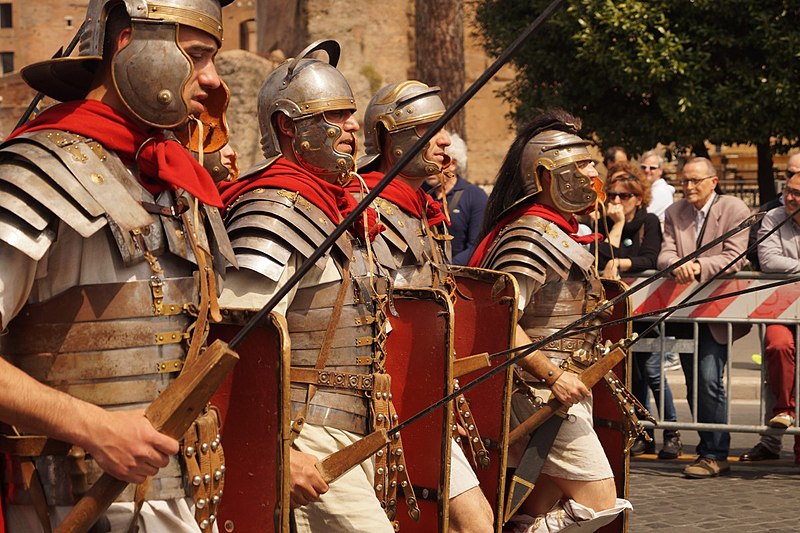
Re-enactors in Roman legionary gear, 19 May, 2021.
Original photo from https://pxhere.com/en/photo/883133 via Wikimedia Commons.
I am a proud member of the Airfix generation. The desire (less so the ability) to assemble and paint plastic model kits of aircraft, tanks and ships hit me squarely between the eyes on my tenth birthday in 1970. Several aunts and uncles had arrived at the same solution to bring out my inner Spitfire on the same day. Who needed the high of polystyrene cement and Humbrol enamel when you could refight D-Day across your bedroom floor with kits costing as little as 1/6d? Although Airfix was the premium producer of scale kits, other competing brands included Frog, Tamiya, Monogram, Hasegawa and Revell. I wish I knew what I did with them all, but many of the aircraft I recall casting out of upstairs windows, set on fire by match and candle. Looking back, I can see how it sewed the seeds of my becoming a professional military historian decades later. From little acorns, eh?
Two years later, I discovered I was interested in anything historical when my parents packed us into a train (great excitement in itself) for a trip to London. Although long past the days of steam, I can remember my father walking me down to thank the engine driver for getting us safely into Euston and then the true adventure began. The arrival at the British Museum to see the Tutankhamun Exhibition, which ran from March to December 1972. When it ended, besides the young Caddick-Adams, 1.6 million visitors had passed through the exhibition doors, making it the most popular attraction in the museum’s history. My favourite art class activity thereafter altered from drawing Spitfires and Messerschmitts chasing each other across every page to depicting ghostly, golden burial masks. Ever since, I have held an unbelievably soft spot for the old BM, always remembering that due to its vastness, it is best to go there to see something specific, rather than wander hither and thither, lost in its many treasures.
Then in 1977, when studying Ancient History for “A” Level, it was the turn of the Royal Academy in Piccadilly to capture my imagination with its Pompeii AD 79 exhibition. Mosaics, personal possessions, wall paintings and plaster casts of Romans and their animals caught in the moment of death as toxic gases, ashes, molten rock and pulverized pumice froze them forever, like insects in amber, likewise left a profound mark on my understanding of the bigger wheels of history.
The other day I was more than happy to be reunited with my old friend, the British Museum, this time hosting another Roman exhibition, which promises to be every bit as impactful as the Tutankhamun and Pompeii antecedents. Just unveiled, Legion: Life in the Roman Army is an inspired portrayal of an institution which numbered around 450,000 at its peak in AD 211 (33 legions and c. 400 auxiliary regiments), although numbers always fluctuated. The first amazing realisation is how little archaeological evidence remains of this vast organisation that endured for many centuries. The second is how well the scanty remnants in this exhibition have been preserved and interpreted.
Here, the British Museum has assembled the best surviving examples of arms, armour and personal possessions from collections around the world, in over 200 artefacts from 28 lenders. Though we view gleaming bronze helmets, swords long-rusted into scabbards, a pile of near-fossilised chainmail, it is incredible to think that there is only one intact example remaining of all those hundreds of thousands of rectangular and curved legionary shields (called a scutum), still bearing its decoration and crimson dye. This one comes from Syria.
There are some fine funerary carvings of Roman officers from around the empire, then we encounter some of the battlefield detritus including breastplate armour found near Kalkriese, in the Teutoburgerwald of Lower Saxony. This is where a coalition of Germanic tribes led by a rebel chieftain called Arminius ambushed 3 legions led by Publius Quinctilius Varus in 9 AD. The story of discovering this battle terrain was as dramatic as the assault itself. It was the result of a meticulous British soldier who combed an area north of his base at Osnabrück with a metal detector in 1987. Major Tony Clunn recorded each discovery of Roman coins and sling shot, making it possible to reconstruct the route taken by Roman legionaries under Varus and determine where they were ambushed and massacred.
February 6, 2024
5 HEAVY Tanks | Tank Chats
The Tank Museum
Published Nov 10, 2023Enjoy this compilation of classic Tank Chats presented by David Fletcher. We’ve put together David’s chats on TOG 2, FV4005, Conqueror, Conway and the 40 Ton Centurion – representing some of the heaviest tanks in our collection.
(more…)
Comments Off on 5 HEAVY Tanks | Tank Chats
January 23, 2024
T-34: The tank that won WWII
The Tank Museum
Published 27 Oct 2023The Soviet T-34 was the most prolifically produced tank of WWII. Basic and austere in design, it was highly effective and capable of being mass-produced. In this video we take a close look inside and out at the tank that made victory over Nazi Germany possible.
(more…)
Comments Off on T-34: The tank that won WWII
January 14, 2024
Inside Pz II Luchs | A WW2 Time Capsule
The Tank Museum
Published 13 Oct 2023A remarkably rare vehicle, with just 100 built and just two still in existence, the Panzer II Ausf.L “Luchs” is a reconnaissance variant of the Panzer II and this is one of the most intact and original vehicles we have in our collection. Join Chris Copson as he looks inside this Second World War rarity.
(more…)
Comments Off on Inside Pz II Luchs | A WW2 Time Capsule
January 9, 2024
AMX-13 | Tank Chats #174
The Tank Museum
Published 6 Oct 2023With over 7,700 units built and still in service today, this French light tank stands as a testament to its enduring legacy and historical significance. David Willey gives us an in-depth analysis of the development and history of the AMX-13.
(more…)
Comments Off on AMX-13 | Tank Chats #174


