
The Tank Museum
Published on 2 Mar 2018Known variously as the Tiger Ausf. B, Tiger II or Königstiger (the British also referred to it as the “Royal Tiger”), 489 Tiger IIs, were produced at the Henschel assembly plant, between January 1944 and March 1945. However, despite lacking in numbers, and being prone to mechanical and mobility issues based on its size and weight, the Tiger II’s combination of devastating firepower, and thick sloped armour plate made it a formidable adversary.
Support the work of The Tank Museum on Patreon: ► https://www.patreon.com/tankmuseum
Or donate http://tankmuseum.org/support-us/donateVisit The Tank Museum SHOP: ►https://tankmuseumshop.org/
Twitter: ► https://twitter.com/TankMuseum
Tiger Tank Blog: ► http://blog.tiger-tank.com/
Tank 100 First World War Centenary Blog: ► http://tank100.com/ #tankmuseum #tanks #tigertank
May 30, 2019
Tank Chats #47 King Tiger | The Tank Museum
May 16, 2019
When is an archaeological artifact merely “recyclable”?
In Sweden, they’ve got such a rich history of archaeological artifacts that they’re no longer preserving, categorizing, cleaning, displaying, or storing new artifacts that come to light … they’re dumping them in the recycling bin. Literally:
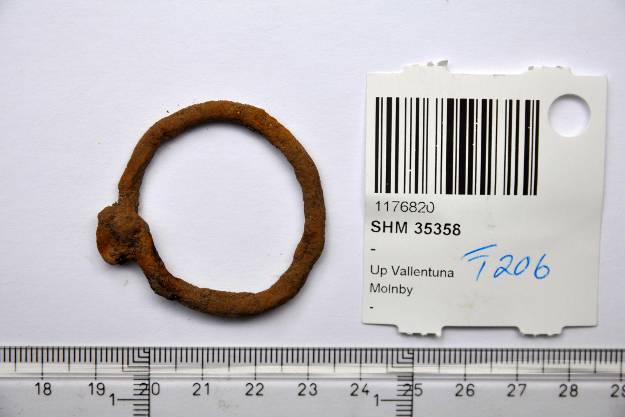
An amulet ring from the Iron Age, an example of the sort of newly found artifact that Swedish archaeologists are recycling. (Photo from Svenska Dagbladet, caption from Never Yet Melted)
In what looks like a new paroxysm of self-hatred and cultural suicide, Sweden has begun destroying artefacts from its ancient Viking history.
One might think that the country, over-run by hordes of Middle Eastern “asylum seekers”, would wish to preserve as much of its national identity and cultural heritage as it could. Even at the most mercenary level, Viking sites, museums, artefacts and souvenirs have been huge tourism money-earners. The television series Vikings shows Western man’s fascination with the hairy old sea-rovers. The immensely popular books and films of The Lord of the Rings drew in large part upon Norse mythology as well as Christianity, showing its deep resonances even for modern man.
Now an angry archaeologist has blown the whistle on the fact that the curators of Stockholm’s Länsmuseum have been ordering the systematic destruction of newly-found artefacts from the Iron Age and the Viking period with the weak excuse that the material would be too burdensome to process. This is despite the fact that preservation of the past is what being a museum curator is meant to be all about.
Coins, arrow-heads, ritual amulets, weapons, jewellery and weights that were kept in the past are now dumped into metal-recycling bins upon discovery instead of being cared for and displayed. Museum excavators are instructed to recycle unearthed iron elements into scrap metal on the weak pretext that “it would take too many resources to process, identify and store them”. The findings are usually quickly disposed of in order to make way for construction machines and building workers.
Ironically yet appropriately, the boom in excavation which has led to the doomed artefacts being unearthed has largely been to provide housing for the asylum seekers flooding into the country, and who are now pushing the crime-rate back towards, well, towards Viking levels.
This process was kept secret until a declaration by Johan Runer, the museum’s archaeologist. He had tried to raise the alarm before but only met indifference from the liberal Swedish media. According to Runer, this has been going on since at least 2016. He claims an entire ancient settlement was secretly levelled to allow roadworks.
If this story seems familiar, it’s because it’s not a new phenomenon … I blogged a similar story back in 2017.
May 15, 2019
Jade of the Maya
Lindybeige
Published on 10 Apr 2019Guatemala – another video from my trip there, this time looking at the jade in the local museum, plus obsidian, idols, and 1970s fashion tips.
Support me on Patreon: https://www.patreon.com/Lindybeige
Camera: Jeremy Lawrence (https://www.futtfuttfutt.com)Lindybeige: a channel of archaeology, ancient and medieval warfare, rants, swing dance, travelogues, evolution, and whatever else occurs to me to make.
▼ Follow me…
Twitter: https://twitter.com/Lindybeige I may have some drivel to contribute to the Twittersphere, plus you get notice of uploads.
website: http://www.LloydianAspects.co.uk
January 23, 2019
A new beginning for the Middle East: The Cyrus Cylinder and Ancient Persia
The British Museum
Published on 18 Jul 2014The Cyrus Cylinder is one of the most famous objects to have survived from the ancient world. It was inscribed in Babylonian cuneiform on the orders of Persian King Cyrus the Great (559-530 BC) after he captured Babylon in 539 BC.
The cylinder is often referred to as the first bill of human rights as it appears to encourage freedom of worship throughout the Persian Empire and to allow deported people to return to their homelands. It was found in Babylon in modern Iraq in 1879 during a British Museum excavation.
November 7, 2018
Romagne 14-18 Museum Tour
Forgotten Weapons
Published on 4 Nov 2018http://www.patreon.com/ForgottenWeapons
Jean-Paul de Vries runs a very interesting private World War One museum in the village of Romagne-sous-Montfaucon in the Meuse region of northeastern France. It is the exact opposite of typical modern museums, as it has a massive number of artifacts on display with almost no printed explanation. It is also unusual in displaying almost exclusively recovered artifacts of the war, the majority of them have been left on the fields or buried for decades. You will not find new specimens here; you will find remnants of war and weather.
That may sound dreary to some, but to me it is a very interesting way to approach the war and its history. You know that every item in this museum was actually used on the field of battle, and that can provide some interesting insights. For example, the American .30-06 Chauchat automatic rifles here indicate, contrary to most printed sources, that those guns were actually used in combat actions by American soldiers and not just for training. Tired of museums that have great open rooms with a single item on a glass case in the center? Then this is one place you will really appreciate!
The museum is an entirely private operation, and includes a small restaurant for sandwiches and such, and a shop offering books, reproduction items, and original artifacts for sale. If it located near the huge American Meuse-Argonne Cemetery, and I would highly recommend it to anyone traveling in the area with an interest in the Great War.
You can see the museum’s web site here:
https://romagne14-18.com/index.php/en/
Contact:
Forgotten Weapons
PO Box 87647
Tucson, AZ 85754
September 4, 2018
WW1 Trucks and Logistics I THE GREAT WAR On The Road
The Great War
Published on 3 Sep 2018Indy and David Willey of the Tank Museum talk a bit about trucks and logistics during WW1 while sitting in some sweet vintage World War 1 trucks.
July 1, 2018
Naval Legends: HMCS Haida | World of Warships
World of Warships Official Channel
Published on 28 Jun 2018“The most fightingest ship of the Royal Canadian Navy”, and the last survivor of the Tribal-class! Find out more in the new Naval Legends episode!
Naval Legends is a series about the construction, service, and daring deeds of legendary 20th-century ships. Very few vessels survived World War I and II — most were decommissioned and scrapped. The Naval Legends production crew travels all across the globe to visit almost every active museum ship and chronicle her story.
Each episode has our own footage, military chronicles, and data from archives. The story of each ship is narrated by military historians, museum staff, and navy veterans for maximum historical accuracy. Computer graphics based on archival blueprints illustrate critical engineering elements and components, along with the ship’s armament, so you can observe these colossal war machines from your armchair!
April 25, 2018
Tank vs. Tank: Villers-Bretonneux, April 1918 | The Tank Museum
The Tank Museum
Published on 20 Apr 2018100 years ago, during the First World War, tank fought tank for the first time in history, at Villers-Bretonneux on 24 April 1918.
It was an engagement that foreshadowed one hundred years of tanks fighting tanks on the battlefield, stories told by The Tank Museum.
February 26, 2018
Tank Chat: 100 Years of The Tank at TANKFEST 2016 | The Tank Museum
The Tank Museum
Published on 1 Jul 2016Watch David Fletcher make a comparison of the First World War Mark IV and Challenger 2, the British Army’s current Main Battle Tank, from the back of the Rolls Royce Armoured car.
January 24, 2018
Peter Jackson to bring modern digital technology to bear on IWM film footage of the Great War
Elizabeth sent me a link to this Daily Mail article on Peter Jackson’s new project:
When you think of First World War footage, chances are you conjure up grainy images of soldiers and jumpy footage of the trenches.
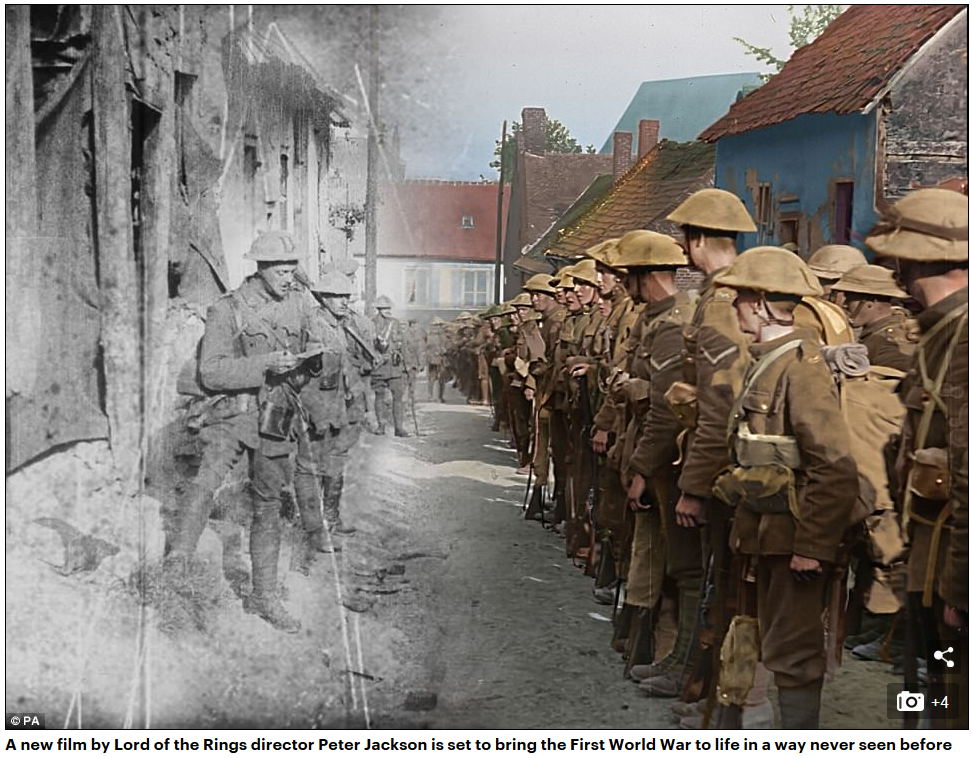
But a new 3D film by Lord of the Rings director Peter Jackson is set to bring the conflict to life in a way never seen before.
The Oscar-winner has restored and colourised 100-year-old footage from the Imperial War Museum’s vast archive, and early photos suggest the results will be remarkable.
One comparison shot shows the dramatic transformation from poor quality black-and-white scenes to clear colour images, while another shows the radically sharpened faces of our troops.
Jackson said he hoped the film, which will premiere at the BFI London Film Festival before airing on BBC1 later this year, will help audiences better connect ‘with the events on screen’.
Explaining the painstaking process of restoring the footage, he said: ‘We started to do some experiments and I was honestly stunned by the results we were getting. We all know what First World War footage looks like.
‘It’s sped up, it’s fast, like Charlie Chaplin, grainy, jumpy, scratchy, and it immediately blocks you from actually connecting with the events on screen.
November 20, 2017
Cambrai: The Tank Corps Story | The Tank Museum
Tank Museum
Published on 17 Nov 2017100 years on from the Battle of Cambrai, The Tank Museum presents a documentary on the moment the Tank Corps delivered one of the greatest advances of the First World War. This is the full-length version of Cambrai: The Tank Corps Story.
As the regimental museum of the Royal Tank Regiment, The Tank Museum is using the World War One centenary to draw attention to the struggle, sacrifice and ingenuity of the early tank men.
October 4, 2017
TANKFEST 2017 – Behind the Scenes with The Mighty Jingles
Tank Museum
Published on 3 Oct 2017See the best display of historic moving armour in the world, 29 June – 1 July, at The Tank Museum, Bovington. Tickets for TANKFEST 2018 are now on sale. www.tankfest.com
Youtuber The Mighty Jingles went behind the scenes at TANKFEST 2017 to meet the people who make TANKFEST work.
September 20, 2017
Tiger Day VIII at The Tank Museum
The Mighty Jingles
Published on 19 Sep 2017It’s Tiger Day once again at The Tank Museum in deepest, darkest Bovington! This time I actually managed to get there and I wasn’t disappointed…
The Tank museum: http://www.tankmuseum.org/home
September 17, 2017
But is it full of eels? If not, feel free to visit the British Hovercraft Museum
In their continuing series of “Geeks’ Guide to Britain”, The Register takes a trip to the former HMS Daedalus, a Fleet Air Arm seaplane training base that is now home to the Hovercraft Museum:
Did you know that the word “hovercraft” was once patented? And did you know that Great Britain is a world leader in the design and manufacture of the floaty transporters, and has been for half a century?
These and other surprising facts – including that some of the largest commercial hovercraft ever to be used in revenue service spent their lives shuttling booze cruisers back and forth across the English Channel – can be found at the Hovercraft Museum, at Lee-on-Solent in the south of England.
A century ago, what is now the site of the museum was known as HMS Daedalus and used as a Fleet Air Arm seaplane base. Back in the early days of aviation, and especially naval aviation, the station was at the forefront of naval and aviation technology alike. Seaplanes and skilled pilots were in great demand by the Royal Navy for anti-submarine patrols, and a new training base had to be set up to fill the service’s demand.
Thus came about the “temporary” Naval Seaplane Training School at Lee-on-Solent, with the new training school being based around a large local property, Westcliffe House. Slipways and hangars were duly erected, with the former leading down into the waters of the Solent itself; of the latter, one of the original J-class hangars, capable of being erected by just 15 men, survives to this day.
[…]
To truly appreciate the hovercraft, one should actually ride one of the things. This is easily done by a short journey along the coast from Lee-on-Solent to Britain’s only scheduled hovercraft service, which operates between Portsmouth and the Isle of Wight.
Operated by Hovertravel, whose sister company Griffon Hoverwork also builds the craft operated by the company, the service runs about every half an hour during the day, with more frequent services during the morning rush hour and a gradual winding-down into the evening.

August 26, 2017
When is an archaeological artifact merely “recyclable”?
In Sweden, apparently, it’s actually becoming a common practice to discard “excess” metal artifacts for literal recycling:
One of the amulet rings from the Iron Age that archaeologists are recycling. Previously, this type of object was saved, says archaeologist Johan Runer.
(Photo from Svenska Dagbladet, caption from Never Yet Melted)
Rough translation from Swedish language article in Svenska Dagbladet:
While the debate about burning books is raging in the media, Swedish archaeologists throw away amulet rings and other ancient discoveries. It feels wrong and sad to destroy thousands of years of ritual arts and crafts, and I’m not alone in feeling so.
“What you do is destroy our history! Says Johan Runer, archaeologist at Stockholm County Museum.
Amulet rings from the Iron Age, like Viking weights and coins, belong to a category of objects that, as far as Runer knows, were previously always saved.
He tried to raise the alarm in an article in the journal Popular Archeology (No. 4/2016), describing how arbitrary thinning occurs. Especially in archeological studies before construction and road projects, the focus is on quickly and cheaply removing the heritage so that the machine tools can proceed.
He works himself in these kinds of excavations. Nobody working in field archeology wants to get a reputation as an uncooperative “find-fanatic” but now he cannot be quiet any longer.
“It’s quite crazy, but this field operates in the marketplace. We are doing business,” says Runer.
Often, especially in the case of minor excavations, there is a standing order from the county administrative boards that as few discoveries as possible should be taken.
If you think it seems unlikely, I recommend reading the National Archives Office’s open archive, such as report 2016: 38. An archaeological preamble of settlement of bronze and iron age before reconstruction by Flädie on the E6 outside Lund.
In the finds catalog, coins, knives, a tin ornament, a ring and a weight from the Viking Age or early Middle Ages have been placed in the column “Weeded Out”.


