
Real Time History
Published 3 Oct 2025The Battle of Manila 1945 was the only urban battle in the American Pacific War comparable with Stalingrad, Berlin or other European battles. In gruelling weeks of fighting the 6th Army fought in house-to-house combat against entrenched Japanese.
(more…)
February 18, 2026
Battle of Manila, 1945
Comments Off on Battle of Manila, 1945
February 2, 2026
The Biggest Naval Battle in History: Leyte Gulf 1944
Real Time History
Published 5 Sept 2025In Fall 1944, Japan is set on stopping the US from re-capturing the Philippines, a vital trade route between the Japanese home islands and the resource-rich occupied territories to the south. With a complex plan they want to strike the US Navy as it’s landing on Leyte island. The resulting series of battles is today known as the Battle of Leyte Gulf, the biggest naval battle in history.
(more…)
Comments Off on The Biggest Naval Battle in History: Leyte Gulf 1944
September 2, 2025
2 September, 1945 marked the formal end to the Second World War
On The Conservative Woman, Henry Getley notes the 80th anniversary of the formal surrender of Japan to the United Nations forces represented by Douglas MacArthur on board the battleship USS Missouri:
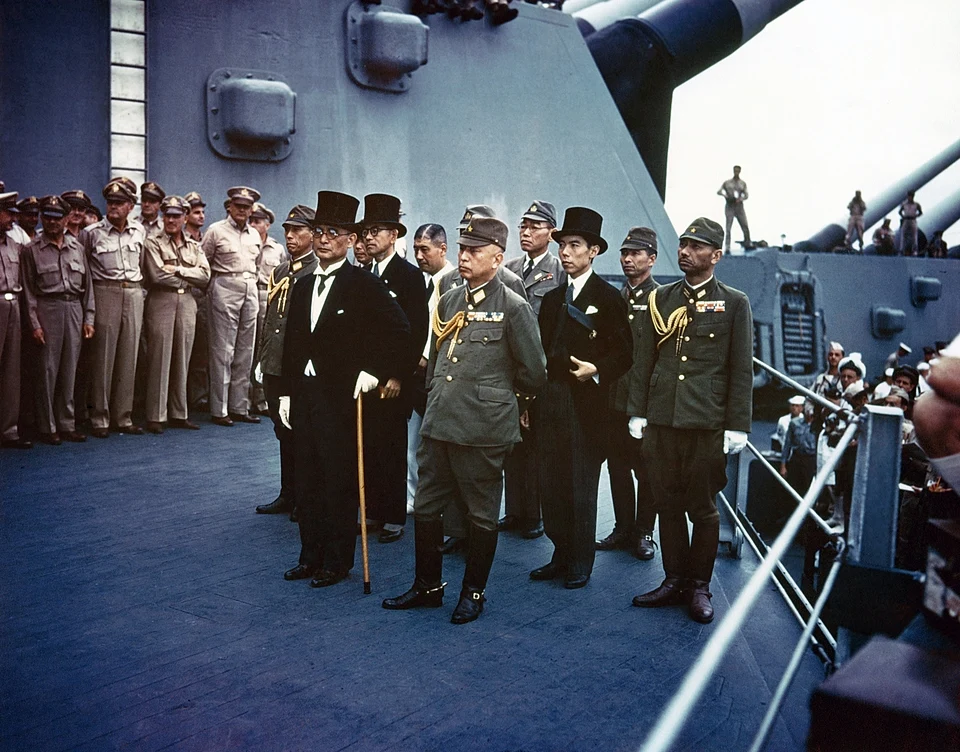
Representatives of the Japanese government on the deck of USS Missouri before signing the surrender documents, 2 September 1945.
Naval Historical Center Photo # USA C-2719 via Wikimedia Commons
ON September 2, 1945 – 80 years ago today – General Douglas MacArthur, Supreme Commander for the Allied Powers, accepted Japan’s formal surrender in a ceremony aboard the US battleship Missouri in Tokyo Bay. Then with the words “These proceedings are closed”, he brought the Second World War to an end.
That final sentence, broadcast worldwide by radio, came five years and 364 days after the global conflict started. Germany invaded Poland on September 1, 1939, but Britain – followed by France – did not declare war on Germany until September 3.
Six years later, on his enforced retirement, MacArthur told the US Congress: “I still remember the refrain of one of the most popular barrack ballads which proclaimed most proudly that ‘old soldiers never die, they just fade away'”.
Now, with the 80th anniversary of the war’s end, Britain’s old soldiers, sailors, marines and airmen have indeed faded away. At the war’s peak, 3.5 million men served in the Army, 1.2 million in the RAF and almost one million in the Royal Navy. Today, fewer than 8,000 veterans of those fighting forces are thought to be left. Most will be 98 or older.
It’s a striking thought for those of us who were brought up in the immediate post-war years. As I recalled in an earlier TCW blog, back in those days almost everyone’s father, uncle or brother had served in the military in some capacity.
The men we kids saw going to work in the offices, shops and factories of Civvy Street were the unsung heroes of the River Plate, Dunkirk, the Battle of Britain, the Battle of the Atlantic, the Arctic Convoys, the Western Desert, Italy, Normandy, Arnhem, the Rhine, Imphal, Kohima, the jungles of Malaya and Burma and many other battles large and small.
Being interested in military history, I was lucky enough to have become friends with several veterans of the Second World War, all sadly no longer with us. They were without exception the finest of men – modest, generous, good-humoured, gentlemanly. All had been at the sharp end in battle, but the last thing any of them would have called himself was a hero. They shared their memories with me reluctantly, anxious not to be thought they were “shooting a line” – that is, exaggerating or boasting. I was honoured and humbled to have known them.
Their passing reminded me that while the war was obviously seared into the very being of those who had experienced it, we of the first post-war generation inherited a lot of what you might call its folk memories and thus it loomed large in our perceptions.
Comments Off on 2 September, 1945 marked the formal end to the Second World War
July 8, 2025
Korea: War Without End by Richard Dannatt and Robert Lyman
Taylor Downing reviews the latest co-operative work between former British Chief of the General Staff Lord Dannatt and Dr. Robert Lyman:
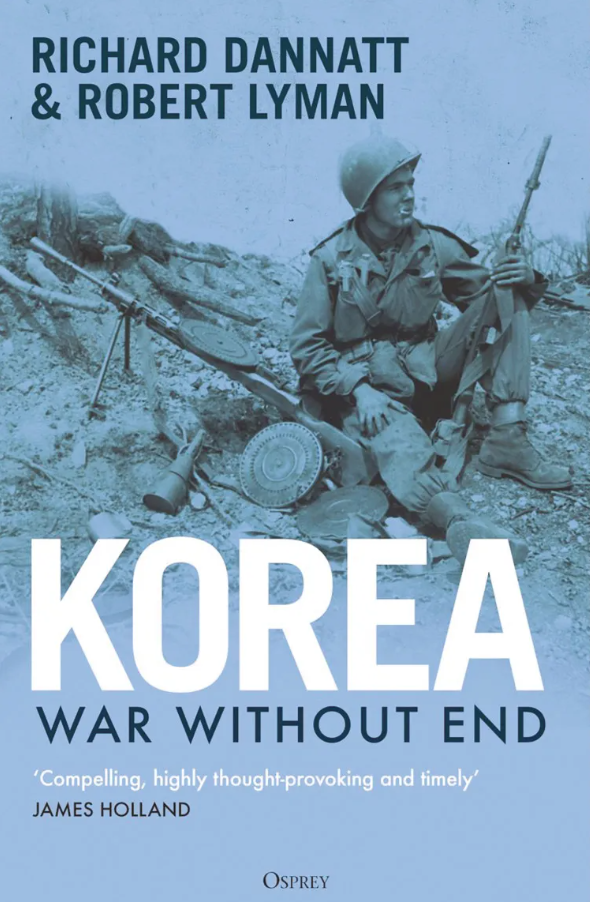
Their book has three premises. First, that the conflict in Korea is a forgotten one that very much deserves retelling. Second, that the war is very topical today partly because it shows how to fight (or not to fight) a conventional war in a nuclear age, and partly because it shows how politics must always take precedence over military ambition. And, third, the authors argue that the war was not a single conflict but was in fact two wars, quite separate but consecutive.
The “first” war is the story of the surprise invasion of South Korea by the North Korean People’s Army (NKPA), or the In Mun Gun, in June 1950 as their leader Kim Il Sung sought to reunite the Korean peninsula under Communist control without having any sense of the political response he would unleash. What followed was a rapid advance towards the southern city of Pusan in a form of Blitzkrieg that had not been seen since World War II.
This early phase covers the establishment of a US-led United Nations force for the first time in its history – only formed because the Soviet Union was boycotting the Security Council at the time. US troops finally slowed the NKPA advance and then, in a brilliant counterstroke masterminded by General Douglas MacArthur, an amphibious troop landing took place behind enemy lines at Inchon. This resulted in a complete reversal in the fortunes of the North Koreans and their retreat to pretty well their starting lines on the 38th Parallel that had divided the peninsula since 1945.
This, the authors argue, is where the war should have ended. The UN had achieved its aim of liberating the south from a Communist takeover. But instead a “second” war unfolded in which General MacArthur, convinced that he was fighting a crusade against world Communism, advanced rapidly through North Korea towards the Yalu River and the border with Communist or (as he called it) “Red” China. For him, victory had to include total defeat of the enemy. In scenes of remarkable hubris, MacArthur was convinced he had the war wrapped up and his troops would be home by Christmas. Instead, he provoked an attack by the Chinese People’s Volunteers on a massive scale, leading to the humiliating rout of US troops and a midwinter retreat back into southern Korea.
This “second” war had as its next phase the final standstill along lines roughly similar to the 38th Parallel and two years of stalemate, before an armistice was signed. The breakdown of the war into two separate conflicts is a fine way of interpreting the remarkable see-saw events of the first year of fighting. Seoul was captured and recaptured four times in nine months. Pyongyang was captured and lost, becoming the only Communist capital to have been taken in battle during the entire Cold War.
In the first stages of the conflict, UN troops, largely Americans who had been sent in from keeping the peace in Japan and who were entirely untrained and unprepared for combat, were thrown back so rapidly that many simply threw down their weapons and retreated. The NKPA, using the tactics the Japanese had used in their invasions of Malaya and Burma, completely outclassed the unprepared US forces.
Then, a few months later, the US-led advance made the Americans feel completely unstoppable as they headed north, only to be turned once more by the Chinese. Again, tactically outclassed and totally unprepared for mountain warfare in midwinter, where conditions were brutal, the UN forces collapsed. It is a remarkable story that very much merits the retelling.
Comments Off on Korea: War Without End by Richard Dannatt and Robert Lyman
June 18, 2025
The Korean War Week 52 – MacArthur Fades, Ceasefire Hopes Rise – June 17 , 1951
The Korean War by Indy Neidell
Published 17 Jun 2025The UN troops continue their advance to the Kansas Line, meeting no resistance at Pynoggang, but heavy resistance beyond it inside the Iron Triangle. 8th Army Commander Jim Van Fleet does not want to advance much beyond where they are now, though, since territory further north would be tougher to defend, should ceasefire talks begin. And Douglas MacArthur continues to tour the states, but to ever smaller crowds.
(more…)
Comments Off on The Korean War Week 52 – MacArthur Fades, Ceasefire Hopes Rise – June 17 , 1951
June 4, 2025
The Korean War Week 50 – Trapped in the Triangle: Korea’s Killing Zone – June 3, 1951
The Korean War by Indy Neidell
Published 3 Jun 2025The MacArthur Senate Hearings continue this week, with US Secretary of State Dean Acheson now in the hot seat. He takes a rather confusing barrage of questions, and yet manages to signal to the world at large, i.e. the Chinese, that the US is open to negotiations to end the war. The war still continues in the field, of course, with the UN forces’ Operation Piledriver in action, driving into the “Iron Triangle” and trying to trap as much of the enemy as possible.
Chapters
00:00 Intro
01:07 Recap
01:35 Acheson Speaks
05:44 Operation Piledriver
09:10 Attacks Begin
10:53 A Unifying JCS Directive
16:54 Summary
(more…)
Comments Off on The Korean War Week 50 – Trapped in the Triangle: Korea’s Killing Zone – June 3, 1951
May 28, 2025
The Korean War Week 49 – Race to Trap 70,000 Soldiers – May 27, 1951
The Korean War by Indy Neidell
Published 27 May 2025The Chinese Spring Offensive continues this week, but comes to its end — it has cost the Communist forces tens of thousands of men, but even as it ends, the UN counteroffensive begins — and costs them tens of thousands more! And in Washington the MacArthur hearings continue, and it is obvious by now to all and sundry that General Douglas MacArthur had been very much out of line and President Truman was within his authority for firing him.
Chapters
00:00 Intro
00:41 Recap
01:12 More PVA and KPA Attacks
03:41 The Counterattack Begins
07:14 Advances Everywhere
13:07 NSC 48/5
17:45 End of the Hearings?
19:05 Summary
19:18 Conclusion
(more…)
Comments Off on The Korean War Week 49 – Race to Trap 70,000 Soldiers – May 27, 1951
May 21, 2025
The Korean War Week 48 – Cut Off. Outnumbered. Doomed – May 20, 1951
The Korean War by Indy Neidell
Published 20 May 2025The Chinese Spring Offensive reignites, and it does so with a vengeance, kicking straight into high gear, and also totally surprising the UN forces by hitting them heavily much further east than they had ever expected — in the high Taebacks. Units find themselves, cut off, sandwiched, or broken … although a redeployment means that already by the end of the week, a UN counterattack is in the cards.
Chapters
00:00 Intro
00:50 Recap
01:28 The Offensive Begins
07:39 Van Fleet Reorganizes
11:03 ROK 3rd Corps Breaks
12:55 A Counteroffensive
14:13 The Joint Chiefs Speak
16:31 Summary
16:46 Conclusion
(more…)
Comments Off on The Korean War Week 48 – Cut Off. Outnumbered. Doomed – May 20, 1951
May 14, 2025
The Korean War Week 47 – MacArthur’s Big Lie Exposed – May 13, 1951
The Korean War by Indy Neidell
Published 13 May 2025The MacArthur Hearings continue in Washington, and George Marshall is adamant that what Mac says about the January 12th proposal is just plain not true. There’s still a war going on in the field, although this week is really a week of deployments, as 8th Army moves north to reoccupy former lines, even as reports come in of the Chinese massing for a possible attack.
Chapters
00:00 Intro
00:43 Recap
01:18 McMahon and MacArthur
06:28 Day Two
08:28 George Marshall’s Turn
12:20 Van Fleet Plans and Deploys
17:03 Summary
17:11 Conclusion
(more…)
Comments Off on The Korean War Week 47 – MacArthur’s Big Lie Exposed – May 13, 1951
May 7, 2025
The Korean War Week 46 – The MacArthur Senate Hearings Begin – May 6, 1951
The Korean War by Indy Neidell
Published 6 May 2025The Senate Hearings digging into Douglas MacArthur’s dismissal as UN forces commander begin this week, though they’ll likely continue for some time. Meanwhile in the field, the Chinese Spring Offensive that raged all last week continues, although it cannot reach Seoul, and by the end of the week the enemy seems to be withdrawing on all fronts.
(more…)
Comments Off on The Korean War Week 46 – The MacArthur Senate Hearings Begin – May 6, 1951
April 27, 2025
QotD: Fighting against Japan in the Pacific
Japan’s biggest advantage in the Pacific was knowing the terrain. Volcanic atolls being what they are, there are only a few places in the whole South Pacific that can be turned into airfields. Not only that, but there are only a very few approaches to those places, and the Japanese knew them all. If you’re outmanned and outgunned, a strategy of digging in deep and selling your lives as dearly as possible is the only way to go. Bleed the enemy white.
And lord knows the Americans took the bait, more than once. If “bait” is really the right word, because if you’ve got no choice … the early campaigns in the Solomons were so legendarily nasty for that reason: You have no choice but to go right up the pipe to seize an objective, and if you do, the enemy has no choice but to go right up the pipe to get it back.
The genius of the later American strategy — and credit where it’s due, few people have a lower opinion of MacArthur than I, but this was brilliant — was to simply go around. Heavy bomber strips are a must, and in the even fewer places in the Pacific that can take heavy bombers, the Americans had no choice but to go right up the chute … but carrier airpower can do a hell of a lot, particularly when it can move about completely unmolested by the enemy. Thus the Americans turned all those guaranteed meat grinders the Japanese had set up for them into big open-air POW camps, without bothering to go in there and force them to surrender (which, of course, they wouldn’t). Have fun starving in your bunkers, boys; we’ll just leave a covering naval detachment, to make sure you can’t evacuate; see you when the war’s over.
Severian, “Strategy”, Founding Questions, 2021-11-21.
Comments Off on QotD: Fighting against Japan in the Pacific
April 23, 2025
The Korean War Week 44 – Mac’s Lies Boil Truman’s Blood – April 22, 1951
The Korean War by Indy Neidell
Published 22 Apr 2025The stage is set for the Chinese Communist Forces’ next big offensive in Korea, but that is not where American eyes are fixed this week. Instead, focus swings to Washington D.C. where the recently-fired Douglas MacArthur arrives and proceeds to address crowds and Congress alike. It soon becomes clear that he will not go gentle into that good night.
Chapters
00:00 Intro
00:58 Recap
01:46 Soviet Intervention?
04:22 Operation Rugged
07:01 Task Force 77
09:36 South Korean Porters
11:02 MacArthur and McClellan
13:55 Summary
14:13 Conclusion
(more…)
Comments Off on The Korean War Week 44 – Mac’s Lies Boil Truman’s Blood – April 22, 1951
April 16, 2025
The Korean War Week 43 – Truman Dismisses MacArthur! – April 15, 1951
The Korean War by Indy Neidell
Published 15 Apr 2025It’s finally happened, President Harry Truman has relieved Douglas MacArthur of command. If you’ve followed us lately you’ll know the why, but today you’ll see then how, when, and where. But the fight in the field goes on- this week fighting for control of the Hwacheon Reservoir.
(more…)
Comments Off on The Korean War Week 43 – Truman Dismisses MacArthur! – April 15, 1951
April 9, 2025
The Korean War Week 42 – Seize Hwacheon Reservoir? A Dam Good idea – April 8, 1951
The Korean War by Indy Neidell
Published 4 Apr 2025Operation Rugged is in full swing, and it’s taking a decent amount of territory, but Matt Ridgway is worried about the possibility of the enemy blowing the dam at the Hwacheon Reservoir and flooding his army, so he gets set to try and soon take it. Meanwhile there’s an explosion in Congress in Washington DC, when the Minority Leader openly reads Douglas MacArthur’s letter of his plans for the war that are diametrically opposed to those of President Harry Truman. Truman realizes that he’s going to have to remove MacArthur from UN command.
Chapters
00:57 Recap
01:31 When to Fire MacArthur?
03:53 Joe Martin Speaks
07:11 Operation Rugged
09:23 The Hwacheon Reservoir Dam
13:35 Summary
13:51 Conclusion
(more…)
Comments Off on The Korean War Week 42 – Seize Hwacheon Reservoir? A Dam Good idea – April 8, 1951
April 2, 2025
The Korea War Week 41 – One Order Away from WWIII – April 1, 1951
The Korean War by Indy Neidell
Published 1 Apr 2025The UN forces have again crossed the 38th Parallel in many places, but High Command is worried about Soviet intervention, which could ultimately force them to withdraw from Korea entirely. However, plans are still set for Operation Rugged to soon go into action — aiming into the Iron Triangle.
Chapters
00:00 Intro
00:58 Recap
01:46 Soviet Intervention?
04:22 Operation Rugged
07:01 Task Force 77
09:36 South Korean Porters
11:02 MacArthur and McClellan
13:55 Summary
14:13 Conclusion
(more…)
Comments Off on The Korea War Week 41 – One Order Away from WWIII – April 1, 1951


