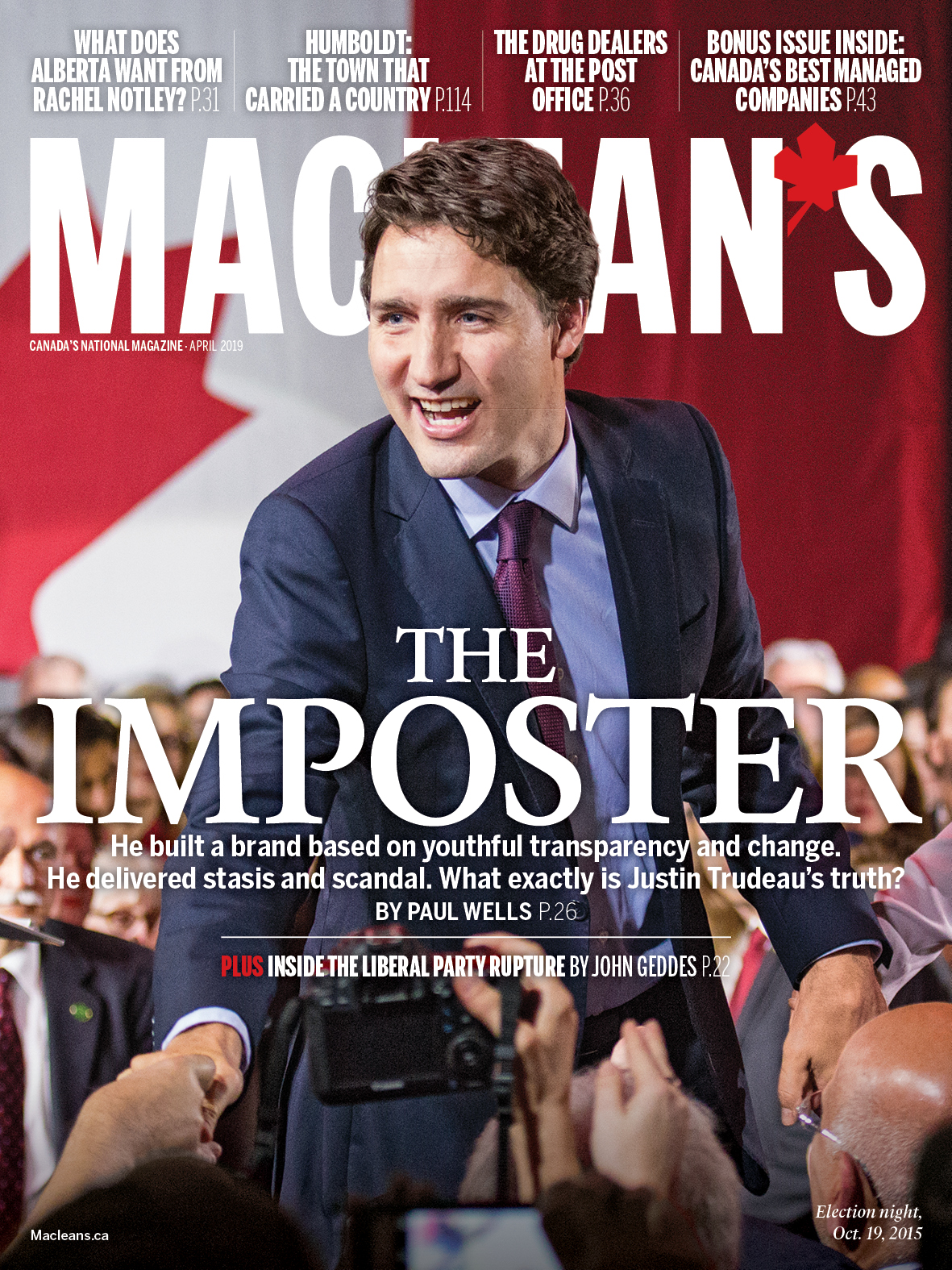
Ted Campbell responds at some length to a Globe and Mail article by Doug Saunders, outlining the degradation of diplomatic relations with almost all our allies and trading partners since Justin Trudeau became PM.
The Globe and Mail‘s award-winning international affairs correspondent Doug Saunders, someone with whom I (almost equally) often disagree and agree, has penned an insightful piece in the Good Grey Globe in which he says that “Suddenly, Canada finds itself almost alone in the world, with a Liberal government realizing that its optimistic foreign policy no longer entirely makes sense … [but, he concludes] … Even if the current crisis in liberal democracy proves temporary and short-lived, we know that it can recur – and likely will. If the institutions of 1945 no longer work and the doctrines of 2015 have failed to have an effect, we should develop new ones that will keep Canada connected to the better parts of the world for the rest of the century.”
[…]“After the Second World War,” Mr Saunders writes, “Canada gained a few more foreign-policy outlets. Canada played a large role in creating the institutions that governed the postwar peace: the United Nations and its various organizations; NATO; the global trade body that became the World Trade Organization; the Bretton Woods institutions, including the International Monetary Fund and the World Bank. Canada was decisive in the international agreement that authorized the future creation of the twin states of Israel and Palestine, giving it a role in the Middle East that expanded with its creation of the institution of peacekeeping after the Suez Crisis in 1956 … [but this really is a silly statement, albeit one that too many Canadians believe to be true. Canada didn’t create the “institution of peacekeeping” in 1956. It was already there, in the United Nation’s case since Ralph Bunch (USA) and Sir Brian Urquhart (UK) created it in 1948 and it had been around since, at least, Woodrow Wilson’s 14 Points speech in 1918, but it is now part of the Laurentian Elite‘s quite dishonest revisions of Mike Pearson’s sterling legacy as a diplomat and politician] … And, starting in the 1950s, Canada became a player and a spender in the new field of foreign aid and development. Under both Liberal and Progressive Conservative governments, Canada used those tools to play a small but well-regarded place in the liberal-democratic order – and to slowly but profitably build its trade and economic relations.”
[…]
I agree with Doug Saunders about the sources of Canada’s current weakness. He neglected to mention the root cause: Pierre Trudeau explicitly rejected, in the late 1960s, the “St Laurent Doctrine” and replaced it with a social “culture of entitlement” which meant that our place in the world had to be sacrificed on the altar of a reinforced social safety net. I agree that Donald J Trump is the key to our and the West’s current angst and confusion, not Vladimir Putin, Xi Jinping or Arab terrorists, all of whom are easier to understand, but I would argue that we would be much better placed to cope with president trump and the 21st century had we not abandoned our role as a leading middle power circa 1970. I have reservations about all three of Mr Saunder’s prescriptions:
- I’m not sure another G-N, not even a “committee to save the world” is a really good idea;
- I am nervous about interfering in the internal affairs of other countries ~ think about “do unto others” and all that; and
- I really doubt that Canadians are ready to spend what’s needed on our defence and, I suspect, they will not be until it is (almost) too late.
Like Mr Saunders, Mr Lang and Professor Paris, I, too, want to save the liberal world order and Canada’s place in it; I’m just not sure that any of the proposed solutions offered by Doug Saunders, by Eugene Lang or even by Professor Roland Paris are going to be enough. I think we need less formality and fewer organizations in international actions and a lot more ad hocery. I hope that we will have new, adult leadership here in Canada in the fall of 2019 and I hope that a new, grownup prime minister will begin, quickly, to mend relations with Australia, India, Japan and the Philippines and other Asian nations, to shore up our relations with Europe and, especially, with Iceland, the Netherlands, Norway, Switzerland and UK. I also hope Canada will open new, more productive dialogues with Africa, the Caribbean and Latin America and with Iran, Russia and China, also. I am convinced that Professor Stein is correct and we must have an “interests-based,” even a selfish suite of foreign, defence, immigration and trade policies. We should not go about looking for enemies, but we must understand that we have precious few friends and, for now, we cannot count on America to be one of them. America, Australia and Britain, China, Denmark and India, Japan, Mexico and the Philippines, and Singapore and Senegal, too, will all act in pursuit of their own interests; Canada needs to be willing and able to do the same and to work with them, even with Donald Trump’s America and Xi Jinping’s China and Vladimir Putin’s Russia when our interests converge and, politely, stand aside when they diverge. The G7 and G20 and a proposed new G9 are all harmless, but also, largely useless, talking shops. Both diplomacy and foreign affairs must be conducted on a case-by-case, country-by-country, issue-by-issue and interest-by-interest basis and diplomacy and foreign affairs can only be conducted with positive effect when Canada is respected for both its examples and values (soft power) and for its hard, economic and military power, too.
Thus, the first step in doing our part to “save the world” is probably the one that most Canadians will have near the bottom of their priority list: rebuilding Canada’s military ~ which must start, after a lot of the fat has been trimmed from a morbidly obese military command and control (C²) superstructure, with steadily growing the defence budget … and that cannot happen until the economy is firing on all cylinders, including energy exports to the world.