
World War Two
Published 20 Sept 2023How did the Allies build and manage an enormous railway supplying the Soviet Union through Iran? How did the Red Cross deliver aid parcels through enemy territory to Allied POWs? And, how effective were the rear gunners in ground attack aircraft like the Stuka and Sturmovik? Find out in this episode of Out of the Foxholes.
(more…)
September 21, 2023
Iranian Railways, Red Cross Care Packages, and Tail Gunners – WW2 – OOTF 31
Comments Off on Iranian Railways, Red Cross Care Packages, and Tail Gunners – WW2 – OOTF 31
December 4, 2022
Operation Overlord Confirmed at Teheran – WW2 – 223 – December 3, 1943
World War Two
Published 3 Dec 2022The Teheran Conference is in full swing and the Allied leadership and plan for a cross channel invasion of Europe is agreed upon by Stalin, Churchill, and Roosevelt. There are new Allied attacks across Italy, but at Bari a German air raid releases deadly poison gas.
(more…)
Comments Off on Operation Overlord Confirmed at Teheran – WW2 – 223 – December 3, 1943
December 2, 2022
Bombing Berlin with Ed Murrow of CBS – War Against Humanity 089
World War Two
Published 1 Dec 2022Ed Murrow accompanies the RAF on a bombing raid on Berlin, and files one of his most iconic broadcasts with CBS. In Teheran, Winston Churchill walks out on a dinner with Joseph Stalin, after the USSR Premiere suggests mass murdering German officers.
(more…)
Comments Off on Bombing Berlin with Ed Murrow of CBS – War Against Humanity 089
October 5, 2022
Are the protests in Iran about to tip over into actual revolution?
In The Line, Kaveh Shahrooz reports on the still-ongoing public protests after the death of a young woman at the hands of the morality police:
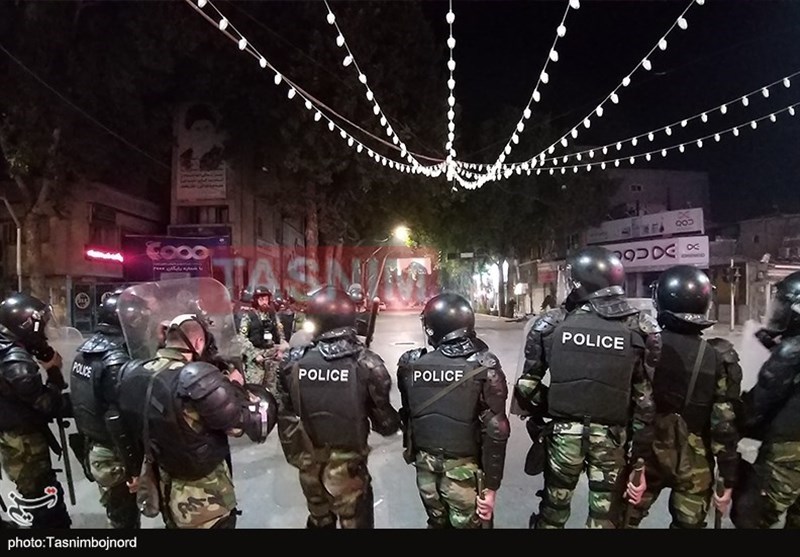
Aftermath of anti-government protests in Bojnord, North Khorasan Province, Iran, 22 September, 2022.
Photo from Tasnim News Agency Bojnord Desk via Wikimedia Commons.
Revolutions are funny things. They sometimes appear impossible until, in one single moment, they become inevitable. In Iran, that moment came on September 13th with the murder of a young woman.
Mahsa Amini, a 22-year-old who was also known by her Kurdish name “Gina”, had come from Iran’s Kurdistan region to visit her brother in Tehran. It was during that trip that she faced a particular humiliation that has become a fact of life for tens of millions of women in that country: a run-in with the country’s gasht-e ershad (“Guidance Patrol”). The role of this roving gang, seemingly imported from Atwood’s Gilead and called Iran’s “morality police”, is to monitor the streets to find and punish violations of the regime’s seventh-century moral and dress codes.
Having determined that Mahsa’s hijab exposed a little too much hair — a few strands of a woman’s hair and men will simply be incapable of controlling their sexual urges, the logic goes — they detained and beat her severely. The story for most women who deal with the morality police typically ends there, after which they are released to seethe at having endured another round of state-imposed gender apartheid. For Mahsa, the story ended differently: with a skull fracture that caused her to be brought, brain dead, to a local clinic. She died there on September 16th.
The murder of Mahsa Amini was the spark that set off a revolution. The killing reminded women of their daily misery at the hands of a regime that, both de facto and de jure, treats them as second-class citizens. And it reminded everyone of the million other senseless cruelties, large and small, that they must endure daily at the hands of a barbaric theocracy. Outraged by the death of an innocent young woman, the people took to the streets in protests that continue to this day.
There have been mass protests in Iran before. In 2009, in response to a widespread belief that Mahmoud Ahmadinejad had illegally stolen the presidential election — to the extent the word “election” means anything in a country where candidates must first be approved by a clerical body loyal to the regime — citizens protested by the millions. Their slogan, “Where’s my vote?” rested on the premise that a fair, albeit controlled, election was something that could change the system for the better. The protesters typically avoided confrontation with security forces. Even when they happened to corner a regime thug periodically, they ensured that no harm was done to him.
Comments Off on Are the protests in Iran about to tip over into actual revolution?
September 26, 2022
Canada, a confessed “ongoing” genocidal state, has no moral grounds to criticize China, Russia, or Iran
In Quillette, Jonathan Kay expresses his frustration as Canadian Prime Minister Trudeau’s performative moral posturing and virtue signalling for his globalist comrades comes back to bite him in the ass … again:
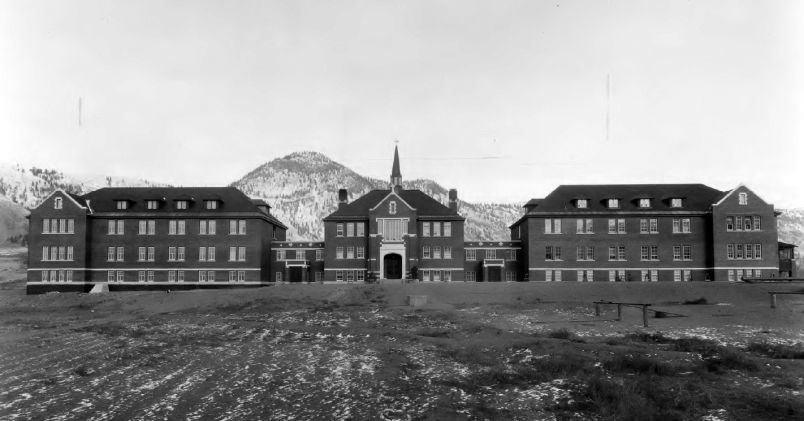
Kamloops Indian Residential School, 1930.
Photo from Archives Deschâtelets-NDC, Richelieu via Wikimedia Commons.
… [Iranian President Ebrahim Raisi] also threw in an attack on Canada’s treatment of Indigenous peoples, declaring that “bodies of hundreds of children were discovered in mass graves in a [former residential] school.”
The issue of supposed unmarked Indigenous child graves dominated the Canadian media in the latter half of 2021. But as I reported in Quillette several months ago, no “mass graves” were ever found. In fact, even the Indigenous groups that initially reported ground-penetrating radar (GPR) survey results consistent with the possible presence of unmarked burial sites weren’t talking about “mass graves”. Rather, the invented mass-graves claim was popularized by a badly botched New York Times May 28th, 2021, story written by reporter Ian Austen. (For a definitive debunking, see Terry Glavin’s account in Canada’s National Post).
In the 16 months that have passed since the unmarked-graves story broke in late May 2021, not a single body has been found, nor any human remains. And so even the less sensational allegation that 215 individual unmarked child graves lie buried under the grounds of a former Indigenous residential school in Kamloops, British Columbia, now seems doubtful. Nor have bodies or human remains been recovered at any of the other former residential-school properties where GPR surveys were conducted.
Yet that didn’t prevent Prime Minister Justin Trudeau from lowering flags on Canadian public buildings for more than five months, nor from speaking publicly as if bodies were already being dug up. And aside from the National Post, not a single major Canadian media outlet has admitted its role in feeding the unmarked-graves social panic that exploded last year, and which often included lurid speculation that the supposed grave sites not only contained the remains of Indigenous children, but that these children had been murdered through methods worthy of a horror-movie plot.
Given this, what can Canadian public figures say to Raisi now that he’s throwing spurious moral equivalences into our faces? Nothing. In making the false claim that “bodies of hundreds of children were discovered in mass graves in a [former residential] school”, the man is merely reading our own officially sourced misinformation back to us.
This isn’t the first time that Trudeau has managed to maneuver Canada into this kind of mortifying position vis-à-vis the world’s tyrants. Last year, when Canadian lawmakers voted to denounce China’s treatment of Uighurs in western Xinjiang as a form of genocide, Trudeau and his Cabinet abstained. The suspected reasons for that move were complex. But they included the fact that Canada was, by its own description, morally compromised on the genocide file: Back in 2019, Trudeau had explicitly acceded to the (absurd) claim that Canada, too, was guilty of “genocide” — this one against Indigenous women. Indeed, according to the official report that precipitated Trudeau’s mea culpa, this supposed Canadian genocide remains ongoing.
Comments Off on Canada, a confessed “ongoing” genocidal state, has no moral grounds to criticize China, Russia, or Iran
July 25, 2022
Stalin, Hitler, and Churchill – Architects of Death – WAH 070 – July 24, 1943
Comments Off on Stalin, Hitler, and Churchill – Architects of Death – WAH 070 – July 24, 1943
March 16, 2022
QotD: Muslim views of western culture
Not surprisingly, even the less devout Moslems look on western civilisation with uncomprehending horror. They accept western technology and science, and envy western prosperity. But they largely reject the spirit of free inquiry, intellectual and practical, upon which the western ascendancy rests. Yasmin Alibhai, for example, has not only lived in England for several years, but also worked as a journalist for The New Statesman and Society. She is completely unable to understand how a nation with no taste for book burning and the murder of authors can be anything but a “moral chaos”. But the most explicit rejections come from the younger theorists of the Iranian Revolution. Majid Anaraki, who spent several years in southern California, sees the west as
a collection of casinos, supermarkets and whore-houses linked together by endless highways passing through nowhere. All that money, all that effort all those resources that are wasted so that idiotic women and shallow men can prolong their lives … You see ancient women who refuse to die at a normal time and who continue to paint themselves and crave youthful lovers right to the edge of the grave … To eat tons of hamburgers and popcorn, to imbibe oceans of Coca-Cola and whisky, to watch hundreds of hours of stupid television, to copulate mechanically a few hundred times, to be on guard minute against being robbed, raped or murdered. That is the American way of life.
Our civilisation is regarded as evil, and its destruction is taken as a sacred duty for reasons both defensive and offensive.
Defensive
There can be no doubt that Khomeini was a firm anti-communist. But, unlike the timid monarchies of the Arabian Peninsula, he saw quite clearly where the true threat to Islam lay. Throughout his reign, the Russians presented at least a potential threat to the northern borders of Iran, But this was as nothing to the actual ideological threat of the west, Marxism in Iran had converted its tens of thousands, and influenced its hundreds of thousands. But western civilisation — with its clothing fashions, its films, its music, its enshrinement of individual happiness, its secular knowledge — had captured its millions. There was a “Great Satan” devouring Islam; and its body was not communism, but the West; and its head was not Russia, but America, “We must break those pens” he wrote, “that teach people there is something other than divine law. We must smash those mouths that tell the people they are free to say whatever they please, regardless of right and wrong in accordance with the commands of the Almighty”. On this reasoning, to carry the fight from Iran, or wherever, into the west, is the equivalent of turning from the periphery to the centre of an infection.
Offensive
In one of his occasional attempts at humane argument, Khomeini justified a war of extirpation against the west on the following grounds:
If one allows the Infidels to continue playing their role of Corruptors on Earth, their eventual moral punishment will be all the stronger. Thus, if we kill the Infidels in order to put a stop to their [corrupting] activities, we have indeed done them a service. For their eventual punishment will be less.
For the most part, however, it is conversion to Islam that is desired of people in the west. Only those refusing to convert are to be slaughtered. In the first instance, all those areas of the world that were once Islamic, but have since been lost, are to be restored; and all those areas that contain sizeable Moslem minorities are to be Islamised. In 1982, a new map of the world was presented to Khomeini by the Cartological Society in Teheran. It was divided into three regions, distinguished by three colours. First, in green, came the House of Islam — this being the 41 member states of the Islamic Conference, together with soviet central Asia, southern Spain, Malta and Lampedusa, Albania, part of Yugoslavia, north eastern China, parts of Siam, Burma, the Philippines, and most of Africa. The remaining areas, the red and black, were divided between communism and the west. But the final state of affairs is to be a totally Islamic world. No part whatever is to be left in the hands of the “Cross worshippers”, as the Christians are contemptuously termed. Moslems in Great Britain at the moment comprise barely three per cent of the population. Nonetheless, “[t]hose Moslems” says Dr Shabbir Akhtar of the Bradford Council of Mosques, “who find it intolerable to live in a United Kingdom contaminated with the Rushdie virus need to seriously consider the Islamic alternatives of emigration (hijira) to the House of Islam or a declaration of holy war (jihad) in the House of Rejection. The latter may well seem a kind of hasty militancy that is out of the question, though, with Allah on one’s side, one is never in the minority. And England, like all else, belongs to Allah.
Comments Off on QotD: Muslim views of western culture
June 16, 2021
QotD: The Shah of Iran
He was intelligent and wily, and his achievements were not negligible. He managed to wrest control of Iran’s oil first from the British and then from the international oil consortium that succeeded them. He played the oil market with great skill. He instituted an important land reform that genuinely benefitted the peasantry, expanded education, and had a full understanding of the importance of technology in the modernization of Iran necessary if it were to be anything other than a dependent state. His foreign policy was flexible, pragmatic, and shrewd. He needed the Americans but did not trust them (or anybody else, for that matter), realising that in politics there were no friendships, only common interests. This was to be borne out in the most terrible and tragic way during his last few years of exile, with which this book does not deal. Where there is no friendship, there is no gratitude for services rendered.
His failures were at least as great as his successes, and in the end more important from the point of view of his personal destiny. He so hollowed out political life in Iran, in order to exercise power as a true autocrat, that it came to have two poles: sycophancy and plotting against him. Sycophancy is a terribly addictive drug, no doubt a permanent temptation of the powerful (and therefore a good reason to restrict political terms of office); you can never have enough of it, nor can it ever be outrageous enough.
Unfortunately for the Shah, no one is sycophantic from principle, indeed sycophants tend (rightly) to despise themselves, fully aware that they are acting from the most naked of self-interest. There is no rat that leaves a sinking ship faster than a sycophant deserting a lost cause. A sycophant will take a risk to preserve his skin, but not to preserve his master.
Theodore Dalrymple, “Downfall of the House of Pahlavi”, The Iconoclast, 2021-03-03.
Comments Off on QotD: The Shah of Iran
October 19, 2020
Tank Chats #82 Challenger 1 | The Tank Museum
The Tank Museum
Published 9 Aug 2019David Willey, The Tank Museum Curator, discusses the development and deployment of the UK’s Main Battle Tank from 1983 – 2001, the Challenger 1.
Challenger 1 was in service with the British Army and saw action during the First Gulf War. It remains in service with the Jordanian Army.
Support the work of The Tank Museum on Patreon: ► https://www.patreon.com/tankmuseum
Visit The Tank Museum SHOP: ► https://tankmuseumshop.org/
Twitter: ► https://twitter.com/TankMuseum
Instagram: ► https://www.instagram.com/tankmuseum/
Tiger Tank Blog: ► http://blog.tiger-tank.com/
Tank 100 First World War Centenary Blog: ► http://tank100.com/

Comments Off on Tank Chats #82 Challenger 1 | The Tank Museum
August 30, 2020
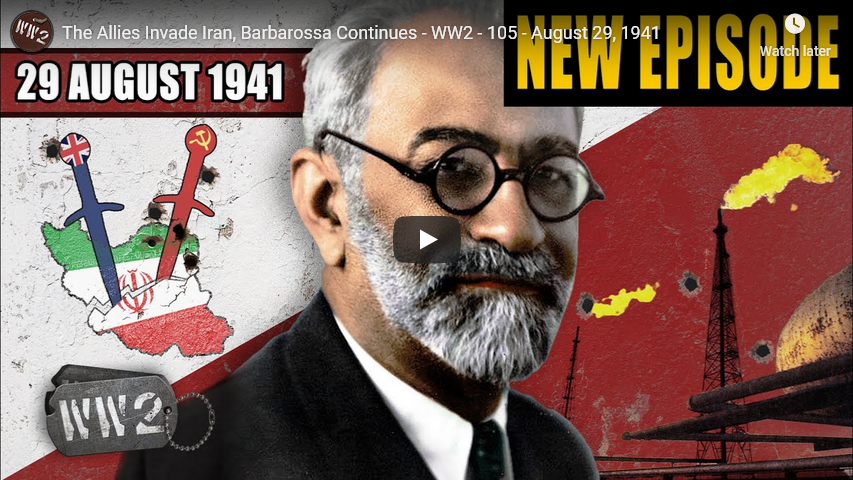
The Allies Invade Iran, Barbarossa Continues – WW2 – 105 – August 29, 1941
World War Two
Published 29 Aug 2020The British and Soviets work together invade Iran, while Barbarossa trudges ever on, with heavy losses. Bletchley Park intercepts German messages, and unease grows among the German public.
Join us on Patreon: https://www.patreon.com/TimeGhostHistory
Or join The TimeGhost Army directly at: https://timeghost.tv
Check out our TimeGhost History YouTube Channel: https://www.youtube.com/c/timeghost?s…Follow WW2 day by day on Instagram @World_war_two_realtime https://www.instagram.com/world_war_two_realtime
Between 2 Wars: https://www.youtube.com/playlist?list…
Source list: http://bit.ly/WW2sourcesWritten and Hosted by: Indy Neidell
Director: Astrid Deinhard
Producers: Astrid Deinhard and Spartacus Olsson
Executive Producers: Astrid Deinhard, Indy Neidell, Spartacus Olsson, Bodo Rittenauer
Creative Producer: Joram Appel
Post-Production Director: Wieke Kapteijns
Research by: Indy Neidell
Edited by: Iryna Dulka
Sound design: Marek Kamiński
Map animations: Eastory (https://www.youtube.com/c/eastory)Colorizations by:
– Adrien Fillon – https://www.instagram.com/adrien.colo…
– Norman Stewart – https://oldtimesincolor.blogspot.com/
– Julius Jääskeläinen – https://www.facebook.com/JJcolorization/Sources:
– National Portrait Gallery
– Mil.ru
– Narodowe Archiwum Cyfrowe
– Yad Vashem: 1249_67, 1249_4, 4613_1055, 57_15, 7271_40aArchive by Screenocean/Reuters https://www.screenocean.com.
A TimeGhost chronological documentary produced by OnLion Entertainment GmbH.
Comments Off on The Allies Invade Iran, Barbarossa Continues – WW2 – 105 – August 29, 1941
February 3, 2020
Yet another attempted settlement of the Arab-Israeli conflict that will go nowhere
Ted Campbell on the recent peace plan proposed by US president Donald Trump:
On the subject of the Trump Mideast Peace Plan, I agree with both The Economist which says, “as a blueprint for a two-state solution it was dead on arrival,” and with the Globe and Mail‘s Mark MacKinnon who writes that “President Donald Trump’s Middle East peace plan … aims to resolve the Israeli-Palestinian conflict almost completely on Israel’s terms [and, while] Mr. Trump’s allegiances came as no surprise [to the Palestinian leaders, but] some of [their] bitterness was reserved for the leaders of Arab states that Palestinians see as quietly going along with the designs of the U.S. President and Israeli Prime Minister Benjamin Netanyahu.”
I think that is because President Trump, and much of the world, has lost patience with the Palestinians who still demand a right of return that, if ever seriously considered by anyone, would destroy Israel. Only Iran really wants that.
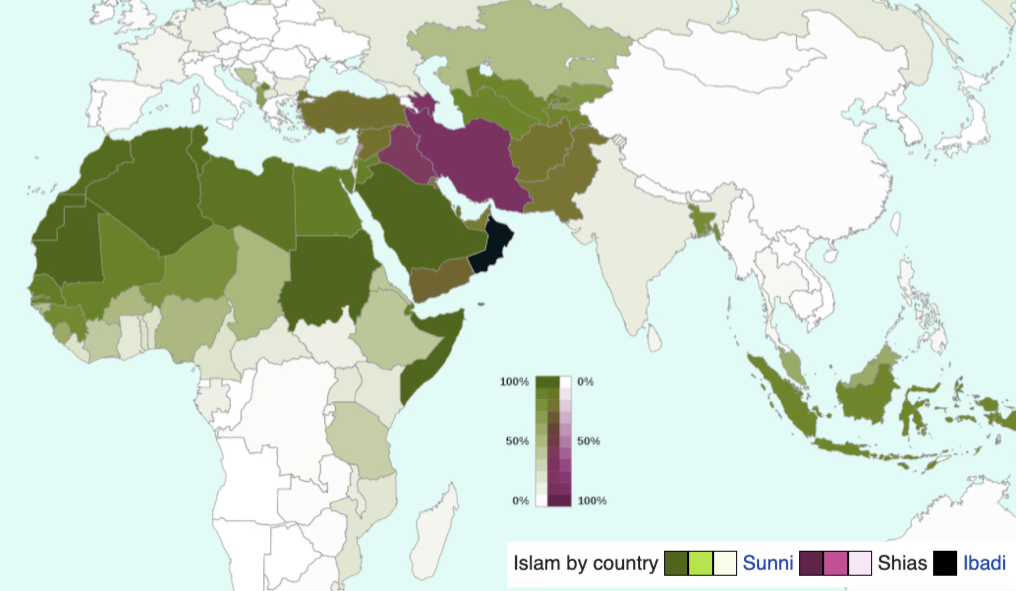
The strategic situation in the region, indeed in the entire Islamic Crescent which stretches from Mauritania and Morocco on the Atlantic coast of West Africa to Indonesia in East Asia, has changed in the past 70 years. There is no longer a unified Muslim “world” that opposes the very existence of a Jewish state in the Middle East. Indeed, a few Arab and Islamic states have correct, even friendly relations with Israel and others trade with the Jewish state (without having diplomatic relations) to their mutual advantage. The current problems in the region are centred on a power struggle between the Shia Islamic community, centred in Iran and the larger but socially and politically fragmented Sunni Islamic community …
… the differences are more than just religious. Iran, backed by China and Russia, and Saudi Arabia, backed by the USA, are engaged in something close to a real shooting war while Egypt and Turkey egg them both on. All four have some claim to dominance in the region and none is a real “friend” to any of the others and none gives a damn about Palestine or the Palestinian people.
[…]
President Trump has done a big political favour for Benjamin Netanyahu … but, ultimately it is probably pointless, and he and his successor and her (or his) successor, too, will likely still be seized with this issue in 2025 and 2030 and beyond.
Eventually, a solution will be found … it will, I suspect, involve Israel ceding a bit of territory to a new Palestinians state and, perhaps, establishing some sort of controlled, limited access corridor from the West Bank, possibly across the Northern Negev Desert. More importantly, it will involve Israel and Jordan, working in tandem, helping the new state to grow and prosper and live in peace with its neighbours. It’s a dream, of course, but it’s better, better for everyone, than is another war.
Comments Off on Yet another attempted settlement of the Arab-Israeli conflict that will go nowhere
January 17, 2020
The crying need for “regime change” … in Canadian newsrooms
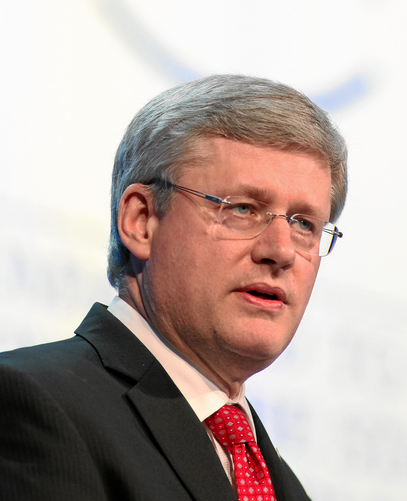
Chris Selley discusses the amazingly tone-deaf “corrections” issued by CBC and CTV over their malicious misquoting of former Prime Minister Stephen Harper’s comments on the Iranian government:
Harper did not advocate military intervention in Iran, or indeed any particular intervention whatsoever. Despite describing Iran (accurately) as an “anti-Semitic state” premised on “religious fanaticism and regional imperialism” that is standing resolutely in the way of cooperation between other Middle Eastern nations, Harper didn’t even advocate “a complete change of government.”
Prime Minister Stephen Harper speaking at the Annual Meeting of the World Economic Forum in Davos, Switzerland, January 26, 2012.
World Economic Forum photo via Wikimedia Commons.“I do believe we need to see a change in Iran if we are going to see peace in the Middle East,” he said.
“Without a change in the nature of the government of Tehran,” he said, “the Middle East will continue to be in turmoil.”
He said he hoped the furious protests in Iran might nudge the country toward “a better trajectory.”
These are perfectly anodyne statements. Who doesn’t want the Iranian regime to alter its behaviour?
Clarification or correction? I would say this calls for something more like “colossal embarrassment necessitating deep introspection.”
The root problem, I think, is that so much of Canadian politics is purely for show. We are a sparsely populated, not very powerful nation where the differences between the two major federal parties are remarkably small — and thus so are the stakes. It requires special measures to keep people interested, as much for the media as for politicians.
[…]
That’s how the big outlets like CBC and CTV make the sausage of the day, and it’s understandable. They do great investigative work, but the beast needs feeding not just every day, but all day every day. During the campaign I would watch colleagues set up for live hits in various parking lots and back yards and sometimes even on the campaign bus, and imagine them speaking the truth: “I’m here in Delta, B.C. and there’s f–k-all to report. Back to you, Kent.” But the viewers must never know. They need drama, as weak as it might be. I can easily imagine how that principle transformed “a changed regime” into “regime change.”
The real problem with this reporting regime is when it’s applied to things that actually do matter. There are serious potential consequences to telling the world that Stephen Harper thinks, in essence, that we should declare war on Iran with an eye to bouncing the ayatollahs. Harper’s successor and his government are in the midst of an extremely delicate and frankly improbable operation to find out precisely what happened the morning of Jan. 8 in the skies above Tehran and seek justice for the victims and their families. Those families don’t deserve fake news about a warmongering former PM, and I’m sure our diplomats would prefer members of the unchanged Iranian regime didn’t come across it either.
This isn’t a Canadian federal election. It’s real life, and needs to be covered as such.
Comments Off on The crying need for “regime change” … in Canadian newsrooms
January 12, 2020
The shoot-down of Flight 752
Colby Cosh discusses the destruction of Ukraine International 752 in the historical context of the Vincennes incident (later on Friday, the Iranian official position appears to have shifted to accepting responsibility for an accidental missile launch):
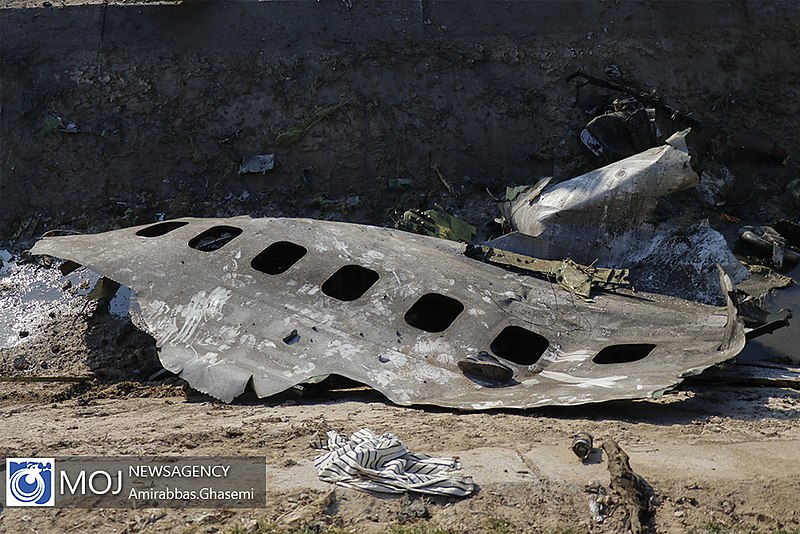
Some of the wreckage of Ukraine International flight 752 near Tehran, Iran.
Photo from MOJ Newsagency via Wikimedia Commons.
It has become fairly obvious, whatever the Iranian authorities may say now or later, that Ukraine International Airlines Flight 752 was shot down after departing Tehran. This was, in truth, overwhelmingly probable the moment the news broke, but there was still widespread shock and disbelief on Thursday when several Western heads of government announced signal-intelligence evidence of a missile strike. There are still “How could such a thing happen?” reactions pouring forth — mostly from people who are old enough, in theory, to recall the USS Vincennes accidentally shooting down an Iran Air Airbus A300 in 1988.
I say “in theory,” but the truth is that popular memory of the Vincennes incident has been much diminished — outside Iran — by later events in the region. This must qualify as one of the good Lord’s most sadistic jests. The United States wasn’t officially at war with anyone in the region at the moment when its best-trained sailors, equipped with scorchingly new and uncannily powerful missile and battlespace-mapping technology, blew up a commercial airliner full of religious pilgrims.
The Navy was in the Gulf not to fight or oppose anybody in particular, but to protect neutral shipping from the Iran-Iraq War. Up to the time of the accident, it was Iraq that demonstrably presented the greater danger to American warships. Ronald Reagan was still president. The First Gulf War wouldn’t kick off until 1990.
In other words: we forgot. The memory of Vincennes was overwritten by a generation of Middle East conflict, like an old computer file.
Which leaves a paradox. Liberals who regard recent U.S. history as one enormous, indistinguishable mass of bloodthirsty actions don’t seem especially aware of one of the most horrifying tactical blunders in American military history. What’s one jet plane more or less in the black ledger of imperialism? Conservatives, meanwhile, are racing to accuse Iran of “murder” in the case of Flight 752.
Blunders can be worse than crimes, according to one of the most famous of all military maxims. But if one points out that Iran’s “murder” of innocents is starting to look like a nightmarish replay of Vincennes, one risks being accused of postulating “moral equivalence” between the United States and Iran.
Comments Off on The shoot-down of Flight 752
January 9, 2020
The “Ostrich” school of Canadian foreign policy
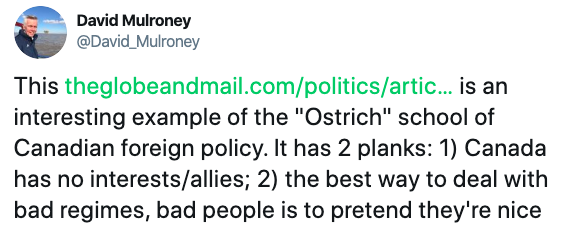
Ted Campbell on what former Canadian diplomat David Mulroney calls the “Ostrich” school:
John Ibitson, writing in the Globe and Mail, suggests that Justin Trudeau might want to try what former diplomat, national strategic planner in the Privy Council Office, and commentator David Mulroney refers to (on social media) as …
… “the ‘Ostrich’ school of Canadian foreign policy.” It has, he says, two pillars:
First, “Canada has no interests/allies“; and
Second, “The best way to deal with bad regimes, bad people is to pretend they’re nice.”
Mr Ibbitson himself says that it may be impossible to work “with European and Asian allies, including Japan, to forge a coherent response that provokes neither the Americans nor the Iranians.”
The situation in the Middle East is, as I have explained several times, hideously complex. President Trump may have made it worse … although it’s hard for me to see how any added complications really matter all that much. The socio-cultural and religious hatreds that bedevil the region are likely beyond making “worse.”
In fact, there may be an argument that a nice, all-out, albeit contained, Middle East war might be useful. Perhaps the Iranians and Saudis and Iraqis and Syrians and Yemenis and so on need to sort one another out in the way that tends to produce lasting results: on a bloody battlefield … it worked for Europe, more than once, in 1648, in 1815 and again in 1945.
John Ibbitson says that “Iran’s rage over the U.S. assassination of Qassem Soleimani risks dragging Canada and the rest of the Western alliance into a new confrontation in the Middle East, courtesy of Donald Trump … [that true, as far as it goes, and he adds] … Most Canadians would want no part of such a conflict, especially since the U.S. President might simply be seeking to distract attention from his impending impeachment trial in the Senate … [and that, the first part about Canadians wanting no part of any conflict, is also true, but President Trump’s motives are irrelvant]. The fact is that he has ignored many Iranian provocations while he attempts, vainly, in my opinion, to disengage America from the wider world. The attack on a US embassy seems to have crossed a “red line.”
[…]
But, John Ibbitson says, “Mr. Trump’s high stakes gamble – that killing one of the most senior figures in the Iranian regime will deter rather than provoke further acts of aggression from Iran – could lead to some kind of asymmetrical war, with the U.S. military attacking Iranian targets, and Iran responding through militias and proxies in Iraq and possibly in North America and Europe … [true enough, and he asks] … What would Mr. Trump expect from Canada in such a conflict?” That’s the key question.
My guesstimate is that President Trump will ask little or nothing, militarily, because his military chiefs of staff will not even have mentioned Canada when they proffer lists of nations that might help or hinder US efforts. Canada is not on any of their lists of countries that matter. Diplomatically, however, I think we do matter to the USA and I would not be surprised if the phone lines have been busy all weekend as US officials tell (rather than ask) Canadian officials to get our government “onside” with the USA. The Americans hold ALL the high cards in the game of power.
I’m sure that Prime Minister Trudeau will follow John Ibbitson’s advice and adopt the “Ostrich” strategy … head buried in the sand, pretending that Canada has neither interests nor allies and pretending that evil people are good.
Perhaps co-incidentally with the “revenge” Iranian missile attacks on Iraqi airbases known to have US troops in the area, a Ukraine International Airlines Boeing 737-800 passenger jet crashed shortly after take-off from Tehran airport. Officially, the Iranian authorities are saying it was due to catastrophic mechanical breakdown, but they have refused to hand over the aircraft’s “black box” flight recorders for analysis. All of the 176 passengers and crew died in the crash, including 63 Canadians. It has been suggested by many that the timing was not a co-incidence and that the plane was likely hit by an Iranian surface-to-air missile due to the heightened state of tension in Iranian airspace during and after the missile launches against Iraq. Colby Cosh has more:
Some of the wreckage of Ukraine International flight 752 near Tehran, Iran.
Photo from MOJ Newsagency via Wikimedia Commons.
I am writing these words at a strange moment Wednesday morning. The president of the United States has just been on television, reassuring the American public that the crisis inspired by the assassination of Iranian general Qassem Soleimani has reached a satisfactory equilibrium. Iran made a demonstrative show of force against U.S. installations in the Middle East that killed nobody. Honour has been satisfied. Relief, among American observers, is general.
Meanwhile, Canada is mourning the deaths of dozens of its citizens in a passenger jet crash on Iranian soil. Perhaps it is a terrible coincidence. Stranger things have happened. But if you are old enough to remember the shooting down of Iran Air Flight 655 by the U.S. Navy missile cruiser USS Vincennes in 1988, you are old enough to doubt it.
The Vincennes incident is part of the historical litany that has made news consumers innately distrustful of the first draft of history. The ship was in the Persian Gulf, which at the time was swarming with Iranian gunboats trying to squeeze off the supply of arms to its enemy Iraq. The U.S. Navy had rushed to the area to keep one of the world’s economic arteries open to neutrals. But this had foreseeable consequences — plenty of confusing penny-ante firefights, and some notable accidents, including a puzzling Iraqi attack with air-launched Exocet missiles on an American frigate, USS Stark.
Comments Off on The “Ostrich” school of Canadian foreign policy
January 8, 2020
Trump versus Iran (and significant parts of the US and western media)
Kurt Schlicter‘s take on the way President Trump has been breaking recent US habits in their dealings with Iran:
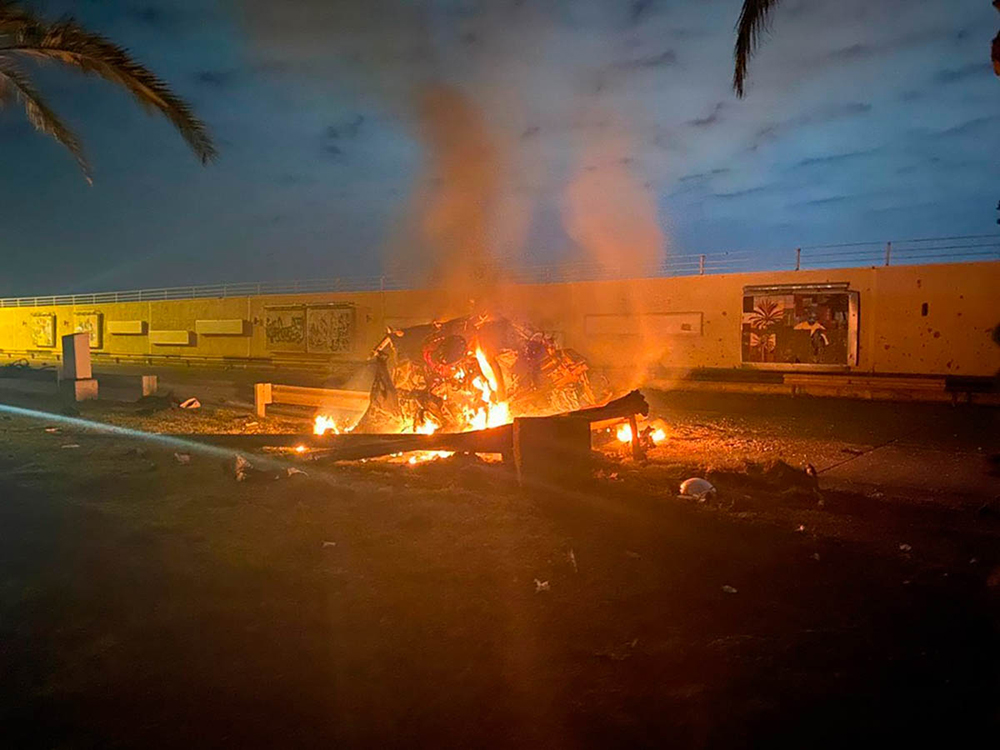
A burning vehicle at Baghdad International Airport following an American airstrike, early Friday, Jan. 3, 2020. The Pentagon said Thursday that the U.S. military has killed Gen. Qassem Soleimani, the head of Iran’s elite Quds Force, at the direction of President Donald Trump.
Photo from the Iraqi Prime Minister’s Press Office via Wikimedia Commons.
The Iranians had been getting uppity for a while, but then their punks killed an American contractor in a rocket attack on a U.S. base – and let’s not get distracted about whether we should still be there. They killed an American. We are there, and you don’t get a pass on murdering U.S. citizens because we may or may not have a good reason for them still being there. You get dead.
See, for too long we were asking the wrong question when tinpot dictators dared hurt Americans. We asked, “What would a gender-fluid Oppression Studies major at Yale do?” As I have observed before, the correct question is “WWJC do?” – “What would Julius Caesar do?”
Trump ordered hard hits at five Shiite militia weapon sites, and not with any warnings either. They got one of ours, we got about two dozen of theirs. Like the old joke about 1,000 lawyers at the bottom of the sea, that’s a good start.
The Iranians, whose Islamic Revolutionary Guard Corps is the ultimate source of most of the Shiite terror in the world, decided to respond in what they thought was a clever way: send a few thousand of their camo-clad dummies to attack the embassy and hope and pray a bunch of them got mowed down on camera. In the meantime, wave a lot of banners, burn some stuff, and pound on the reinforced glass for the press’s benefit.
But apparently, no one told the “mourners,” as the austere scholars at the endlessly useless New York Times dubbed the members of Islamic Antifa, that they were supposed to get smoked. They went home with the embassy unseized. Getting martyred en masse is not that much fun when you’re just one sucker out of dozens – heck, they may run of virgins.
See, Trump made it clear he was not playing. There would be no Benghazi II: Bagdad Boogaloo on his watch, and he acted well before 13 hours ran on the clock. Rejecting the elite’s preferred model of craven submission to every Third World cretin with a grievance and a camera, the Trump administration flew some Apache gunships over the crowd of unwashed morons, kicking off some flares, and generally sending the unequivocal message that if those SOBs had a problem, the AH-64s had a 30mm solution.
And then the administration sent in 100 Marines, about a company, on Ospreys as a quick reaction force and alerted the ready brigade at Ft. Bragg to start shutting 82nd Airborne Division paratroopers into theater.
Whatever the opposite of “stand down” is, Trump ordered that.
Comments Off on Trump versus Iran (and significant parts of the US and western media)


