
Those Puritans who snort against the current dances are quite right when they argue that the tango and the shimmie are violently aphrodisiacal, but what they overlook is the fact that the abolition of such provocative wriggles would probably revive something worse, to wit, the Viennese waltz. The waltz never quite goes out of fashion; it is always just around the corner; every now and then it comes back with a bang. And to the sore harassment and corruption, I suspect, of chemical purity, the ideal of all right-thinkers. The shimmie and the tango are too gross to be very dangerous to civilized human beings; they suggest drinking beer out of buckets; the most elemental good taste is proof enough against them. But the waltz! Ah, the waltz, indeed! It is sneaking, insidious, disarming, lovely. It does its work, not like a college-yell or an explosion in a munitions plant, but like the rustle of the trees, the murmur of the illimitable sea, the sweet gurgle of a pretty girl. The jazz-band fetches only vulgarians, barbarians, idiots, pigs. But there is a mystical something in “Weiner Blut” or “Kiinstler Leben” that fetches even philosophers.
The waltz, in fact, is magnificently improper the art of tone turned bawdy. I venture to say that the compositions of one man alone, Johann Strauss II, have lured more fair young creatures to lamentable complaisance than all the hypodermic syringes of all the white slave scouts since the fall of the Western Empire. There is something about a waltz that is simply irresistible. Try it on the fattest and sedatest or even upon the thinnest and most acidulous of women, and she will be ready, in ten minutes, for a stealthy kiss behind the door nay, she will forthwith impart the embarrassing news that her husband misunderstands her, and drinks too much, and cannot appreciate Maeterlinck, and is going to Cleveland, 0., on business to-morrow …
H.L. Mencken, “The Allied Arts: Tempo di Valse”, Prejudices: Second Series, 1920.
December 28, 2013
QotD: Dance
December 5, 2013
Happy Repeal Day!
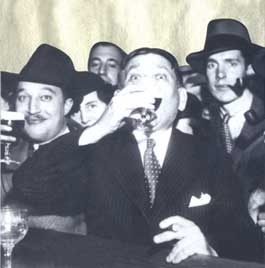
Eighty years ago today, the US finally repealed Prohibition. Baltimore’s own H.L. Mencken was among the first to publicly celebrate the demise of the hated legislation:
Published on 5 Dec 2012
In honor of Repeal Day, which celebrates the end of America’s “noble experiment” in banning alcoholic beverages, Reason TV is happy to introduce you to George Cassiday, a man whose life and work should be taught to every schoolkid — and to every member of Congress hell-bent on legislating the nation’s morals.
From 1920 through 1930 — the thick of the Prohibition era — Cassiday supplied illegal liquor throughout the halls of Congress. Known as “The Man in the Green Hat,” Cassiday was the Capitol’s highest-profile bootlegger, with a client list that included senior members of the Republican and Democratic Parties. How instrumental was he to the D.C. power elite? He even had his own office in the House and Senate office buildings.
Cassiday gave up the liquor trade after his arrest in 1930, but gained notoriety by penning a series of front-page articles for The Washington Post about his days as Congress’ top bottle man.
Though he never named names, Cassiday’s stories detailed every aspect of his former business — and the depths of hypocrisy in Washington. By his own estimation, “four out of five senators and congressmen consume liquor either at their offices or their homes.” Appearing days before the 1930 mid-term elections, Cassiday’s revelations caused a national stir and helped sweep pro-Prohibitionist — and ostensibly tee-totaling — congressmen and senators out of power.
Today, with the rise of cocktail culture and prohibition-vogue in full swing, Cassiday’s life and legacy are being re-discovered. Through books such as Garrett Peck’s Prohibition in Washington, D.C.: How Dry We Weren’t to New Columbia Distillery’s Green Hat Gin, the remarkable story of George Cassiday — “The Man in the Green Hat” — is again being told.
Reason TV spoke with Cassiday’s son, Fred, author Garrett Peck, and New Columbia Distillery’s John Uselton to discuss George Cassiday and the end of Prohibition.
October 3, 2013
QotD: Biographies of Abraham Lincoln
… Lincoln is yet to be got vividly between the covers of a book. The Nicolay-Hay work is quite impossible; it is not a biography, but simply a huge storehouse of biographical raw materials; whoever can read it can also read the official Records of the Rebellion. All the other standard lives of old Abe — for instance, those of Lamon, Herndon and Weil, Stoddard, Morse and Miss Tarbell — fail still worse; when they are not grossly preachy and disingenuous they are trivial. So far as I can make out, no genuinely scientific study of the man has ever been attempted. The amazing conflict of testimony about him remains a conflict; the most elemental facts are yet to be established; he grows vaguer and more fabulous as year follows year. One would think that, by this time, the question of his religious views (to take one example) ought to be settled, but apparently it is not, for no longer than a year ago there came a reverend author Dr. William E. Barton, with a whole volume upon the subject, and I was as much in the dark after reading it as I had been before I opened it. All previous biographers, it appeared by this author’s evidence, had either dodged the problem, or lied. The official doctrine, in this as in other departments, is obviously quite unsound. One hears in the Sunday-schools that Abe was an austere and pious fellow, constantly taking the name of God in whispers, just as one reads in the school history-books that he was a shining idealist, holding all his vast powers by the magic of an inner and ineffable virtue. Imagine a man getting on in American politics, interesting and enchanting the boobery, sawing off the horns of other politicians, elbowing his way through primaries and conventions, by the magic of virtue! As well talk of fetching the mob by hawking exact and arctic justice! Abe, in fact, must have been a fellow highly skilled at the great democratic art of gum-shoeing. I like to think of him as one who defeated such politicians as Stanton, Douglas and Sumner with their own weapons — deftly leading them into ambuscades, boldly pulling their noses, magnificently ham-stringing and horn-swoggling them — in brief, as a politician of extraordinary talents, who loved the game for its own sake, and had the measure of the crowd. His official portraits, both in prose and in daguerreotype, show him wearing the mien of a man about to be hanged; one never sees him smiling. Nevertheless, one hears that, until he emerged from Illinois, they always put the women, children and clergy to bed when he got a few gourds of corn aboard, and it is a matter of unescapable record that his career in the State Legislature was indistinguishable from that of a Tammany Nietzsche.
But, as I say, it is hopeless to look for the real man in the biographies of him: they are all full of distortion, chiefly pious and sentimental. The defect runs through the whole of American political biography, and even through the whole of American history.
H.L. Mencken, “Roosevelt: An Autopsy”, Prejudices, part 2, 1920.
July 1, 2012
H.L. Mencken’s New Dictionary turns 70
Terry Teachout celebrates the 70th anniversary of the original publication of H.L. Mencken’s New Dictionary of Quotations on Historical Principles From Ancient and Modern Sources:
The “New Dictionary” was a byproduct of its prolific editor’s fanatically industrious journalistic career. For years Mencken maintained a card file of quotations “that, for one reason or another, interested me and seemed worth remembering, but that, also for one reason or another, were not in the existing quotation-books.” In 1932 he decided to turn it into a book. When the “New Dictionary” finally saw print a decade later, Time praised it as “one of the rare books that deserve the well-worn phrase ‘Here at last.'”
Painstakingly organized and cross-referenced by subject, with each entry arranged in chronological order by date of original publication, the “New Dictionary” is formidably wide-ranging. Indeed, the only major writer missing from its index is Mencken himself. (“I thought it would be unseemly to quote myself,” he told a curious reporter. “I leave that to the intelligence of posterity.”) Its 1,347 pages abound with such innocent-sounding rubrics as “Civilization,” “Flag, American,” “Hell,” “Hypocrisy,” “Old and New” and “Science and Religion.” At first glance you might mistake it for a cornucopia of the world’s wisdom—but don’t let appearances fool you. The fathomlessly cynical Mencken wisely warned his readers in the preface that the “New Dictionary” was aimed at “readers whose general tastes and ideas approximate my own…. The Congressman hunting for platitudes to embellish his eulogy upon a fallen colleague will find relatively little to his purpose.”
He wasn’t kidding. Look up “Evolution,” for example, and you’ll find this 1925 statement by the Bible-thumping evangelist Billy Sunday: “If a minister believes and teaches evolution, he is a stinking skunk, a hypocrite, and a liar.” Look up “Critic” and you’ll be confronted with a rich catalog of ripe insults, among them this passage from Samuel Coleridge’s “Modern Critics”: “All enmity, all envy, they disclaim, / Disinterested thieves of our good name: / Cool, sober murderers of their neighbor’s fame.” Or check out “Irish,” under which can be found no less than a page of invidious comments, including a sideswipe from, of all people, Gerard Manley Hopkins: “The ambition of the Irish is to say a thing as everybody says it, only louder.”
Teachout is the author of a brilliant biography of Mencken: The Sceptic: A Life of H.L. Mencken, which I happen to be re-reading at the moment. For more on Mencken himself, the wikipedia entry is here.
October 26, 2011
Dan Gardner on how to rate politicians
Dan Gardner provides a handy way to scale the achievements of politicians:
The central dilemma facing any elected politician is this: What is good is often not popular and what is popular is often not good.
Most politicians want to do good. But in order to do anything, good or otherwise, they must first hold power, and the only way to do that is to promise and deliver what is popular. Thus, politicians are pulled between doing what is good and what is popular.
Imagine a Venn diagram with two partially overlapping circles. One is labelled “good politics.” The other “good policy.” That’s the whole game.
It’s also a handy way of judging politicians.
The Bad Politician is one who is only concerned with the “good politics” circle. Fortunately, they are less common than cynics think. H.L. Mencken had the Bad Politician in mind when he observed that “the saddest life is that of a political aspirant under democracy. His failure is ignominious and his success is disgraceful.”
The Average Politician finds the area that clearly lies in both circles and stays there. He may make occasional road trips into good politics/bad policy but he avoids good-policy/bad politics like an alcoholic avoids dry counties. This is a crowded category.
The Good Politician finds previously unidentified areas where policy and politics overlap and occasionally risks his popularity by supporting good policies that are bad politics. Every politician claims to make this grade — “It may not be popular to promise sunshine and lollipops but, by golly, it’s the right thing to do!” — and yet only a minority ever do.
The Great Politician expands the “good politics” circle so that more good policy — as he sees it — becomes good politics. In a phrase, the Great Politician leads.
As he quite correctly points out, our current prime minister is an Average Politician, and Gardner is being neither too critical nor too generous in that assessment. Stephen Harper is very good at finding ways to back popular policies without alienating too many of his supporters (the recent shipbuilding contract process is a good example).
December 25, 2010
Merry Christmas!
Among my gifts this year, I received the H.L. Mencken collection Prejudices, so I’ve got lots to read over the next few days.
I also received the “Yes, Minister” and “Yes, Prime Minister” DVD collections, although getting a chance to play them will probably not come up for a few days, given how many other DVDs were exchanged as gifts this year.
I hope your Christmas (if you celebrate it) was equally happy.
Now, turn off your browser and go enjoy yourself offline!
November 4, 2010
Something I’m adding to my Christmas list
H.L. Mencken was a literary giant in the 1920s and into the 1930s, but fell from the pinnacle of popularity as the Great Depression hit. His consistent opposition to FDR and the New Deal moved him further and further away from the limelight, and his outspoken opposition to the war rendered him all but unpublishable from 1941 until his death. A large collection of his shorter works from 1914 through 1927 were published in Prejudices, running to six volumes.
The books are back in print, in two large volumes, through Library of America. An excerpt from the New York Review of Books just starts to get interesting before the cut-off for non-subscribers:
The material that H.L. Mencken published in a series of six volumes under the title Prejudices was a collection of his journalism written between 1914 and the late 1920s. Most of it, he told a good friend on publication of the first volume in 1919, was “light stuff” with an occasional “blast from the lower woodwind” that would “outrage the umbilicari, if that is the way to spell it.” Such books, he added, were “mere stinkpots, heaved occasionally to keep the animals perturbed.”
Most of the pieces in the first volume — or “series,” as it was called — had originally appeared in The Smart Set, the magazine he had edited since 1914, but they also included articles published in newspapers, as well as material written especially for the book. A painstaking editor of his own work, Mencken also did a good bit of rewriting; stinkpot or not, this was not to be a quick harum-scarum hustling of secondhand goods but a high-quality piece of prose from a master.
Its commercial success surprised him as well as his friend and publisher, Alfred Knopf, who seemed to realize for the first time that Mencken had a promising future, or, as he expressed it to his author, “that H.L. Mencken has become a good property.” The book was quickly followed by Prejudices: Series Two, Series Three, and so on to a final Series Six in 1927, by which time Mencken had developed from a good property into the most exciting literary figure in the country.
H/T to Mark at Unambiguously Ambidexterous for the link.
September 27, 2010
Air travel: does the punishment fit the crime?
Terry Teachout isn’t enjoying his air travel experiences on his current trip. A selection of his Twitter updates from this morning:
First: I’m at LaGuardia and seized with an all-consuming hatred for air travel, every aspect of which is disgusting, degrading, and dehumanizing.
Second: I’d also like to throttle most of my fellow travelers, including all who are conducting cell-phone conversations within earshot of me.
Third: Finally, I’d like to offer a special welcome in hell to the people at Gate D6 who are reading self-evidently stupid books and magazines.
Fourth: Gee, you wouldn’t think that I’m H.L. Mencken’s biographer, would you?
Fifth: “Democracy is the theory that the common people know what they want, and deserve to get it good and hard.”
Sixth: I guess I’m in what I like to call one of my exterminate-all-the-brutes moods. This, too, shall pass…
As I’ve mentioned before, I’ve pretty much given up on air travel since my last flight experience. I’ll use it for extreme long distance or trans-oceanic travel, but otherwise, I’ll continue to avoid it as much as possible. (Probably my worst trip overlapped with one of the attempted terrorist attacks.)
July 22, 2010
Cultivating a taste for parody
The Economist reviews The Oxford Book of Parodies by John Gross:
Writing a parody is hard. In the 1940s, a competition in the New Statesman invited readers to parody Graham Greene. Greene himself entered under a pseudonym and only came second. Get it right, though, and you have a withering form of criticism and an immortal entertainment rolled into one. John Gross’s new anthology of parodies in English (with a few foreign titbits) has samples both high and low of this diverse genre.
[. . .]
Any well-known poem or character is fair game. A.A. Milne’s Christopher Robin is revisited as an ailing pensioner who has retired to Spain (“He peers through a pair of bifocals;/He talks quite a lot to a bear that he’s got/Who is known as El Pu to the locals.”) Ezra Pound wrote a wintry variation on “Sumer is icumen in” (“…skiddeth bus and sloppeth us…”) But why limit oneself to a single writer? Portmanteau parodies let writers do two voices at once, thus “Chaucer” rewrites Sir John Betjeman (“A Mayde ther was, y-clept Joan Hunter Dunn…”) and “Dylan Thomas” redoes “Pride and Prejudice” (“It is night in the smug snug-as-a-bug-in-a-rug household of Mr and Mrs Dai Bennet and their simpering daughters — five breast-bobbing man-hungry titivators, innocent as ice-cream, panting for balls and matrimony.”)
[. . .]
Documents, philosophies and schools of thought can be good fodder, too. H.L. Mencken did a “Declaration of Independence in American” (“When things get so balled up that the people of a country got to cut loose from some other country, and go it on their own hook, without asking no permission from nobody, excepting maybe God Almighty, then they ought to let everybody know why they done it, so that everybody can see they are not trying to put nothing over on nobody . . .”)


