Quotulatiousness

June 11, 2010

It’s not really about market share: that’s just keeping score

Filed under: Technology — Tags: , , , , , , — Nicholas @ 16:45

Eric Raymond thinks a lot of people are missing the point on the ongoing iPhone-Android battle:

It’s not about whether or not Apple will be crushed. It’s not about who makes the “best” products, where “best” is measured by some interaction between the product and the speaker’s evaluation of the relative importance of various features and costs. It’s about what the next generation of personal computing platforms will be. Down one fork they’ll be open, hackable, and user-controlled. Down the other they’ll be closed, locked down, and vendor-controlled. Though there are others on each side of this struggle, in 2010 it comes down to whether Apple or Android wins the race to over 50% smartphone market share; after that point, network effects will become self-reinforcing until the next technology disruption.

If he’s right — and he very well might be — then Apple’s moderately disappointing upgrades in the newly announced iPhone 4 may have handed the long-term advantage to Google. This may be bad news for Apple shareholders, but it’ll be a long-term positive for mobile computing.

May 22, 2010

Copyright suits . . . and profanity

Filed under: Humour, Law, Technology — Tags: , , — Nicholas @ 11:27

Cory Doctorow finds fulfilling both interests easy in this case:

You know what I’m interested in? Copyright lawsuits.

And profanity.

Lucky for me, Google and Viacom have provided both today, in the form of a series of emails released through the discovery process in Viacom’s billion-dollar lawsuit against YouTube. In these emails, the two companies take turns cussin’ and spittin’ and swearin’ about each other. Hilarity ensues. Ars Technica rounds up some of the highlights.

May 11, 2010

Android alert!

Filed under: Economics, Technology — Tags: , , , , , — Nicholas @ 12:24

Apple fanboi faithful must be having mass cases of the vapours with the news that Android sales are eating everyone’s lunch:

I’ve written before that I think Google has been running a long game aimed against the telecomms carriers’ preferred strategy of customer lock-in, and executing on that game very well. Against the iPhone, its strategy has been a classic example of what the economist Clayton Christensen called “disruption from below” in his classic The Innovator’s Dilemma. With the G-1, Google initially competed on price, winning customers who didn’t want to pay Apple/AT&T’s premium and were willing to trade away Apple’s perceived superiority in “user experience” for a better price. Just as importantly, Android offered a near-irresistible deal to the carriers: months, even years slashed off time-to-market for a state-of-the-art cellphone; a huge advantage in licensing costs; and the illusion (now disintegrating) that said carriers would be able to retain enough control of Android-powered devices to practice their habitual screw-the-customer tactics.

In Christensen’s model, a market being disrupted from below features two products, sustaining and disrupter, both improving over time but with the disruptor at a lower price point and lesser capabilities. Typically, the sustaining company will be focused on control of its customers and business partners to extract maximum margins; on the other hand, the disruptor will be playing a ubiquity game, sacrificing margin to gain share. The sustaining company will gold-plate its product in order to chase high-end price-insenstive customers; the disruptor will seek out price-sensitive low-end customers.

I have to admit, I didn’t see this coming . . . I thought Google was mistaken to put so much development effort into the mobile phone market. I was clearly wrong about that.

In the smartphone market I have been expecting a disruptive break that would body-slam Apple’s market share, but I expected it to be several quarters in the future and with a really fast drop-off when it happened. Instead, it looks like Apple took a bruising in 4Q 2009 and has failed to regain share in 1Q 2010 while Android sales continued to rocket. Android hammered market-leader Blackberry just as badly, a fact which has gooten far less play than it probably should because the trade-press loves the drama of the Apple-vs.-Google catfight so much.

What actually seems to be going on here is that Android is successfully disrupting both Apple and Blackberry from below; together they’ve lost about 25% of market share, not enough to put Android on top but close enough that another quarter like the last will certainly do that.

I’ve heard several comments from folks that Apple’s iPhone sales are probably lower because of the widespread interest in the “next” iPhone model, which is likely to be announced in the next few weeks. Apple has followed this pattern since introducing the original iPhone, but there’s no rule saying they can’t break the pattern.

I’ll be interested in the announcement, as I’ll have a year left in my Rogers contract, so if the next iPhone isn’t a block-buster, I’ll be considering other options for when I’m out of contract.

April 30, 2010

The revolution is almost complete . . . hold on tight

Filed under: Economics, Technology — Tags: , , , , , — Nicholas @ 16:25

Charles Stross thinks he understands why Steve Jobs won’t allow Adobe Flash on to the iPhone and iPad:

Steve Jobs believes he’s gambling Apple’s future — the future of a corporation with a market cap well over US $200Bn — on an all-or-nothing push into a new market. HP have woken up and smelled the forest fire, two or three years late; Microsoft are mired in a tar pit, unable to grasp that the inferno heading towards them is going to burn down the entire ecosystem in which they exist. There is the smell of panic in the air, and here’s why . . .

We have known since the mid-1990s that the internet was the future of computing. With increasing bandwidth, data doesn’t need to be trapped in the hard drives of our desktop computers: data and interaction can follow us out into the world we live in. Modem uptake drove dot-com 1.0; broadband uptake drove dot-com 2.0. Now everyone is anticipating what you might call dot-com 3.0, driven by a combination of 4G mobile telephony (LTE or WiMax, depending on which horse you back) and wifi everywhere. Wifi and 4G protocols will shortly be delivering 50-150mbps to whatever gizmo is in your pocket, over the air. (3G is already good for 6mbps, which is where broadband was around the turn of the millennium. And there are ISPs in Tokyo who are already selling home broadband delivered via WiMax. It’s about as fast as my cable modem connection was in 2005.)

[. . .]

This is why there’s a stench of panic hanging over silicon valley. this is why Apple have turned into paranoid security Nazis, why HP have just ditched Microsoft from a forthcoming major platform and splurged a billion-plus on buying up a near-failure; it’s why everyone is terrified of Google:

The PC revolution is almost coming to an end, and everyone’s trying to work out a strategy for surviving the aftermath.

Read the whole thing. I don’t see any obvious flaw in his line of thought. It may not happen the way he predicts, but it is consistent with what we know, and it should frighten the heck out of Apple’s competitors.

April 1, 2010

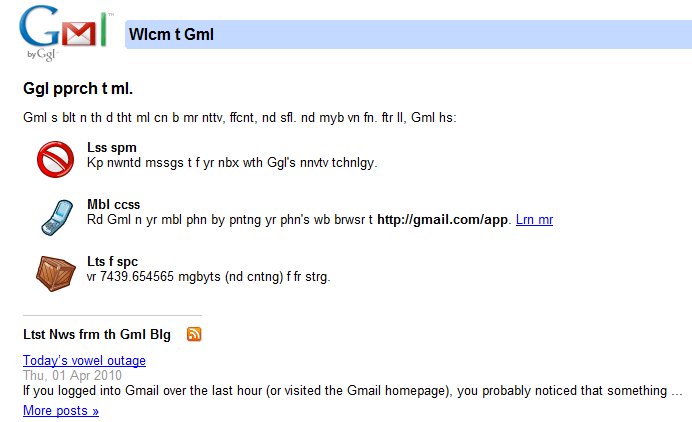
Gmail’s latest problem

Filed under: Humour, Technology — Tags: , — Nicholas @ 15:57

December 21, 2009

The evolution of the smart phone

Filed under: Technology — Tags: , , — Nicholas @ 09:30

Charles Stross looks at the rapid changes in the mobile computing and telephone markets brought about by the smart phone:

Pre-2005, digital mobile phones typically ran on GSM, with GPRS data limited to 56kbssec, or Verizon’s CDMA. This badly choked their ability to do anything useful and internet-worthy. By 2005, the first 3G networks based on WCDMA (aka UMTS) began to open up. By 2009, 3G HSDPA networks can carry up to 7.2mbps. The modem-grade data throughput of the mid-noughties smartphone experience has been replaced by late-noughties broadband grade throughput, at least in the densely networked cities where most of us live. (I am not including the rural boondocks in this analysis. Different rules apply.)

To the mobile phone companies, 3G presented a headache. They typically offered each government billions for the right to run services over the frequencies freed up by the demise of old analog mobile phone services and early TV and other broadcast systems; how were they to monetise this investment?

They couldn’t do it by charging extra for the handsets or access, because they’d trained their customers to think of mobile telephony as, well, telephony. But you can do voice or SMS perfectly well over a GSM/GPRS network. What can you do over 3G that justifies the extra cost?

Version 1 of their attempt to monetise 3G consisted of walled gardens of carefully cultivated multimedia content — downloadable movies and music, MMS photo-messaging, and so on. The cellcos set themselves up as gatekeepers; for a modest monthly fee, the customers could be admitted to their garden of multimedia delights. But Version 1 is in competition with the internet, and the roll-out of 3G services coincided (and competed) with the roll-out of wifi hotspots, both free and for-money. It turns out that what consumers want of a 3G connection is not what a mobile company sees fit to sell them, but one thing: bandwidth. Call it Version 2.

Becoming a pure bandwidth provider is every cellco’s nightmare: it levels the playing field and puts them in direct competition with their peers, a competition that can only be won by throwing huge amounts of capital infrastructure at their backbone network. So for the past five years or more, they’ve been doing their best not to get dragged into a game of beggar-my-neighbour, by expedients such as exclusive handset deals (ever wondered why AT&T in America or O2 in the UK allowed Apple to tie their hands and retain control over the iPhone’s look and feel?) and lengthening contractual lock-in periods for customers (why are 18-month contracts cheaper than 12-month contracts?).

October 8, 2009

Google’s neglect of its USENET archive

Filed under: Economics, History, Technology — Tags: , , — Nicholas @ 08:05

Maybe giving Google a monopoly over all those millions of out of date books won’t work out as well as we might hope. They’ve (kinda) been here before, and the results weren’t what you would expect. For those who remember the “good old days” when USENET was the place to be (before the Web, it was the best thing online), Kevin Poulsen looks at what happened after Google took over the effective ownership of the archive:

Salon hailed the accomplishment in an article headlined “The geeks who saved Usenet.” “Google gets the credit for making these relics of the early net accessible to anyone on the web, bringing the early history of Usenet to all.”

Flash forward nearly eight years, and visiting Google Groups is like touring ancient ruins.

On the surface, it looks as clean and shiny as every other Google service, which makes its rotting interior all the more jarring — like visiting Disneyland and finding broken windows and graffiti on Main Street USA.

Searching within a newsgroup, even one with thousands of posts, produces no results at all. Confining a search to a range of dates also fails silently, bulldozing the most obvious path to exploring an archive.

Want to find Marc Andreessen’s historic March 14, 1993 announcement in alt.hypertext of the Mosaic web browser? “Your search — mosaic — did not match any documents.”

July 13, 2009

Google or Bing? Try them side-by-side

Filed under: Technology — Tags: , , — Nicholas @ 10:23

Craig Zeni sent along this useful link, which allows you to check the results of a search sent to both Bing and Google (so far, in my tests, Google is the hands-down winner): http://www.bing-vs-google.com/.

(Cross-posted to the old blog, http://bolditalic.com/quotulatiousness_archive/005576.html.)

« Newer Posts

Powered by WordPress


