Quotulatiousness

June 24, 2013

Irish bank bailouts based on lies and deception

Filed under: Europe, Government — Tags: , , , — Nicholas @ 09:39

In the (Irish) Independent, Paul Williams explains what the bankers did to force the Irish government to bail them out:

TAPE RECORDINGS from inside doomed Anglo Irish Bank reveal for the first time how the bank’s top executives lied to the Government about the true extent of losses at the institution.

The astonishing tapes show senior manager John Bowe, who had been involved in negotiations with the Central Bank, laughing and joking as he tells another senior manager, Peter Fitzgerald, how Anglo was luring the State into giving it billions of euro.

Mr Fitzgerald had not been involved in the negotiations with the Central Bank and has confirmed he was unaware of any strategy or intention to mislead the authorities. Mr Bowe, in a statement last night, categorically denied that he had misled the Central Bank.

The audio recordings are from the bank’s own internal telephone system and date from the heart of the financial crisis that brought the State to its knees in September 2008.

Anglo itself was within days of complete meltdown — and in the years ahead would eat up €30bn of taxpayer money. Mr Bowe speaks about how the State had been asked for €7bn to bail out Anglo — but Anglo’s negotiators knew all along this was not enough to save the bank.

The plan was that once the State began the flow of money, it would be unable to stop.

May 2, 2013

Fraudster who sold fake bomb detectors to Iraq jailed for ten years

Filed under: Britain, Law, Middle East, Technology — Tags: , , , — Nicholas @ 08:54

Under the circumstances, a ten year sentence is pretty lenient:

Fraudster James McCormick has been jailed for 10 years for selling fake bomb detectors.

McCormick, 57, of Langport, Somerset perpetrated a “callous confidence trick”, said the Old Bailey judge.

He is thought to have made £50m from sales of more than 7,000 of the fake devices to countries, including Iraq.

The fraud “promoted a false sense of security” and contributed to death and injury, the judge said. He also described the profit as “outrageous”.

Police earlier said the ADE-651 devices, modelled on a novelty golf ball finder, are still in use at some checkpoints.

Sentencing McCormick, Judge Richard Hone said: “You are the driving force and sole director behind [the fraud].”

He added: “The device was useless, the profit outrageous, and your culpability as a fraudster has to be considered to be of the highest order.”

One invoice showed sales of £38m over three years to Iraq, the judge said.

The bogus devices were also sold in other countries, including Georgia, Romania, Niger, Thailand and Saudi Arabia.

April 23, 2013

Seller of fake bomb detectors found guilty of fraud

Filed under: Britain, Law, Middle East, Technology — Tags: , , , , — Nicholas @ 11:01

Back in 2010, I said “There should be a special hell for this scam artist” who mocked up bomb detector kits and sold them for thousands of dollars in Iraq and other areas with a real need for protection against IEDs. It’s taken more than three years, but he’s finally been found guilty:

A Somerset-based businessman has been convicted of three counts of fraud over the sale of bogus bomb detectors after his operation was exposed in a BBC Newsnight investigation in 2010.

This was a scam of global dimensions. James McCormick marketed his fake bomb detectors around the world, selling them in Georgia, Romania, Niger, Thailand, Saudi Arabia and beyond.

But his main market was Iraq, where lives depended on bomb detection and where the bogus devices were, and still are, used at virtually every checkpoint in the capital.

Between 2008 and 2009 alone, more than 1,000 Iraqis were killed in explosions in Baghdad.

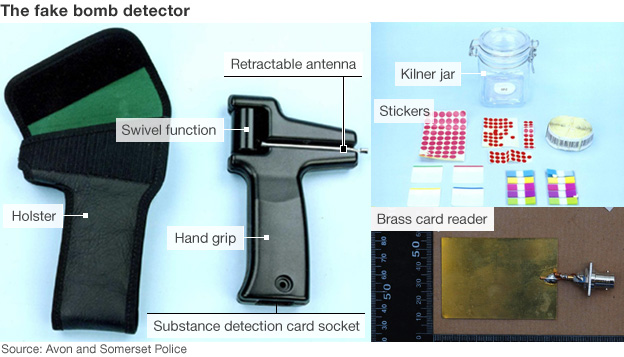
ADE-651 fake bomb detector

How the device was meant to work:

  1. A small amount of the substance the user wished to detect — such as explosives — was put in a Kilner jar along with a sticker that was intended to absorb the “vapours” of the substance
  2. The sticker was then placed on a credit-card sized card, which was read by a card reader and inserted into the device
  3. The user would then hold the device, which had no working electronics, and the swivelling antenna was meant to indicate the location of the sought substance

In other words, a magical dowsing stick that depended on the user to “detect” whatever the device was supposedly seeking. This wasn’t a case of a device that didn’t do what it was designed to do: it was a deliberate fraud with just enough “technological” mumbo-jumbo to appear to be a solution to a real problem:

The court heard that McCormick began his business by buying a batch of novelty “golf ball detectors” from the USA for less than $20 each. In fact they were simply radio aerials, attached by a hinge to a handle. He put the labels of his company, ATSC, on them and sold them as bomb detectors for $5,000 each.

He then made a more advanced-looking version which he was to sell for up to $55,000. The ADE-651 came with cards which he claimed were “programmed” to detect everything from explosives to ivory and even $100 bills. Police say the only genuine part of the kit — and the most expensive — was the carrying case.

To their credit, the police moved to investigate the same day the BBC’s original story broke. Strategy Page explained why the scam had been so easy to sell. Later it was reported that British civil servants and military personnel had been implicated in the fraud.

March 4, 2013

Hollywood accounting tricks … bring your own popcorn for this one

Filed under: Business, Law, Media, USA — Tags: , — Nicholas @ 13:01

At Techdirt, Mike Masnick is looking forward to some amusing courtroom antics as this case comes up:

We’ve discussed a few times the concept of Hollywood Accounting, which covers the various tricks of the trade pulled by the big studios to basically keep all the money for themselves, and guarantees that the movie is never, ever seen as “profitable,” as that would mean they would need to share some of the profits. It appears that we may be about to see significantly more dirty laundry revealing some of that Hollywood Accounting in detail. And this time, it’s extra special because it involves two companies who were corporate siblings for much of the time in dispute, as both were owned by Vivendi. However, StudioCanal is now suing Universal, claiming that Universal pulled accounting tricks to deny giving StudioCanal many, many millions of dollars that were owed.

December 17, 2012

QotD: Argentina’s little white interest rate lie

Filed under: Americas, Economics, Quotations — Tags: , , , , , — Nicholas @ 09:49

No one gives a toss that Argentina is lying about its inflation rate. Well, except maybe the economists they’ve fined and ruined for calculating the real one. We’ve all put up with Cuba lying about everything for 60 years after all.

Except, except … Argentina has issued index linked bonds as part of the 2001/2 debt restructuring. The interest paid depends on what the inflation rate is. If the government deliberately undercounts inflation then they get away with rooking the holders of those bonds.

That’s what this is about. That’s why anyone cares. It’s not simply that they’re liars it’s that they’re thieves.

Tim Worstall, “I wish people would get it right about Argentina”, Tim Worstall, 2012-12-17

November 21, 2012

Piltdown Man

Filed under: Britain, History, Science — Tags: , , — Nicholas @ 09:33

History Today tweeted that today is the anniversary of the exposure of the Piltdown Man hoax in 1953:

Once cited as the ‘missing link’ between man and beast and definitive proof of the theory of evolution, the Piltdown Man was exposed as a hoax in 1953. Eoanthropus Dawsoni was ‘excavated’ in 1912 by amateur archaeologist Charles Dawson from a shallow gravel pit in Piltdown, Sussex. Great excitement greeted his find, as at the time fewer than five human fossils had been discovered and most of those were incomplete, their dates uncertain and — almost worst of all at a time of intense imperial rivalry — they were foreign. France and Belgium had long boasted Neanderthal skeletons. Germany had Heidelburg Man. Now here, at last, was the first great British palaeoanthropological find. The Piltdown Man, as he was immediately dubbed, was the ‘first Englishman’ and he caused a world sensation.

[. . .]

As time passed and more evidence was disinterred, Piltdown Man became more and more of an anomaly, marginalised in evolutionary theory but remaining on the syllabus. Students were writing dissertations on Piltdown in the 1950s. Then in 1953, following a lecture on Piltdown at the British Museum, South African born Doctor Joseph S. Weiner had an epiphany on the train home to Oxford: Piltdown had to be a fraud.

With his friend and colleague Geoffrey Ainsworth Harrison, who is now the Professor of Biological Anthropology at Oxford, Weiner set about collecting as much evidence as he could before approaching the Head of the Anatomy Department at Oxford, Professor Wilfrid Edward Le Gros Clark. Using the latest scientific techniques, including fluorine measurement and radiocarbon dating, the team proved that the mandible of Eoanthropus Dawsoni had been deliberately stained with potassium bichromate and the teeth filed down. The jaw was later shown to have come from an orangutan.

November 2, 2012

California tax collectors discover exciting new technique: double billing

Filed under: Bureaucracy, Government, USA — Tags: , , — Nicholas @ 08:04

Let’s say you’re an honest, upstanding citizen who pays your taxes on time and in full. Let us also say you happen to live in California. What would you do when you got a bill from a different agency of the state government, saying you still owed an amount of money that you paid in your state taxes (and have the documentation to prove it)? David Friedman ponders whether this new approach to state fund-raising is fraud or mere incompetence:

I recently received a bill from the California Board of Equalization (BOE) demanding that I pay them about three hundred dollars in use tax. That puzzled me, since I had already paid the use tax with my California state income tax return—my reporting it on that return is the only reason the BOE knew that I owed it. Just to be sure, I went online and checked my account with the Franchise Tax Board, the body that collects California income tax—it showed me owing nothing.

So I called the number for the BOE. The woman I spoke with told me that they had not received the money from the FTB and that if I did not want them to bill me for it I should call the FTB and have them take care of the matter. I called the number she gave me, got an FTB phone tree with no option of talking to a human being and no reference to use tax.

[. . .]

It is possible, of course, that I am misinterpreting incompetence as dishonesty—that at some stage in the process someone made a mistake, which will now be corrected. One reason I doubt that is that what the letter I received said was:

    “According to information provided to us by the Franchise Tax Board (FTB), you reported a use tax liability on your state income tax return. However, FTB advised the funds were not available to be transferred to the State Board of Equalization (BOE), which is ultimately responsible for the collection of use tax.”

    “If the use tax was remitted with your FTB return, the use tax was either redirected to a FTB liability or refunded by FTB. Accordingly, the BOE is sending this letter to inform you that the use tax remains due (see enclosed billing notice)”

They do not say that I did not pay the money to the FTB, merely that the FTB did not pay it to them. And the final bit, which I missed in the initial draft of this post and have just added, makes it clear that if I paid the money but the FTB didn’t pass it on, they want me to pay it again.

October 26, 2012

QotD: Supporting the “undeserving” poor

Filed under: Government, Liberty, Quotations — Tags: , , — Nicholas @ 08:26

Two of the great and correct insights of libertarianism are that the state has very limited knowledge, and that its interventions often lead to people gaming the system. This is true of welfare spending as of anything else. The government doesn’t have the knowhow to distinguish well between the deserving and undeserving poor. And its efforts to do so are not only expensive — in terms of paying bureaucrats and corporate scroungers and fraudsters — but also bear heavily upon the honest and naive deserving poor whilst the undeserving, who know how to game the system, get off.

Chris Dillow, “Support the undeserving poor”, Stumbling and Mumbling, 2012-10-25

September 23, 2012

Canada is open for (shady) business

Filed under: Business, Cancon, Law — Tags: , , , — Nicholas @ 10:03

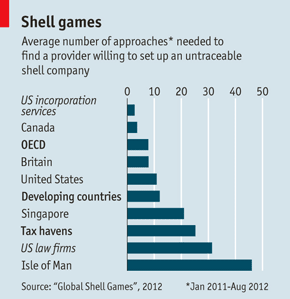
The Economist looks at the relative level of difficulty in setting up a shell corporation in various jurisdictions and how easy it is to create an untraceable shell:

Shell companies — which exist on paper only, with no real employees or offices — have legitimate uses. But the untraceable shell also happens to be the vehicle of choice for money launderers, bribe givers and takers, sanctions busters, tax evaders and financiers of terrorism. The trail has gone cold in many a criminal probe because law enforcers were unable to pierce a shell’s corporate veil.

The international standard governing shells, set by the inter-governmental Financial Action Task Force (FATF), is clear-cut. It says countries should take all necessary measures to prevent their misuse, such as ensuring that accurate information on the real (or “beneficial”) owner is available to “competent authorities”. More than 180 countries have pledged to follow it. A study* scrutinises the level of compliance worldwide. The results are depressing.

Posing as consultants, the authors asked 3,700 incorporation agents in 182 countries to form companies for them. Overall, 48% of the agents who replied failed to ask for proper identification; almost half of these did not want any documents at all. Contrary to conventional wisdom, providers in tax havens, such as Jersey and the Cayman Islands, were much more likely to comply with the standards than those from the OECD, a club of mostly rich countries. Even poor countries had a better compliance rate, suggesting the problem in the rich world is not cost but unwillingness to follow the rules (see chart). Only ten out of 1,722 providers in America required notarised documents in line with the FATF standard.

August 20, 2012

Why scam artists will never miss a meal

Filed under: Business, Economics — Tags: , — Nicholas @ 15:59

Megan McArdle on the perpetual lure of getting something for nothing:

…fraudsters and Ponzi schemers do not succeed at their scams merely because we let them. Recent financial frauds have big dollar signs attached, but at their heart, they’re often not much different from Nigerian email scams or a three-card monte game. They work best when they let the mark believe he’s getting away with something — often something illegal, or at least dishonest. It’s an old saw that “you can’t cheat an honest man,” but it’s mostly true. We are most vulnerable to Ponzi schemes and other confidence tricks when we start to believe that we can cheat the universe — that we can get something for nothing. The best con men succeed mostly because we are so desperate to believe them.

Even spectacular cases of financial fraud usually turn out to be remarkably banal in their execution. Embezzling grotesque sums rarely seems to require dazzling financial wizardry; all it takes is some basic clerical skills and a willingness to deceive.

After Peregrine Financial imploded last July, the firm’s president, Russell Wasendorf, confessed in a note related to a botched suicide attempt how he had misappropriated what seems to be more than half of his clients’ funds. The fraud was breathtaking in its audacity, and its simplicity: Wasendorf had been intercepting the bank statements and counterfeiting new ones using Photoshop and Excel. When auditors and regulators started confirming balances with banks, Wasendorf opened a P.O. box and put the address on the fake bank statements. When regulators started looking at online banking statements, he learned to fake those, too.

Bernie Madoff’s strategy wasn’t much more technically sophisticated than Wasendorf’s. And yet it seems to have been going on since at least the late 1980s, in large part because Madoff’s investors wanted an essentially guaranteed return of more than three times the annual rate of U.S. economic growth. They wanted, in short, to make quite a lot of money without working.

May 14, 2012

The shady back alleys of the wine trade

Filed under: Law, USA, Wine — Tags: — Nicholas @ 10:41

Benjamin Wallace (who wrote the fascinating book The Billionaire’s Vinegar, mentioned here in connection with a lawsuit), has a lengthy article in New York magazine about shady practices in the rare wine business, and the even shadier practitioners:

Among a privileged set, though, Kurniawan’s quirks and résumé gaps were of much less interest than his generosity. After one tasting, Wasserman hailed him for having “poured the sickest lineup of wines I have ever had in one evening” and told him that “the scepter, the crown, the ermine cape is yours.” Meadows, too, became a beneficiary of Kurniawan’s largesse, through which he tasted wines even he had never encountered. Grateful, he took pains to field Kurniawan’s often arcane queries about labeling and capsule nomenclature. “I thought at the time, ‘Jesus Christ, he must take these bottles to bed,’ ” Meadows says. Soon, he was publishing tasting notes based on Kurniawan bottles, lending his blue-chip imprimatur to the young man and his wines. Robert Parker, the world’s most powerful wine critic, also drank them and pronounced Kurniawan “a very sweet and generous man.”

[. . .]

In October 2004, Kurniawan posted on Parker’s website under the header “Last weekend where I tried to kill John Kapon with legendary wines!!” He wrote about an extravagant four-day run in New York in which he and a group of wine lovers had gorged on priceless Bordeaux and Burgundy. Kurniawan had brought with him what seemed an inexhaustible supply of hyperrarities from a “magic cellar” — including two cases of the extremely rare 1945 Romanée-Conti—which he said he’d bought from a collector in Asia for $2 million. Every night, the group would drink from Kurniawan’s stash and then end up at Cru, the Greenwich Village restaurant with a 150,000-bottle wine list, which stayed open as late as 3 a.m. as Kurniawan ordered one expensive bottle after another off the list.
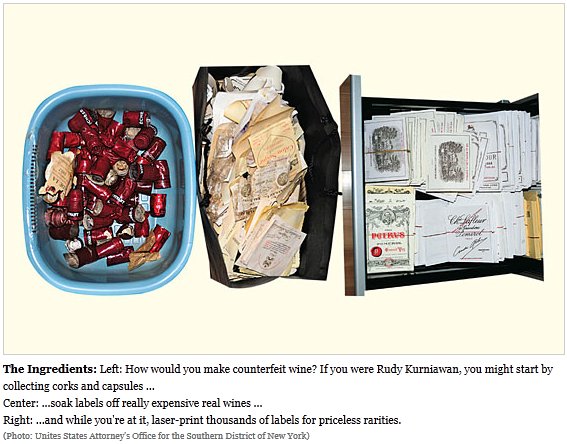
For instance, Kurniawan didn’t mention the five FedEx packages he received from Cru that year, containing the empty bottles from his wild nights at the restaurant. It wasn’t unusual for a customer to take away a memorable bottle after it was spent. But over the course of Cru’s six-year run until it closed in 2010, no other customer ordered as many bottles and then systematically claimed the empties. Kurniawan was building a bottle museum in his garage, he explained to the sommelier.

Though Kurniawan presented himself publicly as a mere wine lover, a buyer and not a seller, by the time he made his splash on the wine boards, he was already consigning at auction. And problems had cropped up. As early as 2003, Internet entrepreneur Eric Greenberg was threatening to sue online auction site Winebid over some “suspect/bad mags,” e-mailing, “My goal is to bury the consignor’s reputation in the wine world.” Soon after, he reported that he had spoken to the consignor, Rudy Kurniawan, and was convinced that he, too, had been duped by whoever sold him the wine.

H/T to Bob Tarantino for the link.

March 6, 2012

This is why I haven’t been covering the robocallpocalypse

Filed under: Cancon, Politics — Tags: , , , , — Nicholas @ 10:23

Margaret Wente in the Globe & Mail brings a sense of proportion to the robo-call “crisis” in Canadian politics:

What’s happened to my country? I went away for a couple of weeks and all hell broke loose. I came back to find that someone named Poutine stole the last election. At first I thought this was a typo, that they meant Putin. But no. It turns out that Russia is a shining beacon of democracy compared to Canada. Apparently, our country has been hijacked by “the most comprehensive electoral fraud in our nation’s history” (Pat Martin, NDP critic). Voter suppression — lying, cheating and general chicanery — has driven us into “uncharted waters” (Bob Rae, Liberal Leader).

I certainly don’t wish to make light of voter fraud. But this fraud seems to have been engineered by the Keystone Kops. Not a single voter claims to have been prevented from voting. No ballot boxes appear to have been stuffed. Nobody was fraudulently elected. There weren’t even any hanging chads. Elections Canada says 31,000 Canadians have complained, but the vast majority of these complaints (“somebody called me at 10 p.m.”) seem trivial.

The dirty trickster at the heart of this evil scheme turns out to be someone with the nom de plume of Pierre Poutine (real identity unknown). Mr. Poutine and his henchmen were not personally directed by Stephen Harper but are widely thought to have been channelling him. In Guelph, Ont., they engineered a bunch of robo-calls that directed people to show up at non-existent voting stations. This tactic was evidently intended to discourage people who didn’t support the Conservatives from voting. It was so effective that the Liberal candidate won by a margin of 11 per cent.

February 22, 2012

Peter Gleick’s career self-destruction

Filed under: Environment, Law, Media, Politics, Science — Tags: , , — Nicholas @ 09:01

Megan McArdle’s post yesterday at The Atlantic on the further revelations in the Heartland Institute caper, where Peter Gleick’s confession of wire fraud is the central bit of news:

You receive an anonymous memo in the mail purporting to be the secret climate strategy of the Heartland Institute. It is not printed on Heartland Institute letterhead, has no information identifying the supposed author or audience, contains weird locutions more typical of Heartland’s opponents than of climate skeptics, and appears to have been written in a somewhat slapdash fashion. Do you:

A. Throw it in the trash

B. Reach out to like-minded friends to see how you might go about confirming its provenance

C. Tell no one, but risk a wire-fraud conviction, the destruction of your career, and a serious PR blow to your movement by impersonating a Heartland board member in order to obtain confidential documents.

As a journalist, I am in fact the semi-frequent recipient of documents promising amazing scoops, and depending on the circumstances, my answer is always “A” or “B”, never “C”.

It’s a gross violation of journalistic ethics, though perhaps Gleick would argue that he’s not a journalist — and in truth, it’s hard to feel too sorry for Heartland, given how gleefully they embraced the ClimateGate leaks. So leave ethics aside: wasn’t he worried that impersonating board members in order to obtain confidential material might be, I don’t know, illegal? Forget about the morality of it: the risk is all out of proportion to the possible reward.

[. . .]

Gleick has done enormous damage to his cause and his own reputation, and it’s no good to say that people shouldn’t be focusing on it. If his judgement is this bad, how is his judgement on matters of science? For that matter, what about the judgement of all the others in the movement who apparently see nothing worth dwelling on in his actions?

When skeptics complain that global warming activists are apparently willing to go to any lengths — including lying — to advance their worldview, I’d say one of the movement’s top priorities should be not proving them right. And if one rogue member of the community does something crazy that provides such proof, I’d say it is crucial that the other members of the community say “Oh, how horrible, this is so far beyond the pale that I cannot imagine how this ever could have happened!” and not, “Well, he’s apologized and I really think it’s pretty crude and opportunistic to make a fuss about something that’s so unimportant in the grand scheme of things.”

After you have convinced people that you fervently believe your cause to be more important than telling the truth, you’ve lost the power to convince them of anything else.

January 28, 2012

Photoshopping images is so passé: using game footage is the new trend

Filed under: Gaming, Media, Military, Politics — Tags: , , , , — Nicholas @ 11:35

At the BBC website, Phil Coomes shows some side-by-side images of real events and modern FPS game images. The recent flap over clips from the game Arma 2 being cited as genuine film captured from the IRA is only the first of many incidents we should expect to encounter, as games get better (and advocates remain as dedicated to advancing their causes as ever):

Today we are used to seeing real time reports from across the globe, technology has advanced and anyone with an internet connection can travel to far-off places, even imaginary worlds, from their armchair.

The world of video games has progressed too. Some seem real, as highlighted by a recent Ofcom ruling that ITV misled viewers by airing footage claimed to have been shot by the IRA, which was actually material taken from a video game.

Labelled “IRA Film 1988”, it was described as film shot by the IRA of its members attempting to down a British Army helicopter in June 1988. However, the pictures were actually taken from a game called Arma 2.

[. . .]

So I went through my photos taken from various combat zones, and attempted to replicate them in a computer game.

The game Arma 2 was ideal — it’s more of a war simulation than an all-out blaster, with the correct uniforms, vehicles and weapons as well as varied terrains and bang-bang firefights.

Plenty of hours fiddling within the gaming environment, alongside Ivan who developed the game, produced some pretty remarkable results.

In some cases it is actually quite hard to tell the difference between my photographs and the computer version, which is deeply worrying. The level of detail is so precise that the virtual war zone is as convincing as the real thing.

January 13, 2012

Google Kenya’s motto: Do <strike>no</strike> evil

Filed under: Africa, Law, Technology — Tags: , , , — Nicholas @ 11:40

Someone at Google has some explaining to do:

Since October, Google’s GKBO appears to have been systematically accessing Mocality’s database and attempting to sell their competing product to our business owners. They have been telling untruths about their relationship with us, and about our business practices, in order to do so. As of January 11th, nearly 30% of our database has apparently been contacted.

Furthermore, they now seem to have outsourced this operation from Kenya to India.

When we started this investigation, I thought that we’d catch a rogue call-centre employee, point out to Google that they were violating our Terms and conditions (sections 9.12 and 9.17, amongst others), someone would get a slap on the wrist, and life would continue.

I did not expect to find a human-powered, systematic, months-long, fraudulent (falsely claiming to be collaborating with us, and worse) attempt to undermine our business, being perpetrated from call centres on 2 continents.

H/T to Megan McArdle for the link.

Update: BoingBoing got a response to their post on this issue from Google’s Vice-President for Product and Engineering, Europe and Emerging Markets:

We were mortified to learn that a team of people working on a Google project improperly used Mocality’s data and misrepresented our relationship with Mocality to encourage customers to create new websites. We’ve already unreservedly apologised to Mocality. We’re still investigating exactly how this happened, and as soon as we have all the facts, we’ll be taking the appropriate action with the people involved.

« Newer PostsOlder Posts »

Powered by WordPress