Tenant labor of one form or another may be the single most common form of labor we see on big estates and it could fill both the fixed labor component and the flexible one. Typically tenant labor (also sometimes called sharecropping) meant dividing up some portion of the estate into subsistence-style small farms (although with the labor perhaps more evenly distributed); while the largest share of the crop would go to the tenant or sharecropper, some of it was extracted by the landlord as rent. How much went each way could vary a lot, depending on which party was providing seed, labor, animals and so on, but 50/50 splits are not uncommon. As you might imagine, that extreme split (compared to the often standard c. 10-20% extraction frequent in taxation or 1/11 or 1/17ths that appear frequently in medieval documents for serfs) compels the tenants to more completely utilize household labor (which is to say “farm more land”). At the same time, setting up a bunch of subsistence tenant farms like this creates a rural small-farmer labor pool for the periods of maximum demand, so any spare labor can be soaked up by the main estate (or by other tenant farmers on the same estate). That is, the high rents force the tenants to have to do more labor – more labor that, conveniently, their landlord, charging them the high rents is prepared to profit from by offering them the opportunity to also work on the estate proper.
In many cases, small freeholders might also work as tenants on a nearby large estate as well. There are many good reasons for a small free-holding peasant to want this sort of arrangement […]. So a given area of countryside might have free-holding subsistence farmers who do flexible sharecropping labor on the big estate from time to time alongside full-time tenants who worked land entirely or almost entirely owned by the large landholder. Now, as you might imagine, the situation of tenants – open to eviction and owing their landlords considerable rent – makes them very vulnerable to the landlord compared to neighboring freeholders.
That said, tenants in this sense were generally considered free persons who had the right to leave (even if, as a matter of survival, it was rarely an option, leaving them under the control of their landlords), in contrast to non-free laborers, an umbrella-category covering a wide range of individuals and statuses. I should be clear on one point: nearly every pre-modern complex agrarian society had some form of non-free labor, though the specifics of those systems varied significantly from place to place. Slavery of some form tends to be the rule, rather than the exception for these pre-modern agrarian societies. Two of the largest categories of note here are chattel slavery and debt bondage (also called “debt-peonage”), which in some cases could also shade into each other, but were often considered separate (many ancient societies abolished debt bondage but not chattel slavery for instance and debt-bondsmen often couldn’t be freely sold, unlike chattel slaves). Chattel slaves could be bought, sold and freely traded by their slave masters. In many societies these people were enslaved through warfare with captured soldiers and civilians alike reduced to bondage; the heritability of that status varies quite a lot from one society to the next, as does the likelihood of manumission (that is, becoming free).
Under debt bondage, people who fell into debt might sell (or be forced to sell) dependent family members (selling children is fairly common) or their own person to repay the debt; that bonded status might be permanent, or might hold only till the debt is repaid. In the later case, as remains true in a depressing amount of the world, it was often trivially easy for powerful landlord/slave-holders to ensure that the debt was never paid and in some systems this debt-peon status was heritable. Needless to say, the situation of both of these groups could be and often was quite terrible. The abolition of debt-bondage in Athens and Rome in the sixth and fourth centuries B.C. respectively is generally taken as a strong marker of the rising importance and political influence of the class of rural, poorer citizens and you can readily see why this is a reform they would press for.
Bret Devereaux, “Collections: Bread, How Did They Make It? Part II: Big Farms”, A Collection of Unmitigated Pedantry, 2020-07-31.
April 17, 2023
QotD: Tenant-farming (aka “sharecropping”) in pre-modern societies
April 10, 2023
QotD: Interaction between “big” farmers and subsistence farmers in pre-modern societies
And then just over the way, you have the large manor estate, or the Roman villa, or the lands owned by a monastery (because yes, large landholders were sometimes organizations; in medieval Europe, monasteries filled this function in some places) or even just a very rich, successful peasant household. Something of that sort. They have the capital (plow-teams, manure, storage, processing) to more intensively farm the little land our small farmers have, but also, where the small farmer has more labor than land, the large landholder has more land than labor.
The other basic reality that is going to shape our large farmers is their different goals. By and large our small farmers were subsistence farmers – they were trying to farm enough to survive. Subsistence and a little bit more. But most large landholders are looking to use the surplus from their large holdings to support some other activity – typically the lifestyle of wealthy elites, which in turn require supporting many non-farmers as domestic servants, retainers (including military retainers), merchants and craftsmen (who provide the status-signalling luxuries). They may even need the surplus to support political activities (warfare, electioneering, royal patronage, and so on). Consequently, our large landholders want a lot of surplus, which can be readily converted into other things.
The space for a transactional relationship is pretty obvious, though as we will see, the power imbalances here are extreme, so this relationship tends to be quite exploitative in most cases. Let’s start with the labor component. But the fact that our large landholders are looking mainly to produce a large surplus (they are still not, as a rule, profit maximizing, by the by, because often social status and political ends are more important than raw economic profit for maintaining their position in society) means that instead of having a farm to support a family unit, they are seeking labor to support the farm, trying to tailor their labor to the minimum requirements of their holdings.
[…]
The tricky thing for the large landholder is that labor needs throughout the year are not constant. The window for the planting season is generally very narrow and fairly labor intensive: a lot needs to get done in a fairly short time. But harvest is even narrower and more labor intensive. In between those, there is still a fair lot of work to do, but it is not so urgent nor does it require so much labor.
You can readily imagine then the ideal labor arrangement would be to have a permanent labor supply that meets only the low-ebb labor demands of the off-seasons and then supplement that labor supply during the peak seasons (harvest and to a lesser extent planting) with just temporary labor for those seasons. Roman latifundia may have actually come close to realizing this theory; enslaved workers (put into bondage as part of Rome’s many wars of conquest) composed the villa’s primary year-round work force, but the owner (or more likely the villa’s overseer, the vilicus, who might himself be an enslaved person) could contract in sharecroppers or wage labor to cover the needs of the peak labor periods. Those temporary laborers are going to come from the surrounding rural population (again, households with too much labor and too little land who need more work to survive). Some Roman estates may have actually leased out land to tenant farmers for the purpose of creating that “flexible” local labor supply on marginal parts of the estate’s own grounds. Consequently, the large estates of the very wealthy required the impoverished many subsistence farmers in order to function.
Bret Devereaux, “Collections: Bread, How Did They Make It? Part II: Big Farms”, A Collection of Unmitigated Pedantry, 2020-07-31.
February 25, 2023
QotD: Feudalism versus “Manorialism”
Bret Devereaux, “Collections: Bread, How Did They Make It? Part IV: Markets, Merchants and the Tax Man”, A Collection of Unmitigated Pedantry, 2020-08-21.
February 9, 2023
QotD: Collecting taxes, Medieval-style
(Note: for a more detailed primer on what this kind of apparatus can look like, check out Wayne Lee’s (@MilHist_Lee) talk “Reaping the Rewards: How the Governor, the Priest, the Taxman, and the Garrison Secure Victory in World History” here. He’s got some specific points he’s driving at, but the first half of the talk is a broad overview of the problems you face as a suddenly successful king. Also, the whole thing is fascinating.)
In a pre-modern society, this task – assembling and organizing the literate bureaucrats you need to run a state – is very difficult. Literacy is often very low, so the number of individuals with the necessary skills is minuscule. Training new literate bureaucrats is expensive, as is paying the ones you have, creating a catch-22 where the king has no money because he has no tax collectors and he has no tax collectors because he has no money. Looking at how states form is thus often a question of looking at how this low-administration equilibrium is broken. The administrators you need might be found in civic elites who are persuaded to do the job in exchange for power, or in a co-opted religious hierarchy of educated priests, for instance.
Vassalage represents another response to the problem, which is the attempt to – as much as possible – do without. Let’s specify terms: I am using “vassalage” here because it is specific in a way that the more commonly used “feudalism” is not. I am not (yet) referring to how peasants (in Westeros the “smallfolk”) interact with lords (which is better termed “manorialism” than as part of feudalism anyway), but rather how military aristocrats (knights, lords, etc) interact with each other.
So let us say you are a king who has suddenly come into a lot of land, probably by bloody conquest. You need to extract revenue from that land in order to pay for the armies you used to conquer it, but you don’t have a pile of literate bureaucrats to collect those taxes and no easy way to get some. By handing out that land to your military retainers as fiefs (they become your vassals), you can solve a bunch of problems at once. First, you pay off your military retainers for their service with something you have that is valuable (land). Second, by extracting certain promises (called “homage”) from them, you ensure that they will continue to fight for you. And third, you are partitioning your land into smaller and smaller chunks until you get them in chunks small enough to be administered directly, with only a very, very minimal bureaucratic apparatus. Your new vassals, of course, may do the same with their new land, further fragmenting the political system.
This is the system in Westeros, albeit after generations of inheritance (such that families, rather than individuals, serve as the chief political unit). The Westerosi term for a vassal is a “bannerman”. Greater military aristocrats with larger holding are lords, while lesser ones are landed knights. Landed knights often hold significant lands and a keep (fortified manner house), which would make them something more akin to European castellans or barons than, say, a 14th century English Knight Banneret (who is unlikely to have been given permission to fortify his home, known as a license to crenellate). What is missing from this system are the vast majority of knights, who would not have had any kind of fortified dwelling or castle, but would have instead been maintained as part of the household of some more senior member of the aristocracy. A handful of landless knights show up in Game of Thrones, but they should be by far the majority and make up most of the armies.
There’s one final missing ingredient here, which is castles, something Westeros has in abundance. Castles – in the absence of castle-breaking cannon – shift power downward in this system, because they allow vassals to effectively resist their lieges. That may not manifest in open rebellion so much as a refusal to go on campaign or supply troops. This is important, because it makes lieges as dependent on their vassals as vassals are on their lieges.
Bret Devereaux, “New Acquisitions: How It Wasn’t: Game of Thrones and the Middle Ages, Part III”, A Collection of Unmitigated Pedantry, 2019-06-12.
September 1, 2022
“This rise of non-profits is reminiscent of feudal times, when the rich and powerful donated to the Church to ensure that its message wouldn’t threaten their power”
At UnHerd, Joel Kotkin considers the parallels between Oedipus Rex and the wider political/cultural situation we face in much of the western world:

Amazon’s Jeff Bezos, Microsoft’s Bill Gates, and Berkshire Hathaway’s Warren Buffet.
Fox Business.
As in Sophocles’s tragedy Oedipus Rex, we are witnessing a generational drama in which inheritors kill their proverbial father to marry their mother, in this case Mother Earth. The psychology behind this pattern is above my pay grade, but many of the richest people on the planet, and their heirs, now seem anxious to disparage the economic system that created their fortunes. With few exceptions, the new rich, and particularly their children and ex-wives, embrace a racial, gender and environmental agenda that, while undermining merit and economic growth, still leaves them on top of the heap.
The ideology of the mega-rich will shape our society for the next generation, in large part through philanthropy. The non-profit sector, the primary vehicle for inherited wealth to be laundered into political influence, has been growing rapidly; in the US, non-profits’ assets have grown nine-fold since 1980. In 2020, non-profits brought in $2.62 trillion in revenues, constituting over 5.6% of the US economy. Increasingly, much this money came from the new tech elite: among the most prolific donors were Jeff Bezos and his ex-wife, Mackenzie Scott; Bill Gates and his now-discarded wife, Melinda French Gates; Mark Zuckerberg and his wife, Priscilla Chan; and Laureen Powell Jobs, the Left-leaning publisher of the Atlantic and the widow of Apple’s founder.
This rise of non-profits is reminiscent of feudal times, when the rich and powerful donated to the Church to ensure that its message wouldn’t threaten their power. Indeed, our society is becoming more like the Middle Ages all the time, with entrepreneurial success becoming more difficult and property and wealth becoming ever more concentrated. “Inherited wealth”, notes Thomas Piketty, is making a “comeback”. In the US, according to the consulting firm Accenture, the Silent Generation and Baby Boomers will gift their heirs up to $30 trillion by 2030 and $75 trillion by 2060.
Of course, the use of inherited wealth to push Left-wing causes is nothing new. As Heather Mac Donald demonstrated in 1996, big-money foundations in the US have been bankrolling far-Left politics for several generations. But the rise of the tech oligarchy seems likely to accelerate this move to the gentrified Left. Many of these billionaires are still in their 30s and 40s but have accumulated more cash than anyone since the Gilded Age. And unlike their early 20th-century counterparts, today’s robber-barons — with a few notable exceptions, such as Peter Thiel — are decisively aligned with the Left. In 2020, five of the top eight donors to Joe Biden came from people tied to tech firms.
This is partly explained by Trump’s toxicity, which engendered something of an oligarchical jihad to overthrow a man who was both needlessly crass and potentially threatening to their monopolies. Particularly critical in the 2020 election was the weaponising of the Chan-Zuckerberg Initiative, which poured over $300 million into state and local election administration to stoke turnout. Conservatives claim, with some justification, that these efforts were concentrated in highly Democratic areas of swing states, and therefore may have tilted the outcome. But what is beyond question is that Zuckerberg and the others participated in what Time — owned by yet another oligarch, Marc Benioff, co-founder of Salesforce.com — gleefully described as “a conspiracy unfolding behind the scenes”.
May 18, 2022
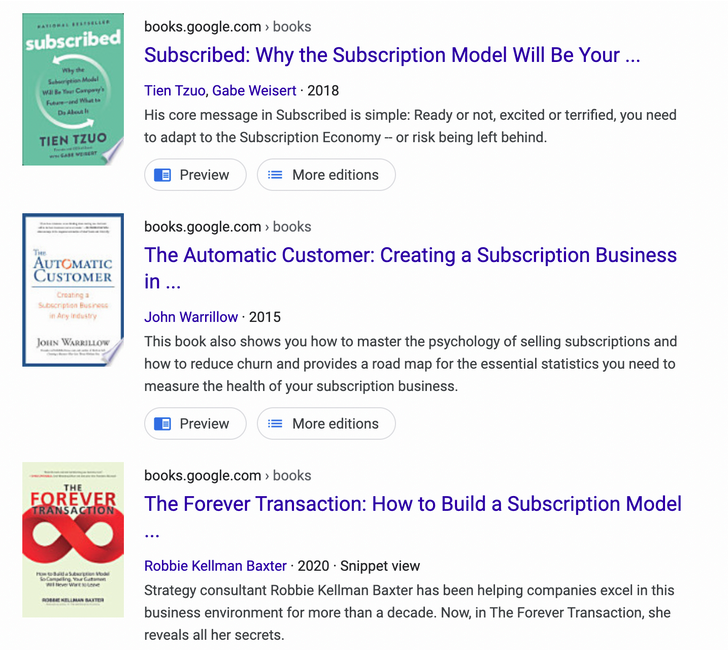
From “Software as a Service” to “Property as a Service” then to “Hypercapitalism” aka Neo-Feudalism
Whenever I could, as the software I used to depend on switched from the old-fashioned “purchase a license” to “Software as a Service” model, I found something else to use or I didn’t bother “upgrading” from the last iteration before it went SaaS. My Microsoft Office installation is the 2007 version — after that I used Open Office (and now LibreOffice) for anything Microsoft-related. Even working in the software business, I hated SaaS and I try as much as I can to avoid products distributed that way. Imagine how I feel about the expansion of that toxic idea to other areas of life, as Chris Bray discusses here:
Twenty-two years ago, the economist and social critic Jeremy Rifkin warned about the emerging commodification of human experience. Markets have always exchanged private property, he wrote, and people have grown accustomed to the act of holding it personally – that is, of owning things. But in a new “hypercapitalist” world, he warned, ownership would be concentrated in a few corporate hands, and most people would pay to access property, “in the form of short-term leases, rentals, memberships, and other service arrangements,” rather than owning it. Remember that description about leasing all of your stuff in a series of service arrangements, because you’ll be seeing it again in a minute or two.
The man was not wrong about the degree to which businesses would aspire to turn one-time sales of stuff into endless monthly purchases of a service:
And then comes the politics:
The shift from a propertied regime based on the idea of broadly distributed ownership to an access regime based on securing short-term limited use of assets controlled by networks of suppliers changes fundamentally our notions of how economic power is to be exercised in the years ahead. Because our political institutions and laws are steeped in market-based property relations, the shift from ownership to access also portends profound changes in the way we will govern ourselves in the new century.
And this, and look closely for the most important sentences — two of them, short and adjacent:
In a society where virtually everything is accessed, however, what happens to the personal pride, obligation, and commitment that go with ownership? And what of self-sufficiency? Being propertied goes hand in hand with being independent. Property is the means by which we gain a sense of personal autonomy in the world. When we access the means of our existence, we become far more reliant on others. While we become more connected and interdependent, do we risk at the same time becoming less self-sufficient and more vulnerable?
The shift in the structuring of human relationships from ownership to access appears to invite a trade-off of sorts whose outcome is far from certain. Will we liberate ourselves from our possessions, only to lose a sense of obligation to the things we fashion and use? Will we become more embedded in networks of relationships, only to become more dependent on powerful networks of corporate suppliers?
Property is autonomy. That was a warning about your own life: less autonomous, more dependent. And it was, specifically, a warning about corporate capitalism on the subscription model, and the social and political effects of a concentration of property in increasingly few hands. Hypercapitalism would be the new feudalism, a system of lords and serfs.
March 23, 2022
QotD: Fansplaining that feudalism is bad
Portrayal is not promulgation, people.
That said, I’ve spent thirty years learning that no writer, be they ever so clear and plain, can control how readers read, or misread, their texts. Reading is a dance, not a march. If some readers step on one’s feet, well, it’s still better than sitting by the wall … Usually.
Lois McMaster Bujold, “Lois McMaster Bujold on Fanzines, Cover Art, and the Best Vorkosigan Planet”, Tor.com, 2017-11-02.
March 7, 2022
QotD: Historical fiction and fantasy works usually leave out the vast majority of the people who did all the work
But the actual human landscape of the pre-modern period was defined – in agrarian societies, at least – by vast numbers of farms and farmers. Their work proceeded on this cyclical basis, from plowing to sowing to weeding to harvesting and threshing to storage and then back again. Religious observances and social festivals were in turn organized around that calendar (it is not an accident how many Holy Days and big festivals seem to cluster around the harvest season in late Autumn/early Winter, or in Spring). The uneven labor demands of this cycle (intense in plowing and reaping, but easier in between) in turn also provided for the background hum of much early urban life, where the “cities” were for the most part just large towns surrounded by farmland (where often the folks living in the cities might work farmland just outside of the gates). People looked forward to festivals and events organized along the agricultural calendar, to the opportunities a good harvest might provide them to do things like get married or expand their farms. The human drama that defines our lives was no less real for the men and women who toiled in the fields or the farmhouses.
And of course all of this activity was necessary to support literally any other kind of activity.
Bret Devereaux, “Collections: Bread, How Did They Make It? Part III: Actually Farming”, A Collection of Unmitigated Pedantry, 2020-08-06.
July 4, 2021
QotD: It’s not your money … it’s the GOVERNMENT’S money
The left seems to be going off the same book when they say things like “How will you pay for the tax cuts?” as if the government is OF COURSE entitled to all your money, and if you’re getting some back, that part must be compensated for.
Sarah Hoyt, “The Tragedy of the Squid Farms on Mars”, Libertarian Enterprise, 2018-12-05.
June 3, 2021
QotD: Simon de Montfort
Simon de Montfort’s Good Idea
Simon de Montfort’s Idea was to make the Parliament more Representative by inviting one or two vergers, or vergesses, to come from every parish, thus causing the only Good Parliament in History. Simon de Montfort, though only a Frenchman, was thus a Good Thing, and is very notable as being the only good Baron in history. The other Barons were, of course, all wicked Barons. They had, however, many important duties under the Banorial system. These were:
- To be armed to the teeth.
- To extract from the Villein(*) Saccage and Soccage, tollage and tallage, pillage and ullage, and, in extreme cases, all other banorial amenities such as umbrage and porrage. (These may be collectively defined as the banorial rites of carnage and wreckage).
- To hasten the King’s death, deposition, insanity, etc., and make quite sure that there were always at least three false claimants to the throne.
- To resent the Attitude of the Church. (The Barons were secretly jealous of the Church, which they accused of encroaching on their rites — see p. 30, Age of Piety.)
- To keep up the Middle Ages.
(*) Villein: medieval term for agricultural labourer, usually suffering from scurvy, Black Death, etc.
W.C. Sellar & R.J. Yeatman, 1066 And All That, 1930.
February 8, 2021
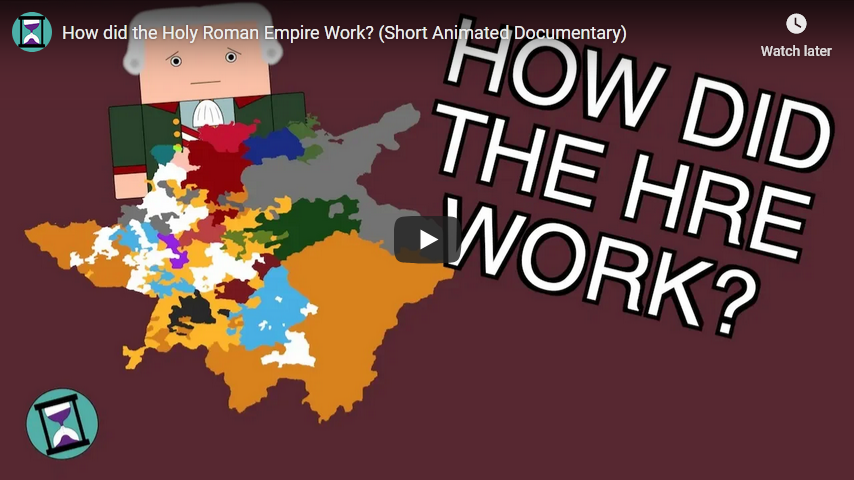
How did the Holy Roman Empire Work?
History Matters
Published 25 Aug 2019Twitter: https://twitter.com/Tenminhistory
Patreon: https://www.patreon.com/user?u=4973164
Merch: teespring.com/stores/history-matters-…Special Thanks to the following Patrons for their support on Patreon:
Kevin Sanders
Chris Fatta
Daniel Lambert
Richard Wolfe
Joshua
Tom Loghrin
Warren Rudkin
Andrew Niedbala
Mitchell Wildoer
Blaine Tillack
Bernardo Santos
Matthew
John Garcia
Richard Hartzell
Will Davis-Coleman
Danny Anstess
Henry Rabung
August Block
Perry Gagne
Shaun Pullin
Joooooshhhhh
Vesko Dinev
PaulToon
Kelly Moneymaker
FuzzytheFair
Armani_Banani
Jeffrey Schneider
Byzans_Scotorius
Seth Reeves
Haydn Noble
Josh Cornelius
Gideon Rashkes
Spencer Smith
Cornel Borină
Roberto
Andrew Keeling
Richard Manklow
Chance Cansler
João Santos
Gabriel Lunde
Pierre Le Mouel
anonHow did the Holy Roman Empire work? It was an antiquated mess but it did have a system of government that did work. Sort of. If everyone felt like it.
Sources:
Prussia’s Relations with the Holy Roman Empire, 1740-1786 by Peter H. Wilson.
Benjamin Franklin, Student of the Holy Roman Empire: His Summer Journey to Germany in 1766 and His Interest in the Empire’s Federal Constitution by Jürgen Overhoff.
The Constitution of the Holy Roman Empire after 1648: Samuel Pufendorf’s Assessment in His Monzambano by Peter Schröder.
Bolstering the Prestige of the Habsburgs: The End of the Holy Roman Empire in 1806 by Peter H. Wilson.
July 9, 2020
Ethiopian Emperor Haile Selassie died in 1974, but was toppled in 2020
In The Critic, James Jeffrey explains the late emperor and how he fell off his plinth in June of this year:
The Ethiopian emperor has fallen in leafy Wimbledon, but there’s more to his demise than meets the eye
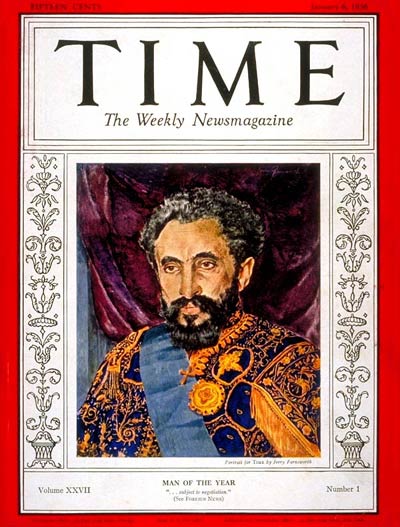
In 1936, Emperor Haile Selassie gave a rousing speech to the League of Nations reminding it of its moral duty to defend Ethiopia which was being invaded and ransacked by Italy.
Despite the League entirely ignoring him — thereby dooming its proclaimed doctrine of collective security, which in turn hastened World War II — Selassie’s impressive performance recounting “the tortures inflicted upon the Ethiopian people,” while imploring the League to save Ethiopia from the “bonds of vassalship,” cemented his iconic international reputation. Time magazine named him “Man of the Year.”
All the while, and for the span of his reign from 1930 to 1974, the vast majority of Ethiopians lived in feudal conditions, knowing only vassalship. An authoritarian ruler, Selassie’s full title was “By the Conquering Lion of the Tribe of Judah, His Imperial Majesty Haile Selassie I, King of Kings, Lord of Lords, Elect of God.”
Among his retinue of lackies there was a man whose sole job was to wipe away the urine of the imperial dog Lulu after it relieved itself on the shoes of visiting dignitaries, according to Ryszard Kapuscinski’s The Emperor: Downfall of an Autocrat (a hotly contested point and accused of being invented by Kapuscinski; it sounds entirely plausible to me having seen how much Ethiopians, especially those with wealth and power, go in for being kowtowed to and waited on).
Civil rights and political rights were little known during Selassie’s reign — cementing an oppressive trend that continues to this day in Ethiopia — while he failed to adequately respond to famines in 1958 and 1973, dooming tens of thousands, possibly hundreds of thousands, of Ethiopians to their deaths.
Yet for all his faults — based on what I know and saw in Ethiopia, and on my gut instinct, I’ve never been a fan — Selassie opened up Ethiopia to the world and pushed to develop it. He introduced the country’s first written constitution in 1931, which while heavily in favour of the nobility, envisaged a transition to democracy. In Ethiopia today, he remains an inspiring figure for many, his image appearing all over the place. Among the Rastafari movement, Selassie is revered by many as the returned messiah and God incarnate.
Last week a group of Ethiopian diaspora in London got to give their judgement on the so-called Negusa Nagast, King of Kings, whose dynastic lineage reportedly stretched back to Emperor Menelik I, the offspring of King Solomon and the Queen of Sheba. In a Wimbledon park on June 30, a bust of Selassie was destroyed by a group of around 100 people, leaving a shattered plinth surrounded by rubble.
May 9, 2020
History Summarized: The Meiji Restoration
Overly Sarcastic Productions
Published 8 May 2020Japan may well have the record for World’s Speediest Industrialization, but how did they accomplish so much so fast without falling victim to Europe’s favorite 19th century pastime of “Colonization”? And how did Japan build up a Pan-Asian empire so darn quickly? All that and more in this deep-dive into the Meiji Restoration!
SOURCES & Further Reading:
Modern Japan: A Very Short Introduction by Goto-Jones.
The Japanese Empire: Grand Strategy from the Meiji Restoration to the Pacific War by Paine.
Bushido: The Soul of Japan by Nitobe.THAT WACKY POLITICAL CARTOON: “Japan Makes Her Debut Under Columbia’s Auspicies” https://tile.loc.gov/storage-services…
This video was edited by Sophia Ricciardi AKA “Indigo”. https://www.sophiakricci.com/
Our content is intended for teenage audiences and up.
PATREON: https://www.Patreon.com/OSP
DISCORD: https://discord.gg/h3AqJPe
MERCH LINKS: https://www.redbubble.com/people/OSPY…
OUR WEBSITE: https://www.OverlySarcasticProductions.com
Find us on Twitter https://www.Twitter.com/OSPYouTube
Find us on Reddit https://www.Reddit.com/r/OSP/

April 29, 2020
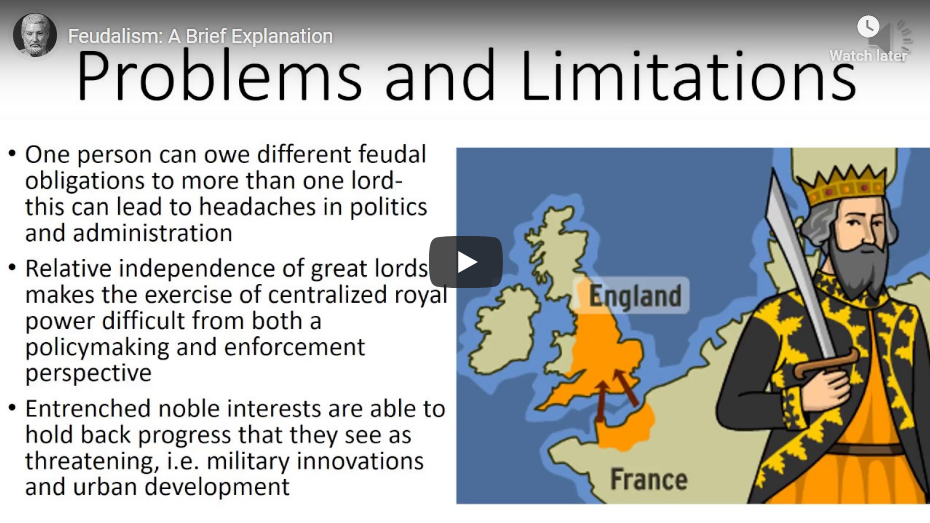
Feudalism: A Brief Explanation
Thersites the Historian
Published 26 Oct 2017In this video, I try to bring order to the chaos that is feudalism and render it comprehensible.
November 9, 2019
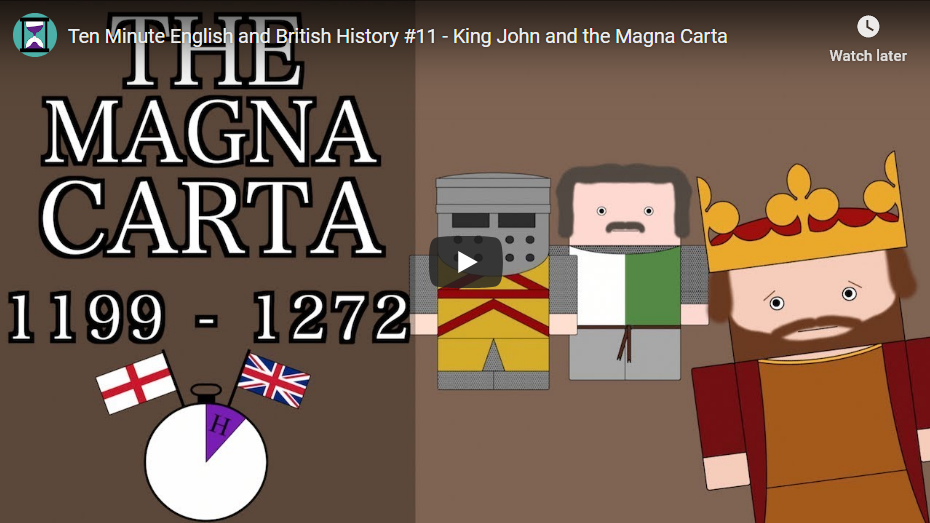
Ten Minute English and British History #11 – King John and the Magna Carta
History Matters
Published 1 Jan 2018Twitter: https://twitter.com/Tenminhistory
Patreon: https://www.patreon.com/user?u=4973164This episode covers the reign of King John and the problems he had securing the Angevin inheritance and the subsequent issues his barons posed. These problems culminated in the signing of the Magna Carta in 1215 which severely limited the strength of John and his son, Henry III, whose reign was overshadowed by the document.
Ten Minute English and British History is a series of short, ten minute animated narrative documentaries that are designed as revision refreshers or simple introductions to a topic. Please note that these are not meant to be comprehensive and there’s a lot of stuff I couldn’t fit into the episodes that I would have liked to. Thank you for watching, though, it’s always appreciated.