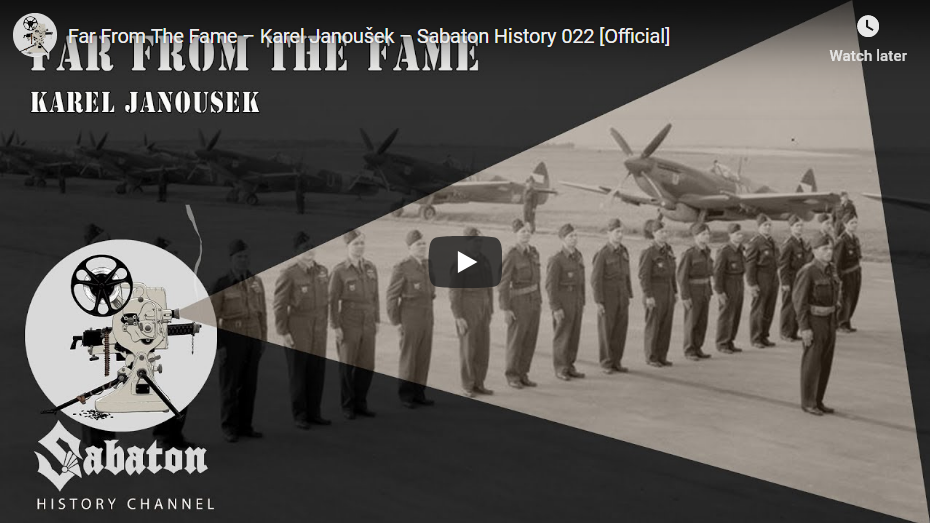
Published on 1 Jul 2017
Czechs and Slovaks were minorities with the Austro-Hungarian and Russian Empire. Even before the outbreak of the war they demanded more rights as industrious citizens but were often overheard. During the war, they decided to take matter into their own hands and fight. And that they did in many armies across Europe.
July 2, 2017
Fighting Without A Country – Czechoslovak Legions of World War 1 I THE GREAT WAR Special
April 23, 2015
Kicking Neville Chamberlain while he’s dead
Poor old Neville … he’s become such a byword for failure that they’re even comparing Barack Obama to Chamberlain. This is hardly fair to either party:
One of the hardest things to do in history is to read history in context, shutting out our foreknowledge of what is going to happen — knowledge the players at the time did not have.
Apparently Neville Chamberlain is back in the public discourse, again raised from the dead as the boogeyman to scare us away from any insufficiently militaristic approach to international affairs.
There is no doubt that Neville Chamberlain sold out the Czechs at Munich, and the Munich agreement was shown to be a fraud on Hitler’s part when he invaded the rest of Czechoslovakia just months later. In retrospect, we can weep at the lost opportunity as we now know, but no one knew then, that Hitler’s generals planned a coup against him that was undermined by the Munich agreement.
But all that being said, let’s not forget the historic context. World War I was a cataclysm for England and Europe. It was probably the worst thing to happen to Europe since the black death. And many learned folks at the time felt that this disaster had been avoidable (and many historians today might agree). They felt that there had been too much rush to war, and too little diplomacy. If someone like Britain had been more aggressive in dragging all the parties to the bargaining table in 1914, perhaps a European-wide war could have been avoided or at least contained to the Balkans.
If you’ve read my Origins of WW1 posts, you’ll probably agree that Britain alone could not have averted the First World War, although they could have stayed out of the war (which would probably have guaranteed a German victory by 1916). Unlike the attitudes in 1914, few Europeans wanted any kind of war in the late 1930s, having learned too well what the casualties of modern war could be. The idea that Chamberlain and Édouard Daladier could somehow have deterred Hitler requires an amazing lack of awareness of the political realities in Britain and France at the time … and of the state of the respective armed forces of the two nations. Neither politician could have survived the reaction if they’d forced Hitler’s hand … which might well have served Hitler’s purposes just as well as the “scrap of paper” did in the end.
In a postscript, Warren also points out that FDR could just as easily take the place of Neville Chamberlain for his own “sell out” of Poland and the rest of what became the Warsaw Pact “allies”:
Years ago in my youth I used to excoriate FDR for caving into Stalin at Yalta, specifically in giving away most of Eastern Europe. I still wish he hadn’t given his moral authority and approval to the move, but even if we stood on the table and screamed at Stalin in opposition, what were we going to do? Was there any appetite for extending the war? Zero. That is what folks who oppose the dropping of the atomic bombs on Japan get wrong in suggesting there were alternatives. All those alternatives involved a longer war and more American deaths which no one wanted.

September 11, 2014
Would Scottish separation resemble the “Velvet Divorce” of Czechoslovakia?
At the Volokh Conspiracy, Ilya Somin looks at the breakup of Czechoslovakia and compares the possible UK-Scotland divorce in that context:
One relevant precedent is the experience of the “Velvet Divorce” between Slovakia and the Czech Republic, whose success is sometimes cited by Scottish independence advocates as a possible model for their own breakup with Britain. Like many Scottish nationalists, advocates of Slovak independence wanted to break away from their larger, richer, partner, in part so they could pursue more interventionist economic policies. But, with the loss of Czech subsidies, independent Slovakia ended up having to pursue much more free market-oriented policies than before, which led to impressive growth. The Czech Republic, freed from having to pay the subsidies, also pursued relatively free market policies, and both nations are among the great success stories of Eastern Europe.
Like Slovakia, an independent Scotland might adopt more free market policies out of necessity. And the rump UK (like the Czechs before it), might move in the same direction. The secession of Scotland would deprive the more interventionist Labor Party of 41 seats in the House of Commons, while costing the Conservatives only one. The center of gravity of British politics would, at least to some extent, move in a more pro-market direction, just as the Czech Republic’s did relative to those of united Czechoslovakia.
If the breakup of the UK is likely to resemble that of Czechoslovakia, this suggests that free market advocates should welcome it, while social democrats should be opposed. Obviously, other scenarios are possible. For example, famed economist Paul Krugman claims that Scottish independence is likely to result in an economic disaster, because a small country without a currency of its own cannot deal with dangerous macroeconomic crises. I lack the expertise to judge whether Krugman’s prediction is sound. But it does seem like there are obvious counterexamples of small countries that have done well without having their own currencies; Slovakia is a good example. Moreover, although Scottish independence advocates today claim that they will stick to the pound, they could reverse that decision in the future.
All of the above assumes that an independent Scotland will be able to stay in the European Union, and that there would be free trade and freedom of movement between it and the remaining United Kingdom. If the Scots get locked out of the EU or prevented from interacting freely with the UK (perhaps as a result of backlash by angry English public opinion), Scottish independence becomes a lot less viable and a lot more likely to cause serious harm on both sides of the new border.
September 30, 2013
Re-evaluating Neville Chamberlain
BBC News Magazine on the reputation of British PM Neville Chamberlain:
…this derogatory reference reflects the continuing potency of a well-established conventional wisdom assiduously propagated by Chamberlain’s detractors after his fall from the premiership in May 1940. As Churchill is once supposed to have quipped, “Poor Neville will come badly out of history. I know, I will write that history”.
In his influential account The Gathering Storm, published in 1948, Churchill characterised Chamberlain as “an upright, competent, well meaning man” fatally handicapped by a deluded self-confidence which compounded an already debilitating lack of both vision and diplomatic experience. For many years, this seductive version of events remained unchallenged and unchallengeable.
[…]
The Munich agreement, which later came to symbolise the evils of appeasement, was signed 75 years ago, in the early hours of 30 September. At Munich, Britain and France acquiesced in the dismemberment of Czechoslovakia and the transfer of its Sudeten region to Germany in face of Hitler’s increasingly bellicose threats of military action. Chamberlain’s hopes that this humiliating sacrifice would satisfy Hitler’s last major territorial demand and thus avert another catastrophic war were dashed within four months.
After this monumental failure of policy Chamberlain’s name became an abusive synonym for vacillation, weakness, immoral great-power diplomacy and, above all, the craven appeasement of bullies — whatever the price in national honour. Despite his many achievements in domestic policy, therefore, ultimately Chamberlain’s reputation remains indelibly stained by Munich and the failure of his very personal brand of diplomacy.
As he confessed in the Commons at the outbreak of war, “Everything I have worked for, everything that I have hoped for, everything that I have believed in during my public life, has crashed into ruins.”
March 11, 2012
Music control freaks? The Nazis got there well before you
J.J. Gould in The Atlantic a couple of months ago, but brought to my attention by the folks at BoingBoing:
Skvorecky left no shortage of legacies to remember him by, but one of the more notable themes in his nonfiction writing is an emphasis on, as Welch puts it, “the oftentime minute similarities between applied fascism and communism.” And some of Skvorecky’s more notable variations on that theme in turn are found in his recollections and insights on the common totalitarian hatred of, among all things, jazz.
[. . .]
Anyone who finds this proposition fascinating won’t, I promise, be disappointed to read the rest of this book, or for that matter all of Talkin’ Moscow Blues: Essays About Literature, Politics, Movies, and Jazz. But maybe the single most remarkable example of 20th-century totalitarian invective against jazz that Skvorecky ever relayed was here in the intro to The Bass Saxophone, where he recalls — faithfully, he assures us (“they had engraved themselves deeply on my mind”) — a set of regulations, issued by a Gauleiter — a regional official for the Reich — as binding on all local dance orchestras during the Nazi occupation of Czechoslovakia. Get this:
- Pieces in foxtrot rhythm (so-called swing) are not to exceed 20% of the repertoires of light orchestras and dance bands;
- in this so-called jazz type repertoire, preference is to be given to compositions in a major key and to lyrics expressing joy in life rather than Jewishly gloomy lyrics;
- As to tempo, preference is also to be given to brisk compositions over slow ones so-called blues); however, the pace must not exceed a certain degree of allegro, commensurate with the Aryan sense of discipline and moderation. On no account will Negroid excesses in tempo (so-called hot jazz) or in solo performances (so-called breaks) be tolerated;
- so-called jazz compositions may contain at most 10% syncopation; the remainder must consist of a natural legato movement devoid of the hysterical rhythmic reverses characteristic of the barbarian races and conductive to dark instincts alien to the German people (so-called riffs);
- strictly prohibited is the use of instruments alien to the German spirit (so-called cowbells, flexatone, brushes, etc.) as well as all mutes which turn the noble sound of wind and brass instruments into a Jewish-Freemasonic yowl (so-called wa-wa, hat, etc.);
- also prohibited are so-called drum breaks longer than half a bar in four-quarter beat (except in stylized military marches);
- the double bass must be played solely with the bow in so-called jazz compositions;
- plucking of the strings is prohibited, since it is damaging to the instrument and detrimental to Aryan musicality; if a so-called pizzicato effect is absolutely desirable for the character of the composition, strict care must be taken lest the string be allowed to patter on the sordine, which is henceforth forbidden;
- musicians are likewise forbidden to make vocal improvisations (so-called scat);
- all light orchestras and dance bands are advised to restrict the use of saxophones of all keys and to substitute for them the violin-cello, the viola or possibly a suitable folk instrument.
December 28, 2011
“Truth and love must prevail over lies and hatred”
Matt Welch returns to Prague for Václav Havel’s funeral:
It’s a safe bet that in the history of state funerals, no former president has been sent off to the Absolute Horizon by not one but at least three different live, nationally televised rock songs about heroin.
Such was Václav Havel’s genre-straddling life and thoroughgoing conception of freedom that it seemed as natural as tartar sauce on fried cheese to bookend a portentous, Dvořák-haunted National Requiem Mass in Central Europe’s oldest Gothic cathedral with a loose-limbed, hash-scented rock and roll celebration at the Czech Republic’s most storied music venue, all while the non-VIPs on the streets of Prague (and their counterparts outside the capital) lent the most dignity of all to the three-day National Mourning by creating ad-hoc candlelit shrines in whatever patches of cobblestone reminded them of the man who made them most proud to be Czechs.
It was a remarkable memorial, one that — like Havel himself — could not have happened in any other city or country. Yet the celebration offered enough bread crumbs for non-Czechs to stumble upon the promise of forgotten political alchemies lurking just outside our daily view. I was there to pay my respects; here are some observations and pictures.
December 18, 2011
Vaclav Havel has died, aged 75
Matt Welch has a post at Hit & Run quoting his profile of Havel from 2003:
Like Orwell, Havel was a fiction writer whose engagement with the world led him to master the nonfiction political essay. Both men, in self-described sentiment, were of “the left,” yet both men infuriated the left with their stinging criticism and ornery independence. Both were haunted by the Death of God, delighted by the idiosyncratic habits of their countrymen, and physically diminished as a direct result of their confrontation with totalitarians (not to mention their love of tobacco). As essentially neurotic men with weak mustaches, both have given generations of normal citizens hope that, with discipline and effort, they too can shake propaganda from everyday language and stand up to the foulest dictatorships.
Unlike Orwell, Havel lived long enough to enjoy a robust third act, and his last six months in office demonstrated the same kind of restless, iconoclastic activism that has made him an enemy of ideologues and ally of freedom lovers for nearly five decades.
April 13, 2010
Another interesting use of Twitter
The brief log entries at RAF Duxford, a Royal Air Force airfield in Cambridgeshire, will move from the historical Operations Record Book to Twitter to mark the 70th anniversary of the Battle of Britain:
Every squadron, station and certain other units in the Royal Air Force had to complete an Operations Record Book, known as a Form 540.
Those for RAF Duxford and No 19 Squadron from 1940 show events such as patrols over Dunkirk, the problems encountered with early cannon-armed Spitfires, and the arrival of Czech pilots to form 310 Squadron.
They describe the sorties carried out by No 19 Squadron and pilots’ experiences during dogfights over south-east England.
A museum spokesman said: “This exciting new campaign will give a direct insight into Battle of Britain history, and will show how the campaign built in momentum throughout 1940.
Follow RAFDuxford1940 on Twitter.