
February 27, 2011
QotD: Big government and big unions
The Times managed to get the salient feature of the story entirely wrong. They were not an “anti-government” mob, but a government mob, a mob of “public servants” objecting to austerity measures that would end, for example, the tradition of 14 monthly paychecks per annum. You read that right: the Greek public sector cannot be bound by anything so humdrum as temporal reality. So, when it was mooted that the “workers” might henceforth receive a mere 12 monthly paychecks per annum, they rioted. Their hapless victims — a man and two women — were a trio of clerks trapped in a bank when the mob set it alight and then obstructed emergency crews attempting to rescue them.
You don’t have to go to Athens to find “public servants” happy to take it out on the public. In Madison, politicized doctors provide fake sick notes for politicized teachers to skip class. In New York’s Christmas snowstorm, Sanitation Department plough drivers are unable to clear the streets, with fatal consequences for some residents. On the other hand, they did manage to clear the snow from outside the Staten Island home of Sanitation Dept head honcho John Doherty, while leaving all surrounding streets pristinely clogged. Three hundred Sanitation Department workers have salaries of over $100,000 per year. In retirement, you get a pension of 66 grand per annum plus excellent health benefits, all inflation proofed.
That’s what “collective bargaining” is about: It enables unions rather than citizens to set the price of government. It is, thus, a direct assault on republican democracy, and it needs to be destroyed. Unlovely as they are, the Greek rioters and the snarling thugs of Madison are the logical end point of the advanced social democratic state: not an oppressed underclass, but a spoiled overclass, rioting in defense of its privileges and insisting on more subsidy, more benefits, more featherbedding, more government.
Mark Steyn, “States of the Unions”, SteynOnline, 2011-02-26
February 24, 2011
Wisconsin’s proposed labour laws not uncommon
To read all the huffing and puffing, you might get the impression that if the proposed labour law changes be enacted, Wisconsin public workers would be uniquely disenfranchised. As Josh Barro points out, however, that’s not very accurate:
The truth, as laid out in a GAO report from 2002, is that there are already 12 states with no public employee collective bargaining law at all. In these states, state workers have no right to collective bargaining; local employees have collective bargaining only if local elected officials choose to grant it. (And in a few states, notably Virginia and North Carolina, state law forbids localities to allow collective bargaining.) Another 12 states grant collective bargaining rights only to certain classes of employees, such as only state workers or only teachers. Only 26 states have a collective bargaining law covering nearly all public workers.
So that means that the model from which Walker proposes to break, much to the horror and outrage of public worker unions and their backers, is a model only actually followed by 25 other states. And indeed, by retaining limited bargaining rights for most workers (and fuller rights for a few classes, including police and firefighters) Walker is going less far in restricting public-sector collective bargaining than a substantial number of states already do.
H/T to Walter Olson for the link.
February 17, 2011
Once upon a time, working in public service entailed a bit of sacrifice
But that old notion of “lower wages but better pensions” for public service work has gone the way of the buggy-whip industry. Now, public servants get better wages, much better pensions, and generally much more generous benefits. Even through the recession, federal and provincial wages continued to outpace those in the private sector:
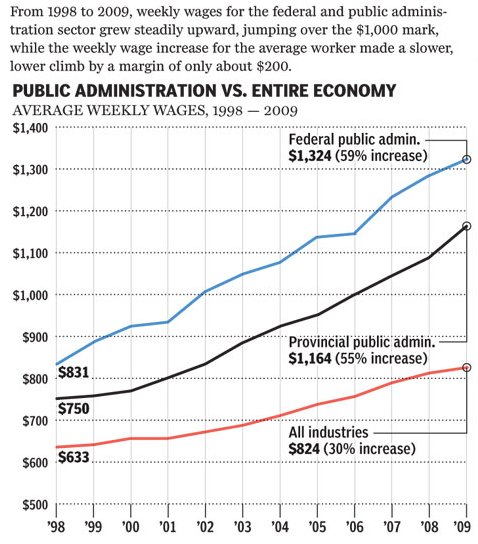
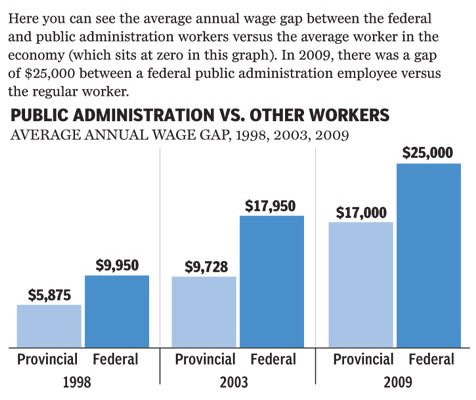
Both images are details from this National Post graphic.
December 23, 2010
Prichard, Alabama defaults on civil service pensions
The town failed to fully fund the pension plan for their employees, and it ran out of money in 2009. In spite of state law, they stopped paying the pensioners:
Since then, Nettie Banks, 68, a retired Prichard police and fire dispatcher, has filed for bankruptcy. Alfred Arnold, a 66-year-old retired fire captain, has gone back to work as a shopping mall security guard to try to keep his house. Eddie Ragland, 59, a retired police captain, accepted help from colleagues, bake sales and collection jars after he was shot by a robber, leaving him badly wounded and unable to get to his new job as a police officer at the regional airport.
Far worse was the retired fire marshal who died in June. Like many of the others, he was too young to collect Social Security. “When they found him, he had no electricity and no running water in his house,” said David Anders, 58, a retired district fire chief. “He was a proud enough man that he wouldn’t accept help.”
The situation in Prichard is extremely unusual — the city has sought bankruptcy protection twice — but it proves that the unthinkable can, in fact, sometimes happen. And it stands as a warning to cities like Philadelphia and states like Illinois, whose pension funds are under great strain: if nothing changes, the money eventually does run out, and when that happens, misery and turmoil follow.
Prichard is only the start: far too many local governments are approaching the same situation.
November 3, 2010
Monty: The flushing sound you just heard is California’s future
Monty pronounces the final doom of California:
That sound you just heard was the State of California irretrievably flushing itself down the toilet.
[. . .]
California’s most dire problems right now are related to public-employee obligations (pensions and healthcare). The power of public-employee unions in California have held the State and local governments in thrall for years, and with the election of Jerry Brown as Governor, the people of California have opted to spray kerosene on a blaze that was already threatening to overwhelm them.
[. . .]
Well, the die has been cast, California. You have placed your fate into the hands of a political party and a governmental machine that cares for nothing except what it can squeeze out of you to keep the party-train rolling. There will come a time in the not-too-distant future when you will have cause to bitterly regret what happened last night, and to wonder when the disaster truly became unavoidable. Well, now you know: it happened last night when you elected Jerry Brown as your governor. You chose to kowtow to the labor unions; you chose to believe comforting lies rather than the horrible truth.
You will reap the whirlwind.
Update: A couple of Twitter updates from Iowahawk sum things up nicely.
10:28: Boxer, Brown, no on Prop 19: congrats, California. You have officially gone Full Retard.
11:05: And as if California wasn’t already full of idiots, lunatics, and drug abusers, I’m flying there this afternoon.
October 28, 2010
October 25, 2010
Studying bureaucratic bias
I’ve always thought that behaviour patterns of bureaucrats are fairly easy to predict: it all hinges on risk/reward. A bureaucrat with expectation of retiring at the peak of pension eligibility will have a very high aversion to risk — but not quite what most people refer to as risk. A bureaucrat has a built-in bias to “stay the course”, to avoid “rocking the boat”, and to prevent the kind of change that will introduce exceptions to normal process.
Expecting a bureaucrat to react like an entrepreneur is unrealistic, because the bureaucrat’s risks (loss of promotion opportunities, loss of status, but not usually loss of job) do not scale well against the possible rewards — except in particularly corrupt jurisdictions, bureaucrats do not directly benefit from making risky decisions.
Given that, is it any surprise that bureaucrats, as a whole, are quite unwilling to step outside “normal practice” or to allow variances, exceptions, or (sometimes) even common sense solutions?
I should be careful (except that I’m a blogger, where “careful” really just means “avoiding lawsuits”), because there’s a risk I’m suffering from one of the traits identified in behavioural economics, the illusion of competence in my preceding horseback judgement:
There is a fashionable new science — behavioral economics, they call it — which applies the insights of psychology to how people make economic decisions. It tries to explain, for instance, the herd instinct that led people during the recent bubble to override common sense and believe things about asset values because others did: the “bandwagon effect.” And it labels as “hindsight bias” the all-too-common tendency during the recent bust to imagine that past events were more predictable than they were. Behavioral economics has also brought us notions like “loss aversion”: how we hate giving up a dollar we have far more than forgoing a dollar we have not yet got.
But while there is a lot of interest in the psychology and neuroscience of markets, there is much less in the psychology and neuroscience of government. Slavisa Tasic, of the University of Kiev, wrote a paper recently for the Istituto Bruno Leoni in Italy about this omission. He argues that market participants are not the only ones who make mistakes, yet he notes drily that “in the mainstream economic literature there is a near complete absence of concern that regulatory design might suffer from lack of competence.” Public servants are human, too.
Mr. Tasic identifies five mistakes that government regulators often make: action bias, motivated reasoning, the focusing illusion, the affect heuristic and illusions of competence.
In the last case, psychologists have shown that we systematically overestimate how much we understand about the causes and mechanisms of things we half understand.
July 8, 2010
May 22, 2010
Another reason public service pensions are better than private ones
Megan McArdle points out another key difference between “ordinary” pensions and US state government pensions:
Public employees rack up overtime in their last year of work, with the active encouragement of their supervisors and even local politicians, then they retire with inflated pensions that can be greater than their base salary.
New York is the understandable focus, but these problems are hardly unique to my home state. In fact, New York is among the better states on funding of pensions, because they actually have to do some. Other states kinda sorta haven’t really bothered — at least not at anywhere near the levels that would be needed. New York’s problem is notable only because its public sector unions are unusually powerful.
The problem is that these things are nearly impossible to change. People have worked for twenty years or more under the expectation of pensions that were calculated this way; you can’t just wait until they’re 58 and say “Ha, ha, just foolin’.”
<sarcasm>Of course, the money will always be there, right? No reason for anyone to change their expectations.</sarcasm>
May 21, 2010
California’s version of the Greek public service problem
David Crane shows why California’s public pension scheme has much in common with the Greek pension scheme, in the sense of a mind-boggling disconnect from economic reality:
In 1999 then California Governor Gray Davis signed into law a bill that represented the largest issuance of non-voter-approved debt in the state’s history. The bill SB 400 granted billions of dollars in retroactive pension boosts to state employees, allowing retirements as young as age 50 with lifetime pensions of up to 90% of final year salaries. The California Public Employees’ Retirement System sold the pension boost to the state legislature by promising that “no increase over current employer contributions is needed for these benefit improvements” and that Calpers would “remain fully funded.” They also claimed that enhanced pensions would not cost taxpayers “a dime” because investment bets would cover the expense.
What Calpers failed to disclose, however, was that (1) the state budget was on the hook for shortfalls should actual investment returns fall short of assumed investment returns, (2) those assumed investment returns implicitly projected the Dow Jones would reach roughly 25,000 by 2009 and 28,000,000 by 2099, unrealistic to say the least (3) shortfalls could turn out to be hundreds of billions of dollars, (4) Calpers’s own employees would benefit from the pension increases and (5) members of Calpers’s board had received contributions from the public employee unions who would benefit from the legislation. Had such a flagrant case of non-disclosure occurred in the private sector, even a sleepy SEC and US Attorney would have noticed.
Until very recently, public service pension schemes might as well have been listed in the dictionary under “soporific” — except for the beneficiaries, nobody paid much attention. Even so, you’d think that the breathtaking assumptions in the Calpers bill would have woken up at least a few politicians and reporters. Of course, no political body has an effective “Office of Realistic Assumptions” to run proposed legislation past (although it wouldn’t be a bad idea), so it might well be that nobody bothered to check the sums before the bill was passed.
Or, more likely, that nobody voting that day expected to be held accountable for the outcome.
Update: Good news! The state legislature just passed new regulations! That’s bound to fix the problem, right?
Oh, wait . . .
California’s public pension funds would have to report the ethnicity and gender of some of the outside investment managers they hire under a bill that passed the state Assembly on Thursday.
The bill states that businesses owned by women and minorities are not adequately represented in the state’s pension fund portfolios, compared to their proportion of California’s population. It passed on a 41-22 vote and now moves to the state Senate.
Well, that will certainly fix the funding issues in no time, won’t it? Your California state legislature, constantly working for you!
May 20, 2010
The root of the Greek economic crisis
No, it’s not the evil banks, the evil insurance companies, the evil oil companies, or even the evil manufacturing sector (take it as read that most media types think every corporation is, by definition, evil). No, in this case the reports are starting to identify the real culprit: the civil service. Mark Steyn summarizes handily:
They were not an “anti-government” mob, but a government mob, a mob comprised largely of civil servants. That they are highly uncivil and disinclined to serve should come as no surprise: they’re paid more and they retire earlier, and that’s how they want to keep it. So they’re objecting to austerity measures that would end, for example, the tradition of 14 monthly paycheques per annum. You read that right: the Greek public sector cannot be bound by anything so humdrum as temporal reality. So, when it was mooted that the “workers” might henceforth receive a mere 12 monthly paycheques per annum, they rioted. Their hapless victims — a man and two women — were a trio of clerks trapped in a bank when the mob set it alight and then obstructed emergency crews attempting to rescue them.
Unlovely as they are, the Greek rioters are the logical end point of the advanced social democratic state: not an oppressed underclass, but a pampered overclass, rioting in defence of its privileges and insisting on more subsidy, more benefits, more featherbedding, more government.
We’ve already seen that employees in the public sector have been outpacing their private sector equivalents handsomely, but the Greek civil service has it even better than most:
Greek public sector employees are entitled not only to 14 monthly paycheques per annum during their “working” lives, but also 14 monthly retirement cheques per annum till death.
Nice. I wonder how they got into that interesting arrangement? No matter, the private sector will ride to the rescue, right? Not likely:
According to the World Bank, when it comes to the ease of doing business, Greece ranks 109th out of 183 countries. If they were dramatically to liberate their business-killing economy, they might overtake Lebanon at big hit position 108, and Ethiopia at 107, and maybe Papua New Guinea at 102. And who knows? With even more radical reform, they might crack the Hot One Hundred and be bubbling under such favourable business environments as Yemen (99) and Moldova (94). Greece ranks 140th when it comes to starting a business, and 154th when it comes to protecting investors.
If it’s that difficult to start a new business, is it any wonder that so much of the Greek economy is in the underground/unreported/untaxed sector? Many media reports say that anywhere from 10% to 25% of Greek economic activity is “off the books”. A quick Google search will show a much higher range of estimates going up to 60% . . . and that might be an optimistic under-estimate.
If more than half of the nation’s economic activity is in the black market, it will take much more than adding a few auditors and inspectors to the tax department to fix the problem: an absolute majority of Greeks are actively hiding their business from the government, and any serious attempt to crack down on them will bring down the government. And that’s not even the biggest danger — the Greek government isn’t the most stable entity to start with. The government falling might be a safety valve, because the other alternative is literally revolution.
Talk about your destabilization!
March 31, 2010
More on the growth in public sector employment
March 15, 2010
PSAC president says public servants not paid as well as private sector workers
In direct opposition to common belief, John Gordon of the Public Service Alliance of Canada says that civil servants are worse-paid than private sector workers:
“Here we are again,” says John Gordon, the president of the Public Service Alliance of Canada that represents 165,000 workers.
“Every time the government gets into [trouble] they kind of ramp up the rhetoric and the Canadian public starts to believe them . . .” he said.
In general terms, he added, his members’ wages run behind those in comparable positions in the private sector.
His workers are an easy target, he said, because the government fails to explain what it means to get rid of public servants — that services provided to the public would be affected.
For example, Mr. Gordon points to the work done by federal public servants during the H1N1 crisis to get vaccines in place and deal with the pandemic.
“It’s easy to broad brush it and say they should be freezing wages, which they have already done and cutting public services, which they are already doing . . .” he said, but added that the public has to ask itself what services it would like to see gone.
You see, unlike in the bloated private sector, where jobs are for life, and pensions are awesome, civil servants are overworked and underpaid. Any hint of reducing the costs of the civil service will automatically produce the most painful cuts for the public — that’s how the game is played. Even a freeze would somehow, through the arcane alchemy of public service financing, result in cuts only in the services most visible to the public.
Update, 16 March: An interesting sidelight to this is reported in Hit and Run:
California citizens are now encountering “state and local government officials [who are] increasingly . . . blaming budget cuts and furloughs when they withhold or delay the release of information requested under the state Public Records Act.”
March 13, 2010
Privatization? Let’s not be ideological!
Robert Fulford on the problems with unions in the public service:
Unions hate the very word “privatization.” And no wonder. Their present system is close to perfect: Their workers can’t be fired but can strike, as they do from time to time, demonstrating their power. They win most of their struggles with politicians, who throw billions at them just to keep them quiet. (After all, it’s not as if the politicians were spending their own money.)
This arrangement became commonplace in Canada about half a century ago, turning public-sector employees into princes of the working class who make more money than other people doing the same jobs, and receive more generous benefits.
Union members passionately believe this is no more than their due. The unions and their friends believe public ownership is fundamentally good, private ownership at best dubious. In 1994, when it seemed possible that Ontario would privatize liquor sales, the Ontario Liquor Boards Employees’ Union commissioned a study by a York University economist, Nuri Jazairi. He found, no surprise, that this was a bad idea and that the provincial government should continue to control every ounce of liquor sold within provincial boundaries, presumably for eternity.
But his report was most revealing when he turned to the motives of those who favour privatization. He suggested the idea sprang from “purely political and ideological reasons,” among which he listed “the control of public expenditures” and “limiting the role of government in managing the economy.”
It’s no surprise that the folks who benefit disproportionally from the current arrangement are the most vocally opposed to any changes which would reduce their advantages. If the government did get enough political will to go ahead and privatize, there’s no way (unless the government tied their hands in advance) that private enterprise would give — or could afford to give — their employees the same pay and benefits they currently enjoy under public ownership.
Update: Speaking of situations which could only arise under public ownership, here’s a perfect example:
More than 1,250 Ontario Ministry of Revenue employees will soon be receiving severance packages of up to $45,000 each — but they won’t be out of work. Most of them aren’t even switching desks. They’re simply being transferred from the provincial payroll to the federal payroll when the province moves to a federal harmonized sales tax this summer.


