Quotulatiousness

September 15, 2012

The amazing time-travel effects of sequestration

Filed under: Government, Media, USA — Tags: — Nicholas @ 11:35

Nick Gillespie tells us to expect a lot more stories attributing current troubles to future spending cuts:

Now that the White House has released its massive sequestration report detailing the $1.2 trillion in possible cuts to future spending over the next 10 years, expect to read more headlines like the following from Buzzfeed:

You got that implication, kemo sabe?

Possible future trims in spending have something to do with what’s going in the Middle East right now. Not that embassies are under attack now because of American foreign policy or world events or rotten security or whatever. Or that we can’t defend our citizens and diplomatic corps right now despite record-high levels of spending on defense and military operations for most of the 21st century.

No, the real bad news is coming if and when the United States stops its 12-year long spending spree that has all but killed any chance of recovery and piled on the debt like Dagwood Bumstead loading cold cuts onto a sandwich roll.

[. . .]

This much is true: The planned cuts are across-the-board to particular programs including everything from defense to Medicare to education to you name it (that was the point, to share the costs).

And this much is complete bullshit: “sequestration would be deeply destructive to national security, domestic investments and core government functions.”

In fact, the cuts for 2013 amount to maybe a whopping $120 billion in an annual budget that is likely to run about $3.8 trillion. Out of the $120 billion, about $50 billion will come out of military budget that will be well north of $650 billion, including war funding.

August 24, 2012

It’s an odd sort of “austerity” that increases government spending

Filed under: Britain, Economics, Government — Tags: , , , , — Nicholas @ 10:27

Everyone knows that Britain’s current economic woes are because of the government’s harsh austerity measures, right?

The argument over ‘the cuts’ has now become wholly detached from reality. Listen to any BBC debate and you’ll find the debate presented along these lines: ‘The Coalition, aiming to eliminate the deficit by 2015, has cut spending; this has had the effect of reassuring the markets and preventing a Greek-style meltdown but, on the other hand, it has impeded growth, and so reduced the tax-take, which has meant that the deficit now won’t be abolished until at least 2017. Some people believe that we need to focus on growth, not austerity. They are calling for Plan B’.

Every assumption contained in that summary is false. Net government expenditure is higher now than it was three years ago. Such deficit reduction as there has been has come largely through tax rises rather than spending cuts. The reason that government borrowing costs are low is not because of the imagined austerity programme, but because the Bank of England has magicked up nearly £400 billion through quantitative easing, given it to banks and told them to buy government debt with it. Growth and austerity are not antonyms: it was debt-fuelled growth caused the disaster in the first place. As for Plan B, no one has yet tried Plan A: spending less.

July 8, 2012

Economic land mines laid by Blair and Brown’s governments exploding now

Filed under: Britain, Economics, Government — Tags: , , , , , — Nicholas @ 10:34

At The Commentator, John Phelan wonders if it’s now time for “an economic Nuremburg” for the 1997-2010 British governments of Tony Blair and Gordon Brown:

Like an iceberg, the extent of the damage wrought by the last Labour government is still becoming apparent.

One of the wheezes Labour used to camouflage its vast spending spree was the Private Finance Initiative. These had been brought in by John Major’s Conservatives (to criticism from the then Labour opposition) and involved a private sector entity building something and then selling it or leasing back to the government over a number of years, usually decades.

Upon winning the election in 1997 however, Labour performed a volte face and embraced PFIs. They appealed to Gordon Brown because the liabilities taken on under PFIs would not show up on the government’s balance sheet. In other words, they wouldn’t be included in the national debt figure.

Labour signed up to an estimated £229 billion of PFI projects. That’s almost two and a half times the entire projected budget deficit for 2012 – 2013, or 16 percent of GDP.

[. . .]

Indeed, like the cat who leaves little ‘presents’ around the house for you to discover when you return from holiday, the Labour government of 1997 to 2010 is the gift that keeps on crapping on your carpet. We will be discovering fiscal turds left by Labour for literally decades to come.

If you were being charitable you would ascribe the fiscal incontinence of the Blair/Brown governments to some sort of Keynesian economic theory, though that fails to explain why they applied fiscal ‘stimulus’ for seven years to an already growing economy.

If you were being slightly less charitable you might ascribe it to incompetence of a quite staggering degree. The last Labour government, after all, were probably the biggest set of mediocre idiots ever to govern this country.

And, if you were being even less charitable, you might ascribe it to something more sinister – Brown poisoning the wells when he heard opposition tanks at the end of his strasse.

July 5, 2012

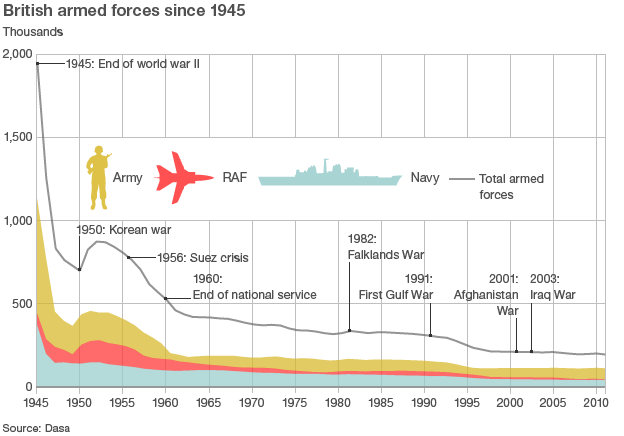
British army reduces and consolidates 17 units

Filed under: Britain, Military — Tags: , , , — Nicholas @ 09:47

As reported earlier, the British army will be losing several battalions of infantry in the consolidation effort to reduce the army’s total manpower by 20,000:

The four infantry battalions to disappear are the 2nd Battalion the Royal Regiment of Fusiliers, the 2nd Battalion the Yorkshire Regiment (Green Howards), the 3rd Battalion the Mercian Regiment and the 2nd Battalion the Royal Welsh.

A fifth infantry battalion, the 5th Battalion the Royal Regiment of Scotland (Argyll and Sutherland Highlanders), will become a single company to carry out public duties in Scotland.

The Armoured Corps will be reduced by two units with the mergers of the Queen’s Royal Lancers and the 9th/12th Royal Lancers and the 1st and 2nd Tank Regiments.

The Royal Artillery, the Royal Engineers, the Army Air Corps, the Royal Logistic Corps, the Royal Electrical and Mechanical Engineers and the Royal Military Police will also be affected.

[. . .]

Details of the other changes are:

  • The Royal Artillery will be reduced from 13 to 12 units with the withdrawal of the 39th Regiment Royal Artillery
  • The Royal Engineers will be reduced from 14 to 11 units with the withdrawal of 24 and 28 Engineer Regiments and 67 Works Group
  • The Army Air Corps will reduce from five to four units as 1 Regiment AAC merges with 9 Regiment AAC
  • The Royal Logistic Corps will be reduced from 15 to 12 units with 1 and 2 Logistic Support Regiments withdrawn from the Order of Battle and 23 Pioneer Regiment disbanded
  • The Royal Electrical and Mechanical Engineers will be reduced to seven units with the withdrawal of 101 Force Support Battalion
  • 5 Regiment Royal Military Police will be removed

Update: As you’d expect, the changes are not being welcomed by current or former soldiers.

The reforms have caused anger and frustration within senior ranks. Earlier this week, a leaked letter to General Wall from one senior officer in the Royal Fusiliers showed the anger brewing over the scale of the proposed cuts.

Brigadier David Paterson, the honorary Colonel of the Regiment of Fusiliers, said the decision to axe one of its battalions would not “best serve” the armed forces and “cannot be presented as the best or most sensible military option”.

He added: “I, as Colonel, have the duty to tell my men why it is their battalion, which at the time of the announcement will be the best manned battalion in the army, with recruits waiting in the wings, was chosen by CGS. I will then also have to explain to my Fusiliers in a fully manned battalion why they are likely to be posted to battalions that cannot recruit. This will not be an easy sell.”

July 3, 2012

Details of British army cuts leaked

Filed under: Britain, Military — Tags: , — Nicholas @ 09:19

The Guardian has some details on the upcoming cuts to the British army, which will include the elimination of several battalions of infantry and the merging of some armoured regiments:

The acrimony and chaos surrounding plans to cut 20,000 troops from the army have been laid bare after details of the battalions to be scrapped were leaked before a ministerial statement on Thursday.

The proposals, whose publication has been delayed by Downing Street because of their sensitivity, show historic units to be axed include the third battalion of the Yorkshire regiment and the Argyll and Sutherland Highlanders, the fifth battalion of the Royal Regiment of Scotland. One battalion will be lost from the Royal Welsh, the Mercians and the Royal Fusiliers.

[. . .]

Official letters to army commanders were sent out on Tuesday, ready for the announcement in parliament by the defence secretary, Philip Hammond. The hope had been that soldiers would hear about the cuts from senior officers, but this has been dashed by the leak in Tuesday’s Sun.

[. . .]

The army is losing a fifth of its overall strength because of budget cuts and restructuring set out in the much criticised 2010 Strategic Defence and Security Review.

A subsequent MoD re-evaluation — last year’s so-called “three-month exercise” — more than doubled the number of troops to be lost to 20,000.

[. . .]

The battalions to be saved include the Royal Scots Dragoon Guards, the Queen’s Dragoon Guards and the Royal Dragoon Guards. The Parachute Regiment’s three battalions will be spared.

Under the proposals, the Queen’s Royal Lancers will be merged with the 9th/12th Lancers, and the 1st Royal Tank Regiment with the 2nd Royal Tank Regiment.

“The longer the euro area’s debt crisis drags on, the more it resembles an instrument of economic torture”

Filed under: Economics, Europe — Tags: , , , , , — Nicholas @ 08:47

The Economist on the long-drawn-out European financial mess:

THE longer the euro area’s debt crisis drags on, the more it resembles an instrument of economic torture. Like the medieval rack, every turn of the crisis tears Europe further apart. This week Cyprus announced it would seek a bail-out. Spain formally asked for money to recapitalise its banks. The Greek limb is close to being ripped off. How long can the Italian one hold?

Monetary union was meant to be a blessing. The euro’s founders dreamed that it would end chronic and divisive currency crises, promote growth and multiply Europe’s economic power. After the creation of the single market, the euro was the next step toward political union.

[. . .]

Now, after first blaming speculators, then profligate states, then, more broadly Europe’s lack of competitiveness, the cardinals of monetary union have belatedly come to understand that the main problem is the euro itself. A new report by a group of prominent economists — sponsored by Jacques Delors, the former president of the European Commission, and Helmut Schmidt, the former German chancellor — describes in telling detail how the euro is destroying itself.

Start with the European Central Bank’s “one size fits all” interest rate, which the report’s leading author, Henrik Enderlein of the Hertie School of Governance in Berlin, relabels a “one size fits none” rate. Differences in inflation are magnified: in countries with higher-than-average inflation (eg, Italy), the real interest is too low, fuelling more inflation; the opposite is true in countries where inflation is low (eg, Germany). Another problem is that the single market is far from complete, so that competition does not even out price differences across the EU. The market in services, which represents the biggest share of economic output, is still fragmented. Moreover, European workers are less likely to move in search of jobs than, say, American ones. A further curse is that countries of the euro zone do not independently control their own money. Because each lacks its own central bank to act as a lender of last resort, troubled countries can more easily be pushed into default as markets panic. Lastly, cross-border financial integration has spread far enough to channel contagion from one country to another, but not so far as to break the cycle of weak banks and weak sovereigns bringing each other down.

June 21, 2012

Conservative government, but only in name

Filed under: Cancon, Government — Tags: , , , — Nicholas @ 00:03

Andrew Coyne on the palpable absurdity of the “Harper government” stonewalling the very office it insisted on setting up for oversight of government spending:

The reality is that the PBO has been given anything but the “free and timely access” that Parliament demanded. Time and time again, rather, he has been given the back of the government’s hand — stonewalled by the bureaucrats, ridiculed by the politicians, and lied to by both.

When, for example, the Department of National Defence at last consented to share the cost of the F-35 fighter jet purchase with the PBO, it provided only the most rudimentary figures, without any indication of how they were arrived at. These figures, on which the last election was fought, were later shown to understate the true costs of the jets by at least 40% and probably 60%, in violation not only of Treasury Board rules but the department’s own stated policies. For the crime of having been right, the PBO was subjected to a volley of ministerial insults, while the department pretends to this day not to have understood the office’s clearly stated requests.

More recently, the PBO (Kevin Page is his name) has been trying to get government departments to explain how they plan to achieve the $5.2-billion in largely unspecified “efficiencies” pencilled into the 2012 budget. How much of these, Page wanted to know, would be achieved by reducing costs, and how much by reducing services? How would federal employment be affected in either event? In other words, what did the budget mean by “efficiencies”? This would seem useful information for Members of Parliament considering their vote, assuming — you’ll indulge me here — MPs do indeed consider their votes.

Power corrupts, as Lord Acton reminds us, and the discipline that Stephen Harper enforced over his unruly caucus on their way to winning a minority government is now extended to the majority he enjoys today. What affronted him about Jean Chretien’s imperial ways now seems quite normal and unexceptional. Power does indeed corrupt.

June 14, 2012

What is at stake in the amendment process to the omnibus bill

Filed under: Cancon, Government, Law — Tags: , — Nicholas @ 00:02

As Andrew Coyne points out, if nothing else the stack of amendments the opposition have proposed does accomplish something (even if none of the amendments are accepted):

The House of Commons was to begin voting Wednesday night on several hundred amendments to Bill C-38, the 425-page monster known as the omnibus budget implementation bill. The voting was expected to go on all night and all day Thursday.

Viewed one way, the whole thing is quite silly. Given the government’s majority, none of the amendments is likely to pass, nor is the bill itself in any danger of defeat. Viewed another way, however, this is an important moment. For the first time since the last election, the opposition is putting up a serious fight against the abuses this government has visited upon Parliament: not only the omnibus bill, which repeals, amends or introduces more than 60 different pieces of legislation, but the repeated, almost routine curtailing of debate by means of “time allocation”; the failures of oversight, misstating of costs, and abdication of responsibility in the F-35 purchase; and the refusal to provide basic information on spending to Parliament or the Parliamentary Budget Officer — to say nothing of the stonewalling, prorogations and other indignities of the minority years.

What’s the point? Once, as in the famous “bell-ringing” episode of 1982, the point would have been to hold up parliamentary business until the government relented: not on the substance of the bill, which a duly elected government is entitled to pass, but on the principle that the bill should be split, that Parliament is entitled to vote on each of its several major parts separately, and to give each the kind of informed scrutiny and debate it warrants. Again, that is not only in the opposition’s interests, or even Parliament’s, but the nation’s: it makes for better legislation.

May 26, 2012

Andrew Coyne on Harper’s real “hidden agenda”

Filed under: Cancon, Economics, Government — Tags: , , , , — Nicholas @ 09:32

We’ve been hearing about Stephen Harper’s “hidden agenda” for nearly a decade and it’s about time for some of it to finally come to light — what’s the point of having a hidden agenda if you never actually implement any of it? Andrew Coyne thinks he’s detected the real thing:

It is becoming more difficult to accuse this government of having a hidden agenda. Not because it hasn’t tried, mind you. But while it remains as obtuse as ever about its intentions, the signs of an agenda are by now unmistakable. Where before it had attitudes, or at best stances, it is beginning to sprout what look remarkably like policies.

To be sure, they are modest, even piecemeal. They are often poorly communicated, where the Conservatives deign to communicate them at all. More often they are simply dropped on the unsuspecting public without consultation, or jammed through Parliament with little debate or scrutiny, quite apart from monstrosities like the omnibus bill.

But put them together and they have all the markings of an agenda:

  • Reform of Old Age Security, not only raising the age of eligibility by two years (starting in 2023, and phased in over six years) but offering higher benefits to those willing to keep working past the standard retirement age.
  • Free trade agreements, now being negotiated with virtually everything that moves: Europe, India, Japan, the Trans-Pacific Partnership, the ASEAN group.
  • Reform of immigration policy, across every category: skilled immigrants, refugees, investors, entrepreneurs, with an emphasis on recruiting immigrants with demonstrable economic prospects.
  • Reform of employment insurance, announced this week, to give repeat users, in particular, fewer excuses to refuse available work.
  • Moreover, the government is at last beginning to implement the Red Wilson report on productivity, four years after it was delivered, with recent reforms opening the door to foreign takeovers in the telecommunications sector (for companies with less than 10% of the market), and raising the threshold asset value for automatic review of foreign takeovers to $1-billion.

May 22, 2012

Reason.tv: Is Austerity to Blame for Europe’s Economic Woes?

Filed under: Economics, Europe, Government, Media — Tags: , , , — Nicholas @ 11:50

May 8, 2012

Absurd meme of the month: that European countries have imposed draconian fiscal austerity

Filed under: Economics, Europe, Government, Media — Tags: , , , , — Nicholas @ 11:00

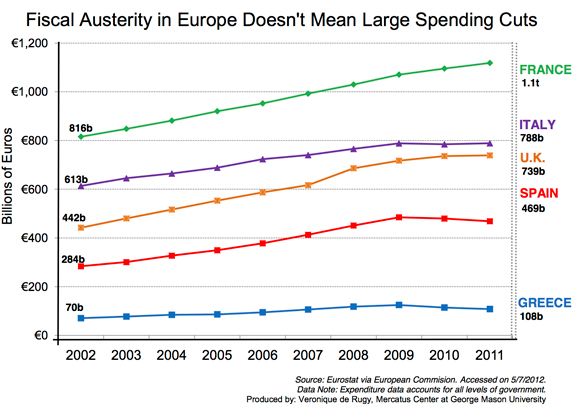
For all the gasping about the impact of fiscal austerity on weakened European economies, it’s hard to detect from the actual numbers:


(Image from the Mercatus Center)

See all those coloured lines dropping precipitously? Me neither.

Veronique de Rugy asks where the “savage” spending cuts can be seen:

Austerity is destroying Europe, we are told. In fact, this “anti-austerity” slogan was a big reason for the victory of newly elected socialist François Hollande to the presidency of France. Interviewed in The Economist a few weeks ago, Hollande’s campaign director said “We are not disciples of savage spending cuts.”

But then, I look at the data and I am asking: What “savage” spending cuts?

Look at [the chart above]. It is based on Eurostat data which you can find here. Following years of large spending increases, Spain, the United Kingdom, France, and Greece — countries widely cited for adopting austerity measures — haven’t significantly reduced spending since 2008. As you can see on this chart:

  • These countries still spend more than pre-recession levels
  • France and the U.K. did not cut spending.
  • In Greece, and Spain, when spending was actually reduced — between 2009–2011 — the cuts have been relatively small compared to what is needed. Also, meaningful structural reforms were seldom implemented.
  • As for Italy, the country reduced spending between 2009 and 2010 but the data shows and uptick in spending 2011. The increase in spending represents more than the previous reduction.

In addition to failing to curb spending, several governments have raised taxes (which has a negative effect on growth in the economy and can — contrary to popular wisdom — actually reduce the total tax collected as people and companies change their habits to minimize the impact of the tax change).

April 8, 2012

The F-35 program is “Military Keynesianism”

Wayne K. Spear explains the ordinary and the extraordinary parts of a military procurement process, as illustrated by the F-35 project:

A straight-shooting bureaucrat will admit that procurement processes are often initiated with the final selection a foregone conclusion. If you know in advance what you need, and you furthermore know who’s most qualified to deliver, then formalities intended to promote transparency and accountability are at best inconveniences to circumnavigate — and every public servant knows well how to steer that ship. That this occurs regularly within the bureaucracy is an open secret.

The Joint Strike Force program, at the centre of which is a proposed purchase of F-35 fighters, introduces disturbing wrinkles to an otherwise unremarkable bureaucratic occurrence. On military matters I refer to the self-described “prolific Ottawa blogger” Mark Collins , who has been training his keen eye on this fiasco for years. At his site you’ll find links to a range of useful resources, for example a DND PowerPoint which makes it clear that military leaders chose the F-35 and only later manufactured the selection criteria. Again, not unusual in procurement. The department however did so on grounds no one has yet admitted, never mind defended. That’s only one of many problems.

Reviewing the Auditor General’s report and the media coverage of this issue, I infer that the F-35 achieved the status of a foregone conclusion for the following reasons. 1) Canada had invested millions of dollars into the F-35 program as early as the 1990s; 2) Lockheed Martin Aeronautics lobbied aggressively, and more effectively, than its rivals (and employed Prospectus Associates, a consultancy firm with the inner track to Defence Minister Peter MacKay); and 3) the F-35 series of fighters — although years from completion and with many important details unclear and ever-changing (including year of completion, engine cost, cost to maintain) — were the only “fifth generation” fighters on the table. As the Auditor General points out, fifth generation “is not a description of an operational requirement.” My own research suggests this phrase means something like ”Ooo!” — which is what I often say when I see a jet fighter in action.

It’s a given that the Royal Canadian Air Force needs to address the rapidly aging CF-18 fleet before 2020 (the estimated end-of-life for the current fighters). The choice had appeared to be simple: follow on our pre-existing development deal with a purchase of F-35 fighters. The problems were that the development schedule had slipped multiple times, the estimated costs had climbed and climbed again, and the technical “teething” issues were still promising longer delays and higher costs. Canada had intended to buy 65 aircraft — in my opinion at least 33% less than the RCAF actually needed — at a “fixed” cost.

The F-35 is still years away from being in service in any air force, there’s no way to be sure that the government’s budget will be enough to buy the minimum number of aircraft, and the CF-18 isn’t getting any younger.

We need (some) new fighter aircraft in the next eight years, but the F-35 is no longer the automatic choice to fill that role.

There’s another root problem, and it’s also to be found in the 2012 federal budget. This document superstitiously relies on the notion that everything the feds do creates jobs. Every spending initiative in the budget creates jobs. Every departmental trim, and every restraint, ditto. Having gone through the budget, I wonder if Mr. Flaherty thinks a job is created when he sneezes. At the same time I was reading the budget, I was reviewing the federal government’s 2010 F-35 sales pitch — which, coincidentally, was the DND’s and Lockheed Martin’s sales pitch. Again, it’s all about “industrial benefits.” Lo and behold: the F-35 program creates jobs!

One name for this line of argument is “Military Keynesianism,” the idea that a brilliant and effective way to create jobs and boost the economy is to give folks like Lockheed Martin billions of dollars of public money. In the 1980s, the American public heard many Pentagon procurement stories concerning $40 staplers and $200 hammers, all part of a federal stimulus effort which by 1988 had tripled the nation’s deficit. There are distinctions to be made between this and the present case. Nonetheless, these staplers and hammers came to my mind as I dug down into the bogus F-35 procurement process and my shovel chipped the Reagan-era bedrock.

The Military-Industrial Complex lives

Filed under: Military, Politics, USA — Tags: , , , , — Nicholas @ 10:55

From Strategy Page, where the US Army doesn’t want any more tanks right now, but the politicians (and their crony capitalist “friends”) want the tanks to continue to be built and upgraded:

The U.S. Army is fighting the politicians to avoid having to buy more M-1 tanks, or upgrade some older ones that do not need upgrades. What it comes down to is that the politicians want to keep the only American tank manufacturing plant open. It’s all about political posturing, votes and getting reelected. But the army wants to spend its shrinking budgets on things that will save lives in the next battle. At stake is several billion dollars. The generals cannot openly say that this is about buying votes versus buying lives, but that’s what it comes down to.

So far, over 9,000 American M-1 tanks have been produced and most of them subsequently updated at least once. But the army, seeking to save a billion dollars, wants to close the plant that builds and modifies the M-1. The closure would be for three years, and when it was reopened there would be a backlog of upgrades and parts orders to fill to keep the plant open until, perhaps, an M-1 replacement comes along. At the moment the generals do not have any firm plans for an M-1 replacement.

Politicians and the operators of the plant want to keep the plant open in order to save jobs, votes, and operating profits. This is basically a largely political decision that involves getting the money (from the taxpayers) to stay open by pretending that the army wants this. But the army leadership has not cooperated and has openly opposed this plan. How long the plant will remain in business is uncertain, as is the future of the M-1 tank.

April 2, 2012

Kelly McParland: Judge Harper not on what he says, but what he does

Filed under: Cancon, Economics, Government — Tags: , , — Nicholas @ 09:14

In the National Post, Kelly McParland scrutinizes the entrails of the federal budget to determine what Prime Minister Stephen Harper is really thinking:

It’s pretty self-evident that prime ministers reveal a lot of their own character in the content of their budgets, but it may be particularly so for Stephen Harper. The guy is an economist, after all. Messing around with graphs and figures was what he planned to do with his life, if seizing control of the country’s government didn’t work out. And since we know he’s a bit of a micro-manager, it’s probably safe to say there’s at least as much Harper as there is Jim Flaherty in the nitty gritty of the latest budget document. So let’s use it to figure out what Stephen Harper believes — really believes — when it comes to running the country.

We know what he says he believes in: smaller government, fewer bureaucrats, restrained spending, less intrusion, an end to taxpayer-financed welfare for businesses and governments. Accountability, prudence, fairness. Individual responsibility rather than the smothering embrace of the nanny state. No more currying favour with every special-interest advocacy group that captures the attention of congenitally correct.

Maybe on some plane he does honestly hold those values dear to his heart. But we all profess to believe in ideals we never quite get around to displaying. Mr. Harper has been Prime Minister for six years, and since last May has had the majority needed to have his way with legislation. Yet, as Andrew Coyne has so clearly demonstrated on more than one occasion, Mr. Harper’s actions habitually belie his words. If he were applying for membership in the True Conservative Believers Club of Canada, they’d turn him away as unqualified.

March 30, 2012

Looking ahead to the next federal budget

Filed under: Cancon, Economics, Government — Tags: , — Nicholas @ 08:29

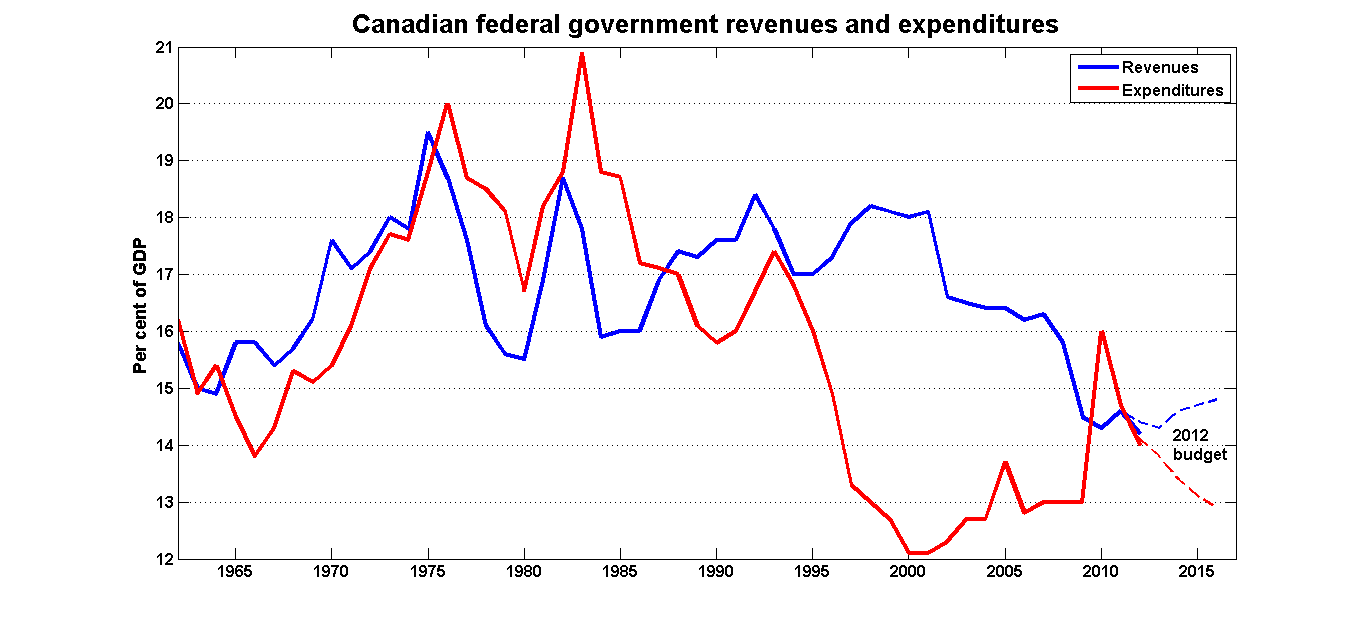
In the Globe and Mail Economy Lab, Stephen Gordon thinks he can accurately predict the overall shape and content of the next budget:

The main features of the expenditure side of next year’s 2013-14 federal budget should be fairly easy to predict:

  • Transfers to persons will be about 4 per cent of GDP, and future projections will be consistent with this share.
  • Transfers to other levels of government will be about 3.2 per cent of GDP, and future projections will also be consistent with this share.
  • Direct program spending will be at or just above 6 per cent of GDP, and this share will be projected to decline throughout the forecast horizon.

The reason we can make these predictions with a certain amount of confidence is that these paths were set out by the Conservative government several years ago, and they have shown little sign of wanting to deviate from them.

Even if they wanted to — and it can be fairly imagined that they do — cutting transfer programs would generate a certain amount of political blowback from the people and provinces that are on the receiving end. The Conservatives have doubtlessly concluded that limiting the rate of growth of transfer payments to that of the economy — which is the same as keeping them at a constant share of GDP — is probably the most restraint they can impose without incurring lasting political damage.

« Newer PostsOlder Posts »

Powered by WordPress