Quotulatiousness

April 19, 2010

Sometimes simple ideas are best

Filed under: Middle East, Military, USA — Tags: , , , — Nicholas @ 09:02

A case where super-sizing is a good thing:

The product was inspired by a marine who, while serving in Somalia in 1993, thought it an obvious thing to have large size wipes. But there was no such product on the market. So the ex-marine took the idea to a friend who ran a gym, who then developed the product and found someone to manufacture it. All that took fifteen years, from the time the sweaty marine in Somalia got the idea.

Klenz Showers is a towel sized (2×4 feet/61x122cm) baby wipe. It was designed so that the package containing it fit into the pockets of field uniforms. The Klenz Showers wipe was large enough to clean yourself up, and feel refreshed. There was no scent, but there was aloe, so that the wipe helped heal the usual scrapes troops accumulated out in the bush. To keep the Klenz Showers light, you have to add four ounces (120ml) of water before using.

In the last two years, the Klenz Showers have become a major boost to morale, and cleanliness, for troops in Afghanistan, where many of them are out in the hills for weeks at a time. After ammo, water, batteries and food, the troops want their Klenz Showers packets.

Once you get past the initial “Dude, it’s a baby wipe” reaction, this is actually a really good idea.

April 14, 2010

Unexpected findings on delaying or avoiding PTSD

Filed under: Health, Military — Tags: , , , — Nicholas @ 08:58

With American troops being deployed so frequently to combat missions over the last few years, efforts to diagnose and treat Post-Traumatic Stress Disorder (PTSD) have become far more urgent. The risk of troops suffering from PTSD goes up the longer they are in combat or combat-like situations. The repeat deployments can’t be avoided, but other things can be done to reduce the risks:

The U.S. Army has found that PTSD (post-traumatic stress disorder) often does not appear immediately after combat, but gradually, over a longer (5-10 year) period. Short term, the army has found that 14 percent of troops on their first combat tour have stress problems. That goes to 18 percent for those on their second tour, and 31 percent for those on their third. But in the longer term (after five years of being in combat), 24 percent of troops who have served 12 months (one tour) in a combat zone will develop some PTSD. That goes to 39 percent for those who serve two tours and 64 percent for those who do three. The army wants to limit the number of troops suffering from PTSD. This is essential if the army is to maintain an experienced combat force.

[. . .]

Once a soldier has PTSD, they are usually no longer fit for combat, and many troops headed for Afghanistan are falling into this category. PTSD makes it difficult for people to function, or get along with others. With treatment (medication, and therapy), you can recover from PTSD. But this can take months or years. In extreme cases, there is no recovery. And while being treated, you stay away from the combat zone.

The army has found that PTSD can be delayed, or even avoided, by providing the troops with what previous generations of soldiers would have considered luxuries. For example, when possible, combat troops sleep in air conditioned rooms, and have access to the Internet and video games, as well as good food and other amenities. The video games and Internet resulted in an unexpected positive effect. The surveys found that troops that spent 2-4 hours a day on the Internet or playing video games (even violent ones) had far fewer stress problems. Having exercise facilities available also helped, despite the physically strenuous nature of combat in Afghanistan. While the combat troops spend most of their time out in the countryside, living rough, their commanders know what even a few days back at a larger base, with all the goodies, makes a big difference in attitudes, morale and combat effectiveness.

March 30, 2010

Retired US general apologizes for smear on Dutch troops

Filed under: Europe, Military, USA — Tags: , , , , , — Nicholas @ 07:57

Former USMC general John Sheehan has apologized for his remarks about gay Dutch soldiers in the Srebrenica massacre:

An ex-U.S. general has apologised after saying Dutch UN troops failed to prevent the Srebrenica genocide partly because their ranks included openly gay soldiers, the Dutch defence ministry said Tuesday.

John Sheehan, a retired former NATO commander and senior Marine officer, “wrote a letter of apology,” ministry spokeswoman Anne van Pinxteren told AFP.

In it, Mr. Sheehan said he was “sorry” for remarks made at a Senate hearing earlier this month where he argued against plans by President Barack Obama to end a ban on allowing gays to serve openly in the US military.

[. . .]

Mr. Sheehan claimed that Dutch leaders, including the former chief of staff of the Dutch army General Henk van den Breemen, had told him that the presence of gay soldiers had contributed to the fall of the enclave which led to the massacre of nearly 8,000 Muslim men and boys.

There were a lot of reasons for the massacre, but the sexual orientation of individual soldiers in the Dutch contingent had nothing to do with it.

The US Army’s love affair with Apple

Filed under: Military, Technology — Tags: , , , — Nicholas @ 07:41

The US Army, like every army since the dawn of history, can be a slow-moving, ponderous, and hidebound organization. Surprisingly, it’s not always behind the times:

The U.S. Army is getting very tight with the Apple Corporation, mainly because soldiers have long been enthusiastic users of Apple products (iPod and iPhone, and probably iPad as well). But Apple has tight control over what software can be used on these devices, so the military needs a close relationship with Apple just to get their custom military software on the iPods, iPhones and iPads the troops are so enthusiastic about.

This relationship enabled the army to recently run a programming contest for troops and civilian employees. The goal was to create the most effective smart phone software for the troops. Mainly, this was for the iPhones (and iPod Touch), but also for other smart phones like the Google Android. The army believes their military and civilian personnel know what applications are most needed. The troops have already decided what hardware they most need, because they have been buying iPods and iPhones with their own money.

The army sees these portable devices as key battlefield devices. Not just for communication, but for a wide range of data handling (computer) chores. The army wants to work closely with Apple to ensure the troops get the software need, as well as customized hardware. Details are largely kept secret.

[. . .]

The Touch has become the new “most favorite gadget” for the troops. It’s cheap (under $200), has the same interface as the iPhone, has several hundred thousand programs (and growing rapidly) available, and can also serve as an iPod (to listen to music or view vids). What the military sees the Touch as is the PDA (Personal Digital Assistant) that has often (in many different models) been issued over the years, but never really caught on. The Touch has caught on, and it does the job better than any earlier PDA. The Touch also has wi-fi built in, making it easier for the troops to get new software or data onto their Touch.

For use in the combat zone, troops usually put one of the many protective covers on their Touch, and, so far, the Touch has held up well under battlefield conditions. Meanwhile, some of the software written for earlier iPods, is now available for the Touch. This includes the VCommunicator Mobile software and libraries. This system translates English phrases into many foreign languages. Each language takes up four gigabytes per language, so they easily fit on the Touch. The software displays graphics, showing either the phrase in Arabic, or a video of a soldier making the appropriate hand gesture (there are a lot of those in Arabic), and this looks great on the Touch. There are collections of phrases for specific situations, like checkpoint, raid or patrol. You can use any accessory made for the iPod, like larger displays or megaphones.

March 25, 2010

Is this the beginning of the end for “Don’t ask, don’t tell”?

Filed under: Military, USA — Tags: , , , , , , , — Nicholas @ 10:14

US Defense Secretary Robert Gates has announced some changes to the “don’t ask, don’t tell” policy that makes it a bit less easy to force gay or lesbian service members out of the armed forces:

The Pentagon announced immediate changes on Thursday to make it more difficult for the military to kick out gay service members, an interim step while Congress debates repeal of the existing “don’t ask, don’t tell” policy.

Defense Secretary Robert Gates told a news conference that the directives included raising the rank of those allowed to begin investigation procedures against suspected violators of the “don’t ask, don’t tell” policy.

If you wonder why even a small step like this has been so long in coming, this explains how deeply embedded anti-homosexual attitudes can be:

Well now we know. The reason Western forces failed to prevent the massacre in Srebrenica in 1995 is because of the gays. You see the Dutch lifted a ban on homosexuals in the armed services in 1974 and ever since then the Nancy boys have been so busy watching Sex and the City, baking flans and checking out the backsides of their hetero comrades-in-arms that the whole operation has gone to pot.

This is the theory floated with an ironically straight face by retired Marine General John Sheehan during congressional hearings on abandoning Don’t Ask Don’t Tell, Bill Clinton’s cowardly split-the-difference policy on gays in the service. The General’s criticism wasn’t limited to the Dutch, mind you; he thinks many European armies have gone “soft” owing to liberal social engineering projects.

General Sheehan may be more representative of attitudes at the higher levels of the armed forces than Secretary Gates. I don’t get it, but this is nothing new. As I wrote back in 2008:

As a recruiting policy, DADT is just plain dumb. As a “retention” policy, DADT is worse: gay and lesbian soldiers are pretty clearly determined to serve — in spite of the widespread anti-gay mentality pervasive in some units — and are being dismissed from the service for being honest. This, at a time when all branches of the US armed forces are struggling to maintain troop levels. It’s a stupid, dishonest policy and should be discarded ASAP.

Oh, and here:

It’s truly mind-boggling that the US military can still justify this stupid policy: being gay isn’t a crime, and is becoming “normal” across the country, yet it still counts as a reason to drum someone out of the military. This, at a time when the armed forces are finding their demands for personnel outstripping the supply.

A gay man or a lesbian woman is no more a threat to the efficient functioning of a military unit than anyone else — all things being equal — and may well be more motivated to succeed because they’ve volunteered to serve in spite of the idiotic “Don’t ask, don’t tell” policy.

Another tidbit on military reform in China

Filed under: China, Military — Tags: , , , — Nicholas @ 08:50

In an article briefly discussing the not-widely-reported unrest in ethnic Uighur regions, a mention of some progress in reducing corruption in China’s military hierarchy:

There’s a lot of corruption remaining in the military as well. For over a decade, the government has worked to eliminate the worst of the theft and moonlighting. The most outrageous examples of this have been curbed. Thus military officers no longer use cash from the defense budget to set up weapons factories they run and profit from. Big chunks of procurement cash no longer disappear into the offshore bank accounts of generals and admirals. But there’s still a lot of corruption. Much is still for sale, like promotions. Lower ranking officers and NCOs can still be found selling weapons and equipment that is reported “destroyed” or “mission.” Commanders who are not doing so well, can pay to have reports of their performance upgraded. Senior government officials still have doubts about how effective the military would be in another war. It was noted, usually by journalists, that the army response to several recent national disasters (which usually employ troops for disaster relief) had problems. This is not supposed to be reported, but the journalists discuss it among themselves, and some of this knowledge gets onto the Internet and outside the country. People love to gossip, especially in a police state like China.

In response to the corruption, and uncertainly about how the military reform (and modernization) program is going, this year’s defense budget only went up 7.5 percent. For over a decade, the annual increases were in the double digits. But another reason for the stall is the impact of the worldwide recession. While the Chinese economy continued to grow, the rate was less.

The usual caveats apply about any official statistics used in discussions about China: if you’ve somehow managed to avoid seeing ’em before, there’s a roundup here.

March 23, 2010

Another sign of modernization or just window-dressing?

Filed under: China, Military — Tags: , , — Nicholas @ 07:45

China has been actively modernizing their military forces for the last couple of years, including not only new designs in equipment, but also doctrinal changes in how those forces go about doing their jobs. The generals seem to have finally decided that moving away from the Mao-era massed infantry is necessary, as Korean War tactics won’t prevail against an opponent with modern equipment. A minor name change is a way-marker for all the other military changes happening:

Without any fanfare, China has changed the names of its armed forces. Gone are the PLA (Peoples Liberation Army) prefix for the navy (PLAN) and air force (PLAAF). It’s now just the Chinese Army, Chinese Navy and Chinese Air Force. Since there was no official announcement, there was no explanation for why the old PLA prefix was dropped. The PLA was the original armed forces, founded in 1927, of the Chinese Communist Party. This force was initially known as the Chinese Red Army. After World War II, the PLA name was formally adopted for all the armed communist armed forces.

If nothing else, it will make future reports on the Chinese military sound less like propaganda reels from the 1950s.

Post-traumatic stress in soldiers

Filed under: Health, Middle East, Military — Tags: , , , — Nicholas @ 07:35

Strategy Page looks at the rising rate of reported Post-Traumatic Stress Disorder (PTSD) in the forces engaged in Afghanistan and Iraq:

As expected the U.S. Army is beginning to see more widespread effects from PTSD (post-traumatic stress disorder). There are two main indicators. The suicide rate, which has gone from 9 per 100,000 troops in 2001, to 23 last year, gets most of the media attention. The less noticed indicator, which impacts a lot more people, is the use of anti-stress medications. These have gone up 76 percent since 2001. About 17 percent of all troops now take these drugs, including six percent of those in combat zones. In 2001, the troops used these drugs to about the same degree as the civilian population (ten percent.) The impact of these drugs, especially in combination, can be unpredictable. The army is still waiting to see how this increased use of anti-stress medications will play out. This is all unknown territory.

[. . .]

Nearly a century of energetic effort to diagnose and treat PTSD (including much recent attention to civilian victims, via accidents or criminal assault), had made it clear that most troops eventually got PTSD if they were in combat long enough. During World War II, it was found that, on average, 200 days of combat would bring on a case of PTSD for American troops. After World War II, methods were found to delay the onset of PTSD (more breaks from combat, better living conditions in the combat zone, prompt treatment when PTSD was detected). That’s why combat troops in Iraq and Afghanistan often sleep in air conditioned quarters, have Internet access, lots of amenities, and a two week vacation (anywhere) in the middle of their combat tour. This has extended their useful time in combat, before PTSD sets in. No one is yet sure what the new combat days average is, and new screening methods are an attempt to find out. But more troops appear to be hitting, or approaching, the limits.

March 16, 2010

That Red Dragon may be paper after all

Filed under: China, Economics, Military — Tags: , , — Nicholas @ 07:45

Strategy Page makes a case for the recent military spending and increased media attention being paid to it being highly misleading:

Over the next few years, you’ll be seeing a lot media attention paid to China’s growing military might. China’s ever increasing spending on modern weapons and military equipment gives the illusion of growing military power. It is very much an illusion. The 2.3 million troops in the Chinese armed forces are poorly trained and led. China has a long history of corruption and rot in the military during long periods of peace. The last time the Chinese military has been in action was 1979 (when they attacked Vietnam, and got beaten up pretty bad). [. . .]

American sailors are constantly exposed to examples of the poor training and leadership in the Chinese navy, whenever they encounter Chinese warships at sea. Foreigners living in China, and speaking Chinese, can pick up lots of anecdotes about the ineptitude and corruption found in the military. It’s all rather taken for granted. But in wartime, this sort of thing would mean enormous problems for the troops, when they attempted to fight better trained and led troops.

You don’t see much in the media about the poor training of Chinese troops, pilots and ship crews. You don’t hear much about the poor leadership and low readiness for combat. But all of this is common knowledge in China. There, the military is not walled off from everyone else. Cell phone cameras and the Internet make it easy to pass around evidence (often in the form of “hey, this one is hilarious”). The government tries to play up how modern and efficient the military is, but most Chinese know better, and don’t really care. China is winning victories on the economic front, and that what really counts to the average Chinese.

According to this analysis, the key role of the Chinese military is actually as a tool in American politics, specifically filling the role once occupied by the mighty Soviet armed forces. The Chinese are portrayed as being the reason for maintaining or increasing US military spending, which must work well enough, for aside from the required money to keep troops on active duty in Iraq and Afghanistan, the government still provides additional funds for this purpose.

The basic weapon for this sort of thing is FUD (Fear, Uncertainty and Doubt). Works every time, although it is difficult to pitch the Chinese navy as a crack force. Most of their ships are elderly, poorly designed and rarely used. Their nuclear subs are worse than the first generation of Russian nukes back in the 1960s. The most modern Chinese ships are Russian made, Cold War era models. Chinese ships don’t go to sea much, not just because it’s expensive, but because Chinese ships tend to get involved in nasty incidents. Like the submarine that killed its crew when the boat submerged (and the diesel engines did not shut down when the batteries kicked in, thus using up all the oxygen.) Breakdowns are more common, as well as a lot of accidents you don’t hear about (weapons and equipment malfunctions that kill and maim.)

Given my skepticism about the Chinese economy (see here for example), I’m somewhat inclined to agree with the author of this article about the Chinese military.

March 3, 2010

Horses for courses: weapons and targets

Filed under: Middle East, Military, Weapons — Tags: , , — Nicholas @ 09:00

Strategy Page reports on changing conditions in Afghanistan forcing troops to adapt, especially in the personal weapons category:

In Afghanistan, the Taliban has learned that the safest way to attack foreign troops, is at long distance (at least 300 meters away). That’s because most foreign troops are armed with 5.56mm assault rifles. These are very accurate, and deadly, at under 200 meters. But beyond that, the 5.56mm bullet rapidly loses accuracy and hitting power. So the Taliban will set up a long range ambush using one or more 7.62mm machine-guns, 7.62mm rifles (preferred by snipers and sharpshooters everywhere, but in Afghanistan this often means a decades old bolt action weapon) and RPGs(rocket propelled grenades.)

[. . .]

The foreign troops have learned to adapt. For example, British infantry squads in Afghanistan have learned to adjust their armament to the mission. For example, when the troops will not be travelling long distances, over rough terrain, and expect to encounter armed resistance, they will carry more firepower, including more long range weapons. Thus an eight man squad will go out with two men armed with L85 5.56mm assault rifles (one equipped with a 40mm grenade launcher), two with 5.56mm LSW automatic rifles (an L85 with a longer and heavier barrel), two with 5.56mm FN Minimi machine-guns and two with FN-MAG 7.62mm machine-guns. The latter are particularly useful if the squad is fired on by an enemy several hundred meters away. These “heavy” squads are also receiving the new 7.62mm L129A1 semi-automatic sharpshooter rifles, and one of those will often be carried along as well. Most squads already have one man armed with the existing FN-FAL 7.62mm sharpshooter rifle. Thus the heavy squad would go out with only one standard L85 assault rifle, and that one carrying a 40mm grenade launcher attachment under the barrel. The 40mm grenades are officially accurate out to 400 meters. But an experienced grenadier can put rounds on targets at twice that range.

Under normal conditions, the squad is armed with four L85s, two LSWs and two FN Minimis. One L85 has the 40mm grenade launcher and, especially in Afghanistan (where longer shots are more common), one L85 is often replaced with a 7.62mm sharpshooter rifle. In some cases, one or both of the LSWs are replaced by a 7.62mm or .338 sniper rifle.

This informal upgrading of squad firepower is nothing new, and was quite common during World War II, where even captured enemy weapons (particularly automatics) were carried instead of the standard infantry rifle.

During peacetime, there’s the official, standard TO&E. When the shooting starts, the troops on the ground quickly adapt. That’s SOP.

March 2, 2010

Military neglect: “it’s how we’ve always done it”

Filed under: Cancon, Military, Politics, Weapons — Tags: , , , , — Nicholas @ 12:23

Matt Gurney discusses the military share of the federal budget, in light of proposed spending restrictions in the upcoming throne speech:

It can’t be denied that the Harper government has delivered what the troops needed. German-made tanks, American transport helicopters and British artillery cannons have made our troops more effective and harder to kill. But it has also revealed an enduring flaw in Canadian military procurement policy: In peacetime, we convince ourselves we’ll never need a military, and in wartime, we pay through the nose to buy one off the shelf. From building virtually a whole new navy and air force to battle the Nazis, to the recent race to get drones and helicopters into Kandahar in time to make a difference, it’s how we’ve always done it. This must change.

Neglecting our Forces in peacetime and then racing to properly equip them once they’re already committed to battle not only puts our men and women in danger, it’s fiscally inefficient. It would be better, both for our military and our treasury, to commit ourselves to maintaining a large, robust military in peacetime that is capable of going to war on short notice, with all it needs already on hand. That means maintaining a high tempo of training, recruiting enough manpower to fill the ranks, and replacing obsolete or worn out equipment promptly.

[. . .] arguably, each branch of the Canadian Forces, most particularly the army but certainly the navy as well, ought to be considerably larger than it is. Even if Canadians are willing to settle for the status quo — a small military that uses technology and guts to punch above its weight — we’re going to need to spend to keep us there.

Many will no doubt argue that Canada doesn’t need a powerful military. But to their credit, the Conservatives, who’ve spent the last several years positioning themselves as the party that gave the military its pride back, aren’t taking that line. Thursday’s budget — and those that follow it — must put the money where their mouths have been.

Historically, Canadians have not supported military spending outside wartime. The necessity of paying for salaries, training, and equipment when they’re not actively being employed seems to most Canadians to be wasted spending. Even when the government manages to overcome its hesitation to spend money on new kit, it is viewed primarily as a source of regional development assistance, political patronage, or industrial policy, rather than providing the troops with the tools they need to do their jobs.

It’s (barely) possible that the goalposts have shifted over the last several years: Canada’s military has a higher profile in public eyes than at any time since 1945. Canadians are far more individually supportive of soldiers, sailors, and airmen than ever before. Perhaps there won’t be the political cost to the government for paying the extra financial costs to keep our military kit up to current standards.

But the smart money isn’t betting on that as the most likely outcome.

February 26, 2010

Going hand-to-hand

Filed under: Military, USA — Tags: , — Nicholas @ 08:38

Strategy Page reports on the US Army’s Combatives program:

The army began its Combatives program eight years ago, and it proved so popular that it evolved into a competitive sport. Last September, the fifth annual Army Combatives Tournament was held. There were 318 soldiers competing, organized into 48 teams (organized by units or bases worldwide).

The army has a 40 hour course to teach the basic of Combatives. The U.S. Air Force was so impressed that it developed a 20 hour version of the army Combatives training.

Three years ago, the marines began requiring that everyone qualify for the lowest level belt (tan) of their martial arts (Combatives) program. That goal has proved more difficult than anticipated, but has got marines more focused on hand-to-hand combat. The skills obtained through combatives training have proved to be lifesavers, especially in raids and search operations, where a nearby civilian often turns into a deadly threat on very short notice.

February 24, 2010

Make up your minds!

Filed under: Germany, History, Military, USA — Tags: , , , — Nicholas @ 07:17

American soldiers have been accused of being too “egg-headed” in their approach to war, with much being made about the constant upgrading of equipment with newer electronic and computerized gizmos. But it’s not what it seems — now a New York Times Idea of the Day blogger says the US military has a “fetish” for Wilhelmine and Hitlerian Germany:

“Why do people have a fixation with the German military when they haven’t won a war since 1871?”

That’s the Tom Clancy quote William J. Astore uses to begin this essay on TomDispatch (picked up by Mother Jones), renewing a critique of what some see as a Clausewitz cult among American military strategists.

Mr. Astore, a former Air Force Academy history instructor (and Wehrmacht buff as a boy), says “the American military’s fascination with German military methods and modes of thinking” is reflected outwardly in busts of Clausewitz on display American military academies, and more tangibly in echoes of the Blitzkrieg in the first and second Iraq wars:

In retrospect, what disturbs me most is that the military swallowed the Clausewitzian/German notion of war as a dialectical or creative art, one in which well-trained and highly motivated leaders can impose their will on events. In this notional construct, war became not destructive, but constructive. It became not the last resort of kings, but the preferred recourse of “creative” warlords who demonstrated their mastery of it by cultivating such qualities as flexibility, adaptability and quickness. One aimed to get inside the enemy’s “decision cycle” . . . while at the same time cultivating a “warrior ethos” within a tight-knit professional army that was to stand above, and also separate from, ordinary citizens.

There were lots of things that western armies could profitably learn after 1945 from German tactical and operational models. There was no intrinsic reason why small German units fought better and more effectively than their allied opponents, in spite of Nazi propaganda, there was no “racial” strength that made German soldiers better at their trade than other nations. Remember that a lot of “German” soldiers were Austrians, Poles, Czechs, Slovaks, and other allied or conquered peoples.

German soldiers were better trained, and had much greater tactical autonomy, which gave them more flexibility and encouraged improvisation at all levels. Western armies were much more hierarchical and didn’t delegate decision-making to lower ranks. That alone made German battalions, companies, and platoons far more dangerous: when things didn’t go according to the detailed plan, they adapted and still tried to accomplish their assigned mission. British, French, and (especially) Soviet units were not rewarded for departing from their (inevitably) more detailed orders.

Non-military critics may easily assume that trying to learn anything from the Kaiser’s army or Hitler’s army carries a moral taint, but paradoxically, those soldiers — fighting for an authoritarian or dictatorial government — had more tactical freedom than Allied soldiers who could vote (and whose votes actually mattered).

February 21, 2010

Sports bulletin: Canada defeats US 16-2 in hockey

Filed under: Cancon, Military, Sports, USA — Tags: , , — Nicholas @ 12:36

But that’s not the Olympic match-up, that’s in Kandahar:

“Half of our team is in Iraq” was one of the good-natured excuses offered by U.S. troops to explain Canada’s 16-2 victory over the United States in a ball-hockey game on Sunday that had all the passion, but none of the drama, expected of the Olympic ice hockey tilt between the two countries later in the day in Vancouver.

The lopsided score was a fair indication of the play before a crowd of nearly 1,000 often deliriously happy soldiers at the smartly laid out ball-hockey rink that Canada built at Kandahar Airfield in 2006.

Honestly taken aback by a Canadian offer to balance the game by swapping a few players when the score stood 10-1 in Canada’s favour, U.S. army Col. Mark Murray, invoked the immortal words of Gen. Anthony McAuliffe, commander of the 101st Airborne, who responded to a Nazi ultimatum to surrender during the Battle of the Bulge, by replying: “Nuts! It will be a cold day in hell before we do that.”

February 18, 2010

Artillery in Afghanistan

Filed under: Military, Technology, Weapons — Tags: , , — Nicholas @ 07:35

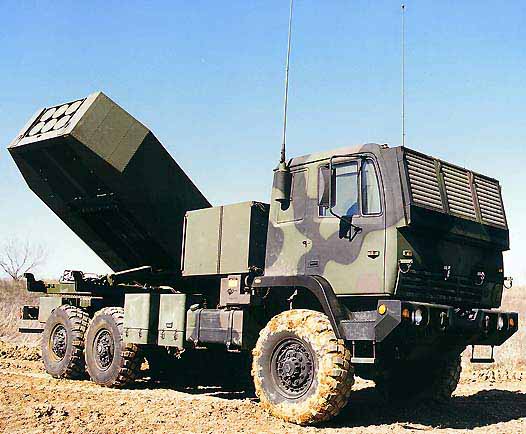
The most useful artillery for US troops in Afghanistan is reported to be the HIMARS rocket launcher system:

HIMARS carriers only one six MLRS rocket container (instead of two in the original MLRS vehicle), but the 12 ton truck can fit into a C-130 transport (unlike the 22 ton tracked MLRS) and is much cheaper to operate. The first HIMARS entered service in 2005, about a year after GPS guided rockets did.

The 680 pound GMLRS (guided multiple launch rocket system) missile is as GPS guided 227mm rocket that entered service six years ago. It was designed to have a range of 70 kilometers and the ability to land within meters of its intended target, at any range. This is possible because it uses GPS (plus a back up inertial guidance system) to find its target. Two years ago, the army tested GMLRS at max range (about 85 kilometers) and found that it worked fine. This enables one HIMARS vehicle to provide support over a frontage of 170 kilometers, or, in places like Afghanistan, where the fighting can be anywhere, an area of over 20,000 square kilometers. This is a huge footprint for a single weapon (an individual HIMARS vehicle), and fundamentally changes the way you deploy artillery in combat.


HIMARS: High Mobility Artillery Rocket System

« Newer PostsOlder Posts »

Powered by WordPress