
Extra Credits
Published on 13 Jun 2017The Germans expected the Allies to invade France to re-open the Western Front, but they did not know when or where the invasion would start – thanks largely to the operations of MI5, British intelligence services, who staged an elaborate deception called Operation Bodyguard designed to make the Germans think they would be invading Pas de Calais instead of their real target: Normandy.
June 7, 2018
D-Day – II: The Secret War – Extra History
Comments Off on D-Day – II: The Secret War – Extra History
June 6, 2018
D-Day – I: The Great Crusade – Extra History
Extra Credits
Published on 6 Jun 2017D-Day: June 6, 1944, the day when Allied forces stormed the beaches of Normandy to retake France from the Germans. They hoped to take the Germans by surprise, and their decision to brave rough weather to make their landings certainly accomplished that, but despite these small advantages, the American forces at Utah and Omaha Beach had to overcome monumental challenges to establish a successful beachhead.
Comments Off on D-Day – I: The Great Crusade – Extra History
June 5, 2018
The Landings At ANZAC Cove And Suvla Bay 1915 I THE GREAT WAR On The Road
The Great War
Published on 4 Jun 2018With thanks to Mr. Ali Serim for making this episode possible.
Indy and our guide Can Balcioglu explore the northern landings sites of Gallipoli where the Australian and New Zealand Army Corps (ANZAC) landed in 1915.
Comments Off on The Landings At ANZAC Cove And Suvla Bay 1915 I THE GREAT WAR On The Road
May 21, 2018
“Civil War Uniforms of Blue & Grey – The Evolution” Volume 2
LionHeart FilmWorks
Published on 29 Apr 2018http://www.lionheart-filmworks.com
Volume 2 of 4… A display of some of the more unique and important uniforms to represent the evolution of the American Civil War “Blue and Grey” from just before the spark of the war in 1861 to Union victory and occupation in 1865.
This project is meant to honor men from both the north and the south — now together forever in eternity — who served their countries, their states and their comrades while wearing these uniforms, weapons, and accouterments — during some of the most brutal battles Americans have ever faced. Shot in 4K and featuring nine of the best Living Historians in the country.
As accurately as we possibly could, and one uniform at a time.… telling the story of the 2.75 Million soldiers who once wore these sacks coats, shell jackets and kepis with pride — each soldier earning a debt we should all be duty-bound to continue to honor.
Directed/Produced: Kevin R. Hershberger
Cinematography: Hugh Burruss
Costumers & Featuring: Tyler Grecco, Nathan Hoffman, Connor Timony, Brennan Wheatley, Guy Gane, Eric Smallwood… as well as Mark Aaron, Tr’waan Coles & Justin Young.
Grip / Electric: Brian Lyles
Costumes & Props: Historical Wardrobe – Richmond, VA
Comments Off on “Civil War Uniforms of Blue & Grey – The Evolution” Volume 2
May 19, 2018
The Macedonian phalanx – structure and organization
Syntagma
Published on 19 Feb 2018A description of the Macedonian phalanx structure during the Alexander and Diadochi age, based on later written Asclepiodotos and Aelian infantry manuals.
Comments Off on The Macedonian phalanx – structure and organization
QotD: Operation “keeping up appearances”
It’s hard to blame the Army, and even if it wasn’t not all of even most of the blame can be laid at the Army’s doorstep.
Government, both Conservative and Liberal kept repeating Pierre Trudeau’s lie that “we’re here and we’re doing our full, fair and agreed upon share.” Kudos to Prime Minister Mulroney who, when faced with irrefutable and embarrassingly public evidence that we simply could not deploy and sustain two small brigades in war, cancelled the North Norway brigade commitment and pulled the Germany-based brigade back to Canada.
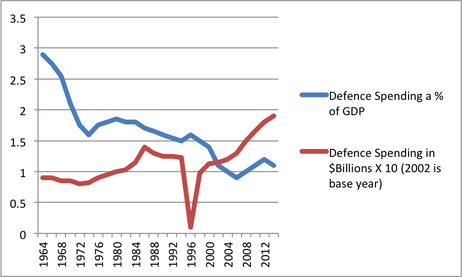
This graph, which is only rough, being drawn from three different sources and “rounded” for ease of plotting, shows, essentially, what happened between 1964 (Prime Minister Pearson) and 2014 Prime Minister Harper). As you can see defence spending as a percentage of Gross Domestic Product ~ a fair measure of our national, political commitment to our defence of Canada and of our allies and neighbours, has declined steadily even though, generally, with one “blip” in the Chrétien era, when he was trying to wrestle with the deficit, the actual dollars spent on defence have grown in number. What it really shows is that our GDP grew a lot in the past 50 years ~ it’s now almost $2.5 Trillion (that’s $2,500,000,000,000.00) ~ but our political willingness (or appreciation of the necessity) to spend 2% of GDP, as we did in about 1970s and as we have, sort of, agreed (in NATO) do aspire to do again, has not kept pace with our increasing prosperity. In fact, while the dollars spend on defence have doubled, in 50 years, the % of GDP spent of defence has fallen to ⅓ of its 1964 level. But ministers’ desires to “talk good fight” remain at historically high levels and even as resources shrink admirals and generals are told to “keep up appearances”. That, keeping up appearances, was what the admirals and generals wanted to do … no one really wanted to go into various international military fora and say “as our resources decline we’re going to have to do less,” instead they went out and said “we’re learning new ways to do more with less,” which is, of course, utter nonsense. Meanwhile more and more quite senior officers came back from tours of duty in the USA and brought with them some very American ideas about organization and management. Now American organizational models might work very well for armies with 1,000,000+ soldiers, or even for those with 495,000, like South Korea’s perhaps, even for those with 100,000+ like the French army, but they are not always or even often suitable for an army with 20,000± regulars and 25,000± reservists. The new organizations might make us look bigger, on paper, but they hide the fact the army has been hollowed out since 1970.
The Army of 1964, the one that consumed its fair share of the 3% of GDP that Canada spent on defence had four brigades, the largest had about 6,500 soldiers in it, the smaller ones had about 5,000 each. That was more men and women in combat units than we have in the entire, top heavy, Canadian Army today in total. But we still have three of the four brigades, we have nine instead of 13 battalions of infantry and three instead of four regiments of artillery … but how? Simple: it’s the Potemkin village, again, battalions that should have 950 soldiers have 500 … if their lucky. In fact there are no combat ready infantry battalions. Any battalion being readied for operations must be reinforced from other infantry battalions … we have nine battalion commanders and nine regimental sergeants major and so on but we only have enough soldiers in rifle platoons to staff five battalions … maybe only four if the battalions are properly equipped with mortars and heavy assault weapons. Why? Because no one, not ministers, not senior civil servants and not the generals want to “cut his coat according to his cloth.”
Ted Campbell, “A Canadian Potemkin Village”, Ted Campbell’s Point of View, 2016-09-15.
Comments Off on QotD: Operation “keeping up appearances”
May 15, 2018
Evolution of French Infantry During World War 1 I THE GREAT WAR Special
The Great War
Published on 14 May 2018The French soldier in 1914 was already very different from the one in 1918 if you looked at his uniform or equipment. Also the combat tactics evolved considerably in four years of war. The Battle of Verdun, the Nivelle Offensive or the Battle of La Malmaison were important steps during that evolution in which the Poilu became a modern French soldier.
Comments Off on Evolution of French Infantry During World War 1 I THE GREAT WAR Special
May 2, 2018
“Civil War Uniforms of Blue & Grey – The Evolution” Volume 1
LionHeart FilmWorks
Published on 7 Apr 2018http://www.lionheart-filmworks.com
Volume 1 of 4… A display of some of the more unique and important uniforms to represent the evolution of the American Civil War “Blue and Grey” from just before the spark of the war in 1861 to Union victory and occupation in 1865.
This project is meant to honor men from both the north and the south — now together forever in eternity — who served their countries, their states and their comrades while wearing these uniforms, weapons, and accouterments — during some of the most brutal battles Americans have ever faced. Shot in 4K and featuring nine of the best Living Historians in the country.
As accurately as we possibly could, and one uniform at a time… telling the story of the 2.75 Million soldiers who once wore these sacks coats, shell jackets and kepis with pride — each soldier earning a debt we should all be duty-bound to continue to honor.
Directed/Produced: Kevin R. Hershberger
Cinematography: Hugh Burruss
Costumers & Featuring: Tyler Grecco, Nathan Hoffman, Connor Timony, Brennan Wheatley, Guy Gane, Eric Smallwood… as well as Mark Aaron, Tr’waan Coles & Justin Young.
Grip / Electric: Brian Lyles
Costumes & Props: Historical Wardrobe – Richmond, VA
Comments Off on “Civil War Uniforms of Blue & Grey – The Evolution” Volume 1
May 1, 2018
The Finnish Jägers In World War 1 I THE GREAT WAR On The Road
The Great War
Published on 30 Apr 2018Visit the Museum: http://hohenlockstedt-museum.de/
During World War 1 Finnish volunteers were trained in Northern Germany. The 27th Jäger Battalion is an important part of Finnish history and we explored their beginnings in Hohenlockstedt or Lockstedter Lager as it was called in 1915.
Comments Off on The Finnish Jägers In World War 1 I THE GREAT WAR On The Road
April 20, 2018
Food for thought on those “second US civil war” comments
Tom Kratman, Mil-SF author and former US Army officer responds to a Quora article titled “Why does the 2nd Amendment bother Europeans so much?” and shared some of his answer on Facebook:
More fun on Quora:
https://www.quora.com/Why-does-the-2nd-Amendment-bother-Europeans-so-much/answer/Pietro-Del-Buono#
A Sample: And here; since you’re not apparently ambitious enough to read it, I’ll copy you what I sent Stafford on just this question:
The Viet Cong, the Taliban, and the Iraqi resistance would all, at this point in time, be terribly surprised to learn of the omnipotence of the US Army, Navy, Air Force, and Marine Corps (retired lieutenant colonel, Infantry, former faculty of the war college, to boot; yes, I’ve had a varied and fun life). It isn’t, remember, a million citizens with arms, it’s probably over 80 million, just to begin with, most of us armed to deck out the wives, children, grandchildren, and no small number of the neighbors. I can, personally, outfit at least one short platoon while my former law firm, when I was in practice, could have fielded a company, less mortars and anti-tank, yes, to include with automatic weapons (machine guns, which are also legal here, though pricey).
How they would do this is perhaps more detailed and more bloody minded than you want, but, basically, tanks do not move when small arms dominating the roads mean they don’t get fuel delivered (no, aerial resupply is highly problematic). Neither do aircraft fly when no trucks or rail bring aviation fuel. Police, who are actually the decisive arm of counter-insurgency (see your own Sir Robert Thompson), pretty much require a disarmed citizenry to exercise control. Facing an armed citizenry willing to kill them, their risks and losses are too great for effectiveness. And then there’s sheer terror: “Nice family you have, Officer Quigley; be a damned shame if, say, you didn’t look the other way when we tell you to and they all ended up dead, don’t you think?”
Most of the US military preponderance is technological. Martin van Creveld has an interesting observation on that, which goes to the effect that high tech really only works well in very simple environments, air, open desert, at sea, and that a) it tends to fail badly when the environment gets more complex, while b) the human heart is the most complex environment of all. In other words, the forces of government would rarely know just who their enemies were in order to bring that tech to bear.
And then there’s the last aspect, an aspect, I think, Euros have the greatest difficulty understanding. Our police and armed forces are simply not reliable, over most of the country (remember, too, we have no real national police force or gendarmerie, not of any size and power, anyway) to the federal government. No, I don’t mean only the state based National Guards; the _regular_ forces actually draw most of their personnel from areas where folk revere the country and the constitution, but tend to detest the federal government. Called on to suppress a rebellion with which they by and large agreed, they’d defect in droves.Indeed, they might be at the forefront of rebellion. You may recall Obama talking about a civilian force, equal in size, budget, and power to DoD? I’ve never been able to shake the feeling that he had Pinochet and Allende in mind when he spoke those words, because he knew, deep down, that he and the left (our left, which is, of course, to the right, generally, of the Euro left) could not rule out a coup in the event of their pushing their agenda just that little bit too far.
Comments Off on Food for thought on those “second US civil war” comments
April 19, 2018
“Blitzkrieg” – What most people get Wrong – Myth vs “Reality”
Military History Visualized
Published on 18 Aug 2017“Blitzkrieg” is probably the most wrongly used word when it comes to Military History. Its buzzword effect is widely known. The question is what was “Blitzkrieg” actually and is it used “correctly” at all? Additionally, the question if “Blitzkrieg” was something unique to the Wehrmacht will be answered?
Military History Visualized provides a series of short narrative and visual presentations like documentaries based on academic literature or sometimes primary sources. Videos are intended as introduction to military history, but also contain a lot of details for history buffs. Since the aim is to keep the episodes short and comprehensive some details are often cut.
» SOURCES «
Citino, Robert M.: The German Way of War
Hughes, Daniel J.: “Blitzkrieg”, in: Brassey’s Encyclopedia of Land Forces and Warfare, p. 155-162
Ong, Weichong: “Blitzkrieg: Revolution or Evolution?”, in: RUSI December 2017 – Vol. 152 No. 6, p. 82-87
Harris, J.P.: “The Myth of Blitzkrieg”, in War in History 1995 2 (3), p. 335-352
Frieser, Karl-Heinz: The Blitzkrieg Legend
Frieser, Karl-Heinz: “The war in the West, 1939-1940: an unplanned Blitzkrieg”. In: Cambridge History of the Second World War, Volume I: p. 287-314
Comments Off on “Blitzkrieg” – What most people get Wrong – Myth vs “Reality”
April 15, 2018
Canada’s military – the difference between fighting wars in the 20th Century and fighting wars today
 In a post from earlier this week about defence spending priorities for the Canadian military, Ted Campbell looks at how wars changed between the first half of the 20th century and the post-Cold War situation we face today:
Is the 2% goal wrong?
No … it’s a pretty sensible level of defence spending for countries that really want to maintain a world at peace, as opposed to those, like Canada and many of its allies, that just want to hope for peace. But 2% is not a magic bullet … 1.5% of GDP, spent carefully, will do more than 2% spent as a job creation slush fund. But spending too little, cutting defence spending again and again and again just because it is unpopular can leave a country with what I have described as a Potemkin Village, a military that is more show than force.
The advent of a nuclear face-off circa 1950 changed the strategic calculus for the rest of the 20th century. We suddenly had the “come as you are war” which meant having regular, professional forces in being and not being able to rely upon time and space to give us time, as we had in past wars, to mobilize our reserves. We would do well, 101 years after the battle of Vimy Ridge, to recall that it, in April 1917, was the first time since war was declared (in the summer of 1914) that the full Canadian Corps, of four infantry divisions, was in battle as a corps ~ it took us over 30 months to get from a tiny standing army backed by small but eager reserves to a full corps composed of about 100,000 of the Canadians who served overseas during that war. We went to war again in the late summer of 1939 and it was not until the summer of 1943, over 40 months later, that we had a small corps, of only two divisions and an independent armoured brigade, in battle, in Italy. It takes a long time to mobilize and equip and train an army. The operational doctrine of the long and expensive cold war said that we could no longer have that time.
It is not clear that we must or even should still have small reserves and a relatively larger permanent force. Perhaps the time has come to re-examine the assumptions that underlie our force structure ideas. Maybe we need 150,000 uniformed people but, maybe, the split should be 50/50 or 75,000 full time and 75,000 part time sailors, soldiers and air force members. Maybe a country like Canada, with a population that will, in 2050, approach 40 million, should have a larger force: say 75,000 full time and even 150,000 part time military members … maybe our reserve force “regiments’ should have 500 or 750 soldiers and be required to “generate” a trained company (125 soldiers) rather than having only 150 soldiers and being hard pressed to “generate” a platoon of only 30 soldiers. I have my own ideas, but someone who has the necessary information at their disposal needs to look ahead at our strategic situation and develop a force model and a sane budget for 2050. That should be a job for skilled civil servants in the defence policy staff.
Our strategic priorities for the next 30 years or more need to be:
- Containing and reducing threats to global peace and security by helping to maintain alliances like NATO and groupings like AUSCANNZUKUS and supporting global peacemaking and peacekeeping efforts, even the generally worthless United Nations efforts;
- Confronting current threats to peace ~ like Russia ~ and deterring (by matching the growth in military power of) potential future threats ~ like China;
- Cooperating with the USA in the protection of North America; and
- Securing the land we claim as our own, the waters contiguous to it and the airspace over both.
When we work out the costs, of people, above all, but also of ships, tanks, guns and aircraft, and of ammunition, food and fuel and everything else, of doing those four things ~ and of doing them well enough ~ then we will know what what sort of forces we need and how much we must budget to build and maintain them. But no matter what the size and what the cost, I guarantee that people will still be the biggest single expense if we keep our priorities straight: and the overarching priority is that people cost more than machines because they matter more than machines.
Comments Off on Canada’s military – the difference between fighting wars in the 20th Century and fighting wars today
March 17, 2018
The Battle of Cannae (Second Punic War) (Lecture)
The Study of Antiquity and the Middle Ages
Published on 16 Mar 2018This lecture aimed towards High School students features the battle of Cannae.
The Battle of Cannae (/ˈkæniˌ-neɪˌ-naɪ/[) was a major battle of the Second Punic War that took place on 2 August 216 BC in Apulia, in southeast Italy. The army of Carthage, under Hannibal, surrounded and decisively defeated a larger army of the Roman Republic under the consuls Lucius Aemilius Paullus and Gaius Terentius Varro. It is regarded both as one of the greatest tactical feats in military history and as one of the worst defeats in Roman history.
Having recovered from their losses at Trebia (218 BC) and Lake Trasimene (217 BC), the Romans decided to engage Hannibal at Cannae, with roughly 86,000 Roman and allied troops. They massed their heavy infantry in a deeper formation than usual, while Hannibal used the double-envelopment tactic. This was so successful that the Roman army was effectively destroyed as a fighting force. Following the defeat, Capua and several other Italian city-states defected from the Roman Republic to Carthage.
Comments Off on The Battle of Cannae (Second Punic War) (Lecture)
March 16, 2018
How Rifles & Railroads influenced Warfare in the 19th Century
Military History Vlogs
Published on 23 Feb 2018The introduction of the breech-loading rifle and the railroad had a tremendous influence on Warfare in the 19th Century. Although, not everyone was as fast or able to adopt then the Prussians. Austria, France and Russia had major issues. Most notably visible in the Austro-Prussian War (1866) and Franco-Prussian War (1870-1871).
Comments Off on How Rifles & Railroads influenced Warfare in the 19th Century
March 14, 2018
Battle Stack: The Battle of Isandlwana tactics
BattleStack
Published on 25 Nov 2016The Battle of Isandlwana was fought between the British and Zulus in 1879. Find out what happened with this animated tactics video!
Comments Off on Battle Stack: The Battle of Isandlwana tactics


