
Quotulatiousness

April 30, 2010

Training to fight lower-tech aircraft in the air

Filed under: Military, USA — Tags: , , , , — Nicholas @ 09:41

Strategy Page rounds up information on US Navy efforts to keep their air-to-air combat skills fresh:

The U.S. Navy has refurbished a surplus U.S. Air Force National Guard F-16 flight simulator to help keep its F-16 pilots in shape for using F-16s to train navy pilots (in F-18s) how to best deal with Chinese, and other potential enemy, pilots. The navy uses F-16s because these aircraft are best able to replicate the performance of likely high end enemy fighters. That’s because Russia and China have used the F-16 as the model for most of their latest fighters (the Russian MiG-29 and Chinese J-10). The navy bought 26 of a special model (F-16N) of the aircraft in the late 1980s. But in the 1990s, the navy retired its F-16Ns, because of metal fatigue, and had to wait nearly a decade before it got sixteen more. The refurbished simulator had its cockpit modified to reflect the one the navy F-16s use.

The navy also uses F-5s to simulate lower performance enemy fighters. Two years ago, the navy completed a six year effort to buy and modify 44 F-5E fighters from Switzerland. The U.S. uses F-5s, a 12 ton fighter roughly similar to the MiG-21. The F-5 is normally armed with two 20mm cannon, and three tons of missiles and bombs. The U.S. Navy modified and refurbished the Swiss F-5s so their performance better matched that of Russian or Chinese aircraft.

It may sound odd to have older equipment still in service, but they are very useful for training purposes. Both the air force and the army will perform better if they’ve trained against the kind of equipment and tactics used by likely opponents, and it’s unlikely that you can arrange a “friendly” wargame exercise against a force you may be fighting for real in the near future.

The other thing is that the troops playing the “other side” in wargame exercises tend to have a lot more fun doing so . . .
March 29, 2010

Costs continue to rise for F-35B aircraft

Filed under: Economics, Europe, Military, USA — Tags: , , , , , — Nicholas @ 08:47

Strategy Page has more on the increasing spendiness of the F-35 program, especially the part the Navy is most concerned about:

Denmark has decided to wait, until 2014, to decide what to replace its elderly F-16 fleet with. Meanwhile, 18 of the F-16s will be retired. But the other 30 will be refurbished so that they can continue to operate for the rest of the decade. Denmark had wanted to replace the F-16s with F-35s. But the F-35s keeps getting delayed (now more than two years behind schedule), and is becoming more expensive (nearly a hundred percent over budget). The Danish F-35 buy is no longer a sure thing. The delays have lots of users concerned. The U.S. Navy has been nervously watching as the costs of the new F-35C and F-35B carrier aircraft versions go up.

It comes down to this. Currently, it costs the navy, on average, $19,000 an hour to operate its AV-8 vertical takeoff and F-18C fighter aircraft. It costs 63 percent more to operate the F-35C (which will replace the F-18C) and the F-35B (which will replace the AV-8). These costs include buying the aircraft, training and maintaining the pilots, the aircraft and purchasing expendable items (fuel, spare parts, munitions.) Like the F-22, which recently had production capped at less than 200 aircraft, the capabilities, as superior as they were, did not justify the much higher costs. The F-35, at least for the navy, is headed in the same direction. The navy can go ahead with the more recent F-18E, and keep refurbishing, or even building, the AV-8. Politics, and lobbying by the F-35 manufacturer, will probably keep the F-35 headed for fleet service, no matter what the cost.

Another ally watching the F-35B costs rise with trepidation is the Royal Navy, whose aircraft carriers are not able to handle conventional aircraft (even the two large carriers under construction won’t have catapults for launching non-STOL planes). Earlier posts on the Royal Navy’s carrier worries here and here.

March 18, 2010

Harrier replacement’s first hover test

Filed under: Britain, Military, Technology, USA — Tags: , , , , — Nicholas @ 09:49

The F-35B from Lockheed Martin is intended to replace the Hawker Harrier for the US Marine Corps and the Royal Navy. Here’s a short video of the test plane in its first test of hovering and then a slow-speed landing:

H/T to Lewis Page, who writes:

Though the F-35 had been planned to be bought in thousands by the US forces alone, suggesting good economies of scale and affordable prices for export customers down the road, critics of the programme are now alleging that costs are so far out of control that the well-known military procurement “death spiral” process has set in: higher price, less planes bought, unit cost driven up even higher, even less planes bought and so on.

However it’s important to note that if the F-35 is successful it has the potential to destroy large amounts of the present global military aerospace industry. If it does get made in large enough numbers to be offered cheaply in time, it will be more sophisticated and yet cheaper than any other combat jet on the market, in all likelihood putting several of its competitors out of business in decades to come. This is probably a major reason why so many aerospace people are desperate for it to fail.

But there are others who feel that the Western fighter jet industry is overlarge, bloated, has no real threat to confront any more and is consuming funds which might be better spent on simpler things such as infantrymen or helicopters. They might be hoping that the F-35 can resolve its problems.

Earlier posts on the F-35, particularly from the Royal Navy’s viewpoint here.

March 17, 2010

The secret life of the F-18

Filed under: Military, USA — Tags: , , , — Nicholas @ 09:11

Another interesting article from Strategy Page:

The U.S. Navy has grounded 16 percent (104 of 635) of its older (A/B/C/D models) F-18 fighters. The reason is the discovery of cracks in the airframe. Small cracks were expected to show up eventually, the result of all the stress put on the metal from violent aerial maneuvers, and carrier landings. But in this case, the cracks were showing up sooner than expected. Most of the grounded aircraft can still be flown in an emergency. All these older F-18s have to be examined, and those found with cracks (usually where the wing meets the fuselage), repairs can be made.

Over the last few years, the navy has found that both their older F-18C Hornet fighters, and their newer F-18E “Super Hornet” are wearing out faster than expected. This was sort of expected with the F-18Cs, which entered service during the late 1970s and early 80s. These aircraft were expected to last about twenty years.

This is of interest to a lot of American allies, as the F-18 is in use by many of their air forces. Partly due to the faster aging of the US aircraft, the manufacturer is still producing spare parts (which benefits both the US Navy and allied air forces).

One very interesting detail I didn’t know:

There are actually two quite different aircraft that are called the F-18 (the A/B/C/D version, and the E/F/Gs). While the F-18E looks like the original F-18A, it is actually very different. The F-18E is about 25 percent larger (and heavier) than the earlier F-18s, and has a new type of engine. By calling it an upgrade, it was easier for the navy to get the money from Congress. That’s because, in the early 1990s, Congress was expecting a “peace dividend” from the end of the Cold War, and was slashing the defense budget. There was a lot of commonality between the two F-18s, but they are basically two different aircraft.

Rather like the Royal Navy managing to sneak their last generation of aircraft carriers through the budget process by calling them “through-deck cruisers”.

March 4, 2010

Canadian air travel now to be subject to US oversight

Filed under: Bureaucracy, Cancon, Liberty, USA — Tags: , , , — Nicholas @ 07:11

I’d always suspected that the close co-operation between Canadian and US officials meant that even theoretically domestic flights might be scrutinized by the other country, but now it’s official policy:

Starting in December, passengers on Canadian airlines flying to, from or even over the United States without ever landing there, will only be allowed to board the aircraft once the U.S. Department of Homeland Security has determined they are not terrorists.

Secure Flight, the newest weapon in the U.S. war on terrorism, gives the United States unprecedented power about who can board planes that fly over U.S. airspace — even if the flights originate and land in Canada.

The program, which is set to take effect globally in December 2010, was created as part of the Intelligence Reform and Terrorism Prevention Act, adopted by U.S. Congress in 2004.

Parliament never adopted or even discussed the Secure Flight program — even though Secure Flight transfers the authority of screening passengers, and their personal information, from domestic airlines to the U.S. Department of Homeland Security.

February 12, 2010

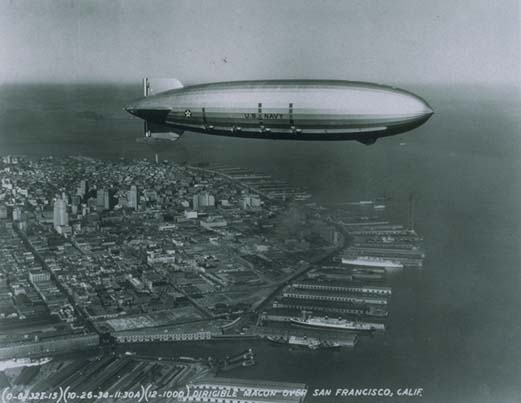
Crash site of the USS Macon declared a National Historic Site

Filed under: History, Military, USA — Tags: , , — Nicholas @ 08:53

Like most people, I assumed that the crashes of various post-WW1 dirigibles had already ruined the future of lighter-than-air flight well before the Hindenburg caught fire. I had forgotten about the US Navy’s fleet, including the Akron, Shenandoah, and the Macon:

The US government has added the crash site of the most powerful flying aircraft carrier ever built to the National Register of Historic Places, 75 years after the event.

The airship USS Macon — comparable in size to the even more famous and equally doomed liner Titanic — suffered storm damage and crashed into the ocean off Point Sur, south of San Francisco, exactly 75 years ago yesterday. The huge dirigible’s remains and those of her embarked biplane fighters now lie 1500 feet below the waves in the Monterey Bay National Marine Sanctuary. However, all but two of the 83 men aboard survived the crash and were rescued by responding waterborne ships.

“The USS Macon and its associated Sparrowhawk biplanes are not only historically significant to our nation’s history, but have unique ties to our local communities, where public museums highlight the airship’s history,” said Paul Michel, Monterey Bay National Marine Sanctuary superintendent. “The National Register listing highlights the importance of protecting the wreck site and its artifacts for further understanding our past.”

February 11, 2010

Montreal’s U.S. airport – Canadians voting with their feet

Filed under: Cancon, Economics, USA — Tags: , , — Nicholas @ 12:31

A new study shows that Canadian travellers can do basic math (which means bad news for Canadian airlines and airport authorities):

It’s not just the cheap fares, many Canadians report it’s simply easier to pass through United States customs via land than air. They also report security lineups at the small regional hubs offer a fraction of the waiting time of their Canadian counterparts.

Self-employed Toronto business owner Mike Payer says the past two years he has flown out of Buffalo’s airport for Christmas vacation because the price difference has been too hard to ignore.

“I saved $3,000 flying to Fort Lauderdale. It was $4,500 [for a family of four] to fly from Toronto but only US$1,200 from Buffalo. On top of all that it’s just so much simpler with U.S. Customs. You stay in a hotel overnight and most of them will even let you leave your car there [while on vacation]. I guess the only risk is the weather and missing a flight.”

I suspect there’s a mistake in the second paragraph of the linked article: no matter how much you can save, I strongly doubt that 18% of Canadians flew out of their closest US airport. 18% of Canadians who flew, maybe, but not 18% of the whole population.

Some regional airports are booming with the new Canadian traffic:

The pitch has been probably the strongest in Plattsburgh, a little town of 25,000 that spent millions in 2007 to convert a former air force base into an airport that would attract Quebec passengers. The airport, which is 100 kilometres from downtown Montreal, is fully bilingual.

“They don’t even call us Plattsburgh. We’re known as Montreal’s U.S. airport now,” said Michele Power, vice-president of marketing with the Plattsburgh-North County Chamber of Chamber of Commerce.

February 2, 2010

Haiti still at high risk of further quakes

Filed under: Americas, Science, Technology — Tags: , , — Nicholas @ 17:27

Wired discusses the results of NASA’s first UAVSAR 3D image of the devastated area:

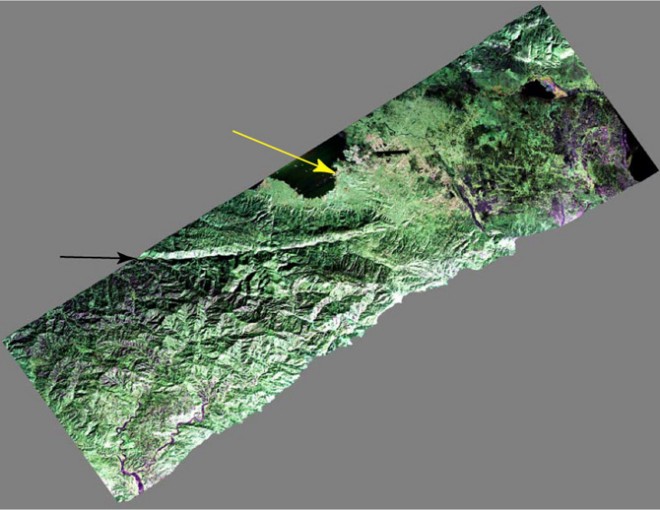
NASA’s radar-equipped jet has returned its first 3-D image of Port-au-Prince, Haiti. This false-color image clearly shows the Enriquillo-Plantain Garden Fault extending east of the city.

The image supports a Jan. 21 U.S. Geological Survey report that suggested the section of the fault (indicated by the black arrow above) nearest to Port-au-Prince (yellow arrow) did not slip significantly in the magnitude 7 Jan. 12 earthquake.

The new image, taken by JPL’s Uninhabited Aerial Vehicle Synthetic Aperture Radar attached to a modified Gulfstream III jet, shows that the ground rupture moved westward from the epicenter. The section of the fault in the image did not rupture, a situation that increases the risk of another significant earthquake in the future.

[. . .]

The colors in the image, which shows a swath of about 12.5 miles, are the result of three different radar polarizations that make vegetation appear green, water appear blue and urban areas look reddish.

January 26, 2010

A message from Transport Canada

Filed under: Bureaucracy, Cancon, Humour — Tags: , , — Nicholas @ 12:01

From the Rick Mercer Report.

CF improve medical evacuation by adding medical technicians to crews

Filed under: Cancon, Health, Military — Tags: , , , — Nicholas @ 07:35

Strategy Page reports on a change in crew composition for Canadian Forces medical evacuation helicopters:

Canadian forces have added a medical technician to the crews of their medical evacuation helicopters, joining a trend that has played a part in saving the lives of many troops wounded in combat, or injured in a combat zone. Previously, Canadian troops had relied on American, or other NATO, air evacuation services. But now Canada has suitable helicopters (CH-146s) for that work, and established an air ambulance service. Following a four year old recommendation by their own military planners, Canada trained medical technicians to work on the medevac choppers, and thus increase the chances that badly wounded soldiers would survive. Canada has also upgraded all of its combat medical care during its years of operations in Afghanistan. This is part of a trend that has been going on since World War II. It’s all about having more medical care available sooner.

The fighting in Iraq and Afghanistan has brought about a major change in how the United States deals with combat casualties. The result is that over 90 percent of the troops wounded, survive their wounds. That’s the highest rate in history. There are several reasons for this. The main one is that medics, and the troops themselves, are being trained to deliver more complex, and effective first aid more quickly. Military doctors now talk of the “platinum 10 minutes,” meaning that if you can keep the wounded soldier, especially the ones who are hurt real bad, alive for ten minutes, their chances of survival go way up. Medics have been equipped and trained to perform procedures previously done only by physicians, while troops are trained to do some procedures previously handled only by medics.

January 9, 2010

QotD: The awfulness of airports

Filed under: Bureaucracy, Quotations, USA — Tags: , , , , , — Nicholas @ 00:02

Over the weekend, an idiot walked the wrong way through a secure exit for arriving passengers at Newark airport. An entire terminal was shut down so that everybody on the “sterile” side of the security barriers could be herded back out and rescreened. The entire process took just under seven hours. The cascading delays disrupted air travel worldwide. They didn’t even catch the doofus who caused the ruckus. No doubt, if they’d announced his location over the paging system, he’d have been drawn and quartered by a mob of traveling salesmen from 3M and a gaggle of middle-school girls returning from a volleyball tournament.

Now, I should back up. When I referred to the “sterile” side of the security barrier, I was using the term narrowly, to refer to folks who’d been through the metal detectors. Because to use the word “sterile” in its usual context in a sentence with “airports” — those belching Petri dishes of bathroom effluence and unidentifiable noisome miasma — would be a grotesque abrogation of journalistic trust.

According to the latest epidemiological research, airports reside somewhere between no-frills Haitian brothels and Penn State fraternity bathrooms when it comes to hygiene. USA Today recently surveyed the health-inspection records of airport restaurants and found that serious code violations were as commonplace as rat and mouse droppings; 77 percent of 35 restaurants reviewed at Reagan National Airport had at least one major violation.

I could go on, of course. The petty humiliations, the routine deceptions from airline employees desperate to rid themselves of troublesome travelers (“Oh, they can definitely help you at the gate!”), the stress-position seats, the ever-changing rules for what can and cannot be in your carry-on, being charged for food that the Red Cross would condemn if it were served at Gitmo: Air travel is the most expensive unpleasant experience in everyday life outside the realm of words ending in -oscopy.

Jonah Goldberg, “A No-Fly List? Count Me In: Flying before 9/11 was already awful, and it has only become worse”, National Review, 2010-01-08

December 31, 2009

“We put the jerk in knee-jerk with the way we respond to threats”

Filed under: Bureaucracy, USA — Tags: , , , — Nicholas @ 20:22

Tom Kelley sent me a link to this Miles O’Brien article:

[. . .] my family and I will face long lines, lots of questions, pat down searches and an hour of lockdown time in our seats before landing. It is as if my ruler-brandishing first-grade teacher Sister Grace took over Delta Air Lines. “Books away — feet on the floor — hands on your desk — eyes straight ahead . . . ”

It is brilliant thinking like the new seat arrest rule that should tell you a lot about our ill-conceived approach to thwarting terrorists who continue to find plane loads full of innocent Americans to be tempting targets. I don’t suppose future terrorists might try to light some portion of their clothing 61 minutes before landing do you?

What about the baby who needs a bottle or a passy on descent and is crying his lungs out? God help him, his mother and the rest of us . . .

We put the jerk in knee-jerk with the way we respond to threats.

Our Homeland Security Czarina Janet Napolitano tried to spin the whole thing into a triumph of our security apparatus. At least she didn’t get a “Nappy, you’re doin’ a heckuva a job!” from our Commander-in-Chief

Gerard van der Leun was right

Filed under: Quotations, USA — Tags: , , , — Nicholas @ 11:17

Back in 2005, I grabbed this as a quote of the day, and it’s on the verge of becoming true today:

On my first flight to Europe, everyone dressed for success. Now everyone dresses for Gold’s Gym. And I’m sure the next step in TOTAL SECURITY will be to require everyone who is not of Arab descent to arrive with a note from their doctor attesting that they had a high colonic an hour before the airport to make the body cavity searches a bit more pleasant for the staff. Then there’s the added coach thrill of a blood clot developing in the legs that stops your heart at 50,000 feet. Plus . . . no peanuts! After all, think of the allergic children! Add to that the new innovation, no pillows! I don’t see why the airlines don’t simply install hooks and, working in concert with government’s laughable security cops, require everyone to hang from said hooks naked. It will come to that. You know it will.

December 30, 2009

If the terrorists don’t kill off the airlines, the TSA will

Filed under: Bureaucracy, Liberty, USA — Tags: , , , , , — Nicholas @ 08:54

Radley Balko joins the chorus of protests about the latest set of how-stupid-can-you-get “security” rules from the TSA:

Seems to me that what this, Flight 93, and the Richard Reid incident have shown us is that the best line of defense against airplane-based terrorism is us. Alert, aware, informed passengers.

TSA, on the other hand, equates hassle with safety. For all the crap they put us through, this guy still got some sort of explosive material on the plane from Amsterdam. He was stopped by law-abiding passengers. So TSA responds to all of this by . . . announcing plans to hassle law-abiding U.S. passengers even more.

If you’re really cynical, you could make a good argument that they’re really only interested in the appearance of safety. They’ve simply concluded that the more difficult they make your flight, the safer you’ll feel. Never mind if any of the theatrics actually work.

After my last business flight (the day of the Shoe Bomber’s transatlantic aircraft attempt), I’ve actively avoided commercial air travel. This latest set of Security Theatre set dressings merely extends the range I’ll be willing to drive rather than putting up with the flight — actually, the flight preparation, rather than the flight itself.

Update: Don’t know why I thought it was the Shoe Bomber . . . it was the would-be liquid bomb conspiracy that happened while I was in transit through Atlanta.

December 29, 2009

Air security gone insane

Filed under: Bureaucracy, USA — Tags: , , , , , — Nicholas @ 12:58

Hard to disagree with Gulliver on this one:

In the wake of Friday’s attempted bombing of a Northwest Airlines flight from Amsterdam to Detroit, the people who run America’s airport security apparatus appear to have gone insane. Despite statements from several officials, including Janet Napolitano, the secretary of homeland security, that there is “no indication” of any broader plot against American airliners, some truly absurd security “precautions” are being implemented on US-bound flights worldwide.

The most ridiculous new rule prohibits passengers on US-bound international flights from leaving their seats or having anything on their laps—even a laptop or a pillow—during the final hour of flight. You’re probably thinking “Wait, what?” Indeed. The New York Times elaborates:

In effect, the restrictions mean that passengers on flights of 90 minutes or less would most likely not be able to leave their seats at all, since airlines do not allow passengers to walk around the cabin while a plane is climbing to its cruising altitude.

Gulliver looks forward to the barrage of lawsuits from the first people who are forced to use the bathroom in their airplane seats. This is the absolute worst sort of security theatre: inconvenient, absurd, and, crucially, ineffective.

« Newer PostsOlder Posts »

Powered by WordPress


