
Lindybeige
Published on 10 Jul 2018Tigers? Why talk about Tigers when one can talk about tanks that were even worse? More tank banter with The Chieftain.
Support me on Patreon: https://www.patreon.com/LindybeigeA low-tech tank with fragile armour, a tank that never saw the enemy, and the tank used to teach how not to build tanks. Thanks to Nicholas Moran (AKA The Chieftain) and Matt Sampson, the cameraman at Bovington Tank Museum.
The third of these three segments was shot with my new camera, and it really shows.
Lindybeige: a channel of archaeology, ancient and medieval warfare, rants, swing dance, travelogues, evolution, and whatever else occurs to me to make.
▼ Follow me…
Twitter: https://twitter.com/Lindybeige I may have some drivel to contribute to the Twittersphere, plus you get notice of uploads.
Facebook: https://www.facebook.com/Lindybeige (it’s a ‘page’ and now seems to be working).
Google+: “google.com/+lindybeige”
website: http://www.LloydianAspects.co.uk
July 29, 2018
A poor tank, a useless tank, and the worst tank in the world
July 20, 2018
Tank Chats #33 Panzer III | The Tank Museum
The Tank Museum
Published on 11 Mar 2017The thirty-third Tank Chat, this time presented by Curator David Willey. Including a fascinating insight into pre-Second World War German tank production and how the Panzer III worked alongside its fellow Panzers.
To find out more, buy the new Haynes Panzer III tank manual. https://www.myonlinebooking.co.uk/tan…
The Panzer III was conceived in 1934 as the principle combat tank of the Panzer divisions. The Museum’s Panzer III went into action in the North African theatre of war and is believed to have been captured at the Battle of Alam Halfa.
Support the work of The Tank Museum on Patreon: ► https://www.patreon.com/tankmuseum
Or donate http://tankmuseum.org/support-us/donate
July 6, 2018
Funny British Army Recruitment Video
Matsimus
Published on 9 Jun 2018
Some old school British Army recruitment video which was very well made but also just hilarious lol!Hope you enjoy!!
(DISCLAIMER: This video is for entertainment purposes only. The views and opinion come from personal experience or information from public accessible sources.)
July 5, 2018
Tales of Cromwell tanks
Lindybeige
Published on 6 Apr 2016War memoirs are filled with amazing anecdotes. Here I relate two, and ramble a bit about British WW2 tank units.
Support me on Patreon: https://www.patreon.com/LindybeigeI am likely to return to this topic – anecdotes from war memoirs. It is a rich vein of stories. These come from Troop Leader by Bill Bellamy, which describes the author’s time commanding a trio of fast Cromwell tanks in World War Two, when fighting the Germans in Holland.
Lindybeige: a channel of archaeology, ancient and medieval warfare, rants, swing dance, travelogues, evolution, and whatever else occurs to me to make.
July 4, 2018
Tank Chats #32 Cromwell | The Tank Museum
The Tank Museum
Published on 24 Feb 2017The thirty second in a series of short films about some of the vehicles in our collection, presented by The Tank Museum’s historian David Fletcher MBE. The Second World War, British, Cromwell tank was one of the fastest tanks of the war.
June 20, 2018
Tank Chats #31 Mark IX | The Tank Museum
The Tank Museum
Published on 3 Feb 2017The thirty first in a series of short films about some of the vehicles in our collection, presented by The Tank Museum’s historian David Fletcher MBE. The First World War Mark IX, the first armoured personnel carrier, was designed to solve the problem of moving infantry across the battlefield with the fighting tanks.
June 10, 2018
D-Day – Lies – Extra History
Extra Credits
Published on 1 Aug 2017D-Day is too vast and important a topic to be completely covered by four short videos, but we hope our series offered some new insights into the massive effort that went into the Normandy beach landings. James Portnow and Richard Cutland, Wargaming’s Head of Military Relations, take some time to chat about some more important D-Day stories.
May 28, 2018
Leopard tanks in Afghanistan – “When the legend becomes fact, print the legend”
There’s a story that’s been told for more than a decade and — given the Canadian government’s legendary unwillingness to spend money on the military — widely believed. David Pugliese does his best to debunk it here:
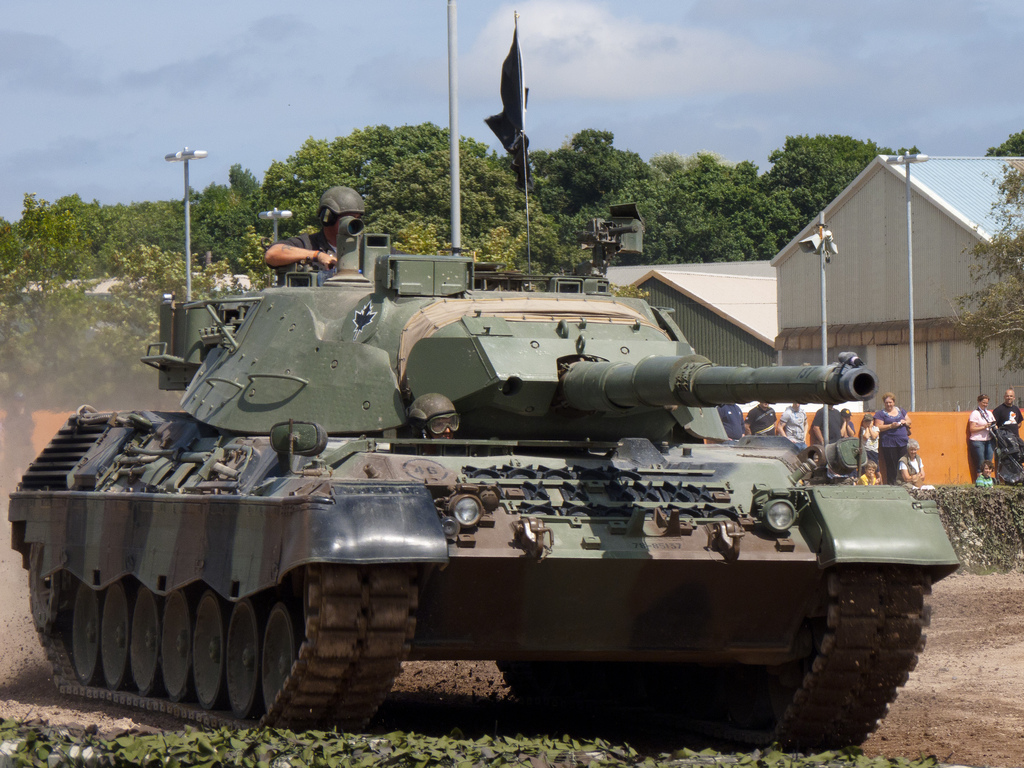
Canadian Leopard 1A3 (Leopard C1) at the Bovington Tank Museum.
Photo by Chris Parfeniuk, via Flickr.
As stories go it’s a pretty good one.
The Canadian Army was up against a tough enemy – the Taliban – in Afghanistan. Commanders called for Leopard tanks to join the battle but those armored vehicles had been mothballed and made into monuments.
So the ever resourceful Canadian Army crews jumped in the Leopard tanks mounted on concrete pads outside bases as monuments and drove them off those platforms, making sure they were shipped to their comrades in Afghanistan.
This myth has been around since 2007 and has once again resurfaced in a new book by retired Maj.-Gen. David Fraser about Operation Medusa.
Fraser also repeated the story in a recent CBC interview with Anna-Maria Tremonti, noting that he knew of at least one Leopard tank pulled off its concrete pad and brought back to serviceability and then shipped to Afghanistan.
In the 2008 book Kandahar Tour by Lee Windsor, David Charters and Brent Wilson the story gets even better. The tanks were driven off the concrete pads and then sent to Afghanistan, according to those authors.
A similar claim is made at the museum devoted to telling the story of the “Essex Regiment (Tank).” On its website the museum claims multiple numbers of Canadian Leopard tanks were taken from monuments (“A mad scramble to retrieve tanks from monuments and prepare them for war,” it claims).
Again, a great story.
But the Canadian Army says it never happened.
The Army points out that Leopard tanks, positioned on the concrete pads as monuments, had already been demilitarized so no one was driving them anywhere.
So what did happen?
May 24, 2018
Tank Chats #30 M3 Grant | The Tank Museum
The Tank Museum
Published on 27 Jan 2017The thirtieth in a series of short films about some of the vehicles in our collection presented by The Tank Museum’s historian David Fletcher MBE.
Tanks of this type were first used in Western Desert in 1942. The M3’s were mechanically reliable, but soon superseded by Sherman.
May 16, 2018
Crusader Tank | Animated History
The Armchair Historian
Published on 25 Jun 2016
May 6, 2018
Tank Chats #29 Daimler Dingo Scout Car | The Tank Museum
The Tank Museum
Published on 21 Dec 2016The wheeled armoured scout car was the British Army’s principal reconnaissance vehicle from the beginning of World War II until the 1980s.
Scout cars were small and much quieter than a tracked vehicle; units equipped with scout cars relied on stealth to obtain information, rather than fighting for it. The Daimler Dingo entered service with the British Army in 1939 and served until the middle 1960s as a reconnaissance and liaison vehicle used by armoured and infantry divisions.
It was so versatile that a multitude of uses were found for it: medical officers used them to search for casualties in the battle field while one unit even issued a Dingo to its chaplain!
April 30, 2018
The Ferdinand: What Not To Do When Building a Tank
Potential History
Published on 11 Mar 2018A brief history of the VK 45.01 (P), or the Porsche Tiger, and the disaster it later became.
April 29, 2018
Tank Crew Training – More German Tank Prototypes I OUT OF THE TRENCHES
The Great War
Published on 28 Apr 2018Chair of Wisdom Time!
April 27, 2018
The First Tank-on-Tank Battle in History – The Zeebrugge Raid I THE GREAT WAR Week 196
The Great War
Published on 26 Apr 2018At Villers-Bretonneux, German and British tanks clash marking the first tank-on-tank battle in history. In the same week, the most successful flying ace of World War 1 is shot down over France: Manfred von Richthofen dies after scoring 80 victories. Meanwhile, the British Navy attempts to eliminate the German U-Boat threat with a daring raid on Zeebrugge and Ostende.
April 25, 2018
Tank vs. Tank: Villers-Bretonneux, April 1918 | The Tank Museum
The Tank Museum
Published on 20 Apr 2018100 years ago, during the First World War, tank fought tank for the first time in history, at Villers-Bretonneux on 24 April 1918.
It was an engagement that foreshadowed one hundred years of tanks fighting tanks on the battlefield, stories told by The Tank Museum.


