
The Great War
Published on 5 Nov 2018Check out Dessert Operations: http://bit.ly/TheGreatWar_DO
George S. Patton and Douglas MacArthur both served as senior officers in the First World War 1, a conflict that shaped their understanding of military strategy and tactics and formed them into the men that would become legends 20 years later.
November 6, 2018
George Patton & Douglas MacArthur In World War 1 I WHO DID WHAT IN WW1?
Comments Off on George Patton & Douglas MacArthur In World War 1 I WHO DID WHAT IN WW1?
November 5, 2018
French Tanks of World War 1 I THE GREAT WAR Special
The Great War
Published on 3 Nov 2018Check Out Supremacy 1914: https://www.supremacy1914.com/index.p…
French tank development started almost simoultaneously with the British. The French tanks were very different in design based on a different understanding of the role of the tank on the battlefield. Arguably, the first modern tank, the Renault FT was a result of this development.
Comments Off on French Tanks of World War 1 I THE GREAT WAR Special
October 28, 2018
Panzerschreck: Germany Makes a Bazooka
Forgotten Weapons
Published on 10 Oct 2018http://www.forgottenweapons.com/panze…
http://www.patreon.com/ForgottenWeapons
The German military first encountered American Bazookas in Tunisia in 1943, and quickly put in place a program to copy and improve on the design. At that point, the latest German antitank weapons was the Raketenwerfer 43 “Puppchen”, which was a locked-breech rocket launcher built on a carriage like a standard AT gun. It had a substantial range and a very effective 88mm shaped charge warhead, but lacked the one-man mobility offered by the Bazooka. So, the Raketenpanzerbuchse 43 – shortly thereafter renamed the Panzerschreck – was developed in late 1943.
The Panzerschreck kept the 88mm bore of the Puppchen, so that the warhead could be kept unchanged. The rear half of the munition was redesigned to fit an open tube type of launcher. The early Bazookas captured by German forces were at that time fitted with a battery-powered firing system, which the Germans opted to replace (as would the Americans, in later versions). The Panzerschreck trigger used a small generator, where a heavy spring pushed an iron core through a copper winding and magnet, this creating an electrical charge to fire the rocket.
One shortcoming of the Panzerschreck compared to the Bazooka was that the German rockets did not burn completely within the launch tube – the motors continued to fire for about the first 2 meters of flight. This meant that the shooter would receive substantial burns to the face and hands if protective gear was not worn when firing. Initially, troops were instructed to wear filter-less gas masks and winter gloves when shooting, but it was quickly recognized that this was an impractical burden. Soldiers in the field began to craft protective shields to mount on the tubes, and these were formalized in a windowed shield was introduced in 1944 as standard on new production launchers and as a kit to retrofit existing weapons in the field.
If you enjoy Forgotten Weapons, check out its sister channel, InRangeTV! http://www.youtube.com/InRangeTVShow
Contact:
Forgotten Weapons
PO Box 87647
Tucson, AZ 85754
Comments Off on Panzerschreck: Germany Makes a Bazooka
October 21, 2018
Tank Chats #36 Tiger 131 | The Tank Museum
The Tank Museum
Published on 21 Apr 2017Tiger 131 is the most famous tank in The Tank Museum’s collection and arguably the most famous tank in the world.
Here curator David Willey discusses the history of Tiger 131, it’s current place and importance in the collection, and its future.
Support the work of The Tank Museum on Patreon: ► https://www.patreon.com/tankmuseum
Or donate http://tankmuseum.org/support-us/donate
Comments Off on Tank Chats #36 Tiger 131 | The Tank Museum
October 8, 2018
Enzo Ferrari – Tank Sounds – French-American Animosity I OUT OF THE TRENCHES
The Great War
Published on 6 Oct 2018Chair of Wisdom Time!
Comments Off on Enzo Ferrari – Tank Sounds – French-American Animosity I OUT OF THE TRENCHES
October 6, 2018
Development of the Panzer Arm to 1939
The_Chieftain
Published on 28 Sep 2018Synchronising in with the World War Two channel as they go over the German invasion of Poland, a discussion of how the Germans went from “Bad Germans, no tanks!” to “What hit us?” in the period between 1918 and 1939.
The written article on Panzerjager referenced: https://worldoftanks.com/en/news/chie…
To be clear, Wargaming/WoT is not involved in this video, I just mention them for background.
Selected sources:
The Challenge of Change: Winton & Mets (Chapter by Corum)
Storm of Steel: Habeck
Frieser: The Blitzkrieg Legend
Panzer Tracts: Jentz & Doyle
Interview with Panzermuseum Director Raths. (Upcoming video)
Comments Off on Development of the Panzer Arm to 1939
The Tank That Time Forgot – Vimoutiers Tiger
Mark Felton Productions
Published on 14 Sep 2018A video for all big cat lovers – the interesting story of Tiger 231, the Vimoutiers Tiger. Left behind in France by the retreating Germans in August 1944, this rare beast has had fascinating life. Discover the story here.
Comments Off on The Tank That Time Forgot – Vimoutiers Tiger
September 11, 2018
Unleashing The Tank’s Full Potential – 1918/1919 Tank Tactics I THE GREAT WAR On The Road
The Great War
Published on 10 Sep 2018Support The Tank Museum: https://www.patreon.com/tankmuseum
Indy and David Willy from the Tank Museum sit inside a Mark V tank to talk about the evolution of tank tactics and how the Allies started to properly use tanks during and after the battle of Amiens.
Comments Off on Unleashing The Tank’s Full Potential – 1918/1919 Tank Tactics I THE GREAT WAR On The Road
September 8, 2018
Battle of Saipan – Steel and Coral – Extra History – #1
Extra Credits
Published on 6 Sep 2018The battle of Saipan would decide the fate of the Pacific War. On a tiny island, just five miles wide, thousands died under advanced artillery and amphibious tanks. This series is brought to you by World of Tanks PC. Check out the game at the link below and use the invite code FORAGER for extra goodies. https://redir.wargaming.net/r06pve1j/…
Support us on Patreon! http://bit.ly/EHPatreon
Comments Off on Battle of Saipan – Steel and Coral – Extra History – #1
August 28, 2018
Inside the Medium Mark A “Whippet” Tank I THE GREAT WAR On The Road
The Great War
Published on 27 Aug 2018Check out the Tank Museum’s YouTube Channel: http://youtube.com/thetankmuseum
The Medium Mark A “Whippet” Tank was a new kind of tank design for exploiting breakthroughs and wrecking havoc in the rear of enemy positions. It could could reach a, for the time pretty fast, top speed of 8 miles per hour. When looking at the tanks of the First World War it is often overlooked.
Comments Off on Inside the Medium Mark A “Whippet” Tank I THE GREAT WAR On The Road
August 27, 2018
Upgrading Canada’s LAV III armoured fighting vehicles
From the LAV III Wikipedia page:
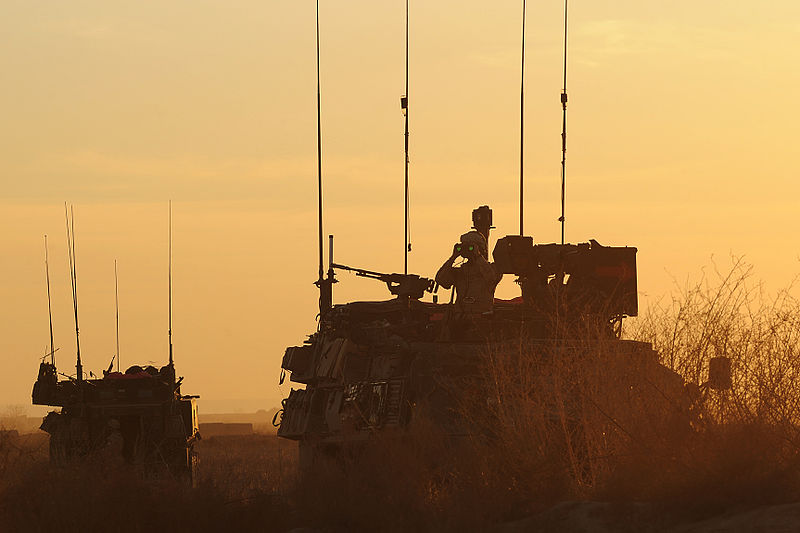
Canadian Army LAV III convoy near Khadan, Afghanistan – 2010-01-25
Photo by Staff Sgt. Christine Jones via Wikimedia Commons
The LAV III, originally named the Kodiak by the Canadian Army, is the third generation of the Light Armoured Vehicle (LAV) family of Infantry fighting vehicle built by General Dynamics Land Systems first entering service in 1999. It was developed in Canada and is the primary mechanized infantry vehicle of the Canadian Army and the New Zealand Army. It also forms the basis of the Stryker vehicle used by the US Army and other operators.
[…]
In July 2009, the Canadian Department of National Defence announced that $5 billion would be spent to enhance, replace and repair the army’s armoured vehicles. Part of the spending would be used to replace and repair damaged LAV III’s due to wear and tear from operations in Afghanistan. As much as 33 percent of the army’s light armoured vehicles were out of service. Furthermore, the LAV III’s will be upgraded with improved protection and automotive components. The Canadian Armed Forces has lost over 34 vehicles and 359 were damaged during the mission in Afghanistan. The Canadian army has lost 13 LAV’s and more than 159 were damaged by roadside bombs or enemy fire. Of the $5 billion announced, approximately 20% of it will be used to upgrade LAV III models. The upgrade will extend the LAV III life span to 2035. The remaining $4 billion is to be spent on a “new family of land combat vehicles”. The Department of National Defence considered the purchase of vehicles meant to accompany the Leopard 2 and to sustain the LAV III into combat. […]
On October 21, 2011 the Canadian government announced a $1.1 billion contract to General Dynamics Land Systems to upgrade 550 LAV III combat vehicles. The government said the upgrade is needed to improve protection against mines and improvised explosive devices (IEDs), which have been the cause of a number of Canadian deaths in Afghanistan. The improvements will also extend the service of the vehicles up to 2035 and will boost troop mobility. The upgrades include a new and more powerful engine, increased armour protection, steering and brake systems. The turret hatches on the LAV III would be made larger and improved fire control, thermal, day and low-light sights, and data displays. The weight of the vehicle would increase from 38,000 pounds (17,000 kg) to 55,000 pounds (25,000 kg). The first of 66 upgraded LAV IIIs was delivered on February 1, 2013. The success of the upgrade program and budget pressures led to the cancellation of the Close Combat Vehicle replacement program later that year.
In September 2012 the original contract valued to at $1.064 billion to upgrade the 550 LAV III’s variants, an infantry section carrier, a command post, an observation post and an engineer vehicle to the LAV 6.0 configuration, was modified. This included an additional $151 million to upgrade 66 LAV III’s to the LAV 6.0 reconnaissance variant or ‘recce’.
On February 10, 2017 General Dynamics Land Systems – Canada of London, Ont. was awarded a $404 million order to work on 141 LAV Operational Requirement Integration Task (LORIT) vehicles. This contract will upgrade the remaining LAV III fleet in the Canadian Army to the LAV 6.0 configuration. This brings the Canadian Army’s Light Armoured Vehicle III Upgrade (LAVUP) program to a total cost of $1.8 billion.
Final completion and delivery of the Canadian Army’s Light Armoured Vehicle III Upgrade (LAVUP) to upgrade the LAV III to the LAV 6.0 is expected to be completed by December 2019.
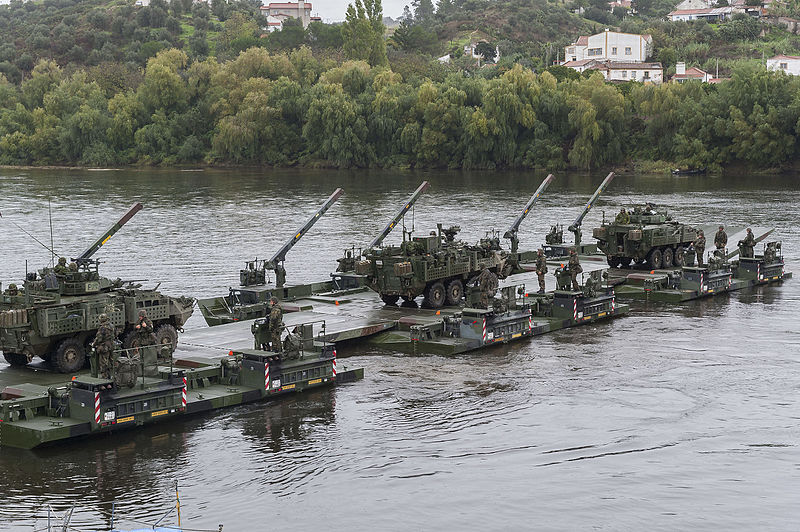
Canadian combat engineers in light armoured vehicules cross the river on a German floating bridge in Tancos, Portugal, during JOINTEX 15 as part of NATO’s exercise TRIDENT JUNCTURE 15 on November 2, 2015.
Photo by Sgt Sebastien Frechette via Wikimedia Commons
Ken Pole has more on the program at Canadian Army Today:
The LAV UP, also known as LAV 6.0, project is expected to push their operational life to 2035.
That effectively was set in motion in November 2008 when the Department of National Defence (DND) confirmed that it wanted to combine three programs into one general set of upgrades to all armoured vehicles. That led to a $1.064-billion contract award to GDLSC in October 2011 to modernize 550 LAV IIIs to enhance not only their survivability, but also their mobility and lethality.
Under the contract, 409 vehicles were to receive turret and chassis upgrades while 141 LAV Operational Requirement Integration Task (LORIT) variants were scheduled to receive only the turret upgrade. A contract amendment in February 2017 added $404 million to upgrade the LORIT chassis as well.
Now the focus within the Directorate of Land Requirements (DLR) is on the Light Armoured Vehicle Specialist Variant Enhancements (LAV SVE). Major Philippe Masse, the project director, brings operational chops from Afghanistan, although he’s quick to say that he’s had a lot to learn about the vehicles since he was assigned. He’s taken a clean-sheet approach, conducting extensive discussions with combat engineers, artillery officers, and gunners.
Masse’s career includes nine months as commander of a light infantry platoon tasked with force protection of the Kandahar Provincial Reconstruction Team and later as second-in-command of the Royal 22nd Regiment battlegroup’s parachute company for its final combat rotation on Operation Athena.
The LAV III infantry carrier and command post variants are the two largest elements of the fleet and are often tasked additional roles. However, the two specialist variants, the Engineer and the Observation Post Vehicle, used by Artillery’s forward detachments, will be “enhanced” under this project.
[…]
There is extra pressure on the LAV SVE package because it was specifically identified in the Strong, Secure, Engaged policy document. “We’re on track; the options are getting a lot of priority,” Masse said. “We’re already engaged with General Dynamics Land Systems because they basically own the intellectual property of the fleet…. When you want to integrate new stuff, they’re among the first phone calls you have to make.”
While integration of a complex system is always a challenge, one of the team’s considerations will also be ease of maintenance, especially for soldiers in the field. “We’re looking to align that, if possible, with existing in-service support contracts that we already [have],” he said. “The bottom line for us is reliability.”
Comments Off on Upgrading Canada’s LAV III armoured fighting vehicles
August 24, 2018
Tank Chats #35 Centurion | The Tank Museum
The Tank Museum
Published on 14 Apr 2017The thirty-fifth Tank Chat, presented David Fletcher MBE, is the first of the videos on the Centurion series of tanks.
The Centurion is one of the most important tanks in the history of the British AFV and is one of the most significant post-war Western tanks. Introduced in the spring of 1945, a small number of the Beach Armoured Recovery Version (BARV) served with the British forces during the Iraq war of 2003, 58 years later.
To find out more, buy the Haynes Centurion tank manual. https://www.myonlinebooking.co.uk/tan…
Support the work of The Tank Museum on Patreon: ► https://www.patreon.com/tankmuseum
Or donate http://tankmuseum.org/support-us/donate
Comments Off on Tank Chats #35 Centurion | The Tank Museum
August 21, 2018
The StuG III – Germany’s deadliest AFV
Lindybeige
Published on 31 Jul 2018At Bovington Tankfest, there were three Stug III assault guns for me to have a look at. Naturally, I looked at all three.
Support me on Patreon: https://www.patreon.com/LindybeigeThanks to The Tank Museum at Bovington for the invitation.
Lindybeige: a channel of archaeology, ancient and medieval warfare, rants, swing dance, travelogues, evolution, and whatever else occurs to me to make.
▼ Follow me…
Twitter: https://twitter.com/Lindybeige I may have some drivel to contribute to the Twittersphere, plus you get notice of uploads.
Facebook: https://www.facebook.com/Lindybeige (it’s a ‘page’ and now seems to be working).
Google+: “google.com/+lindybeige”
website: http://www.LloydianAspects.co.uk
Comments Off on The StuG III – Germany’s deadliest AFV
August 13, 2018
Tank Chats #34 Chieftain | The Tank Museum
The Tank Museum
Published on 31 Mar 2017The thirty-fourth Tank Chat, this time presented by Curator David Willey after some help from Eli. https://youtu.be/T33hp0J-LAw
Britain’s Main Battle Tank for twenty years, Chieftain was one of the first true Main Battle Tanks, designed to replace both medium and heavy tanks in front line service.
To find out more, buy the new Haynes Chieftain tank manual. https://www.myonlinebooking.co.uk/tan…
Support the work of The Tank Museum on Patreon: ► https://www.patreon.com/tankmuseum
Or donate http://tankmuseum.org/support-us/donate
Comments Off on Tank Chats #34 Chieftain | The Tank Museum
August 7, 2018
Flying Tanks! Tetrarchs and Locusts
Lindybeige
Published on 31 May 2018Bovington Tank Museum, and The Chieftain again – ten minutes on the topic of air-portable tanks of World War Two.
Support me on Patreon: https://www.patreon.com/LindybeigeIt is possible that (some?) Tetrarchs had holes in the sides of the turret for a drawstring that could pull the trigger of the smoke projector from inside the turret. However, you really wouldn’t want the rifle cocked and ready to fire unless you were just about to use it. White phosphorous is dangerous stuff and you would make no friends by setting it off by snagging your belt on the string as you climbed in the tank.
Hannibal graphic novel (in production): http://www.InSearchofHannibal.com
Many thanks to The Chieftain, my co-presenter, and to The Tank Museum at Bovington.
Two ideas have been posted in the comments for the name ‘Tetrarch’. One is that it has four equally-sized wheels on each side (which guide the tank, a bit like four rulers guide an empire). The other is that there was a very famous racehorse called ‘The Tetrarch’ that died in 1935. The tank was not designed originally for air-drops, but was presumably meant to be fast, so that makes sense.
Lindybeige: a channel of archaeology, ancient and medieval warfare, rants, swing dance, travelogues, evolution, and whatever else occurs to me to make.
▼ Follow me…
Twitter: https://twitter.com/Lindybeige I may have some drivel to contribute to the Twittersphere, plus you get notice of uploads.
Facebook: https://www.facebook.com/Lindybeige (it’s a ‘page’ and now seems to be working).
Comments Off on Flying Tanks! Tetrarchs and Locusts


