Quotulatiousness

November 15, 2020

QotD: Early successes in recruit training

Filed under: Britain, History, Humour, Military, WW1 — Tags: , — Nicholas @ 01:00

Still, we are getting on. Number Three Platoon (which boasts a subaltern) has just marched right round the barrack square, without —

(1) Marching though another platoon.

(2) Losing any part or parts of itself.

(3) Adopting a formation which brings it face to face with a blank wall, or piles it up in a tidal wave upon the verandah of the married quarters.

They could not have done that a week ago.

Ian Hay (Major John Hay Beith), The First Hundred Thousand: Being the Unofficial Chronicle of a Unit of “K(1)”, 1916.

November 11, 2020

In memoriam

Filed under: Britain, History, Military, WW1, WW2 — Tags: , , — Nicholas @ 03:00

A simple recognition of some of our family members who served in the First and Second World Wars:

The Great War

  • A Poppy is to RememberPrivate William Penman, Scots Guards, died 16 May, 1915 at Le Touret, age 25
    (Elizabeth’s great uncle)
  • Private Archibald Turner Mulholland, Argyll & Sutherland Highlanders, mortally wounded 25 September, 1915 at Loos, age 27
    (Elizabeth’s great uncle)
  • Private David Buller, Highland Light Infantry, died 21 October, 1915 at Loos, age 35
    (Elizabeth’s great grandfather)
  • Private Harold Edgar Brand, East Yorkshire Regiment. died 4 June, 1917 at Tournai.
    (My first cousin, three times removed)
  • Private Walter Porteous, Durham Light Infantry, died 4 October, 1917 at Passchendaele, age 18
    (my great uncle)
  • Corporal John Mulholland, Argyll & Sutherland Highlanders, wounded 2 September, 1914 (shortly before the First Battle of the Aisne), wounded again 29 June, 1918, lived through the war.
    (Elizabeth’s great uncle)

The Second World War

  • Flying Officer Richard Porteous, RAF, survived the defeat in Malaya and lived through the war
    (my great uncle)
  • Able Seaman John Penman, RN, served in the Defensively Equipped Merchant fleet on the Murmansk Run (and other convoy routes), lived through the war
    (Elizabeth’s father)
  • Private Archie Black (commissioned after the war and retired as a Major), Gordon Highlanders, captured at Singapore (aged 15) and survived a Japanese POW camp
    (Elizabeth’s uncle)
  • Elizabeth Buller, “Lumberjill” in the Women’s Land Army in Scotland through the war.
    (Elizabeth’s mother)
  • Trooper Leslie Taplan Russon, 3rd Royal Tank Regiment, died at Tobruk, 19 December, 1942 (aged 23).
    Leslie was my father’s first cousin, once removed (and therefore my first cousin, twice removed).

For the curious, the Commonwealth War Graves Commission the Royal British Legion, and the Library and Archives Canada WW1 and WW2 records site provide search engines you can use to look up your family name. The RBL’s Every One Remembered site shows you everyone who died in the Great War in British or Empire service (Canadians, Australians, New Zealanders, South Africans and other Imperial countries). The CWGC site also includes those who died in the Second World War. Library and Archives Canada allows searches of the Canadian Expeditionary Force and the Royal Newfoundland Regiment for all who served during WW1, and including those who volunteered for the CEF but were not accepted.

In Flanders fields the poppies blow
Between the crosses row on row,
That mark our place; and in the sky
The larks, still bravely singing, fly
Scarce heard amid the guns below.

We are the Dead. Short days ago
We lived, felt dawn, saw sunset glow,
Loved and were loved, and now we lie
In Flanders fields.

Take up our quarrel with the foe:
To you from failing hands we throw
The torch; be yours to hold it high.
If ye break faith with us who die
We shall not sleep, though poppies grow
In Flanders fields.

Lieutenant Colonel John McCrae, MD Canadian Army Medical Corps (1872-1918)

Mark Knopfler – “Remembrance Day”

Filed under: Britain, Cancon, History, Military, WW1, WW2 — Tags: , , , — Nicholas @ 02:00

Bob Oldfield
Published on 3 Nov 2011

A Remembrance Day slideshow using Mark Knopfler’s wonderful “Remembrance Day” song from the album Get Lucky (2009). The early part of the song conveys many British images, but I have added some very Canadian images also which fit with many of the lyrics. The theme and message is universal… “we will remember them”.

November 10, 2020

WWI Pritchard Bayonet for the Webley Revolver

Filed under: Britain, History, Military, Weapons, WW1 — Tags: , , — Nicholas @ 02:00

Forgotten Weapons
Published 23 Nov 2016

Cool Forgotten Weapons Merch! http://shop.bbtv.com/collections/forg…

The Pritchard bayonet for the Webley revolver is one of the more photogenic and less truly practical weapons to come out of the Great War. Designed by one Captain Pritchard after he spent a year in France in 1915-1916 with the Royal Berkshire Regiment, the idea was to use the front 8 inches or so of a sword on a cast gunmetal hilt to create a bayonet mounted on a British service revolver. He first presented the idea to the Wilkinson Sword Company, but they were too busy making sabers and rifle bayonets, and suggested that having to sacrifice usable sword blades for production would make it quite the expensive endeavor.

Pritchard next took his idea to W.W. Greener, where he found a more receptive audience. Greener had a large supply of surplus French Gras bayonets, which were cheap and served as excellent donors for the Pritchard bayonets. Something like 200 were made in total — not formally adopted by the British but available for commercial sale to officers who might want them. While some may have seen service, no hard evidence has been found to prove any combat action with them.

Over the decades, a great many fake and reproduction Pritchard bayonets have been made — many times more than there are originals. As far as I can determine, this one is a legitimate original (although it may have a replacement locking lever). A few things to look for in authenticating a Pritchard are engraved patent and manufacturer marks (most reproductions have no manufacturer logo and a stamped patent number) and a quality casting. When you hold the blade and tap the handle with a hard object, it should ring bright and bell-like (which this one does).

November 9, 2020

Falklands 1914: Von Spee’s Last Stand

Filed under: Americas, Britain, Germany, History, Military, WW1 — Tags: , — Nicholas @ 04:00

Historigraph
Published 7 Nov 2020

For unlimited access to the world’s top documentaries and 25% off between 16 Nov and 3 Jan, check out https://curiositystream.thld.co/histo…

Support the channel on Patreon: https://www.patreon.com/historigraph
Buy Historigraph Posters here! teespring.com/stores/historigraph

#BattleOfTheFalklandIslands #Historigraph #CuriosityStream

► Twitch: https://www.twitch.tv/addaway
► Twitter: https://twitter.com/historigraph
► Instagram: https://www.instagram.com/historigraph

October 30, 2020

QotD: Artillery “duels”

Filed under: Britain, Germany, History, Humour, Military, WW1 — Tags: , , — Nicholas @ 01:00

Each afternoon we creep unostentatiously into subterranean burrows, while our respective gunners, from a safe position in the rear, indulge in what they humorously describe as “an artillery duel.” The humour arises from the fact that they fire, not at one another, but at us.

Ian Hay (Major John Hay Beith), The First Hundred Thousand: Being the Unofficial Chronicle of a Unit of “K(1)”, 1916.

October 24, 2020

QotD: Dealing with the Ordnance Office

Filed under: Britain, Bureaucracy, Humour, Military, WW1 — Tags: — Nicholas @ 01:00

For instance, in the case of the machine-gun washers — by the way, in applying for them, you must call them Gun, Machine, Light Vickers, Washers for lock of, two. That is the way we always talk at the Ordnance Office. An Ordnance officer refers to his wife’s mother as Law, Mother-in-, one — you should state when the old washers were lost, and by whom; also why they were lost, and where they are now. Then write a short history of the machine-gun from which they were lost, giving date and place of birth, together with a statement of the exact number of rounds which it has fired — a machine-gun fires about five hundred rounds a minute — adding the name and military record of the pack-animal which usually carries it. When you have filled up this document you forward it to the proper quarter and await results.

The game then proceeds on simple and automatic lines. If your application is referred back to you not more than five times, and if you get your washers within three months of the date of application, you are the winner. If you get something else instead — say an aeroplane, or a hundred wash-hand basins — it is a draw. But the chances are that you lose.

[…]

Olympus will not disgorge your washers until it has your receipt. On the other hand, if you send the receipt, Olympus can always win the game by losing the washers, and saying that you have got them. In the face of your own receipt you cannot very well deny this. So you lose your washers, and the game, and are also made liable for the misappropriation of two washers, for which Olympus holds your receipt.

Truly, the gods play with loaded dice.

On the whole, the simplest (and almost universal) plan is to convey a couple of washers from some one else’s gun.

Ian Hay (Major John Hay Beith), The First Hundred Thousand: Being the Unofficial Chronicle of a Unit of “K(1)”, 1916.

October 6, 2020

QotD: Herbert Hoover and the Belgian relief program

Filed under: Britain, Europe, Food, Germany, History, Quotations, WW1 — Tags: , , , , , — Nicholas @ 01:00

Just as Hoover is preparing to rest on his laurels, he receives a cry for help. Germany has occupied and blockaded Belgium. The blockade prevents this tiny, heavily urban country from importing food, and the Belgians are starving. Germany needs its own food for its own armies, and is refusing to help. The Belgians order a thousand tons of grain from Britain, but when their representative comes to pick it up, Britain refuses to let them transport it, nervous at sending food into enemy-occupied territory. During tense negotiations, someone suggests using neutral power America as a go-between. But America is 5,000 miles away and busy with its own problems. So the US Ambassador to Britain asks his new best friend Herbert Hoover if he has any ideas.

Hoover invites Emile Francqui, a Belgian mining engineer he knows, to Britain. Together, they plan a Committee For The Relief of Belgium, intended not just to help transport the thousand tons of grain at issue, but to develop a long-term solution to the impending Belgian famine. Nothing like this has ever been tried before. Belgium has seven million people and almost no food. No government is offering to help, and they don’t have enough money to feed seven million people even for one day, let alone indefinitely. Hoover springs into action …

… by crushing all competing attempts to provide food for Belgium. He attacks the Rockefeller Foundation, which is trying to help, with a blitz of press coverage accusing it of various forms of insensitivity and interference, until it finally backs off. Then he gets to work on the government:

    The letter bore several Hoover watermarks, beginning with its heavy load of facts and figures organized in point form. It noted that myriad relief committees were springing up both inside and outside of Belgium, and urged consolidation. “It is impossible to handle the situation except with the strongest centralization and effective monopoly, and therefore the two organizations [Hoover outside Belgium and Francqui inside it] will refuse to recognize any element except themselves alone.” The letter also contained Hoover’s usual autocratic and slightly paranoid demands for “absolute command” of his part of the enterprise.

Control attained, Hoover springs into action actually feeding Belgium. He launches one of the largest public relations campaigns the world has ever seen, sending letters to newspapers around the world asking for donations. He “urged reporters to investigate the famine conditions in Belgium and play up the ‘detailed personal horror stuff’. He personally arranged for a motion picture crew to capture footage of food lines in Brussels, and he hired famous authors, including Thomas Hardy and George Bernard Shaw, to plead for public support of the rescue effort.” He constantly telegrams his exasperated wife and children, now safely back in Palo Alto, demanding they raise more and more money from the West Coast elite.

He browbeats shipping conglomerates until they agree to ship his food for free, then browbeats railroads until they agree to carry it. By telegraph and letter he coordinates banks, railroads, docks, ships, and relief workers on both sides of the Atlantic. But that’s just the prelude. His real problem is the governments. Britain doesn’t want food shipped to Belgium, because right now the starving Belgians are Germany’s problem, and they don’t want to solve an enemy’s problem for them. But Germany also doesn’t want food shipped to Belgium, because the Belgians are resisting the occupation, and they figure starvation will make them more compliant. Shuttling back and forth across the North Sea, Hoover tries to get them to switch theories: Germany needs to think starving Belgians are their problem which it would be helpful to solve, and Britain needs to think starvation would make Belgians more compliant with the German occupation. In the end, both countries allow the shipments.

He goes on a fact-finding mission to Belgium, and managed to somehow offend everyone in the country that he is, at that very moment, saving from mass starvation […] By 1915, Hoover is, indeed, feeding millions of Belgians, indefinitely, using only private funding. He is also almost broke. Millions of Brits and Americans have given him contributions, from tycoons donating fortunes to ordinary people donating their wages, but it’s not enough. His expenses pass $5 million a month, which would be about $100 million today; all these bills are starting to catch up to him. In an act of supreme sacrifice, Hoover pledges his entire personal fortune as collateral for the Committee’s loans, then takes out more money. The grain shipments continue to flow, but his credit is at its end.

He continues beating on the doors of every government official he can find – British, German, American – demanding help. They all say their budgets are already occupied with the war effort. He begs them, lectures them, tells them that millions of people are doing to die. He goes all the way to the top, finagling an opportunity to meet with British Prime Minister David Lloyd George. Lloyd George later calls Hoover’s presentation “the clearest he had [ever] heard on any subject”, but he can offer only moral support.

What finally works is going to Germany and meeting with their top military brass. The brass are unimpressed; they still think that Belgium starving is as likely to help them as hinder. But the contact spooks top British officials, who agree to meet with Hoover again. Hoover feeds them carefully crafted lies, saying that the German brass have told him that British aid to Belgium would be a disaster to the Central Powers and so they, the Germans, are going to fund everything Hoover wants and more. “Oh no they don’t!” say the British, who promise to give Hoover even more funding than his imaginary German partners. The Committee for the Relief Of Belgium is finally back in the black. And what a black it is:

    The scope and powers of the Committee For Relief of Belgium were mindboggling. Its shipping fleet flew its own flag. Its members carried special documents that served as CRB passports. Hoover himself was granted a form of diplomatic immunity by all belligerents, with the British permitting him to cross the Channel at will and the Germans providing him a document saying “this man is not to be stopped anywhere under any circumstances”. Hoover had privileged access to generals, diplomats, and ministers. He enjoyed personal contacts with the heads of warring governments. He negotiated treaties with the belligerents, advised them on policy, and delivered private messages among them. Great Britain, France, and Belgium would soon be turning over to him $150 million a year, enough to run a small country, and taking nothing for it beyond his receipt. As one British official observed, Hoover was running “a piratical state organized for benevolence.”

Scott Alexander, “Book Review: Hoover”, Slate Star Codex, 2020-03-17.

October 1, 2020

Tank Revolutionary: Fuller’s Diary | The Tank Museum

Filed under: Books, Britain, France, History, Military, Weapons, WW1 — Tags: , , , , , — Nicholas @ 02:00

The Tank Museum
Published 5 Jun 2020

J.F.C. Fuller has been described as a satanist, Nazi and bigot. Director Richard Smith, explores this highly controversial character, who was pivotal to the story of armoured warfare, using Fuller’s personal diary.

Support the work of The Tank Museum on Patreon: ► https://www.patreon.com/tankmuseum
Visit The Tank Museum SHOP & become a Friend: ► https://tankmuseumshop.org/

Twitter: ► https://twitter.com/TankMuseum
Instagram: ► https://www.instagram.com/tankmuseum/
Tiger Tank Blog: ► http://blog.tiger-tank.com/
Tank 100 First World War Centenary Blog: ► http://tank100.com/

September 10, 2020

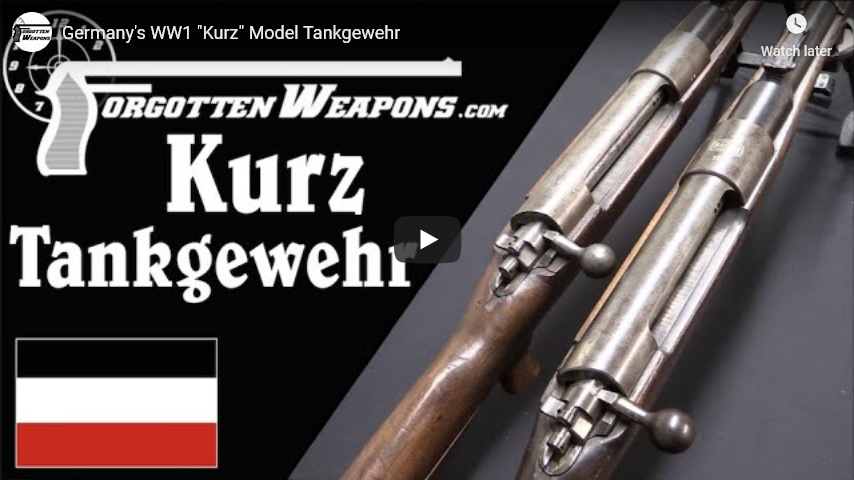
Could a Tankgewehr Really Take Out a British MkIV Tank?

Filed under: Germany, History, Military, Weapons, WW1 — Tags: , , — Nicholas @ 02:00

Forgotten Weapons
Published 6 May 2017

The Tankgewehr antitank rifle was developed by the Mauser company and adopted by the Imperial German military as an emergency measure to counter the introduction of tanks to the WW1 battlefield. The question is, did they really work? Could a 13.2mm AP bullet from a Tankgewehr really perforate the armor of a British tank? Well today we find out!

The armor on a British tank was steel plate of 6mm, 8mm, and 12mm thickness, through-hardened to Brinell 440-480. We have replicated this with a plate of AR450 (ie, Brinell 450) armor, which we will be shooting at a distance of 50 yards. The ammunition we are using is original 1918 production German AP, and the rifle is a Tankgewehr captured by Allied troops late in the war and brought home as a souvenir.

This video was only made possible with help from three very helpful folks:

MOA Targets provided the steel (and on short notice!): https://www.moatargets.com

Mike Carrick of Arms Heritage Magazine provided use of the T-Gewehr: https://armsheritagemagazine.com

Hayes Otoupalik provided the original ammunition: http://www.hayesotoupalik.com

Cool Forgotten Weapons merchandise! http://shop.bbtv.com/collections/forg…

http://www.patreon.com/ForgottenWeapons

If you enjoy Forgotten Weapons, check out its sister channel, InRangeTV! http://www.youtube.com/InRangeTVShow

August 25, 2020

The Russian Revolution 1917

Filed under: Government, History, Military, Russia, WW1 — Tags: , , , , , , — Nicholas @ 06:00

Epic History TV
Published 4 Aug 2016

Everything you need to know about the Russian Revolution in a 13 min video. Produced in partnership with Bridgeman Images http://www.bridgemanimages.com/en-GB/

We explain all the major events of Russia’s TWO revolutions of 1917 – the February Revolution that ended Tsarist rule in Russia, and the October Revolution, that brought the Bolsheviks to power. We explain the causes of Tsar Nicholas II’s growing unpopularity – the role of the mysterious Siberian mystic Rasputin, Russia’s disastrous involvement in World War One, and the events on the streets of Petrograd that led to the Tsar’s abdication. That summer Russia lurched from crisis to crisis, with a Provisional Government that faced riots (the July Days), military revolt (the Kornilov Affair), economic chaos, and constantly dwindling support. Socialist Prime Minister Alexander Kerensky, once hailed as Russia’s great hope, was unable to restore order, or, in October, prevent the Bolsheviks from launching a coup, organised by Leon Trotsky and led by Vladimir Lenin, that overthrow the Provisional Government and brought the Bolsheviks to power. A brutal civil war followed, leading to the death of more than 10 million Russians – amongst them Tsar Nicholas II and his family, executed by Bolsheviks at Yekaterinburg in July 1918. From the wreckage emerged the Soviet Union, formed in 1922, and destined to be one of the 20th century’s two superpowers.

Please help me make more history videos by supporting me at Patreon: https://www.patreon.com/epichistorytv

#EpicHistoryTV #HistoryofRussia #RussianRevolution

Recommended books on the Russian Revolution (as an Amazon Associate I earn from qualifying purchases):
S. A. Smith, The Russian Revolution: A Very Short Introduction http://geni.us/RzOAk2U
Orlando Figes, A People’s Tragedy: The Russian Revolution http://geni.us/UIxyirj
Robert Service, The Last of the Tsars: Nicholas II and the Russian Revolution http://geni.us/A89T
Neil Faulkner, A People’s History of the Russian Revolution http://geni.us/bME0unl

August 24, 2020

Why the British Army was so effective in 1914 – Learning lessons from the Boer War

Filed under: Africa, Britain, Germany, History, Military, Weapons, WW1 — Tags: , , , , , — Nicholas @ 06:00

History West Midlands
Published 10 Oct 2014

When Britain despatched an Expeditionary Force (the BEF) to the Continent in August 1914, the German Kaiser issued an order of the day to his generals to “walk over General French’s contemptible little army”.

But despite being heavily outnumbered, this small force, including many men from the West Midlands, played a vital role in stopping the seemingly overwhelming German advance across Belgium and into France.

Small in size compared with the much larger armies of France and Germany, the BEF was highly effective. This was in stark contrast to the disasters that the British Army had experienced a few years earlier at the start of the Second Boer War (1899-1902) in South Africa.

August 23, 2020

QotD: Herbert Hoover and the American tourists

Count up the victims of World War I, and American tourists will be pretty far down the list. But victims they were. When the conflict broke out, thousands of Americans were overseas visiting the cathedrals of Florence or the museums of London. They woke up one morning to find the ships that were supposed to take them back had been conscripted into the war effort, or refused to sail for fear of enemy fire. The banks that were supposed to cash their travelers’ checks were panicking, or devoting all their funds to the war effort, or dealing with a million other things. The hotels that were supposed to house them were closed indefinitely, their employees rushing to enlist out of patriotic fervor. And so thousands of frantic Americans, stuck in a foreign continent with no money and nowhere to stay, showed up at the door of the US Embassy in London and said – help!

The US Consulate in London didn’t know how to solve these problems either. But Herbert Hoover, still high on his decision to pivot to philanthropy and public service, calls them up and asks if he can help. They say yes, definitely. Hoover gets in touch with his rich friends, passes around the collection plate, and organizes a Committee For The Assistance Of American Travelers. Then he gets to work, the way only he can:

    Within 24 hours, Hoover’s committee had its own stationery, and within forty-eight it was operating a booth in the ballroom of the Savoy Hotel as well as three other London locations. Through his business connections, Hoover managed to bypass restrictions on telegraph service and open a transatlantic line to allow Americans to wire money to stranded friends and relatives. In a city suddenly flooded with refugees, he reserved for American travelers some two thousand rooms in hotels or boardinghouses. He issued a press release proclaiming that his Residents’ Committee was assuming charge of all American relief work in the city, and that in doing so it had the blessings of its honorary chairman, Walter Hines Page, the US ambassador to London.

… which is totally false. Hoover is starting to display a pattern that will stick with him his whole life – that of crushing competing charities. He begins a lobbying effort to get the US Embassy to ban all non-Hoover relief work, focusing on the inefficiency of having multiple groups working on the same problem. When the US Assistant Secretary Of War arrives in London to coordinate a response, he is met on the dock by Hoover employees, who demand he consult with Hoover before interfering in the US tourist issue. Eventually the Embassy, equally exasperated by Hoover’s pestering and impressed with his results, agrees to give him official control of the relief effort.

After two months of work, Hoover and his Committee have repatriated all 120,000 US tourists, supporting them in style until it could find them boat tickets. All of its loans and operating costs have been repaid by grateful tourists, and its budget is in the black. The rescued travelers are universal in their praise for Hoover, partly because Hoover has threatened to ruin any of them who get too critical:

    Other complainants were received with less patience, including a hotheaded professor of history from the University of Michigan, who wrote to accuse the Residents’ Committee of mistreatment. Hoover refuted his charges indignantly and comprehensively, copying his response to the president of the university and its board of regents. After a meeting with his employer, the professor returned Hoover an abject retraction and apology.

Scott Alexander, “Book Review: Hoover”, Slate Star Codex, 2020-03-17.

August 16, 2020

Greco-Turkish War – Treaty of Sèvres I THE GREAT WAR 1920

The Great War
Published 15 Aug 2020

Sign up for Curiosity Stream and get Nebula bundled in: https://curiositystream.com/thegreatwar

While the Greco-Turkish War was still raging, the last of the peace treaties between the Allies and the Central Powers was finalized in Paris. But the Turkish Nationalist Movement under Mustafa Kemal would not accept the terms of the Treaty of Sèvres – even though the Ottoman government had signed it.

» SUPPORT THE CHANNEL
Patreon: https://www.patreon.com/thegreatwar

» OUR PODCAST
https://realtimehistory.net/podcast – interviews with World War 1 historians and background info for the show.

» BUY OUR SOURCES IN OUR AMAZON STORES
https://realtimehistory.net/amazon *
*Buying via this link supports The Great War (Affiliate-Link)

» SOURCES
Halide Edib Adivar, The Turkish Ordeal: Being the Further Memoirs of Halidé Edib, (Piscataway: Gorgias Press, 2012)

John Darwin, Britain, Egypt and the Middle East, (London: Macmillan Press, 1981)

M.L. Dockrill and J. D. Goold, Peace Without Promise: Britain and the Peace Conferences, 1919-1923, (Connecticut: Hamden, 1981)

T G Fraser, Andrew Mango and Robert McNamara, The Makers of the Modern Middle East, (London: Gingko Library, 2015)

Phillip S Jowett, “Armies of the Greek-Turkish War: 1919-1922”, Men at Arms, no 501, (2015)

Michael Llewellyn Smith, Ionian Vision: Greece in Asia Minor 1919-1922, (London: Allen Lane, 1973)

Margaret Macmillan, Paris 1919: Six Months That Changed the World, (London: Macmillan, 2019)

A.E. Montgomery, “The Making of the Treaty of Sèvres of 10 August 1920”, The Historical Journal Vol. 15, No. 4 (December, 1972)

New York Times, “Turk Nationalists Capture Beicos” (July 6, 1920) https://timesmachine.nytimes.com/time…

George Riddell, Lord Riddell’s Intimate Diary of the Peace Conference and After: 1918-1923, (London: Victor Gollancz Ltd, 1933)

» MORE THE GREAT WAR
Website: https://realtimehistory.net
Instagram: https://instagram.com/the_great_war
Twitter: https://twitter.com/WW1_Series
Reddit: https://reddit.com/r/TheGreatWarChannel

»CREDITS
Presented by: Jesse Alexander
Written by: Jesse Alexander
Director: Toni Steller & Florian Wittig
Director of Photography: Toni Steller
Sound: Toni Steller
Editing: Toni Steller
Motion Design: Philipp Appelt
Mixing, Mastering & Sound Design: http://above-zero.com
Maps: Daniel Kogosov (https://www.patreon.com/Zalezsky)
Research by: Jesse Alexander
Fact checking: Florian Wittig

Channel Design: Yves Thimian

Contains licensed material by getty images
All rights reserved – Real Time History GmbH 2020

August 14, 2020

“The End of the War to End All Wars” – The Great War – Sabaton History 080 [Official]

Filed under: Europe, History, Media, Military, USA, WW1 — Tags: , , , , , — Nicholas @ 04:00

Sabaton History
Published 13 Aug 2020

November 11, 1918. The end of the Great War. A war that was also dubbed “the war to end all wars”. And many truly wished that the war’s countless horrors, which had caused the terrible deaths of millions of soldiers and civilians, and had left so many of its survivors crippled and scarred for the rest of their lives, would never repeat themselves. But could this truly be the war that ended the need for war? Was there a solution that promised everlasting peace? Could war even be outlawed? Or was mankind doomed to repeat itself?

Support Sabaton History on Patreon: https://www.patreon.com/sabatonhistory

Listen to The Great War (where “The End of the War to End All Wars” is featured): https://music.sabaton.net/TheGreatWar

Watch the Official Lyric Video of The End of the War to End All Wars here: https://www.youtube.com/watch?v=oXnnb…

Listen to Sabaton on Spotify: http://smarturl.it/SabatonSpotify
Official Sabaton Merchandise Shop: http://bit.ly/SabatonOfficialShop

Hosted by: Indy Neidell
Written by: Markus Linke and Indy Neidell
Directed by: Astrid Deinhard and Wieke Kapteijns
Produced by: Pär Sundström, Astrid Deinhard and Spartacus Olsson
Creative Producer: Joram Appel
Community Manager: Maria Kyhle
Executive Producers: Pär Sundström, Joakim Broden, Tomas Sunmo, Indy Neidell, Astrid Deinhard, and Spartacus Olsson
Post-Production Director: Wieke Kapteijns
Edited by: Karolina Dołęga
Sound Editing by: Marek Kaminski
Maps by: Eastory – https://www.youtube.com/c/eastory
Archive by: Reuters/Screenocean https://www.screenocean.com
Music by Sabaton

Sources:
Icons from The Noun Project by: Vectors Point, Locad, Gan Khoon Lay, RF_Design & banjirolove
National Archives NARA
Library of Congress
Bundesarchiv
Bibliothèque nationale de France
Library of Scotland
Imperial War Museums:Q 43463, Q5733, HU 105641, Q 12363, HU 105641, Q 3117,Q 5733, Q 56637, IWM Q 10378, Q 3117,Q 86635, Q 23760, HU 110852, Q 7815, PST5277,
Archives of New Zealand
TRAJAN 117 from Wikimedia
Srg36 from Wikimedia
F l a n k e r from Wikimedia
Guilherme Paula from Wikimedia
Narodowe Archiwum Cyfrowe

An OnLion Entertainment GmbH and Raging Beaver Publishing AB co-Production.

« Newer PostsOlder Posts »

Powered by WordPress