Quotulatiousness

January 15, 2014

The NSA’s rise to being the “centerpiece of the entire intelligence system”

Filed under: Government, Technology, USA — Tags: , , , — Nicholas @ 09:06

In Wired, Felix Salmon explains that “Quants don’t know everything”:

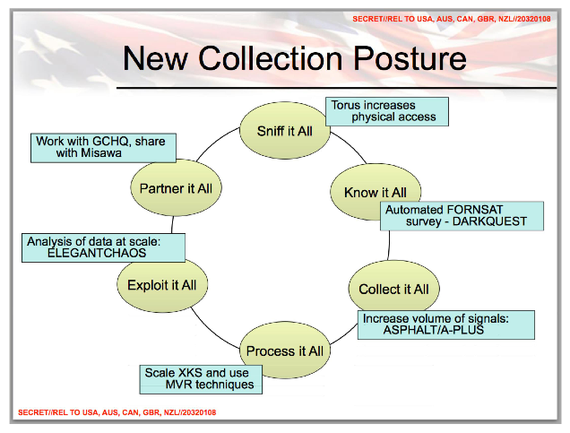
By now, nearly everyone from the president of the United States on down has admit­ted that the National Security Agency went too far. Documents leaked by Edward Snowden, the rogue NSA contractor who has since gained asylum in Rus­sia, paint a picture of an organization with access to seemingly every word typed or spoken on any electronic device, anywhere in the world. And when news of the NSA’s reach became public — as it was surely bound to do at some point — the entire US intelli­gence apparatus was thrust into what The New York Times recently called a “crisis of purpose and legitimacy.”

It was a crisis many years in the making. Over the course of three decades, the NSA slowly transformed itself from the nation’s junior spy agency to the centerpiece of the entire intelligence system. As the amount of data in the world doubled, and doubled again, and again, the NSA kept up with it — even as America’s human intelligence capability, as typified by old-fashioned CIA spies in the field, struggled to do anything useful with the unprecedented quantities of signals intelligence they had access to. Trained agency linguists capable of parsing massive quantities of Arabic- and Farsi-language intercepts don’t scale up nearly as easily as data centers do.

That, however, wasn’t the computer geeks’ problem. Once it was clear that the NSA could do something, it seemed inarguable that the agency should do it — even after the bounds of information overload (billions of records added to bulging databases every day) or basic decency (spying on allied heads of state, for example) had long since been surpassed. The value of every marginal gigabyte of high tech signals intelligence was, at least in theory, quantifiable. The downside — the inability to prioritize essential intelligence and act on it; the damage to America’s democratic legitimacy — was not. As a result, during the past couple of decades spycraft went from being a pursuit driven by human judgment calls to one driven by technical capability.

January 13, 2014

Zombies coming? Here, take this.

Filed under: Cancon, Technology, Weapons — Tags: , , — Nicholas @ 15:03

My very old friend Darrell Markewitz is offering a course on “Building a ZOMBIE KILLER” at The Wareham Forge north of Orangeville this summer:

Wareham Force - Build a ZOMBIE KILLER

This two day, 16 hour session is for FUN, FUNCTION – and PREPARATION.
Learn the basics of building a simple forge, improvising an anvil and other tools, all while making your own bladed weapons for the Upcoming Zombie Apocalypse!
Projects include a spear head and single edged cleaver to add to your bug out kit.

You Will Make a Big Stickin’ Spear Head
Wareham Forge - Zombie spear

a Small Practice Knife
Wareham Force - Zombie knife

a Massive Cutting Cleaver
Wareham Force - Zombie cleaver

This program does not require any previous metalworking experience, and is of interest to anyone wanting to be truly prepared!
Course fee of $325 (+HST) includes coffee and materials.

As well as the projects above, this course covers:

Building a simple forge,
Improvised anvils,
Tools in a pinch,
Scrounging materials from the Ruins,
How to hammer like you Mean It,
Basics of Heat Treating
Getting the Point (and sharpening to an edge)

The GMO debate – “it is a tale told by an idiot, full of sound and fury, signifying nothing”

Filed under: Environment, Food, Media, Science, Technology — Tags: , , , , — Nicholas @ 09:22

Nathanael Johnson says he has taken more abuse over his articles on genetically modified organisms than anything else in his writing career. And he says he learned something from his research: that it actually doesn’t matter at all.

It’s a little awkward to admit this, after devoting so much time to this project, but I think Beth was right. The most astonishing thing about the vicious public brawl over GMOs is that the stakes are so low.

I know that to those embroiled in the controversy this will seem preposterous. Let me try to explain.

Let’s start off with a thought experiment: Imagine two alternate futures, one in which genetically modified food has been utterly banned, and another in which all resistance to genetic engineering has ceased. In other words, imagine what would happen if either side “won” the debate.

In the GMO-free future, farming still looks pretty much the same. Without insect-resistant crops, farmers spray more broad-spectrum insecticides, which do some collateral damage to surrounding food webs. Without herbicide-resistant crops, farmers spray less glyphosate, which slows the spread of glyphosate-resistant weeds and perhaps leads to healthier soil biota. Farmers also till their fields more often, which kills soil biota, and releases a lot more greenhouse gases. The banning of GMOs hasn’t led to a transformation of agriculture because GM seed was never a linchpin supporting the conventional food system: Farmers could always do fine without it. Eaters no longer worry about the small potential threat of GMO health hazards, but they are subject to new risks: GMOs were neither the first, nor have they been the last, agricultural innovation, and each of these technologies comes with its own potential hazards. Plant scientists will have increased their use of mutagenesis and epigenetic manipulation, perhaps. We no longer have biotech patents, but we still have traditional seed-breeding patents. Life goes on.

In the other alternate future, where the pro-GMO side wins, we see less insecticide, more herbicide, and less tillage. In this world, with regulations lifted, a surge of small business and garage-biotechnologists got to work on creative solutions for the problems of agriculture. Perhaps these tinkerers would come up with some fresh ideas to usher out the era of petroleum-dependent food. But the odds are low, I think, that any of their inventions would prove transformative. Genetic engineering is just one tool in the tinkerer’s belt. Newer tools are already available, and scientists continue to make breakthroughs with traditional breeding. So in this future, a few more genetically engineered plants and animals get their chance to compete. Some make the world a little better, while others cause unexpected problems. But the science has moved beyond basic genetic engineering, and most of the risks and benefits of progress are coming from other technologies. Life goes on.

The point is that even if you win, the payoff is relatively small in the broad scheme of things. Really, why do so many people care?

January 8, 2014

“Silicon Valley was … collateral damage in the war on terror”

Filed under: Government, Liberty, Media, Technology, USA — Tags: , , , , , — Nicholas @ 08:40

In Wired, Steven Levy explains how the NSA nearly killed the internet:

On June 6, 2013, Washington Post reporters called the communications depart­ments of Apple, Facebook, Google, Yahoo, and other Internet companies. The day before, a report in the British newspaper The Guardian had shocked Americans with evidence that the telecommunications giant Verizon had voluntarily handed a database of every call made on its network to the National Security Agency. The piece was by reporter Glenn Greenwald, and the information came from Edward Snowden, a 29-year-old IT consultant who had left the US with hundreds of thousands of documents detailing the NSA’s secret procedures.

Greenwald was the first but not the only journalist that Snowden reached out to. The Post’s Barton Gellman had also connected with him. Now, collaborating with documentary filmmaker and Snowden confidante Laura Poitras, he was going to extend the story to Silicon Valley. Gellman wanted to be the first to expose a top-secret NSA program called Prism. Snowden’s files indicated that some of the biggest companies on the web had granted the NSA and FBI direct access to their servers, giving the agencies the ability to grab a person’s audio, video, photos, emails, and documents. The government urged Gellman not to identify the firms involved, but Gellman thought it was important. “Naming those companies is what would make it real to Americans,” he says. Now a team of Post reporters was reaching out to those companies for comment.

It would be the start of a chain reaction that threatened the foundations of the industry. The subject would dominate headlines for months and become the prime topic of conversation in tech circles. For years, the tech companies’ key policy issue had been negotiating the delicate balance between maintaining customers’ privacy and providing them benefits based on their personal data. It was new and contro­versial territory, sometimes eclipsing the substance of current law, but over time the companies had achieved a rough equilibrium that allowed them to push forward. The instant those phone calls from reporters came in, that balance was destabilized, as the tech world found itself ensnared in a fight far bigger than the ones involving oversharing on Facebook or ads on Gmail. Over the coming months, they would find themselves at war with their own government, in a fight for the very future of the Internet.

January 6, 2014

Why patents were invented

Filed under: Law, Technology — Tags: , , , — Nicholas @ 08:57

In The Register, Tim Worstall explains why the notion of patents was introduced to the law and why we need to fix it now:

Having decided that the patent problem is an attempt to solve a public goods problem, as we did in part 1, let’s have a look at the specific ways that we put our oar into those perfect and competitive free markets.

It’s worth just noting that patents and copyright are not, absolutely not, the product of some fevered free market dreams. Rather, they’re an admission that “all markets all the time” does not solve all problems. That exactly why we create the patents.

Given that people find it very difficult to make money from the production of public goods, we think that we probably get too few of them. Innovation, the invention of new things for us to enjoy, is one of those public goods. It’s a hell of a lot easier to copy something you know can already be done than it is to come up with an invention yourself. So, if new inventions can be copied easily then we think that too few people will invent new things. We’re not OK with this idea. Thus we create a property right in that new invention. The inventor can now make money out of the invention and thus we get more new things.

And if it were only that simple, then of course we’d all be for patenting everything for ever. However it isn’t that simple. For not only do we want people to invent new things, we also want people to be able to adapt, extend, play with, improve those new things. Or apply them to areas the original inventor had no thought about. In the jargon, we want not just new inventions but also derivative ones. So we want to balance the ability of inventors to protect with the ability of others to do the deriving. And that’s probably what is actually wrong with our patent system today.

Have a look at Tabarrok’s curve:

Tabarrok's curve (after Laffer's curve), where economist Alex Tabarrok posits that, beyond a certain value, increased protection for intellectual property causes less innovation.

Tabarrok’s curve (after Laffer’s curve), where economist Alex Tabarrok posits that, beyond a certain value, increased protection for intellectual property causes less innovation.

If we have no protection of originality, then we get too little innovation. But if we have too strong a protection, then we get too little of the derivative stuff. There’s a sweet spot and the argument is that we’re not at it at present and are thus missing out on some goodies as a result. Perhaps some tweaks to the system would help?

January 4, 2014

Tim Bray wants you to go “content-free”

Filed under: Business, Media, Technology — Tags: , , — Nicholas @ 12:13

Tim Bray despises the word “content”:

I’m thinking about successful new communication channels, and how we talk about what’s in them. On Twitter, we say tweets. In the blogosphere and on Facebook, posts; also rants, reviews, and flames. Facebook has likes and now everything has links.

But I note the entire absence of “content”; the word, I mean. Yay! I’ve loathed it ever since its first powerpoint-pitch appearance, meaning “shit we don’t actually care about but will attract eyeballs and make people click on ads”. Except for they don’t say “people”, they say “users”, a symptom of another attitude problem.

With every year that passes, it’s increasingly clear that the appearance of “content” in any business plan is a symptom of (likely fatal) infection by cluelessness; and a good predictor of failure.

H/T to Charles Stross for the link.

January 3, 2014

Virginia Postrel on “first world problems”

Filed under: Business, Economics, Technology — Tags: , , , — Nicholas @ 15:53

I’ve heard the term many, many times (and used it more than a few times as well), but as Virginia Postrel points out, it didn’t just happen by chance that there are “first world problems” we can mock-sympathize over:

Third world conditions are defined not merely by economic misery but by unreliable services. “At the age of fourteen I had experienced a miracle,” writes Suketu Mehta in Maximum City, his critically acclaimed 2009 book on Mumbai. “I turned on a tap, and clean water came gushing out. This was in the kitchen of my father’s studio apartment in Jackson Heights [New York]. It had never happened to me before. In Bombay, the tap, when it worked, was always the first step of a process” taking at least 24 hours to produce drinkable water. Mehta’s family lived an affluent life but with third world problems.

By contrast, in a developed country, barring a major natural disaster, you can count on uninterrupted electricity, hot and cold running water, sewage disposal, garbage pickup, heat (and in hot climates, air conditioning), telephone service, Internet access and television. The roads and bridges will be in decent repair; the elevators will work; the ATMs will have cash; and you’ll be able to find a decent public toilet when you need one.

These things aren’t necessarily free, but they’re cheap enough for pretty much everyone to enjoy them. Most significantly, they’re ubiquitous and reliable. Even when natural disasters strike, we can expect heroic efforts to get things back to normal. Under normal circumstances, we can depend on these services to be there consistently and to work as promised. We can make plans accordingly. That’s a first world privilege.

[…]

It took years of sustained efforts by online retailers and delivery services to make overnight orders realistic. It also took dissatisfaction: insanely demanding companies working to please insanely demanding customers — or, in some cases, to offer customers services they hadn’t even thought to ask for — as each improvement revealed new sources of discontent.

“Form follows failure,” is what Henry Petroski, the civil engineering professor and prolific popular writer, calls the process. Every step forward begins with a complaint about what already exists. “This principle governs all invention, innovation, and ingenuity; it is what drives all inventors, innovators, and engineers,” he writes. “And there follows a corollary: Since nothing is perfect, and, indeed, since even our ideas of perfection are not static, everything is subject to change over time.”

Rising expectations aren’t a sign of immature “entitlement.” They’re a sign of progress — and the wellspring of future advances. The same ridiculous discontent that says Starbucks ought to offer vegan pumpkin lattes created Starbucks in the first place. Two centuries of refusing to be satisfied produced the long series of innovations that turned hunger from a near-universal human condition into a “third world problem.”

January 1, 2014

Browning out – the fading era of the incandescent bulb

Filed under: Cancon, Environment, Government, Technology — Tags: , — Nicholas @ 12:40

In Maclean’s, Kate Lunau recounts the history of the venerable incandescent light bulb as new regulations kick in today to phase them out of use in Canada:

The incandescent light bulb was born on Jan. 27, 1880, when U.S. inventor Thomas Edison famously patented his “electric lamp.” Others had paved the way, including Canadians Henry Woodward and Mathew Evans, whose 1874 light bulb patent was bought by Edison. But it was the latter who perfected and would commercialize the technology.

The light bulb — in which an electric current passes through a filament that heats up and glows inside a glass bulb — yanked North America into the electric age. Before then, “all street lamps were gas,” says Anna Adamek, who curates the energy collection at the Canada Science and Technology Museum, which includes about 2,000 light bulbs. “Wealthy people could afford gas lamps for interior lighting, but most would use kerosene, oil, or candles.” In 1882, the Canada Cotton Co., in Cornwall, Ont., became the first Canadian company to install electric lights. “Edison personally supervised the installation,” she says. In 1884, the lights went on in the Parliament buildings and, by 1905, the lighting of Canadian cities was well under way. Electric light changed the way people spent their evenings, and the way businesses operated — allowing people to work around the clock. Once electric wiring was installed, manufacturers were spurred to make all sorts of new gadgets and appliances for the home, from electric irons to refrigerators.

[…]

As the ban approached, many fretted over the cost of replacing their household lights with CFLs and LEDs, as well as the small amount of mercury inside fluorescents — not to mention the loss of pleasant-coloured lighting at home. Traditionalists have responded by stockpiling their beloved bulbs. In the U.K., the Daily Mail carried a story of a 62-year-old pensioner, who hoarded enough to see her “into the grave.” Riffing on the old joke, Freedom Light Bulb, a U.S. blog, asked: “How many politicians or bureaucrats should it take to change a light bulb?” The answer: “None.” On Jan. 1, 2014, Canada’s new regulations will be phased in. Stores will sell through existing inventory; not long after, that warm familiar glow will be gone for good.

Isaac Asimov’s predictions for 2014, written in 1964

Filed under: Technology — Tags: , , , , , , — Nicholas @ 11:51

VA Viper dug up an Asimov essay from 1964, where he speculated on what life would be like in 2014. It’s an interesting read:

What will life be like, say, in 2014 A.D., 50 years from now? What will the World’s Fair of 2014 be like?

I don’t know, but I can guess.

One thought that occurs to me is that men will continue to withdraw from nature in order to create an environment that will suit them better. By 2014, electroluminescent panels will be in common use. Ceilings and walls will glow softly, and in a variety of colors that will change at the touch of a push button.

Windows need be no more than an archaic touch, and even when present will be polarized to block out the harsh sunlight. The degree of opacity of the glass may even be made to alter automatically in accordance with the intensity of the light falling upon it.

[…]

Robots will neither be common nor very good in 2014, but they will be in existence. The I.B.M. exhibit at the present fair has no robots but it is dedicated to computers, which are shown in all their amazing complexity, notably in the task of translating Russian into English. If machines are that smart today, what may not be in the works 50 years hence? It will be such computers, much miniaturized, that will serve as the “brains” of robots. In fact, the I.B.M. building at the 2014 World’s Fair may have, as one of its prime exhibits, a robot housemaid: large, clumsy, slow-moving but capable of general picking-up, arranging, cleaning and manipulation of various appliances. It will undoubtedly amuse the fairgoers to scatter debris over the floor in order to see the robot lumberingly remove it and classify it into “throw away” and “set aside.” (Robots for gardening work will also have made their appearance.)

General Electric at the 2014 World’s Fair will be showing 3-D movies of its “Robot of the Future,” neat and streamlined, its cleaning appliances built in and performing all tasks briskly. (There will be a three-hour wait in line to see the film, for some things never change.)

The appliances of 2014 will have no electric cords, of course, for they will be powered by long- lived batteries running on radioisotopes. The isotopes will not be expensive for they will be by-products of the fission-power plants which, by 2014, will be supplying well over half the power needs of humanity. But once the isotope batteries are used up they will be disposed of only through authorized agents of the manufacturer.

An experimental fusion-power plant or two will already exist in 2014. (Even today, a small but genuine fusion explosion is demonstrated at frequent intervals in the G.E. exhibit at the 1964 fair.) Large solar-power stations will also be in operation in a number of desert and semi-desert areas — Arizona, the Negev, Kazakhstan. In the more crowded, but cloudy and smoggy areas, solar power will be less practical. An exhibit at the 2014 fair will show models of power stations in space, collecting sunlight by means of huge parabolic focusing devices and radiating the energy thus collected down to earth.

[…]

Communications will become sight-sound and you will see as well as hear the person you telephone. The screen can be used not only to see the people you call but also for studying documents and photographs and reading passages from books. Synchronous satellites, hovering in space will make it possible for you to direct-dial any spot on earth, including the weather stations in Antarctica (shown in chill splendor as part of the ’64 General Motors exhibit).

For that matter, you will be able to reach someone at the moon colonies, concerning which General Motors puts on a display of impressive vehicles (in model form) with large soft tires: intended to negotiate the uneven terrain that may exist on our natural satellite.

Any number of simultaneous conversations between earth and moon can be handled by modulated laser beams, which are easy to manipulate in space. On earth, however, laser beams will have to be led through plastic pipes, to avoid material and atmospheric interference. Engineers will still be playing with that problem in 2014.

Conversations with the moon will be a trifle uncomfortable, but the way, in that 2.5 seconds must elapse between statement and answer (it takes light that long to make the round trip). Similar conversations with Mars will experience a 3.5-minute delay even when Mars is at its closest. However, by 2014, only unmanned ships will have landed on Mars, though a manned expedition will be in the works and in the 2014 Futurama will show a model of an elaborate Martian colony.

December 31, 2013

Social networking – your weak contacts may be the most valuable ones

Filed under: Business, Technology — Tags: , , , — Nicholas @ 10:20

Tim Harford explains why your friends and family are not the most valuable members of your extended social network … at least when it comes to looking for jobs:

This dispiriting stuff reminded me of Mark Granovetter’s work on “the strength of weak ties”, published in 1973. Granovetter, a sociologist, brought together two disparate strands of work: a survey of how people with professional or managerial jobs had found those jobs; and a theoretical analysis of the structure of social networks.

Start with the theoretical observation first: the most irreplaceable social connections, paradoxically, are often rather weak or distant ones. A family group or clique of close friends all tend to know each other and know similar things at similar times. Their social ties are strong but also redundant, in the sense that there are many different paths through which information could pass from one member of that group to another.

By contrast, “weak ties” between one social cluster and another are valuable precisely because the social contact is unusual. Information passed along a weak tie will often be totally new — and if it doesn’t arrive through the weak tie, it is unlikely to arrive at all.

Granovetter then supplemented this theoretical idea with his survey, showing that it was very common for people to find jobs — especially managerial jobs and jobs with which they were satisfied — through personal contacts. The old saw is true: it’s not what you know, it’s who you know. Or as Granovetter put it in his book Finding a Job, what matters most is “one’s position in a social network”.

But this is not because of crude nepotism: the key contacts who helped jobseekers find jobs were typically distant rather than close friends — old college contacts, perhaps, or former colleagues. Granovetter’s analysis made this finding make sense: it’s the more peripheral contacts who tell you things you don’t already know.

This observation has certainly been true for many of my jobs: colleagues from a decade or more in the past suddenly pop up with an interesting position or business opportunity (such contacts are all the more interesting because they’re completely unexpected).

December 28, 2013

Facebook ages out

Filed under: Europe, Technology — Tags: , , , — Nicholas @ 10:12

In the Guardian, Jemima Kiss explains why European teens are finding other social networking tools to be more attractive than Facebook:

Facebook is ‘dead and buried’ to older teenagers, an extensive European study has found, as the key age group moves on to Twitter, Instagram, WhatsApp and Snapchat.

Researching the Facebook use of 16-18 year olds in eight EU countries, the Global Social Media Impact Study found that as parents and older users saturate Facebook, its younger users are shifting to alternative platforms.

Facebook is not just on the slide — it is basically dead and buried,” wrote Daniel Miller, lead anthropologist on the research team, who is professor of material culture of University College London.

“Mostly they feel embarrassed to even be associated with it. Where once parents worried about their children joining Facebook, the children now say it is their family that insists they stay there to post about their lives.”

Teens do not care that alternative services are less functional and sophisticated, and they also unconcerned about how information about them is being used commercially or as part of surveillance practice by the security services, the research found.

“What appears to be the most seminal moment in a young person’s decision to leave Facebook was surely that dreaded day your mum sends you a friend request,” wrote Miller.

December 22, 2013

Does the US Constitution actually provide any protection against surveillance?

Filed under: Government, Law, Liberty, Technology, USA — Tags: , , , — Nicholas @ 11:16

Julian Sanchez talks about dismantling the surveillance state:

On Tuesday, Judge Richard Leon held that the National Security Agency’s controversial phone records program likely violates the Fourth Amendment’s guarantee against “unreasonable searches and seizures.” But when the inevitable appeal comes, far more than a single surveillance program will be at stake. Whether far higher courts are prepared to embrace Leon’s logic could determine if Americans enjoy any meaningful constitutional protection against government monitoring in the information age.

The NSA program — a massive database that logs, and stores for five years, the time, date, duration, and number dialed for nearly every call placed in the United States — is based on Section 215 of the Patriot Act, which authorizes the government to obtain any records it reasonably believes are “relevant” to a foreign intelligence investigation. But that authority itself depends on the so-called “third party doctrine,” which says that business records held by a “third party” like a phone company aren’t protected by the Fourth Amendment.

If not for the third party doctrine, “relevance” would not be enough: The government would have to satisfy the Fourth Amendment’s far stricter demand to show “probable cause” that records it had “particularly described” would yield evidence of wrongdoing. Under Fourth Amendment standards, a program that involved vacuuming up billions of records in order to fish through them later for suspicious calls would be out of the question — the kind of unlimited “general warrant” the framers of the Constitution were especially concerned to prohibit.

The roots of this cramped reading stretch back to 1979, when the Supreme Court unwittingly dealt a profound blow to American privacy in the case of Smith v. Maryland. With the cooperation of the phone company, police had traced a series of obscene phone calls from Michael Lee Smith to a woman he had earlier robbed. Because they had not first obtained a warrant from a judge, Smith argued that the police had conducted an illegal search, akin to a wiretap.

The Court disagreed: Because Smith should have known, based on the itemized list of calls on his monthly bill, that the phone company kept business records of the numbers he dialed, he had voluntarily abandoned his “reasonable expectation of privacy” in that information — and with it, the protection of the Constitution.

December 17, 2013

Legal precedents and technological change

Filed under: Law, Liberty, Technology, USA — Tags: , , , — Nicholas @ 10:04

At Ace of Spades HQ, Ace explains why a court decision from the 1970s set a very bad precedent for today’s legal and technological world:

Fifty years ago the police had a very limited ability to utilize your fingerprints record to harm you. If you became a suspect in a case — and only in that case — they could painstakingly compare your fingerprints to those found at a crime scene using slow, precious human labor resources.

There were serious practical limits on what could be done with citizen data held in government files. Yes, the government could use that data to put people in jail, but analysis and comparison was a labor intensive process that at least served as a naturally-existing limiting principle on government intrusion: Sure, the government could search your personally-identifying data to connect you with a crime, but, as a practical matter, it was so time-consuming to do so that they generally would not do so, not unless they had a strong suspicion you were actually a culprit.

They wouldn’t just compare every fingerprint on file with every fingerprint found at unsolved crime scenes, after all.

Well, today, they can — and do — actually do that. So there is no longer any practical limitation on the government’s ability to use your DNA to connect you with unknown DNA found at a crime. They can run everyone’s DNA through the database with virtually no effort.

I exaggerate; there is some lab work needed to process the DNA and reduce it to a 13 allele “genetic fingerprint.” Nevertheless, this can all be done fairly inexpensively, and running it through the database once reduced to a short code is very nearly cost-free.

But within the next ten years all of this will become entirely cost-free.

This is why I disagreed with the Supreme Court’s reliance on an old precedent in claiming that the police can take a DNA sample from every single person arrested. Merely arrested, not convicted. They relied on a precedent established at the dawn of investigatory police science, that every arrestee’s fingerprints may be collected and catalogued.

But way ‘back then, there were natural limitations on the State’s power to make use of such data which simply no longer exist. What would have been considered a silly hypothetical sci-fi objection back then — “But what stops the state from merely searching these fingerprints against every fingerprint ever lifted at a crime scene?” — is actual reality now.

The same arguments apply to all police/FBI/NSA mass data collection: cell-phone usage, internet activity, license plate scanning, facial recognition software, and so on. It resets the baseline assumptions of civil society, where the authorities only look for suspects in actual criminal cases, rather than tracking everyone all the time and deducing “criminal” actions without needing to detect the crime. If your first reaction is to think “if you’ve done nothing wrong, you’ve got nothing to fear”, remember that you cannot possibly know all the laws of your country and that statistically speaking, you probably violate one or more laws every day without realizing it (one author suggests it’s actually three felonies per day).

Update: Ayn Rand explained this phenomenon fictionally in Atlas Shrugged.

“Did you really think that we want those laws to be observed?” said Dr. Ferris. “We want them broken. You’d better get it straight that it’s not a bunch of boy scouts you’re up against — then you’ll know that this is not the age of beautiful gestures. We’re after power and we mean it. You fellows were pikers, but we know the real trick, and you’d better get wise to it. There’s no way to rule innocent men. The only power any government has is the power to crack down on criminals. Well, when there aren’t enough criminals, one ‘makes’ them. One declares so many things to be a crime that it becomes impossible for men to live without breaking laws. Who wants a nation of law-abiding citizens? What’s there in that for anyone? But just pass the kind of laws that can neither be observed nor enforced nor objectively interpreted — and you create a nation of law-breakers and then you cash in on the guilt. Now that’s the system, Mr. Rearden, that’s the game, and once you understand it, you’ll be much easier to deal with.”

December 14, 2013

The death of photography … because too many people are taking too many photographs

Filed under: Media, Technology — Tags: — Nicholas @ 14:00

The death of photography is at hand — even though more people took more photographs in 2013 than in the entire history of photography before this year* — because so many people are taking digital photographs. Or something…

But what does Olmos mean by saying photography is dying? He argues that in the 1850s the rise of photography made many painters, who had previously made nice livings from painting family portraits, redundant. Now it’s the turn of professional photographers to join the scrap heap. “Photographers are getting destroyed by the rise of iPhones. The photographers who used to make £1,000 for a weekend taking wedding pictures are the ones facing the squeeze. Increasingly we don’t need photographers — we can do just as well ourselves.”

[…]

But there’s a stronger reason that makes Olmos argue photography is dying. “The iPhone has a crap lens. You can take a beautiful picture on the iPhone and blow it up for a print and it looks terrible.”

But who needs prints in a paper-free world? “For me the print is the ultimate expression of photography,” he retorts. “When I do street photography courses, I get people to print pictures — often for the first time. The idea is to slow them down, to make them make — not just take — photographs.”

Guardian photographer Eamonn McCabe agrees: “At the risk of sounding like one of those bores defending vinyl over CDs, I think there’s a depth to a print you don’t get with digital.” He recently looked up an old print of a picture he took of novelist and Nobel Laureate Doris Lessing, who died last month. “It was a black and white print I took with a Hasselblad, a tripod and a lot of window. It took me back to the days when photography didn’t make people like me lazy.”

Why is digital lazy? “It’s a scattergun approach. You snap away thinking, ‘One of these shots will work’, rather than concentrate on capturing the image.”

McCabe used to take two rolls of 24 exposures on a typical assignment. “Now I can shoot 1,000 pictures in one of these sessions on digital — and I give myself a massive editing problem as a result. I don’t think photography’s dead, it’s just become lazy. People are taking lots of pictures but nobody’s looking at them.”

As to the first point Olmos makes … portrait art was a monopoly of the rich up to the 1700’s in most countries: hiring an artist to paint you or your family required 1%-style wealth. By the time photography came along, portraits had become a way for the nouveau riche to ostentatiously display their new wealth — portrait paintings now required 5% or 10% wealth (and there were probably more painters earning a living that way than back when it was a perq of the 1%).

There are lots and lots of photographers now, some of whom are genuinely great artists. Those people will probably still be in high demand, because great skill can’t be developed on a constant diet of selfies and food porn.

H/T to Radley Balko for the link.

* As is common with bold statements like this, I have no idea if this is actually true, but it’s “truthy” enough for this purpose.

December 12, 2013

Paranoid? You’re probably not paranoid enough

Filed under: Technology — Tags: , , , , — Nicholas @ 09:26

Charles Stross has a few adrenaline shots for your paranoia gland this morning:

The internet of things may be coming to us all faster and harder than we’d like.

Reports coming out of Russia suggest that some Chinese domestic appliances, notably kettles, come kitted out with malware — in the shape of small embedded computers that leech off the mains power to the device. The covert computational passenger hunts for unsecured wifi networks, connects to them, and joins a spam and malware pushing botnet. The theory is that a home computer user might eventually twig if their PC is a zombie, but who looks inside the base of their electric kettle, or the casing of their toaster? We tend to forget that the Raspberry Pi is as powerful as an early 90s UNIX server or a late 90s desktop; it costs £25, is the size of a credit card, and runs off a 5 watt USB power source. And there are cheaper, less competent small computers out there. Building them into kettles is a stroke of genius for a budding crime lord looking to build a covert botnet.

But that’s not what I’m here to talk about.

[…]

I’m dozy and slow on the uptake: I should have been all over this years ago.

And it’s not just keyboards. It’s ebook readers. Flashlights. Not your smartphone, but the removable battery in your smartphone. (Have you noticed it running down just a little bit faster?) Your toaster and your kettle are just the start. Could your electric blanket be spying on you? Koomey’s law is going to keep pushing the power consumption of our devices down even after Moore’s law grinds to a halt: and once Moore’s law ends, the only way forward is to commoditize the product of those ultimate fab lines, and churn out chips for pennies. In another decade, we’ll have embedded computers running some flavour of Linux where today we have smart inventory control tags — any item in a shop that costs more than about £50, basically. Some of those inventory control tags will be watching and listening to us; and some of their siblings will, repurposed, be piggy-backing a ride home and casing the joint.

The possibilities are endless: it’s the dark side of the internet of things. If you’ll excuse me now, I’ve got to go wallpaper my apartment in tinfoil …

« Newer PostsOlder Posts »

Powered by WordPress