
Seeing Like A State is the book G.K. Chesterton would have written if he had gone into economic history instead of literature. Since he didn’t, James Scott had to write it a century later. The wait was worth it.
Scott starts with the story of “scientific forestry” in 18th century Prussia. Enlightenment rationalists noticed that peasants were just cutting down whatever trees happened to grow in the forests, like a chump. They came up with a better idea: clear all the forests and replace them by planting identical copies of Norway spruce (the highest-lumber-yield-per-unit-time tree) in an evenly-spaced rectangular grid. Then you could just walk in with an axe one day and chop down like a zillion trees an hour and have more timber than you could possibly ever want.
This went poorly. The impoverished ecosystem couldn’t support the game animals and medicinal herbs that sustained the surrounding peasant villages, and they suffered an economic collapse. The endless rows of identical trees were a perfect breeding ground for plant diseases and forest fires. And the complex ecological processes that sustained the soil stopped working, so after a generation the Norway spruces grew stunted and malnourished. Yet for some reason, everyone involved got promoted, and “scientific forestry” spread across Europe and the world.
And this pattern repeats with suspicious regularity across history, not just in biological systems but also in social ones.
Scott Alexander, “Book Review: Seeing Like a State”, Slate Star Codex, 2017-03-16.
March 30, 2017
QotD: “Scientific” forestry
March 25, 2017
Trump Can’t Stop Marijuana Legalization (But He Can Slow it Down)
Published on 23 Mar 2017
“The Trump administration can slow down marijuana legalization, but they can’t stop it.” says Reason Senior Editor Jacob Sullum.
Trump already endorsed medical marijuana on the campaign trail, and said that states should be free to legalize it, but his appointment of old school drug warrior Jeff Sessions as U.S. Attorney General is cause for concern.
“First of all the, federal government doesn’t have the power to force states to make marijuana legal again.” They could sue to knock down state regulations, but that would simply leave behind a legal but unregulated market. The feds don’t have the manpower to crack down on the local level, and there’s very little upside for the administration to roll back legalization. “They can create a lot of chaos, but ultimately they’re not going to reverse legalization and bring back prohibition”
Produced by Austin and Meredith Bragg
March 19, 2017
March 18, 2017
Don’t just “fix” CAFE … eliminate it
Virginia Postrel on the best idea for fixing the Corporate Average Fuel Economy regulations:
Although Congress originally established the Corporate Average Fuel Economy, or CAFE, standards to conserve gasoline in 1975, the Obama administration justified its sharp hike as a way to curb greenhouse gases under the Clean Air Act. A reversal will almost certainly trigger legal challenges.
Fighting over the right level for fuel-economy mandates obscures the fundamental problem, however. The CAFE standards are lousy environmental policy. Instead of targeting the real issue — burning less gasoline — the mandates meddle in corporate strategy, impose enormous hidden costs, and encourage drivers to hang on to their old gas guzzlers. Republicans should scrap the standards altogether while they control the White House and Congress. The CAFE rules are a terrible way to achieve either fuel savings or lower carbon emissions.
For starters, measuring miles per gallon is a misleading way to think about fuel efficiency. What we need is the reverse: gallons per mile. That more clearly shows how much fuel a given improvement might save. Going from 3.3 gallons per 100 miles (better known as 30 mpg) to 2 gallons per 100 miles (50 mpg) presents a much tougher design challenge than getting from 6.7 gallons per 100 miles (15 mpg) to 4 gallons per 100 miles (25 mpg). Yet the more modest improvement saves more than twice as much gasoline. And that’s without considering the relative popularity of gas guzzlers or how better gas mileage can encourage people to drive more.
And, of course, CAFE standards affect only new vehicles, a tiny percentage of the total. Higher mandates don’t get old ones off the road and, in fact, they may very likely keep gas guzzlers driving longer. Research by economists Mark Jacobsen of the University of California-San Diego and Arthur van Benthem at the Wharton School finds that among vehicles more than nine years old, the least fuel-efficient ones stay on the road the longest. By raising the prices of new vehicles, tighter fuel regulations encourage drivers to buy used ones or simply keep what they already have.
March 16, 2017
QotD: Sex and the twentysomethings
To be clear: The ideal female mate is young. You’re going to want three kids, and to do that you really need to get going by 25. My wife had our first in her early 30s and at the hospital she was wheeled through a door that said “Geriatric Mothers.” I thank my lucky stars we were able to defy biology and churn out three so late in life. I know you twentysomethings are convinced you don’t want kids, and I was the same way at your age, but you’re wrong. Talk to social workers who deal with the elderly. The deathbed moans from those with no kids are all about their total lack of legacy. Defying the biological imperative isn’t empowering. It’s a curse. So if you settle down with a woman over 35, you are making a huge mistake.
That being said, I’m not into women under 35. I remember having sex with young women when I was a young man and it sucked. Teenagers were the worst. It was like we were both trying to go through a doorway at the same time as we grunted, “Not there,” and apologized. My single friends often text me pictures of the twentysomethings they’re paired up with and I almost feel sorry for them. Sex lasts, what, 10 minutes? Now you have 23 hours and 50 minutes to talk to someone who says “like” every third word. The sex is terrible, too. They pump away like they’re working at a pump factory and there’s no intellect or imagination involved. It’s like playing tennis with a toddler. I want a woman who has been around the block and knows what she’s doing. I’ll spare you the details, but there are techniques you learn with time that only a wife can know.
Gavin McInnes, “In Praise of the Benjamin Button Babes”, Taki’s Magazine, 2015-07-24.
March 15, 2017
Using the Banana Equivalent Dose (BED) to measure hysteria in media reports on radiation
It’s quite common to find media reports involving radiation that are heavy on the freak-out factor and light on the facts. Here’s an interesting and useful rule of thumb you can use … in the few cases that the reports actually provide any meaningful figures on radioactivity:
Long-time readers know that very useful measures of both radioactivity and radiation dose rates are the Banana Equivalent Dose (BED), and a similar measure I think I invented (because no one else ever bothered) called the Banana Equivalent Radioactivity (BER). (The units here are explained in my old article “Understanding Radiation.”)
Bananas are useful for these measures because bananas concentrate potassium, and a certain amount of that potassium is ⁴⁰K, which is naturally radioactive. The superscript “40” there is the atomic number, or the number of protons in the nucleus, of that particular potassium (symbol K) isotope. Because of that potassium content, bananas are mildly radioactive: a medium banana at around 150g emits about 1 micro-Sievert per hour (1 µSv/hr) and contains about 15 Becquerel (15 Bq) of radioactive material.
(Why bananas? There are a lot of plant-based foods that concentrate potassium. It is, however, an essential rule of humor that bananas are the funniest fruit.)
Our radioactive boars are considered unfit at 600 Bq per kilogram. So, a tiny bit of arithmetic [(1000 g/kg)/150 g/banana × 15 Bq/banana] gives us 100 Bq/kg for bananas. All right, so this boar meat has 6 times as much radioactivity as a banana. Personally, this wouldn’t worry me.
So let’s turn to the radioactivity detected off the Oregon coast. This is 0.3 Bq per cubic meter. Conveniently — the joys of metric — one cubic meter of water is one metric tonne is 1000 liters is 1000 kilograms, so the radiation content here is .0003 Bq/kg.
15/0.0003 is 50,000. So, bananas have 50,000 times more radiation than the seawater being reported.
March 14, 2017
DIY Biohacking Can Change The World, If the Government Allows It
Published on 13 Mar 2017
Biohackers, much like their computer hacker forebears, prefer asking for forgiveness rather than permission.
“Most policy ideas are bad” (especially in US healthcare)
Megan McArdle says that the best plan the Republicans could come up with to deal with Obamacare is to do nothing, at least in the short-term:
For a policy columnist, “Don’t do that” is the easiest column to write. Most policy ideas are bad. If you simply blindly oppose everything that anyone ever puts forward, you’ll end up being right most of the time.
However, that’s not very useful for politicians. If they just sit around Congress playing tiddlywinks all day, voters will get cranky. Congress is supposed to do things. So, having spent a few days saying unkind things about the Republican health-care plan, it probably behooves me to state what I think they should do.
Well, boy, that’s a hard question. Here’s the thing: For all the unkind words I’ve said, I get the forces that have brought Republicans to this point. As I wrote Thursday, Democrats built a shoddy and unworkable structure out of the political equivalent of concrete: nearly impossible to repair or renovate, and darned expensive to demolish. The task is made even harder by the fact that Democrats currently control just enough votes in the Senate to keep Republicans from passing any sort of clean, comprehensive bill.
[…]
What would I do in this situation? Well, the first thing I’d do is accept, deep in my heart, that there are no great outcomes possible at this point. The second thing I’d do is remember that nothing is always a policy option: If you can’t do something better than the status quo, don’t do anything. It’s what I said to Democrats in 2009, and it’s what I’m saying to Republicans now.
So what would I do to minimize the damage, within the constraints of political reality? Well, I foresee two potential futures for the current status quo. One, the exchanges where individuals buy policies could fail, leaving people unable to buy insurance. Or two, the exchanges don’t fail, and we’re left with an unsatisfactory but still operational system.
In either case, the Republicans’ best option is to wait. Why? Because what they can do now — hastily, without touching the underlying regulations that have destabilized the individual market — is worse than either of those outcomes. The partial-reform structure they think they’ll be able to get through the Senate is likely to make the problems in the individual market worse, not better. And the fact that they’ve tinkered with the program means that Republicans will take 100 percent of the blame.
She also re-iterates her own ideal solution (which she admits wouldn’t fly with the American public):
Longtime readers of my column know that my pet proposal is a radical overhaul of the whole system in which we zero out all the existing subsidies and just have the government pick up 100 percent of the tab for medical expenses that exceed 15 or 20 percent of a family’s adjusted gross income: basically, a single-payer catastrophic-care system for expenses that no one can realistically save for. Let people buy insurance for expenses below that, or, if it’s not too expensive taxwise, let people set aside more money tax-free in Health Savings Accounts. And make some more generous provisions for people closer to the poverty line, such as prefunding Health Savings Accounts for them. That’s the whole program. It fits on a postcard, though the finer details — like which cancer treatments we’re actually willing to pay for — obviously aren’t.
However, this is completely politically infeasible, because voters don’t want genuine insurance, by which I mean a pool that provides financial assistance for genuinely unforeseeable and unmanageable expenses. Voters want comprehensive coverage that kicks in at close to the first dollar of spending, no restrictions on treatments or their ability to see a doctor, nice American-style facilities, and so forth. They are also fond of their health-care professionals and do not wish to see provider incomes slashed and hospitals closed, nor do they want their taxes to go up, or to pay 10 percent of their annual income in premiums. This conflicting set of deeply held views is one major reason that Obamacare — and American health-care policy more generally — has the problems it does.
March 13, 2017
“It’s not really a debate over Obamacare, it’s a debate over Medicaid”
Robert Tracinski explains why the Republicans are having such a hard time with their oft-promised “repeal” of Obamacare:
House Republicans have released their proposed measure to “repeal and replace” Obamacare, and the whole enterprise is already losing steam right out of the gate. The measure is too small and incremental, less a repeal of Obamacare and more of a repair of it, keeping numerous basic features intact.
If you want to know why Republicans have bogged down, notice one peculiar thing about the Obamacare debate so far. It’s not really a debate over Obamacare, it’s a debate over Medicaid. That’s because Obamacare mostly turned out to be a big expansion of Medicaid. The health insurance exchanges that were supposed to provide affordable private health insurance (under a government aegis) never really delivered. They were launched in a state of chaos and incompetence, and ended up mostly offering plans that are expensive yet still have high deductibles. Rather than massively expanding the number of people with private insurance, a lot of the effect of Obamacare was to wreck people’s existing health care plans and push them into new exchange plans.
Ah, but what about all those people the Democrats are claiming were newly covered under Obamacare? A lot of them — up to two-thirds, by some estimates — are people who were made newly eligible for a government health-care entitlement, Medicaid. But shoving people onto Medicaid is not exactly a great achievement, since it is widely acknowledged to be a lousy program.
Conservative health care wonk Avik Roy explains why: “[T]he program’s dysfunctional 1965 design makes it impossible for states to manage their Medicaid budgets without ratcheting down what they pay doctors to care for Medicaid enrollees. That, in turn, has led many doctors to stop accepting Medicaid patients, such that Medicaid enrollees don’t get the care they need.” Partly as a result, a test in Oregon found no difference in health outcomes between those with access to Medicaid and those without.
March 10, 2017
The two Elon Musks – the savvy businessman and the crony capitalist
In The Federalist, Eric Peters describes the ways Elon Musk and his SpaceX crew manage to profit from government subsidies in the process of putting their Falcon rockets into space:
Image from SpaceX website.
Today, the National Aeronautics and Space Administration specializes in putting taxpayer dollars into the pockets of crony capitalist chieftains such as Elon Musk, whose SpaceX operation manages to get NASA to pay him to use its launch pads and other infrastructure — all provided at taxpayer expense. He also doesn’t cut NASA in when he uses its facilities — our facilities — to launch rockets carrying private cargo, meaning he effectively gets paid for it twice.
That’s once in the check he gets from the private business whose cargo his rocket is carrying; then again in the de facto subsidy he gets for the free use of NASA’s equipment at the Kennedy Space Center in Florida. Why isn’t Elon paying the freight, as opposed to blowing it up?
Incidentally, that happens a lot. Over the past five years alone, SpaceX has lost the same number of rockets as NASA did space shuttles over the 30 years it operated them. And the shuttle wasn’t a money-making machine for politically connected crony capitalists such as Musk. Taxpayers funded it, but no private citizens got a check from taxpayers.
The shuttle even made some money for taxpayers. Private businesses paid NASA to carry satellites into orbit, recovering some of the cost of building that infrastructure. The shuttle also did things useful for the public, like put the Hubble telescope in orbit. It has given humanity an unprecedented view of the universe, and not on pay-per-view.
I read a biography of Elon Musk soon after it was published … and it did a good job of pushing a more sympathetic view of its subject than the linked article above.
BAHFest Sydney 2016: Dr. James O’Hanlon “Why do males have nipples?”
Published on Feb 26, 2017
Watch Dr. James O’Hanlon discuss how nipples are actually rudimentary balance organs that detect the bodies orientation in space assisting terrestrial mammals stay upright.
The first BAHFest Sydney took place at the Museum of Applied Arts and Sciences on Friday, August 19th 2016.
For more info about BAHFest and upcoming shows in your part of the world, visit http://www.bahfest.com
March 9, 2017
“… we’re psychologically training an entire swath of the population to be crazy”
At Ace of Spades H.Q., Ace talks about the huge rise in reported personality disorders among Millennials:
Therapeutic behavioral conditioning trains people how to de-trigger themselves from triggers that cause panic, anxiety, depression, or bad behavior (drinking, etc.) That sort of behavioral conditioning teaches people to be mindful of their triggers, to understand that the trigger is just a tic with no real world purpose, and to train themselves to associate the trigger not with an adverse behavioral pattern (being in crowd triggers claustrophobia-like panic) but to train the trigger to lead to some other more benign consequence (being in crowd triggers recitation of the Ode to Joy).
The idea is that your brain has miswired itself to connect an input (too many people close to me) to an undesirable psycho-somatic reaction (heart racing, extreme anxiety), and that it takes a determined attempt to reprogram the brain and untangle those wires so that the triggering input leads first to a benign output and, ultimately, no particular output at all.
This works. Allen Carr’s How to Quit Smoking the Easy Way taught me how to re-wire the trigger (the anxiety/stress one feels when one’s 45 minute nicotine clock runs down to 0) into a different behavioral pattern (go outside, gulp in some fresh air, pace around a little bit like I used to do when smoking). It also taught me that the stress of not smoking was irrational, and that it would be helpful to view the addiction as a malignant parasite inside of me trying to manipulate my brain into keeping it fed while it ruined my body.
Works.
[…]
He realized that the process could be reversed. As brains with bad triggers could be un-triggered to be healthy, so too could completely healthy brains be deliberately taught to be triggered by harmless things and bring about various mental ailments, panic, anxiety, irrational emotional outbursts, a compulsion to violence, tantrums, etc.
And he brought this theory to a social psychologist named Haidt and asked him “Is this possible?” And Haidt said, “Damn it, not only is that possible, I think you’ve hit upon a very real malapplication of psychological techniques — we’re psychologically training an entire swath of the population to be crazy.”
Okay, he didn’t really say that. But that’s kind of the gist.
Definitely read it.
There’s no great mystery to what’s going on. People who train themselves to be cool and clear of mind will find themselves becoming more cool and clear of mind.
People who train themselves to go to pieces over every damn thing will find themselves getting better and better at going to pieces over every damn thing.
When you valorize a mental disorder and turn it into a virtue to be cultivated, guess what you’re gonna get? More mental disorders.
March 8, 2017
Soonish, coming later this year from Kelly & Zach Weinersmith
I’ve been reading (and occasionally linking to) Zach Weinersmith’s Saturday Morning Breakfast Cereal webcomic for years. It combines a Far Side sense of the zany with actual science (well, sometimes). Zach and Kelly have combined their talents (she’s a scientist who “studies parasites that manipulate the behavior of their hosts”) to produce a book that will be published in October that I’m eager to read as soon as it’s available:
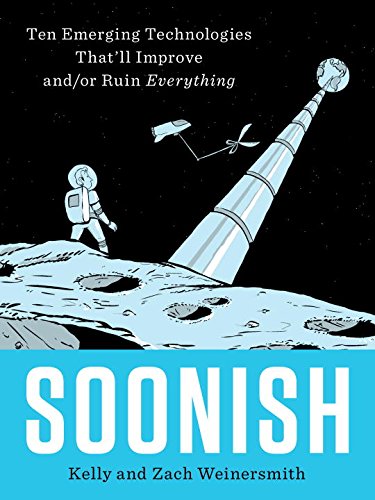
You can click the image to go to the Amazon.ca pre-order page. More information on the book here.
March 6, 2017
QotD: Organic food “standards”
In December 1997 when USDA proposed standards for organic agricultural production, the original version was rejected by the organic enthusiasts, largely because it would have permitted the use of organisms modified with modern genetic engineering techniques (“GMOs”) – which would have been quite sensible in the view of the scientific community. In the end, modern genetic engineering, which employs highly precise and predictable techniques, was prohibited, while genetic modification with older, far less precise, less predictable and less effective techniques were waived through.
The resulting organic “standards,” which are based on a kind of “nature good, technology evil” ethic, arbitrarily define which pesticides are acceptable, but allow “deviations” if based on “need.” Synthetic chemical pesticides are generally prohibited, although there is a lengthy list of exceptions listed in the Organic Foods Production Act – while most “natural” ones are permitted. Thus, advocates of organic agriculture might be described as “pragmatic fanatics.” (Along those lines, the application as fertilizer of pathogen-laden animal manures, as compost, to the foods we eat is not only allowed, but in organic dogma, is virtually sacred.)
What, then, is the purpose of organic standards? “Let me be clear about one thing,” Secretary of Agriculture Dan Glickman said when organic certification was being considered, “the organic label is a marketing tool. It is not a statement about food safety. Nor is ‘organic’ a value judgment about nutrition or quality.”
Organic standards are wholly arbitrary, owing more to the dogma of an atavistic religious cult than to science or common sense. And whatever their merit, as a December 2014 report in the Wall Street Journal described, the standards are not being enforced very effectively: An investigation by the newspaper of USDA inspection records since 2005 found that 38 of the 81 certifying agents – entities accredited by USDA to inspect and certify organic farms and suppliers — “failed on at least one occasion to uphold basic Agriculture Department standards.” More specifically, “40% of these 81 certifiers have been flagged by the USDA for conducting incomplete inspections; 16% of certifiers failed to cite organic farms’ potential use of banned pesticides and antibiotics; and 5% failed to prevent potential commingling of organic and nonorganic products.”
[…]
The bottom line is that buying “certified organic” products doesn’t guarantee that they will be free of genetically engineered ingredients. Even so, buying organic should please those consumers who think that paying a big premium for something means that it’s sure to be better. We hope that at least they get the benefit of the “placebo effect.”
Henry I. Miller and Drew L. Kershen, “Fanaticism, Pragmatism and Organic Agriculture”, Forbes, 2015-07-08.
March 3, 2017
“Apollo 8 altered the self-perception of our species forever”
Colby Cosh contrasts the insane bravado of John F. Kennedy’s moonshot announcement with the more recent insane bravado of Elon Musk and SpaceX:
SpaceX, the private rocketry company founded in 2002 by billionaire adventurer Elon Musk, says it is developing plans to fly two unnamed persons to the moon late in 2018. This announcement has created both skepticism and alarm. This is, I think, partly a matter of confusion about prepositions.
If I announced that, despite being Canada’s most sedentary citizen, I was going to Mount Everest next week, you would probably know better than to assume I was going UP the mountain. SpaceX’s proposal is to send a manned spacecraft beyond the moon. That’s the word they use in the SpaceX press release, and whoever chose it should get a big fat bonus. “Beyond” is an English word of unparalleled connotative power and romance.
But, of course, going beyond the moon — more prosaically, looping around it and coming back — is much, much simpler than landing ON it. It is probably not a fantastically difficult challenge, and the company’s zany-sounding timeline may be justified. (Mind you, this is not a prediction.)
Even if you are old enough to have followed the golden age of spaceflight as it happened, you may not understand or remember the half-insane ambition of John F. Kennedy’s original proposal to land men on the moon. For young and old, the moment that the Apollo 11 lunar module landed on the Sea of Tranquility tends to obscure everything else about the tale in retrospect. But no U.S. astronaut had orbited the Earth yet when JFK threw down the gauntlet. No spaceship had photographed, much less touched, the moon.
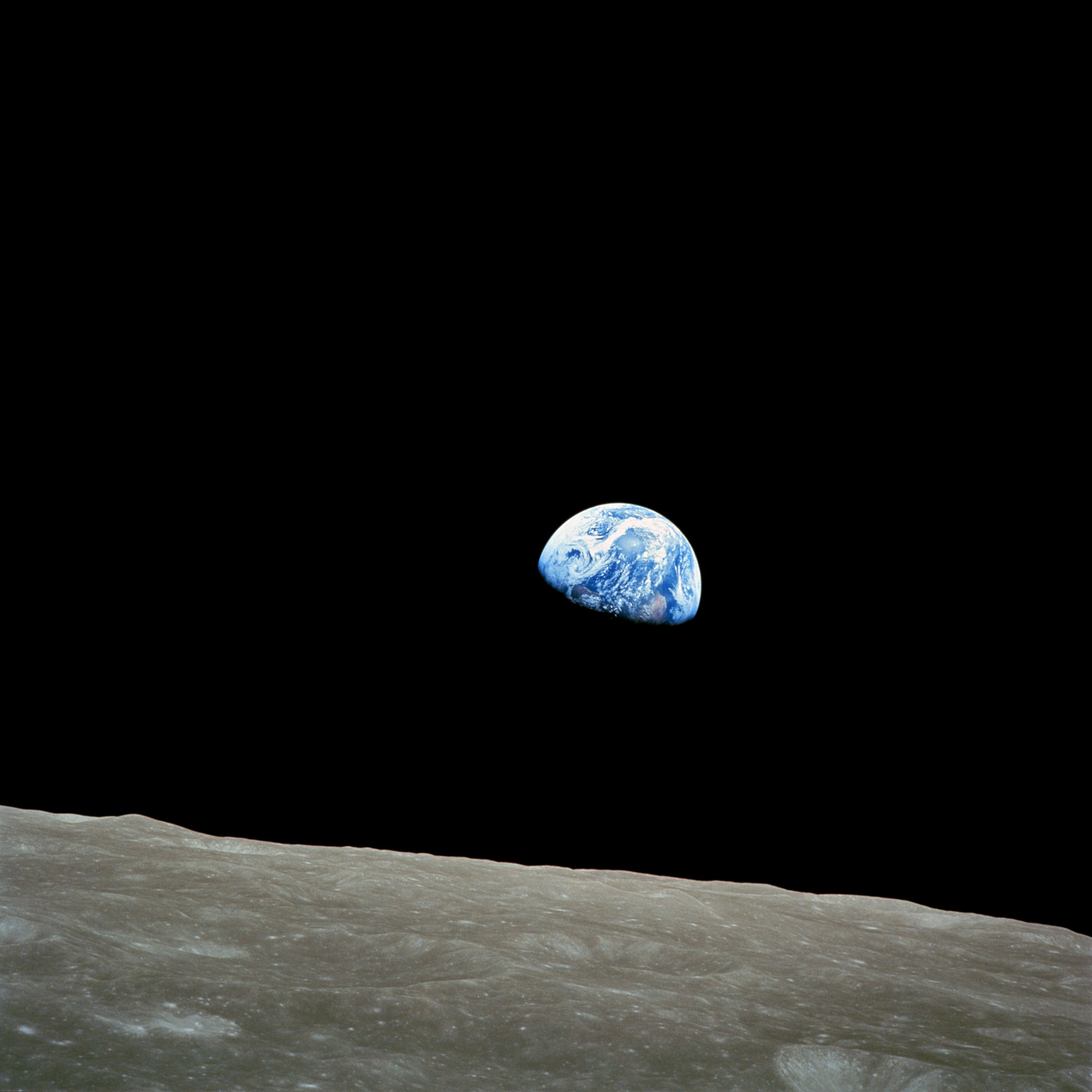
Taken by Apollo 8 crew member Bill Anders on December 24, 1968, at mission time 075:49:07 (16:40 UTC), while in orbit around the Moon, showing the Earth rising for the third time above the lunar horizon. The lunar horizon is approximately 780 kilometers from the spacecraft. Width of the photographed area at the lunar horizon is about 175 kilometers. The land mass visible just above the terminator line is west Africa. Note that this phenomenon is only visible to an observer in motion relative to the lunar surface. Because of the Moon’s synchronous rotation relative to the Earth (i.e., the same side of the Moon is always facing Earth), the Earth appears to be stationary (measured in anything less than a geological timescale) in the lunar “sky”. In order to observe the effect of Earth rising or setting over the Moon’s horizon, an observer must travel towards or away from the point on the lunar surface where the Earth is most directly overhead (centred in the sky). Otherwise, the Earth’s apparent motion/visible change will be limited to: 1. Growing larger/smaller as the orbital distance between the two bodies changes. 2. Slight apparent movement of the Earth due to the eccenticity of the Moon’s orbit, the effect being called libration. 3. Rotation of the Earth (the Moon’s rotation is synchronous relative to the Earth, the Earth’s rotation is not synchronous relative to the Moon). 4. Atmospheric & surface changes on Earth (i.e.: weather patterns, changing seasons, etc.).
NASA photo via Wikimedia.


