Quotulatiousness

May 26, 2012

Does being an organic foodie increase your chances of being a total jerk?

Filed under: Environment, Food, Health, USA — Tags: , , , — Nicholas @ 10:23

Baylen Linnekin at Reason on the organic foodies and the rise of anti-social snobbery among them:

Eskine knows a thing or two about the links between thought, self, other, and eating. His body of research focuses on “how our everyday embodied experiences shape our cognitive architecture.”

His latest paper, “Wholesome Foods and Wholesome Morals? Organic Foods Reduce Prosocial Behavior and Harshen Moral Judgments,” looks at whether people exposed to organic food marketing are so self-satisfied that they are less likely to express empathy toward others.

Extrapolating from existing research on “moral licensing” that found a negative relationship between altruism and salient moral identity, Eskine theorized his research would reveal “that those exposed to organic foods would help less and make harsher moral judgments compared to those exposed to non-organic foods.”

Indeed Eskine’s latest research, published last week in the journal Social Psychological and Personality Science, pegs organic consumers as anti-social jerks. Or at least those are the sort of stark terms that the press has used to frame Eskine’s research.

And while at least some segment of organic consumers has been painted as pretentious and elitist since even before Dave Barry was cracking timely Windows 98 jokes, Eskine says that lumping his research in with such anti-organic digs misses his point.

“I’m not arguing that organic food itself is making people harsh judgers or non-altrustic,” he tells me by email. “What the data suggest is that mere exposure to organic labeling can be enough to lead people to affirm their moral identities, which in much past research can lead people to act unethically later.

May 19, 2012

The politics of the school lunch

Filed under: Bureaucracy, Education, Food, Government, Health, USA — Tags: , , , — Nicholas @ 10:41

Baylen Linnekin examines the school lunch issue, and finds yet another example of experts and government officials trying to override parental input and childrens’ own wishes “for the children”, of course:

School food is always a hot topic, and is perhaps more so now than it’s ever been. From a publicity standpoint, school food has taken off as an issue largely due to the efforts of [British chef and food nuisance Jamie] Oliver and First Lady Michelle Obama. But viewed from the standpoint of edibility, cost, and healthiness, food served by public schools via the USDA’s National School Lunch Program was already an issue because that program and its food have a decades-long track record of sucking. And in spite of the best efforts of Oliver and Mrs. Obama, along with new rules set to take effect in the coming months, I’m not optimistic that the quality of school food is likely to change anytime soon. Why?

If you’re one of those who thought all this talk about the National School Lunch Program had translated into better food, think again. Contrary to any visions you may have of expensive reforms leading to school kitchens serving as virtual clearinghouses for fresh fruits and vegetables, that just isn’t the case. Expensive reforms? You bet. They crop up every few years. But schools are still serving kids nachos. And sometimes — as happened last week at a public school in Ohio — those nachos are full of ants.

Issues like ants in food are hardly rare. And other systemic problems persist.

I remember what kind of crap my middle and high school cafeterias offered … and if I’d forgotten to bring a sandwich with me that day, going hungry always seemed like the better choice. The food on offer always seemed to manage the difficult stunt of being visually unappealing (sometimes being actually disgusting to look at), nutritionally inadequate, and either utterly flavourless (the better choice) or actively nasty. No wonder the best sellers in the cafeteria were the milk cartons (especially the chocolate milk), pop cans, potato chips, chocolate bars, and Vachon cakes (all of which were pre-packaged and relatively invulnerable to further processing).

As a 12-year-old army cadet, my first experience of army cooking was a huge shock: it was actually good! I didn’t know that cafeteria-style cooking didn’t have to be bland, boring, or nauseating. Schools couldn’t seem to manage the trick, but the army could.

School lunches also neuter the ability of families to make dietary choices their children. Consider the pink slime controversy earlier this year. Whether you were up in arms over chemically treated meat or thought it was completely fine to eat, the truth is if you’re a public school parent whose child eats a school lunch you still have little say over whether or not your child eats pink slime — or genetically-modified foods, sugars, starches, and a whole host of other foods about which decent parents (and experts) disagree.

Another good example of how school lunches usurp family decision-making took place in Chicago last year, where a seventh grader named Fernando Dominguez helped lead a revolt against his school’s six-year-old policy that banned students from taking their own lunch to school. According to the Chicago Tribune, the principal argued that the policy was put in place “to protect students from their own unhealthful food choices.”

[. . .]

These anecdotes help illustrate the point that food served in public school cafeterias has — along with prison food — long been one of the best arguments against the singular notion that big, mean corporations are responsible for all of the food problems we face in America. After all, public-school lunches are government creations. They’re subsidized by government, provided by government, served by government, and paid for by government. And they’re often gross, unhealthy, and wasteful.

But supporters of the National School Lunch Program, not surprisingly, argue that what’s needed are reforms, improvements, rejiggering, and — of course — more money.

May 17, 2012

Official response to UN’s Special Rapporteur on the right to food

Filed under: Cancon, Food, Government, Health, Politics — Tags: , , , , — Nicholas @ 00:09

As you’ll know if you’ve been visiting the blog for a while, I’m not a cheerleader for the federal government and I often disagree with their policies and statements. However, I can’t find much to disagree with in this:

May 16, 2012 (OTTAWA, ON) — The Honourable Leona Aglukkaq, Minister of Health, and Minister of the Canadian Northern Economic Development Agency, today issued the following statement:

Today I met with Olivier De Schutter, the UN’s Special Rapporteur on the right to food.

As an aboriginal person from the North, I was insulted that Mr. Schutter chose to “study” us, but chose not to “visit” us.

In fact, Mr. De Schutter confirmed to me that he did not visit a single Arctic community in Canada during nearly two weeks of travel within Canada.

I asked him what stance he would take in his report on uninformed, international attacks on the seal and polar bear hunt that make it harder for aboriginal hunters to earn a livelihood. I told him that I would be reviewing his final report closely, to see if he makes any recommendations to activist groups to stop interfering in the hunting and gathering of traditional foods.

I was concerned that he had not been fully informed of the problems with the discontinued Food Mail program that subsidized the shipping of tires and skidoo parts, as opposed to Nutrition North, which improves access to nutritious and perishable foods.

He made several suggestions that would require the federal government to interfere in the jurisdiction of other levels of government. It was clear that he had little understanding of Canada’s division of powers between the federal, provincial and municipal levels of government despite his extensive briefings with technical officials from the Government of Canada.

Our government is surprised that this organization is focused on what appears to be a political agenda rather than on addressing food shortages in the developing world. By the United Nations’ own measure, Canada ranks sixth best of all the world’s countries on their human development index. Canadians donate significant funding to address poverty and hunger around the world, and we find it unacceptable that these resources are not being used to address food shortages in the countries that need the most help.

-30-

May 16, 2012

Nanny knows best, part MCMLXII

Filed under: Books, Britain, Food, Health, Politics — Tags: , , — Nicholas @ 08:46

Chris Snowdon at the Adam Smith Institute blog:

When we scheduled the release of The Wages of Sin Taxes for 15th May, we did not guess that it would be sandwiched between the announcement of a 50p minimum price for alcohol in Scotland (Monday) and a new campaign for sin taxes on food and soft drinks (today). Writing in the British Medical Journal, two academics have just called for price hikes on sugar-sweetened beverages and ‘junk food’ as a way of dealing with Britain’s alleged obesity epidemic.

Obesity rates, like drinking rates, have not actually risen for ten years, but the same decade saw the medical profession gain an uncanny grip on the nation’s political process and they are in no mood to relinquish it. Taking a break from hassling smokers and drinkers, the mandarins of public health have taken the ‘next logical step’ and moved on to the general population.

“Economists generally agree,” they write, “that government intervention, including taxation, is justified when the market fails to provide the optimum amount of a good for society’s wellbeing.” Even if this dubious statement were true, there has never been a time when the market offered more choice in what we eat than drink than today. And, contrary to popular belief, it is much cheaper for a family to subsist on fresh fruit and vegetables than it is to eat out at McDonalds three times a day. For the spokespeople of public health, the problem is not that there is a lack of options, but that we plebs are not choosing the right ones.

Defining junk food is notoriously difficult. As Rob Lyons explains in his excellent book Panic on a Plate, a portion of McDonalds fries contains a quarter of an adult’s recommended intake of Vitamin C, while middle class favourites like olive oil, parmesan and pasta are rather fattening. A tax on “sugar sweetened beverages” will presumably leave apple juice and smoothies untouched, despite the fact that fruit juices are often sweeter and more calorific than Coca-Cola.

May 13, 2012

Eating experience mediated by the metal in your cutlery

Filed under: Food, Science — Tags: — Nicholas @ 10:41

An interesting post at Edible Geography on a recent taste-test:

Previous studies have suggested that some metals in solution actually produce a “metallic” taste — a distinct sensation to add to the standard sweet, sour, bitter, salty, and umami descriptors. This is still a controversial idea in the world of sensory science, where umami took nearly a century to gain official recognition, although among water engineers iron and copper are known to affect the taste and consumer acceptability of drinking water.

In any case, Laughlin, Miodownik, et al. wanted to test the taste of solid metals. They speculated that metals such as copper and zinc that were less stable, and thus more likely to acquire electrons, would taste more metallic because their atoms would form a solution in human saliva more readily. Their blindfolded spoon-eaters (with each lick of a spoon, as Miodownik explained to Dunlop, we are not just tasting metal, but actually “consuming ‘perhaps a hundred billion atoms’”) confirmed the scientists’ suspicions, rating the less chemically active gold and chrome spoons as the most pleasant and sweet tasting, and the more reactive copper and zinc as bitter, strong, and metallic tasting.

[. . .]

Using four samples of Tesco extra thick double cream with sugar, lemon juice (sour), lemon pith (bitter), and salt added, four teaspoons of identical weight, electroplated in stainless steel, copper, zinc, and gold, and thirty human guinea-pigs, Laughlin, Miodownik, Charles Spence, and Betina Piqueras-Fiszman concluded that “cutlery coated with different materials really does taste different,” and, what’s more, that these differences are significant enough to “influence the perception of taste and pleasantness of food consumed from them.”

The more metallic tasting copper and zinc spoons enhanced or added bitter qualities to each of the creams, as expected, but — to the scientists’ surprise — they also boosted its dominant taste. In other words, the sweet cream was perceived as being slightly sweeter when eaten from a copper or zinc spoon than a gold or stainless steel spoon, while the salty cream tasted saltier.

May 6, 2012

The UN keeps its priorities clear

Filed under: Bureaucracy, Cancon, Food, Politics — Tags: , , , — Nicholas @ 08:59

As if we needed any reminder that the UN is a political entity, this story by Hillel Neuer should provide a useful refresher:

According to the World Food Program, half a million people don’t have enough to eat in Syria. Fears are growing that the regime is using hunger as a weapon.

This is the kind of emergency which should attract the attention of the UN Human Rights Council’s hunger monitor, who has the ability to spotlight situations and place them on the world agenda. Yet Olivier de Schutter of Belgium, the “Special Rapporteur on the right to food,” is not going to Syria.

Instead, the UN’s food monitor is coming to investigate Canada.

That’s right. Despite dire food emergencies around the globe, De Schutter will be devoting the scarce time and resources of the international community on an 11-day tour of Canada — a country that ranks at the bottom of global hunger concerns.

A key co-ordinator and promoter of De Schutter’s mission is Food Secure Canada, a lobby group whose website accuses the Harper government of “failing Canadians…and [failing to] fulfill the right to food for all.” The group calls instead for a “People’s Food Policy.”

[. . .]

Before Canadians can take De Schutter seriously, they ought to ask him some serious questions about whether his mission is about human rights or a political agenda.

First, consider the origins of the UN’s “right to food” mandate. In voluminous background information provided by De Schutter and his local promoters, there’s no mention that their sponsor was Cuba, a country where some women resort to prostitution for food. De Schutter does not want you to know that Havana’s Communist government created his post, nor that the co-sponsors included China, North Korea, Iran and Zimbabwe.

These and other repressive regimes are seeking a political weapon to attack the West. That is why the first person they chose to fill the post, when it started in 2000, was Jean Ziegler. The former Swiss Socialist politician was a man they could trust: In 1989, he announced to the world the creation of the Muammar Gaddafi Human Rights Prize.

H/T to Nicholas Packwood (Ghost of a Flea).

April 26, 2012

Organic farming: larger “footprint” to produce compared to non-organic

Filed under: Economics, Environment, Food, Science — Tags: — Nicholas @ 10:57

Summary of a recent study published in Nature, which found that organic farming has a lower production per acre than non-organic methods:

Organic farming may yield up to a third less of some crop types, according to a study proposing a hybrid with conventional agriculture as the best way to feed the world without destroying it.

Organic farming seeks to limit the use of chemical pesticides and fertilizers, but critics suggest lower crop yields require bigger swaths of land for the same output as conventional farms.

This would conceivably require parts of forests and other natural areas being turned into farmland, undoing some of the environmental gains of organic tilling methods, they say.

The new study by Canadian and American researchers, published in Nature Wednesday, reviewed 66 studies comparing the yields of 34 different crop species in organic and conventional farming systems. The review limited itself to studies assessing the total land area used, allowing researchers to compare crop yields per unit area. Many previous studies have shown large yields for organic farming but ignored the size of the area planted — which is often bigger than in conventional farming.

This means, as most people probably suspected, that true “organic” farming methods are likely to be a boutique for well-off western consumers rather than a solution to malnutrition and poverty in developing nations.

April 19, 2012

The Limits to Growth scorecard, 40 years on

Filed under: Books, Economics, Environment, Food, History, Media — Tags: , , , — Nicholas @ 08:00

Ronald Bailey tots up the hits and misses from that 1972 dystopia manual, The Limits to Growth:

Industrial development: World GDP stood in real 2010 dollars at about $19 trillion in 1972 and has tripled to $57 trillion today. Average per capita incomes rose in real dollars from $5,000 to $8,100 today. Just to explore how incomes might evolve between 1972 and 2000, the researchers simply extrapolated the current growth, investment, and population growth rates to calculate GDP per capita for 10 large countries. They stressed these were not “predictions” but added that if one disagreed then one was obligated to specify which factors changed, when and why. A comparison of their extrapolations with actual GDP per capita (in 2010 dollars) finds U.S. GDP per capita $56,000 versus actual $44,000; Japan’s per capita GDP was projected to be $120,000 versus actual $46,000; the now defunct USSR would be $33,000 versus Russia’s $2,200; and China’s per capita income was supposed to grow to $500, but was instead $1,200.

Population: The Limits researchers noted, “Unless there is a sharp rise in mortality, which mankind will strive mightily to avoid, we can look forward to a world population of around 7 billion persons in 30 more years.” In addition, they suggested that in 60 years there would be “four people in the world for everyone living today.” In fact, average global life expectancy rose from 60 to nearly 70 years. On the other hand, the global fertility rate (the average number of children a woman has during her lifetime) fell from about 6 per woman in 1970 to 2.8 today and continues to fall.

[. . .]

Food supplies: According to the data from the Food and Agriculture Organization, global food production has more than tripled since 1961, while world population has increased from 3 billion to 7 billion. This means that per capita food has increased by more than a third. The latest figures from the United Nations show that as world population increased by a bit over 10 percent between 2000 and 2009, global food production rose by 21 percent.

[. . .]

Nonrenewable resources: Probably the most notorious projections from the MIT computer model involved the future of nonrenewable resources. The researchers warned: “Given present resource consumption rates and the projected increase in these rates, the great majority of currently nonrenewable resources will be extremely expensive 100 years from now.” To emphasize the point they pointed out that “those resources with the shortest static reserve indices have already begun to increase.” For example, they noted that the price of mercury had increased 500 percent in the last 20 years and the price of lead was up 300 percent over the past 30 years. The advent of the “oil crises” of the 1970s lent some credibility to these projections.

To highlight how dire the situation with nonrenewable resources was, the MIT researchers calculated how quickly exponential consumption could deplete known reserves of various minerals and fossil fuels. Even if global consumption rates didn’t increase at all, the MIT modelers calculated 40 years ago that known world copper reserves would be entirely depleted in 36 years, lead in 26 years, mercury in 13 years, natural gas in 38 years, petroleum in 31 years, silver in 16 years, tin in 17 years, tungsten in 40 years, and zinc in 23 years. In other words, most of these nonrenewable resources would be entirely used up before the end of the 20th century.

[. . .]

Environment: In most of the Limits model runs, the ultimate factor that does humanity in is pollution. In their model pollution directly increases human death rates and also dramatically reduces food production. In fact, as the world economy has grown, global average life expectancy has increased from 52 years in 1960 to 70 years now. It must be acknowledged that globally, pollution from industrial and agricultural production continues to rise. But the model assumed that pollution would increase at exponential rates. However, many pollution trends have not increased exponentially in advanced countries.

Consider that since 1970, the U.S. economy has grown by 200 percent, yet the levels of air pollutants regulated by the federal government have fallen by nearly 60 percent. For example, in both the U.S. and the European Union sulfur dioxide emissions have dropped by nearly 70 percent since 1990. Recent data suggests that sulfur dioxide emissions even from rapidly industrializing China peaked in 2006 and have begun declining. Earlier studies cite evidence for a pollution turning point income threshold (purchasing power parity) of around $10,000 for demands to reduce this form of air pollution.

April 5, 2012

Some practical travel tips from LegalNomad

Filed under: Food, Randomness — Tags: — Nicholas @ 08:45

She’s been travelling the world for the last four years, so she has some potentially very useful tips for you (not so much for you expense-account business travellers, but for backpackers and hikers):

2. Be a travel parasite.

No, this does not mean mooching off friends or family. What it means is learning how to use guidebooks to your advantage. While they are useful to have for the history of a place or the basics in itinerary planning, I rarely look to guidebooks for the name of a hostel or restaurant. Instead, I look at their recommendations as things to piggyback on. Lonely Planet recommends a place as “Our Pick”? Great, I go there, and walk two doors down to stay nearby. Rough Guides says “this is the best restaurant in town”? Perfect! Almost every one of those recommendations will spawn another restaurant within walking distance. Industrious entrepreneurs quickly learn that when these books recommend a place, they quickly get overcrowded and prices go up. The solution: they open a place right next door or nearby to handle the spillover. Without fail, those are the places that are cheaper, more delicious and not jaded. Being a parasite isn’t always a bad thing. (Having parasites? Not so much.)

[. . .]

6. Your taxi driver knows where to eat breakfast more than you do.

Swap this out for tuk-tuk driver, songthaew driver or rickshaw driver, where appropriate. When I go to a new place, I find the eldest cab driver possible and ask him where he ate breakfast. Once he gets over his shock that this is what I want to know, he tends to break into a huge grin and start talking about food. Eventually, he takes me there. And the food is almost always delicious, fresh and somewhere I’d have never found without his help. Taxi drivers: more than just getting from A to B.

[. . .]

15. Packing does not get easier.

I wrote a piece on long term travel and the things it doesn’t fix. In it, I talked about how, 2.5 years into my travels, I still hated packing. It’s now 4 years into my travels. Guess what? I still hate packing.

H/T to Tyler Cowen for the link.

March 20, 2012

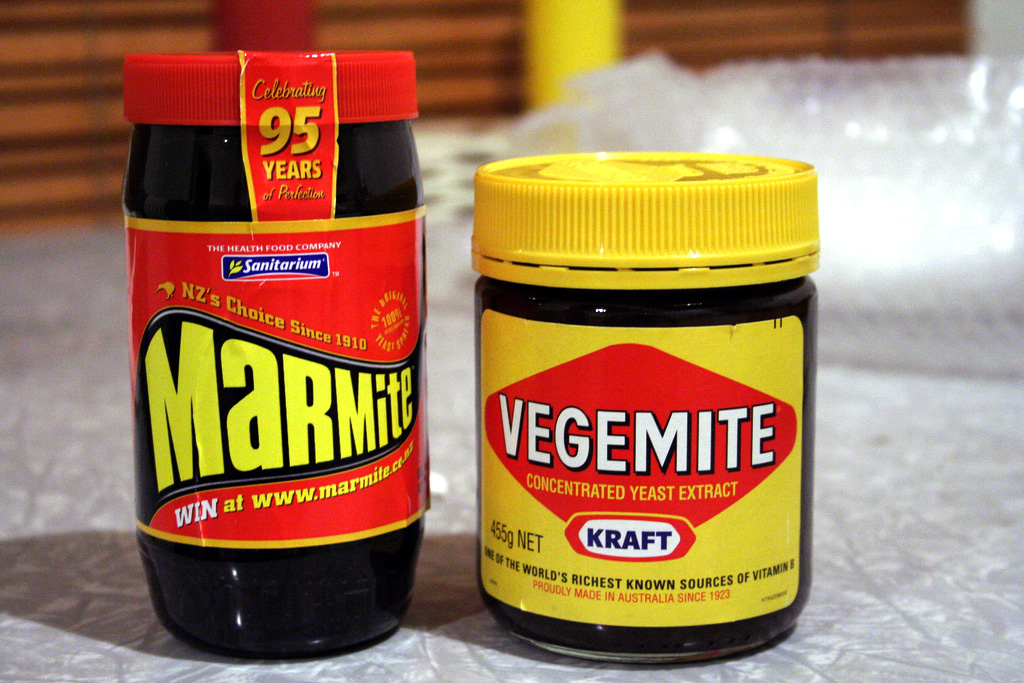
New Zealand facing “Marmageddon”

Filed under: Australia, Food, Health, Pacific, Randomness — Tags: , , — Nicholas @ 09:18

Oh, the Marmanity!

An announcement by New Zealand’s leading manufacturer of the black sandwich spread, Marmite, has sparked “marmageddon” fears among Kiwis.

Food company Sanitarium said on its website that supplies “are starting to run out nationwide” after “our Christchurch factory was closed due to earthquake damage”.

Even Prime Minister John Key said he is rationing his personal supply.

[. . .]

“Supplies are starting to run out nationwide, and across the ditch in Australia. We know that we will be off shelf for sometime but we are doing everything we can to minimise how long,” the company said.

“Don’t freak. We will be back soon!”

Of course, the announcement set off a buying-and-hoarding frenzy, making the situation all the more dire. But not to worry: supply and demand has already set in — prices are rising to help even out the distribution of the remaining stocks.

March 14, 2012

The red meat of medical churnalism

Filed under: Food, Health, Media, Science — Tags: , , — Nicholas @ 11:38

Rob Lyons on the latest red meat scare from the medical press, who “churn out scary-sounding studies about steak and bacon faster than McDonald’s produces Big Macs”.

It’s official, it seems: red meat — particularly processed red meat — will be the death of you. ‘Small quantities of processed meat such as bacon, sausages or salami can increase the likelihood of dying early by a fifth, researchers from Harvard School of Medicine found. Eating steak increases the risk of early death by 12 per cent’, declared the Daily Telegraph yesterday. BBC1 Breakfast’s resident GP, Dr Rosemary Leonard, told millions of viewers the link was ‘very, very clear’.

[. . .]

The topline results were that, after adjustment for major lifestyle and dietary risk factors, there was a 13 per cent increase in the risk of death for each portion of red meat eaten per day and a 20 per cent increase in mortality for each portion of processed meat consumed per day. This is not the first study to suggest that eating meat is bad for you. But that might simply mean that this study shares many of the same problems that all the other studies have had.

However, before we get to the problems, here’s some brighter news. At the end of the study, the members of the two groups studied had, on average, reached the grand old age of 75. How many had died along the way? Less than 20 per cent. Those who started the study were four times more likely than not to reach 75. So, whatever your eating habits when it comes to eating red meat or processed meat, the most important lesson is that most people live a long time these days. ‘Early death’ is very much a relative concept.

The authors claim that 9.3 per cent of deaths in men and 7.6 per cent of deaths in women could be avoided by eating little or no red meat. To put that into some back-of-an-envelope statistical perspective: multiplying that 9.3 per cent by the 20 per cent who actually died shows that about 1.8 per cent of red-meat eaters would die by the time they were 75 because of their meat-eating habit. Even if that claim were absolutely accurate (and even the authors call it an estimate), would you really give up your favourite foods for decades on the slim possibility of an extra year or two of old age?

January 26, 2012

The Crazy Years: today’s exhibit – the junction between bad parenting and bad nutrition

Filed under: Britain, Food, Health, Randomness — Tags: , , , — Nicholas @ 11:21

May we present Stacey Irvine, 17, the new poster girl for neglectful parenting and test case for even more Nanny State intervention:

A teenage girl who has eaten almost nothing else apart from chicken nuggets for 15 years has been warned by doctors that the junk food is killing her.

Stacey Irvine, 17, has been hooked on the treats since her mother bought her some at a McDonald’s restaurant when she was two.

[. . .]

Miss Irvine, who has never eaten fruit or vegetables, had swollen veins in her tongue and was found to have anaemia.

[. . .]

Her exasperated mother Evonne Irvine, 39, who is battling to get her daughter seen by a specialist, told the newspaper: ‘It breaks my heart to see her eating those damned nuggets.

‘She’s been told in no uncertain terms that she’ll die if she carries on like this. But she says she can’t eat anything else.’

She once tried starving her daughter in a bid to get her to eat more nutritious food – but did not have any success.

Miss Irvine, whose only other variation in her diet is the occasional slice of toast for breakfast and crisps, said that once she tried nuggets she ‘loved them so much they were all I would eat’.

Of course, this is reported in the Daily Mail, so the story’s relationship with reality may be a bit looser than one might hope.

January 24, 2012

The Crazy Years: today’s exhibit, the $100 hot dog infused with 100-year-old cognac

Filed under: Cancon, Food, Randomness — Tags: , , , , — Nicholas @ 11:55

There are undoubtedly culinary discoveries yet to be made, some of which may well be amazingly tasty. Pulling together unlikely combinations is certainly one way to discover new and interesting flavours. This one, however, strikes me as being just a little bit crazy:

dougieDog Hot Dogs, a popular Vancouver eatery renowned for its creative all-natural hot dogs, has just added the Dragon Dog to its menu — with a price tag of $100. The hot dog features a foot-long bratwurst infused with hundred-year-old Louis XIII cognac, which costs over $2000 a bottle. Also on the dog, Kobe beef seared in olive and truffle oil and fresh lobster. A picante sauce (ingredients undisclosed) ties the flavors together for 12 inches of absolute culinary decadence.

“In designing this hot dog I wanted to come up with something super tasty and high-end that stays true to the traditional identity of the hot dog — a hot dog that any hot dog lover would enjoy,” explained dougieDOG proprietor and Chief Hot Dog Designer dougie luv.

I’m surprised the owner’s name isn’t C.M.O.T. Dibbler

December 19, 2011

Kelly McParland: “Norwegians are the most revoltingly perfect people in the world”

Filed under: Bureaucracy, Economics, Europe, Food — Tags: , , , , — Nicholas @ 14:24

Don’t worry, my Norwegian friends, it’s just small-minded Canadian jealousy that you tend to beat us in all the “Smug Country” polls and your national monopoly is even more constricting and incompetent than our equivalent national monopoly:

Everyone knows the Norwegians are the most revoltingly perfect people in the world.

They consistently top all lists of Things Good Countries Do.

They give more to foreign aid than just about any other country in the world. Countries are supposed to give 70¢ for every $100 of national production, but hardly any do. Norway gives about 40% more than the benchmark. They’re sitting on hundreds of billions of dollars in oil profits, and instead of blowing it on short-term expediencies (like a certain western province we could mention) they squirrel a lot of it away in an investment fund to help maintain their high standard of living when the oil runs out. And believe me, their standard of living is high: a cradle-to-grave nannyism that revolts conservatives but seems to work for Norwegians. (In Norway, life is so soft that even cows are required to have rubber mats in their stalls so they can rest comfortably between shifts).

They’re so perfect they’re annoying. Even Swedes get tired of hearing about them. So it’s kind of fun to read about how they’ve completely buggered up their supply management system, so that the entire country has been stripped of its butter supply just as Christmas arrives and everyone gears up to make lots of stuff for which butter is required. And if it reminds you of Canada’s own supply management system (think: dairy products and Quebec), all the better.

Chiquita, supporter of narco-terrorist groups, calls for a boycott of Canadian oil

Filed under: Americas, Cancon, Economics, Food, History — Tags: , , , , , , — Nicholas @ 11:39

When corporate social media goes wrong:

I used to work for an ad agency, and I often had animated discussions with my colleagues about the danger of confusing cause marketing with product marketing. I have always maintained that they are separate disciplines that don’t mix, while many of my colleagues disagreed.

As a society, we have become distressingly pious and self-righteous — and as a natural consequence advertisers wish to capitalize on this instinct. Like my erstwhile colleagues, they see this as an easy path to identifying their product with a strong public sentiment. This is such a bad idea that it merits a blog entry of its own, but what lead me to write today was a satisfyingly spectacular self-immolation by a large American brand that managed to make the wrong choice in just about every decision their communications and marketing teams have made over the past few days.

[. . .]

Worse, Chiquita Brands seemed to forget completely about their Canadian market. It’s easy to underestimate Canada. It’s a little country with a tenth the population of the United States. On the other hand, it’s a terrific export market, and much too accessible and rich to be ignored.

Canadians are understandably touchy about the Oil Sands. The majority of Canadians are very proud of the fact that they’ve transformed the country into an energy superpower by successfully accessing a resource that was considered nearly worthless only a decade ago – and they have done this with unprecedented care, investing billions of dollars in developing new technologies to protect the environment. Canadians are also very proud of the fact that they are the only net exporter of oil that is a liberal democracy and respects human rights. They’ve even coined the phrase “ethical oil” to describe their unique approach to oil production.

What Chiquita Brands succeeded in doing with their announcement was to make millions of Canadian consumers very unhappy. People who couldn’t have told you on Monday morning what brand of bananas they bought were determined by Thursday afternoon that it wouldn’t be Chiquita. Worse yet, hundreds of consumers decided to make their feelings known by commenting on the Chiquita Bananas Facebook page. And this is where Chiquita’s marketing and communications team took one bad decision and turned it into a disaster

H/T to Five Feet of Fury for the links.

« Newer PostsOlder Posts »

Powered by WordPress