
Extra Credits
Published on 28 Nov 2017Paradise Lost told the story of Satan, a creation who rejected his creator just like Frankenstein’s monster did. But even Satan had a loving creator, beauty, and friends. The monster had nothing, and his life in Mary Shelley’s eyes was not a horror story, but a tragedy.
November 29, 2017
Frankenstein: Paradise Lost – Extra Sci Fi – #5
Comments Off on Frankenstein: Paradise Lost – Extra Sci Fi – #5
November 25, 2017
Paul Kidby’s Discworld Imaginarium
Jessica Brisbane linked to this Guardian overview of a new book by Paul Kidby, collecting his art to accompany Terry Pratchett’s Discworld series:
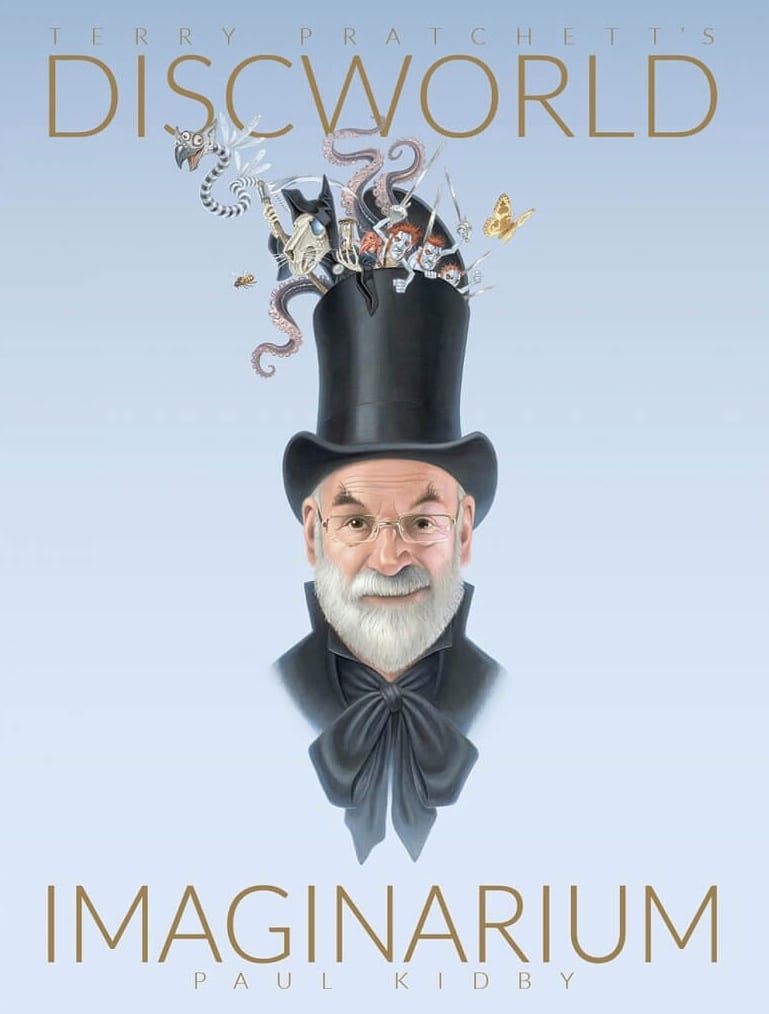
Terry Pratchett’s ‘artist of choice’ Paul Kidby introduces some of the images he produced during their decades-long collaboration
Comments Off on Paul Kidby’s Discworld Imaginarium
QotD: Reading
Reading is inherently ephemeral, but it feels less so when you’re making your way through a physical book, which persists when you’ve finished it. It is a monument to the activity of reading. It makes this imaginary activity entirely substantial. But the quiddity of e-reading is that it effaces itself. […] There is a disproportionate magic in the way black marks on white paper — or their pixilated facsimiles — stir us into reverie and revise our consciousness. Still, we require proof that it has happened. And that proof is what the books on my shelves continue to offer.
Verlyn Klinkenborg, “Books to Have and to Hold”, New York Times, 2013-08-10.
Comments Off on QotD: Reading
November 23, 2017
Frankenstein: Plutarch’s Lives – Extra Sci Fi – #4
Extra Credits
Published on 21 Nov 2017Mary Shelley drew heavily from the style of biography first pioneered by Plutarch, creating characters like Victor Frankenstein and the monster whose lives parallel each other, but whose differing circumstances lead them to embody very different values.
Comments Off on Frankenstein: Plutarch’s Lives – Extra Sci Fi – #4
November 16, 2017
Frankenstein: The Sorrows of Young Werther – Extra Sci Fi – #3
Extra Credits
Published on 14 Nov 2017Frankenstein’s monster discovered three books that shaped his understanding of the world, including the Sorrows of Young Werther. Werther’s unrequited love for a woman eventually leads him to commit suicide. Frankenstein’s monster wants to experience love as well, but Mary Shelley has her own critique of this idea of love.
Comments Off on Frankenstein: The Sorrows of Young Werther – Extra Sci Fi – #3
November 14, 2017
QotD: Depressive writing leads to depressed readers
Agatha Christie gave her characters foibles, sure, and often there was a tight intrigue and not just the murderer but two or three other people would be no good. BUT the propensity of the characters gave you the impression of being good sort of people. Perhaps muddled, confused, or driven by circumstances to the less than honorable, but in general driven by principles of honor or love (even sometimes the murderer) and wanting to do the right thing for those they cared about.
You emerge from a Christie memory with the idea, sure, that of course there was unpleasantness, but most of the people are not horrors.
How did we get from there to now, where the characters aren’t even evil? They’re just dingy and grey and tainted, all of them equally. The victim, the detectives, the witnesses, will be vile and contorted, grotesque shapes walking in the world of men.
If this is a reflection of the psyches of most authors, I suddenly understand a lot about the self-hatred of western intellectuals.
But I wonder if it’s a fashion absorbed and perpetuated, communicated like the flu, a low grade dingy patina of … not even evil, just discontent and depression and a feeling that everyone in the world is similarly tainted.
I realized that was part of what was depressing me, partly because I’m a depressive, so I monitor my mood fairly regularly. BUT what about normal people? What if they just absorb this world view — and the idea that it’s smart and sophisticated, too — through popular entertainment, through movies and books and shows and then spew it out into the world, because it stands like a veil between them and reality, changing the way they perceive everything.
[…] such despairing stuff, such low grade despair and unpleasantness change us, particularly when they’re unremitting. You internalize these thoughts, they become part of you. If humanity is a plague, who will have children? If humanity is a plague, why not encourage the criminals and terrorists? If humanity is a plague who is clean?
You. Me. Most human beings. Oh, sure, we’re not perfect — I often think people who write this lack the ability to distinguish between not being perfect and being corrupt and evil — and we often have unlovely characteristics. But, with very few exceptions, most people I know TRY to be decent by their lights, try to raise their kids, help their friends and generally leave the world a little better.
Now, are we representative of everyone? Of course not. A lot of people are raised in cultures (here and abroad) that simply don’t give their best selves a chance. But why enshrine those people and not the vast majority who are decent and well… human?
Even in a mystery there should be innocent and well-intentioned people. It gives contrast to the darker and more evil people and events.
Painting only in dark tints is no more accurate than painting only in pale tints. It doesn’t denote greater artistry. It just hangs a grey, blotched veil between your reader and reality, a veil that hides what is worthwhile in humans and events.
Make yourself aware of the veil and remove it. It’s time the low-grade depression of western civilization were defeated. No, it’s not perfect, but with all its failings it has secured the most benefits to the greatest number of people in the long and convoluted history of mankind. Self-criticism might be appropriate, but not to the exclusion of everything else.
Say no to the dingy-grey-patina. Wash your eyes and look at the world anew. And then paint in all the tints not just grey or black.
Sarah Hoyt, “A Dingy Patina”, According To Hoyt, 2015-10-22.
Comments Off on QotD: Depressive writing leads to depressed readers
November 9, 2017
Frankenstein: The New Romantics – Extra Sci Fi – #2
Extra Credits
Published on 7 Nov 2017Industrialization and the Age of Reason benefitted society in many ways, but also created an atmosphere of dehumanizing mass production. The Romantic literary movement rose up to assert the value of emotion in a modern world, and praised science as a marvel whose discoveries bounded on magic made real.
Comments Off on Frankenstein: The New Romantics – Extra Sci Fi – #2
Lois McMaster Bujold interview
It’s apparently a reprint, but since I missed it the first time, it’s a new one to me:
Ellen Cheeseman-Meyer: You published a Star Trek fanzine in the 1960s, while the series was still on the air. It’s the fiftieth anniversary of Star Trek, so I can’t resist asking you about it. What was it like to be a fan writer in the 1960s?
Lois McMaster Bujold: It was a lonelier enterprise back then than it is now. I go into it a little in this recent interview.
Other than that, I expect it was like being a newbie writer at any time, all those pictures and feelings churning around in one’s head and latching on to whatever models one could find to try to figure out how to get them down on a page. Besides the professional fiction I was reading, my models included Devra Langsam’s very early ST fanzine Spockanalia, and Columbus, Ohio fan John Ayotte’s general zine Kallikanzaros. It was John who guided Lillian and me through the mechanics of producing a zine, everything from how to type stencils (ah, the smell of Corflu in the morning! and afternoon, and late into the night), where to go to get electrostencils produced, how to run off and collate the pages — John lent us the use of his mimeograph machine in his parents’ basement. (And I just now had to look up the name of that technology on the internet — I had forgotten and all I could think of was “ditto”, a predecessor which had a different smell entirely.)
Fan writing, at the time, was assumed to be writing more about SF and fandom, what people would use blogs to do today, than writing fanfiction. So an all-fiction zine seemed a novelty to some of our fellow fans in Columbus.
[…]
ECM: Miles Vorkosigan is an amazingly resilient kid (and then an amazingly resilient adult), but it sometimes seems like moving to Escobar or Beta Colony, or staying with the Dendarii, would make his life much easier. His attachment to his home planet is a little mysterious. What are Miles’s favorite things about Barrayar?
LMB: I actually put off this question for last, as it was strangely hard to answer. (I may be overthinking it.) Partly it’s that it requires me to reboot a character I haven’t written in some years, and hold his whole 43-years-book-time character development in my head at once. Why does anyone love their childhood home, or their family, if they do? (Not a universal given among F&SF readers, I observe; it’s a very anti-domestic genre. Don Sakers’s Analog review of Gentleman Jole and the Red Queen touched on this.)
Miles’s favorite place on Barrayar is easy to tag: the lakeside retreat at Vorkosigan Surleau, and the wild Dendarii mountain range backing up behind it. Actually including its obstreperous people. As ever, Miles is a conflicted hybrid, half city boy and half country, half Betan and half Barrayaran, half future and half past, stretched between in a moving present. Family, friends, landscapes; all made him and all hold him. And from his very beginning, with all those painful medical treatments as a barely comprehending child, he’s been taught that he can’t run away when things get hard. But which also taught him that painful things can get better. It’s a lesson he’s taken to heart, and not only because it validates his own questioned and criticized existence.
(Miles being Miles, he may also take this a step too far, and confuse pain with hope, which would make him not at all the first human to stray down such a path.)
Comments Off on Lois McMaster Bujold interview
November 8, 2017
Nancy Friday, RIP
In the 1970s, one of the most controversial books was Nancy Friday’s My Secret Garden, drawn from interviews with a large number of women about their sexual fantasies:
My Secret Garden exploded on to bestseller lists around the globe in 1973. The work was shocking, deeply sexy in parts and proved that women had erotic imaginations just as men did, and that they, too, masturbated just as men did. It heralded the innocent dawning of what later became known as the sex-positive feminist movement. My Secret Garden came at the beginning of a wave of overtly sexual content written by women. Also in 1973, Betty Dodson penned what was to become the world’s bestseller on masturbation, Sex for One. My Secret Garden didn’t have the gravitas and respectability of say, Shulamith Firestone, but as author Susie Bright, the original “Sexpert” in the 1980s and 90s, says, “it sold millions and millions of copies and was a big wake-up for America’s puritanical, sheltered girls and young women”.
Of course, Friday was attacked by many. Like Dodson, her work was dismissed for being not scientific enough or for being too personal, or too much like soft porn. But an even bigger issue was that she wasn’t, Bright recalls with glee, “the tiniest bit politically correct”.
There is something quite secret about My Secret Garden. All Friday’s interviewees, who talk about fantasies ranging from being sex workers to being urinated on, talk anonymously. One interviewee explains how, when she has sex with her husband, her fantasy is imagining “the bed practically torn apart and us ending up on the floor wet and sticky and happy”. The reality though is that, “All he’s really doing is lying on top of me and thrusting away.
In 1996, Friday told Salon: “I would no more go to a consciousness-raising group and talk about my intimate life with my husband than fly to the moon.” In that same year, while discussing sexual harassment in the office on Bill Maher’s Comedy Central talk show Politically Incorrect, she claimed that men suffered from harassment as much as women.
H/T to Kathy Shaidle, who commented:
This was a very important book, although some will scoff at the idea. I was always struck by the fact that the only two male fantasy “objects” who were named (possibly for overly cautious “legal” reasons; one is clearly Leonard Cohen but not called that) were Mr. Spock and Sherlock Holmes…
The wide-spread (and I believe disingenuous) surprise that greeted the popularity of 50 Shades of Grey was no surprise at all to me. Friday was denounced as “no feminist” for revealing women’s rape fantasies, and she was decidedly non-p.c. in other respects. Whenever anyone dismisses this or that “evidence” as “simply anecdotal,” I think of this book in which anecdote is all, and more revealing and true than any “experiment” or “survey.”
Comments Off on Nancy Friday, RIP
QotD: The second coming of SF’s depressing and neurotic “New Wave”
Back in the mid to late 70’s the “New Wave” was in full force. Downbeat endings, “black and gray morality” (which can be good if handled well, at least as a change-up from more clear cut items) or worse “black and black.” Those were the tone of Science Fiction.
Then, fairly close to each other, two movies came out which took an entirely different approach: Lucas’ Star Wars and Spielberg’s Close Encounters of the Third Kind. The rogue was given back his heart of gold. The callow youth could be the hero of the piece, not ground down by the world weary cynics. Heroes who are actually heroes fighting bad guys who weren’t so “sympathetic” that you couldn’t tell hero from villain.
It was a refreshing change. And the result was that, for a time, it became OK to have good guys who were good guys. Bad guys who were actually bad and not just “oppressed” or “victims of their backgrounds”. You didn’t have to wonder who to root for.
Today we’re kind of in a similar position. One of the best selling series, for young people is The Hunger Games. Black and Very-Dark-Gray morality, little really to choose from in the sides, and (no spoilers) that’s shown pretty clearly in the ending. And in printed SF? So much “humanity is a plague” stuff. Bleah.
David L. Burkhead, “Star Wars and the Human Wave”, The Writer in Black, 2015-10-21.
Comments Off on QotD: The second coming of SF’s depressing and neurotic “New Wave”
November 7, 2017
Le Corbusier
Theodore Dalrymple could never be called a fan of Le Corbusier’s architecture:
The French fascist architect Charles-Édouard Jeanneret, better known as Le Corbusier, was another of this charmless ilk, though cleaner than Brecht (a Marxist, the latter’s decision not to wash was his tribute, albeit not a very flattering one, to the proletariat). Jeanneret’s inhumanity, his rage against humans, is evident in his architecture and in his writings. He felt the level of affection and concern for them that most people feel for cockroaches.
Like Hitler, Jeanneret wanted to be an artist, and, as with Hitler, the world would have been a better place if he had achieved his ambition. Had he been merely an artist, one could have avoided his productions if one so wished; but the buildings that he and his myriad acolytes have built unavoidably scour the retina of the viewer and cause a decline in the pleasure of his existence.
One of Jeanneret’s buildings can devastate a landscape or destroy an ancient townscape once and for all, with a finality that is quite without appeal; as for his city planning, it was of a childish inhumanity and rank amateurism that would have been mildly amusing had it remained purely theoretical and had no one taken it seriously.
A book has just been published — Le Corbusier: The Dishonest Architect, by Malcolm Millais — that reads like the indictment of a serial killer who can offer no defense (except, possibly, a psychiatric one). The author shares with me an aesthetic detestation of Jeanneret, and also of his casual but deeply vicious totalitarianism; but, unlike me, the author both has a scholarly knowledge of his subject’s life and writings, of which the perusal of only a few has more than sufficed for me, and is a highly qualified structural engineer. Mr. Millais is able to prove not only that Jeanneret was a liar, cheat, thief, and plagiarist in the most literal sense of the words, a criminal as well as being personally unpleasant on many occasions, but that he was technically grossly ignorant and incompetent, indeed laughably so. His roofs leaked, his materials deteriorated. He never grasped the elementary principles of engineering. All his ideas were gimcrack at best, and often far worse than merely bad. To commission a building from Jeanneret was to tie a ball and chain around one’s own ankle, committing oneself to endless, Sisyphean bills for alteration and maintenance, as well as to a dishonest estimate of what the building would cost to build in the first place. A house by Jeanneret was not so much a machine for living in (to quote the most famous of his many fatuous dicta) as a machine for generating costs and for moving out of. In the name of functionality, Jeanneret built what did not work; in the name of mass production, everything he used had to be individually fashioned. Having no human qualities himself, and lacking all imagination, he did not even understand that shade in a hot climate was desirable, indeed essential.
Comments Off on Le Corbusier
November 2, 2017
George Orwell had a lot of rejection slips for Animal Farm
But of those, this one from T.S. Eliot is perhaps the most representative:
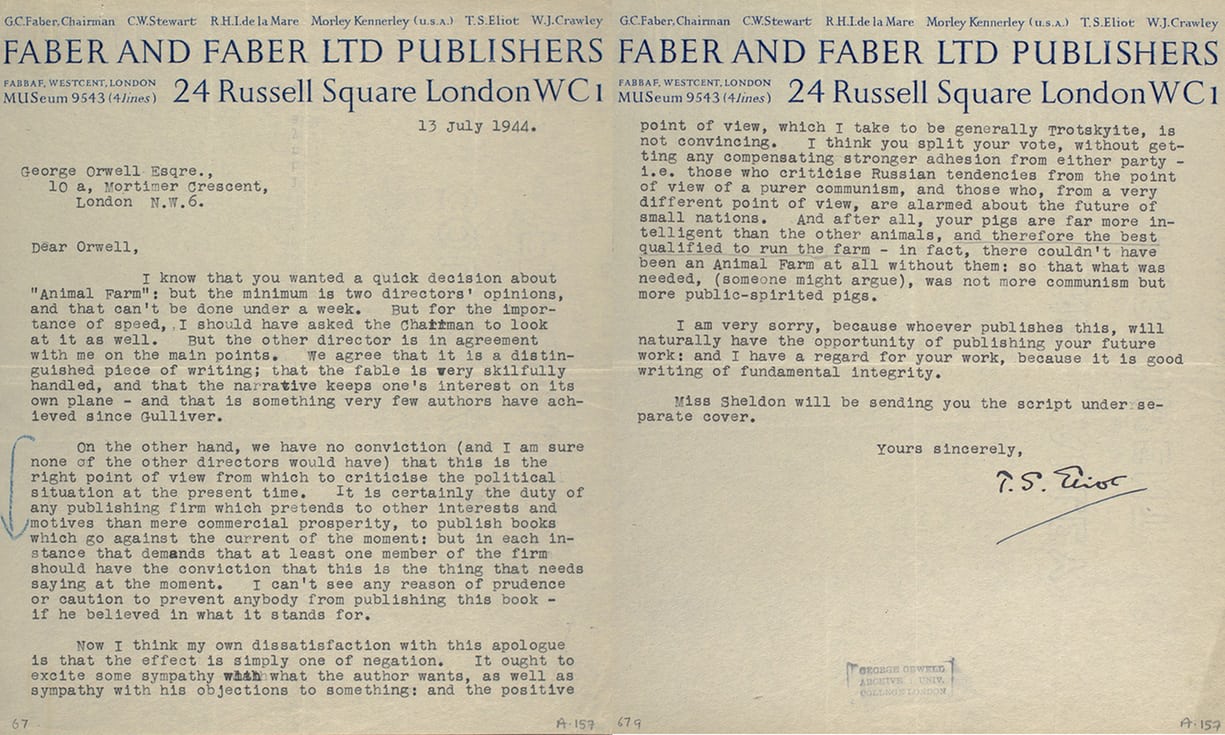 (Click to see full-size)
H/T to Raj Balasubramanyam for the image.
Comments Off on George Orwell had a lot of rejection slips for Animal Farm
November 1, 2017
Frankenstein: The Modern Prometheus – Extra Sci Fi – #1
Extra Credits
Published on 31 Oct 2017Mary Shelley’s Frankenstein launched the entire genre of science fiction. What made it unique? What did Shelley create, and how did her view of the possibilities of science shape the way we imagine our world even today?
Comments Off on Frankenstein: The Modern Prometheus – Extra Sci Fi – #1
October 24, 2017
The many false faces of Aleister Crowley
In the latest Libertarian Enterprise, Sean Gabb reviews a new collection of essays about Aleister Crowley:
Turning to practitioners of the occult, I see no evidence of special success. They do not live longer than the rest of us. However they begin, they do not stay better looking. Any success they have with money, or in bed, is better explained by the gullibility of their followers than by their own magical powers.
So it was with Aleister Crowley (1875-1947) — the “Great Beast 666,” or “the wickedest man alive.” He quickly ran through the fortune his parents had left him. He spent his last years in poverty. Long before he died, he had begun to resemble the mug shot of a child murderer. Whether his claims were simply a fraud on others, or a fraud on himself as well, I see no essential difference between him and the beggar woman who cursed me in the street. He had advantages over her of birth and education. But he was still a parasite on the credulity of others.
Nor can I see him as a thinker or writer of any real value. The book that I am reviewing does its best to claim otherwise. Its varied essays are all interesting and well-written. Anything by Keith Preston, who wrote the fourth essay, is worth reading. Mr Southgate has done a fine job on the editing and formatting. But I found myself looking up from every essay to think what a terrible waste of ability had gone into producing the book. Was Crowley a sort of national socialist, or a sort of libertarian? Was he a sex-obsessed libertine, or did he preach absolute self-control? I suspect all these questions have the same answer. The overall theme of the book is that he was a penetrating critic of “modernity,” and each of its writers — all, in my view, men of greater ability than Crowley — has done his best to reduce a corpus of self-serving nonsense to a coherent system of thought.
The truth, I think, is that, beyond a desire to impose on everyone about him, Crowley had no fixed ideas, but he was too bad a writer for this to be apparent. Take these examples of his prose:
We are not for the poor and sad: the lords of the earth are our kinsfolk. Beauty and strength, leaping laughter, and delicious languor, force and fire are of us…” [quoted, p.68]
The sexual act… is the agent which dissipates the fog of self for one ecstatic moment. It is the instinctive feeling that the physical spasm is symbolic of that miracle of the Mass, by which the material wafer… is transmuted into the substance of the body. [quoted, p.151]
In the second of these, he seems to show an influence of D.H. Lawrence — or of the sources that made Lawrence into another bad writer. In the first, he has certainly been reading too much Swinburne. I confess that I have not read anything by Crowley beyond the quotations in this book. Having seen these, though, I am not curious to look further. He was a nasty piece of work in his private life, and a victim of early twentieth century fashion in everything else.
Comments Off on The many false faces of Aleister Crowley


