In this week’s Substack Post of links they included this gem from weird medieval guys providing lots of illuminated explanations of the visual additions to pages of handwritten text generated in monasteries all over Europe during the Middle Ages:
After perhaps my 9,000th time seeing someone describe medieval marginalia as “doodles” or the product of “boredom”, I thought it might be nice to put together a brief guide to some of the themes and ideas that recur in the margins of manuscripts, hopefully helping to showcase the fact that these drawings were usually anything but “random”! In fact, far more interestingly, these little characters and scenes were part of a complex and visually dense world rooted in religion, pop culture, humour, and folklore. This is just a whistle-stop tour, but I’d love to add a second part soon.
Context matters
Illuminated manuscripts were essentially always written first and illustrated second in the late Middle Ages. The scribes would add their writing to unbound, empty pages, working carefully around blank fields where painted miniatures and initials would later be added by a separate artist or artists. We do not know exactly what sort of education these artists would have obtained. However, they almost certainly would have had a degree of literacy in their native tongue and a familiarity with the scriptures they were illustrating, even if this did not extend to a firm grasp of written Latin.
Understanding this is crucial for pushing back on the idea of medieval marginalia as “random”, since it opens up the possibility of considering marginal drawings in relation to the rest of the page and manuscript as a whole — crucial context that is often neglected when we encounter marginalia as isolated snippets online. Artists were not simply filling in blank voids but adding adornment to a canvas already rich with meaning imparted by the scribe. Thus, the first step to understanding a piece of marginalia should always be to trace it back to its source, if possible. Have a look through the entire work and see what themes and images recur.
Works like the 13th century English prayerbook known as the Rutland Psalter show extensive evidence of the marginal artists playing on specific words and lines from the scriptures featured on the same page. I highly recommend Betsy Chunko Dominguez’ fantastic paper “Playing on Timbrels: The Margins of the Rutland Psalter” for a more complete exposition, but I will go over a couple examples here.
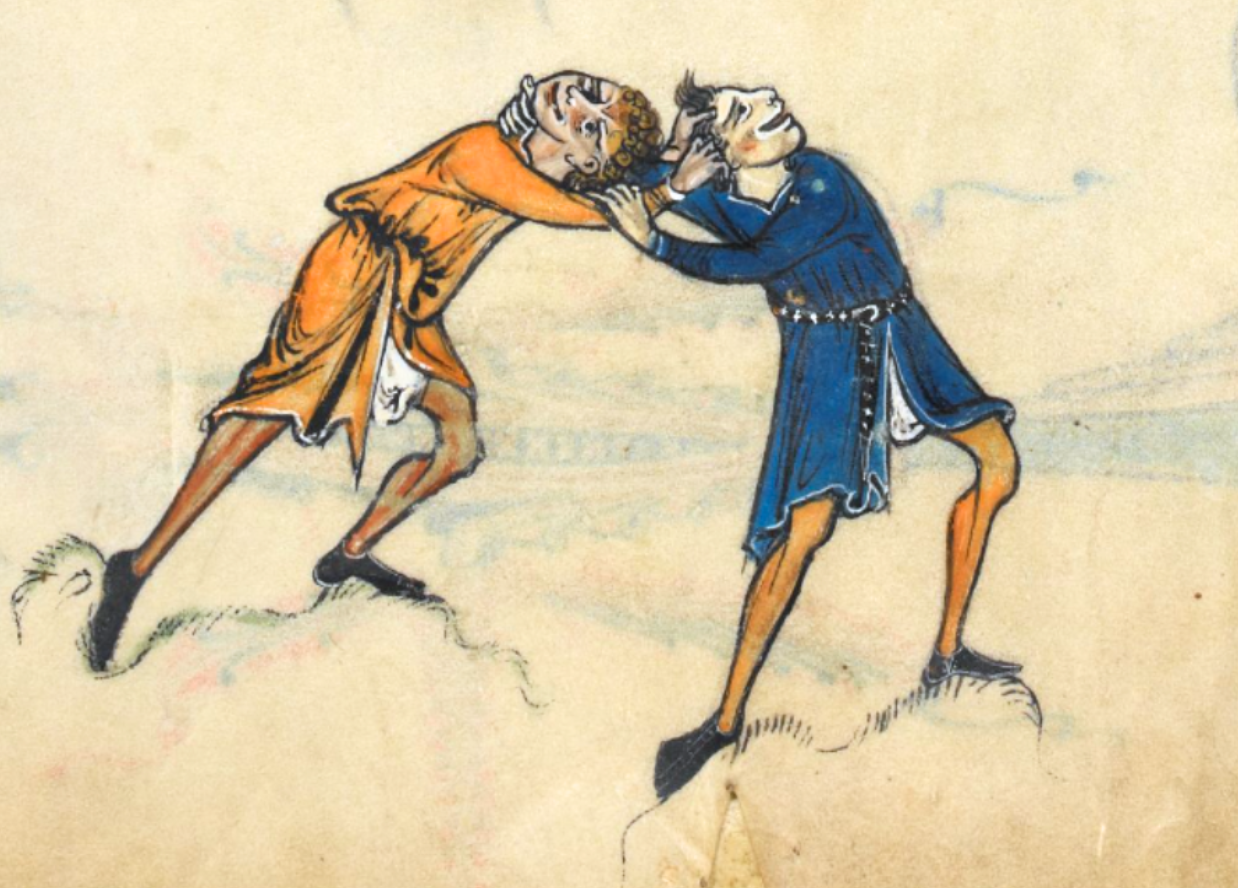
In the lower margin of folio 11r of the Psalter, two men seem to be engaged in a fierce struggle, with one of them apparently trying to rip off the other’s ear. Moving their eyes back up to the start of the opposite page, a reader would have been greeted by the following line from Psalm 5:
Verba mea auribus percipe Domine intellege clamorem meum.
Give ear, O Lord, to my words, understand my cry.
Thus, our marginal brawl becomes a clever pun on the notion of “giving ear” — perhaps a way of making the text more engaging and memorable for its reader.
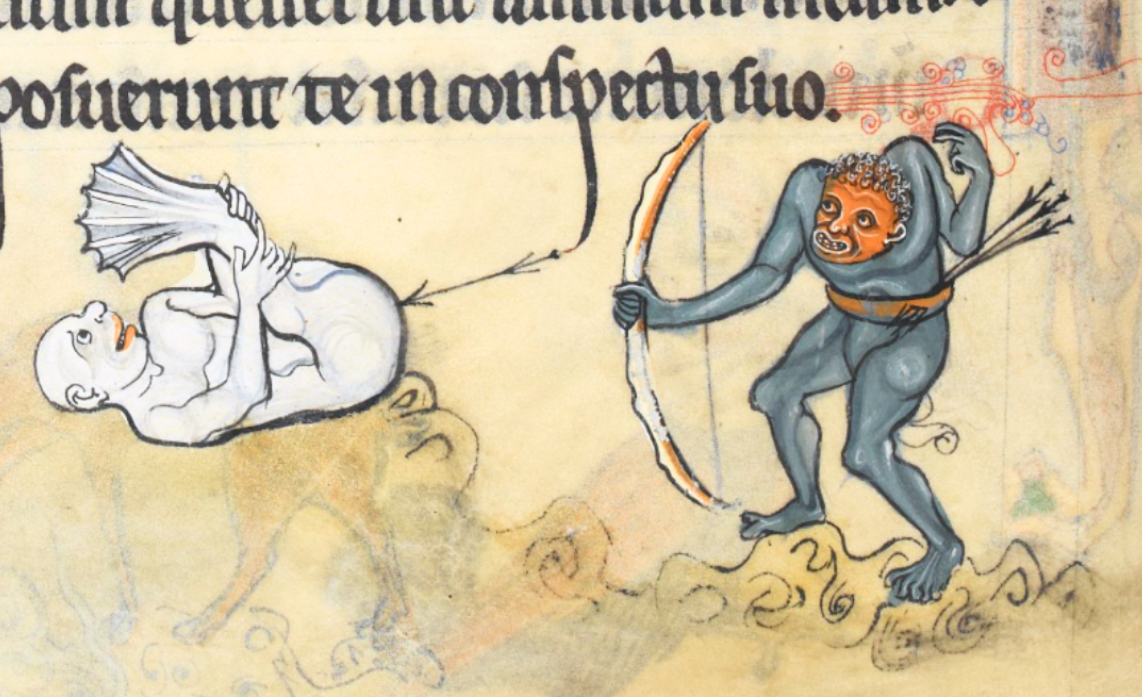
On folio 87v, the artist has extended the letter p from the word conspectu in Psalm 86 (85 in the Vulgate) into an arrow fired from the bow of one monster into the rear end of another.
Conspectu means “to behold” or “to consider”, and the famous medieval scholar Michael Camille connected the arrow’s placement to the notion of gaze as a type of visual penetration. One might also consider the entire verse from the Psalm, which reads:
Deus, iniqui insurrexerunt super me, et synagoga potentium quaesierunt animam meam: et non proposuerunt te in conspectu suo.
Arrogant men are rising up against me, O God; a violent mob seeks my life; they do not keep you before their eyes.
In redirecting the word for “gaze” into the supine creature’s rear end, the artist has perhaps emphasised the evils of turning one’s eyes away from God, connecting the two monsters with the violent mob evoked in the text above.
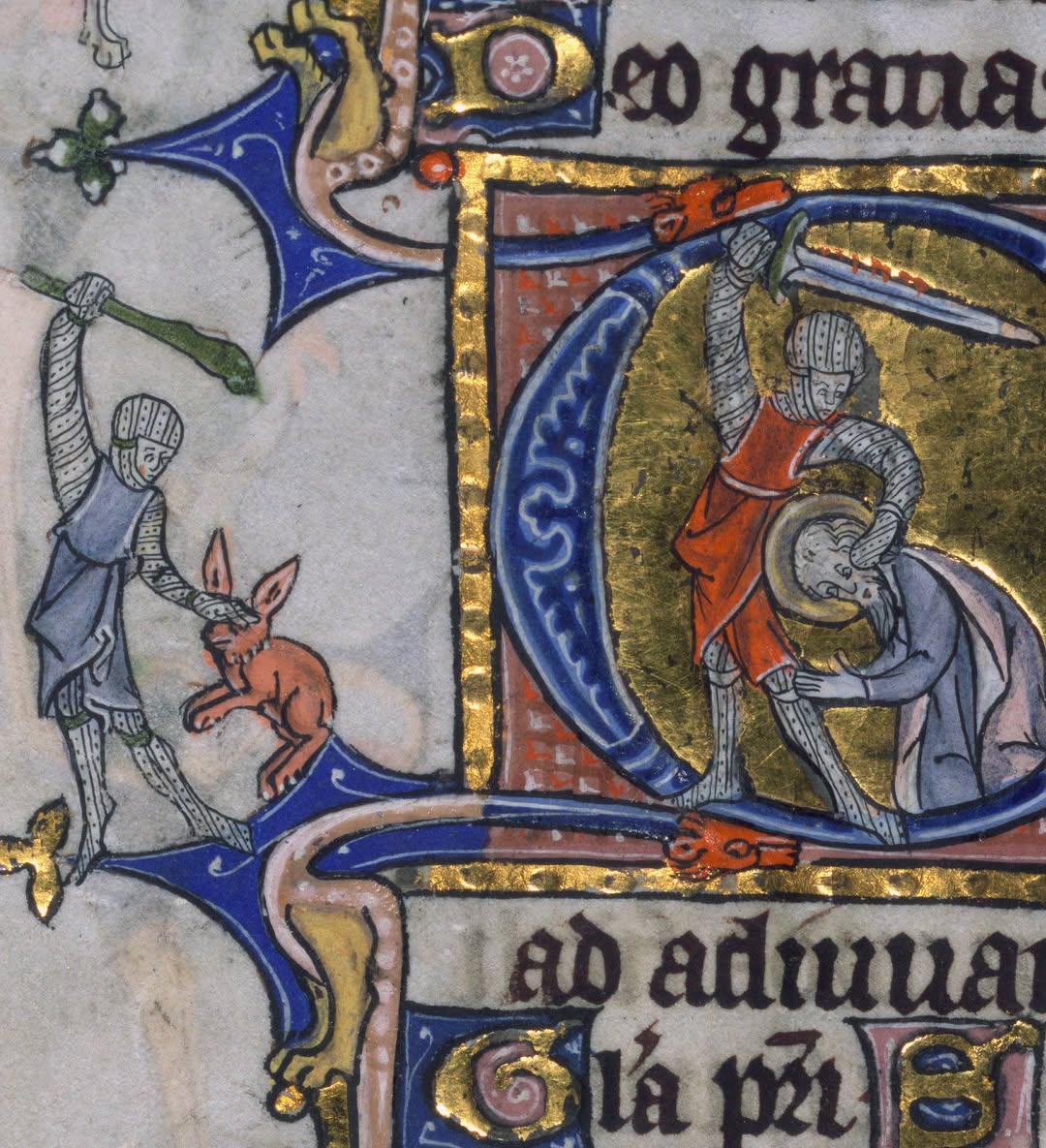
For those who lack an education in Latin, this type of wordplay can be tricky to identify. What may be easier to find are visual parallels between different drawings in a manuscript: the margins could function as a sort of antithesis to the “orthodox” miniatures and initials in the centre of the page. In one 14th century French book of hours, the martyrdom of St Paul in an initial D is reenacted directly to the left by a soldier about to club a rabbit — a humorous elevation of lapine suffering that perhaps emphasises Paul’s innocence.
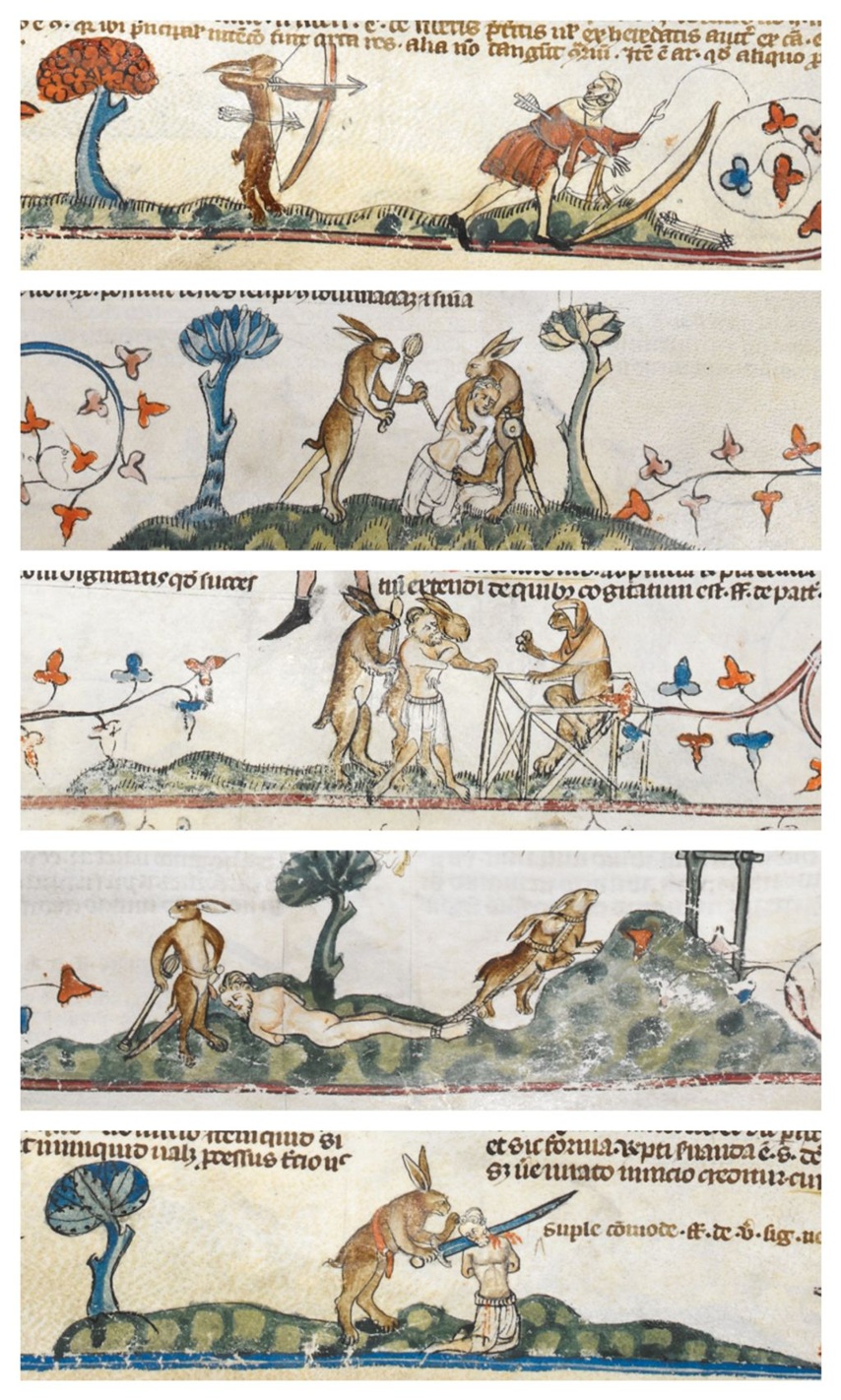
Other manuscripts show narratives playing out in the margins across multiple pages in a comic-book fashion. The 14th century Smithfield Decretals contains more than a dozen multi-page stories, including those of several saints, naughty priests, henpecked husbands, and a group of rabbits who capture, try, convict, and execute a hunter for his crimes against their kind.
British Library, Royal MS 10 E IV