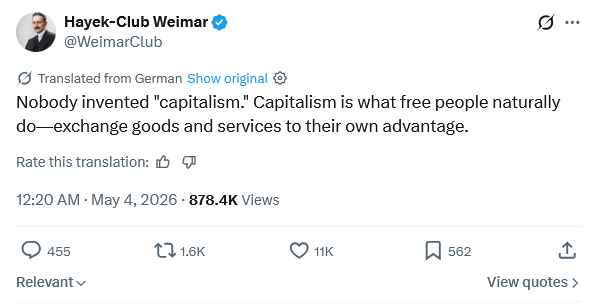
On the social media site formerly known as Twitter, Anish Moonka responds to an auto-translated-from-German post by Hayek-Club Weimar:
There’s a clay tablet with the founding charter of a 12-partner company on it. Twelve merchants pooled 33 pounds of gold to start the firm. The contract has the partner names, the starting capital, the profit split, and the penalty for cashing out early.
The tablet is nearly 4,000 years old. It was found at a site called Kanesh, in central Turkey. Archaeologists have dug up 23,500 of these clay records there, most of them business documents: receipts, loan contracts, shipping orders, lawsuits. The houses they were stored in eventually burned. The fire baked the clay solid and preserved every record.
The merchants came from Assur, in modern-day Iraq. They loaded donkeys with tin and cloth and walked them 1,000 kilometers across mountain passes to Kanesh, roughly the distance from New York to Atlanta. Each donkey carried about 180 pounds and the trip took two to three months. They came home with silver and gold.
The company ran for twelve years under a merchant named Amur Ishtar. A third of the profits went back to the investors. Pull your share out early and the firm gave you four kilos of silver per kilo of gold, half the normal rate. Locked-up money was meant to stay locked up.
That one company was just a tiny piece. The tablets show a complete economy with partners suing each other in commercial court, husbands writing home about prices, and wives writing back complaining the husband had been gone too long. A woman named Ahatum quietly lent silver to four different men over nine years. People bought up other people’s loan documents and used them as collateral for new loans, the same thing Wall Street does today with mortgage-backed securities. One merchant got caught smuggling tin in his underwear to dodge a 10% import tax.
In 2019, four economists from Harvard, Sciences Po, Chicago, and Virginia ran the tablet numbers through a gravity model, the math economists use today to predict how much two countries will trade based on size and distance. The Bronze Age numbers matched modern trade numbers almost exactly. Trade fell off with distance at nearly the same rate it does between countries today. The paper ran in the Quarterly Journal of Economics.
There was no economic theory yet. The idea didn’t even have a name. The word “capitalism” wouldn’t be coined for another 3,800 years, and Adam Smith was 3,700 years away from writing a sentence about markets. Just a guy named Pushu-ken writing a clay tablet to his business partner about a shipment of cloth, and a woman in Assur recording who owed her how much silver. Capitalism was already there, doing its full job, almost four thousand years before anyone wrote down a theory of how it worked.