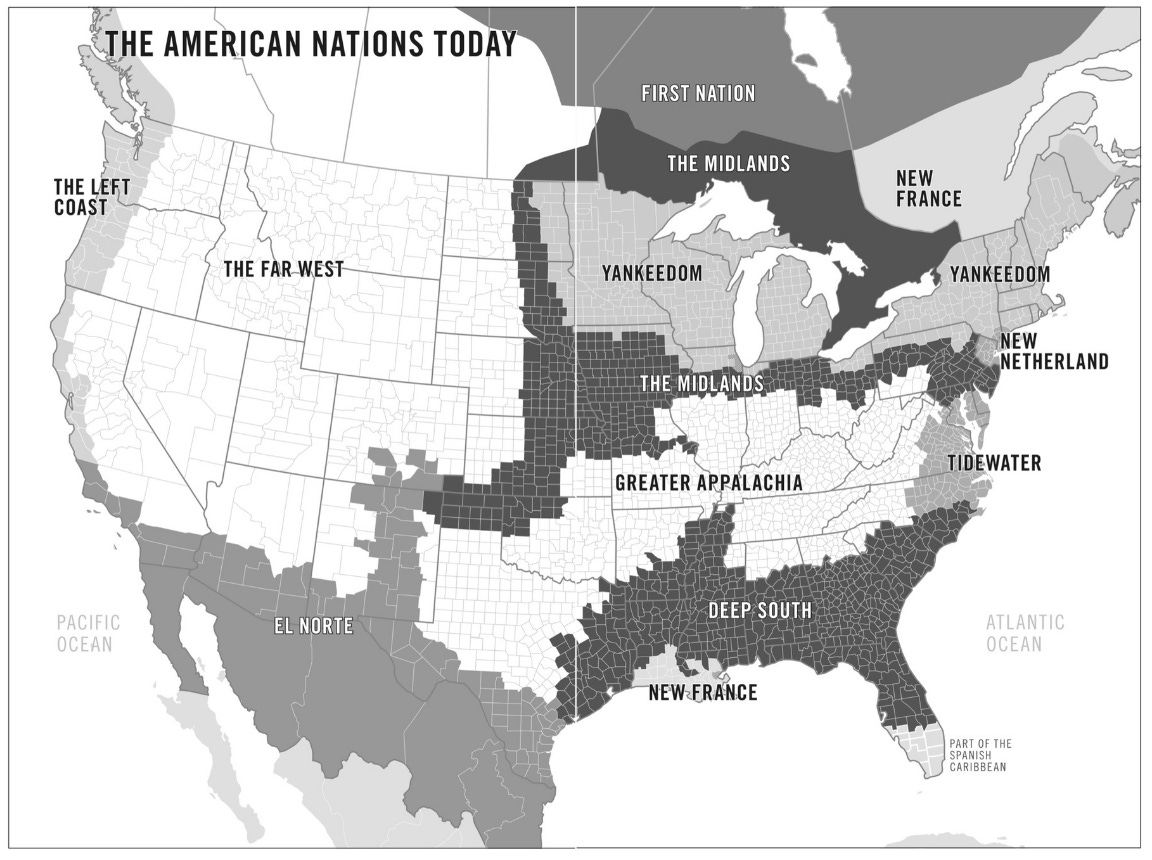
There’s a long tradition of describing the outlines of these regional cultures as they currently exist — Kevin Phillips’ 1969 The Emerging Republican Majority and Joel Garreau’s 1981 The Nine Nations of North America are classics of the genre — but it’s more interesting (and more illuminating) to look at their history. Where did these cultures come from, how did they get where they are, and why are they like that? That’s the approach David Hackett Fisher took in his 1989 classic, Albion’s Seed: Four British Folkways in America, which traces the history of (you guessed it) four of them, but his attention is mostly on cultural continuity between the British homelands and new American settlements of each group,1 so he limits himself to the Eastern seaboard and ends with the American Revolution.2
Colin Woodard, by contrast, assigned himself the far more ambitious task of tracing the history of all America’s regional cultures, from their various foundings right up to the present, and he does about as good a job as anyone could with a mere 300 pages of text at his disposal: it’s necessarily condensed, but the notes are good and he does provide an excellent “Suggested Reading” essay at the end to point you towards thousands of pages worth of places to look when you inevitably want more of something. Intrigued by the brief discussion of the patchwork of regional cultures across Texas? There’s a book for that! Several, in fact.
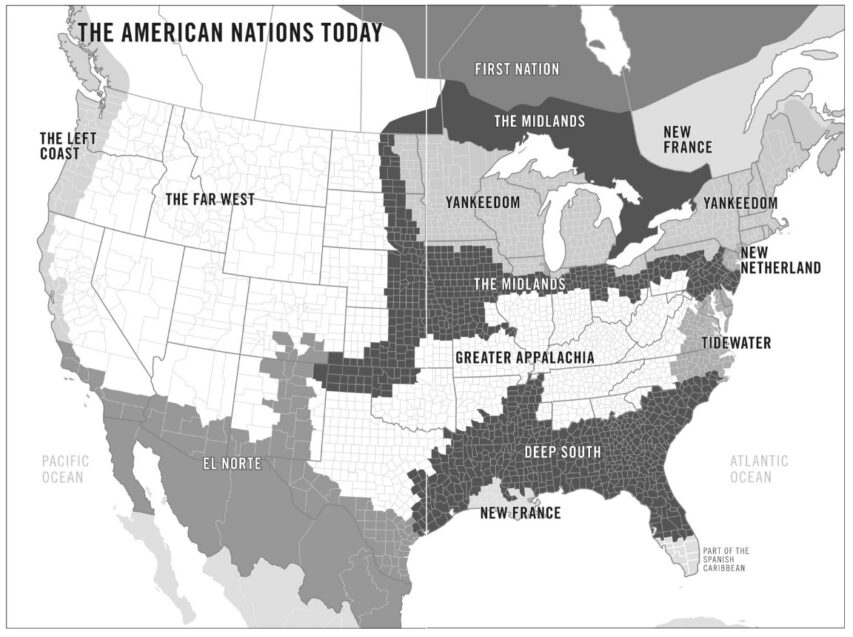
Woodard divides the US into eleven distinctive regional cultures, which he calls “nations” because they share a common culture, language, experience, symbols, and values. For the period of earliest settlement this seems fairly uncontroversial — you don’t need to read a lot of American history to pick up on the profound cultural differences between, say, the Massachusetts townships that produced John Adams and the Virginia estates of aristocrats like Washington, Jefferson, and Madison, let alone the backwoods shanties where Andrew Jackson grew up. As the number of immigrants increased, though (and this began quite early: several enormous waves of German immigrants meant that by 1755 Pennsylvania no longer had an English majority), it doesn’t seem immediately obvious that the original culture would continue to dominate.
Woodard’s response to this concern is twofold. First, he cites Wilbur Zelinsky’s Doctrine of First Effective Settlement to the effect that “[w]henever an empty territory undergoes settlement, or an earlier population is dislodged by invaders, the specific characteristics of the first group able to effect a viable, self-perpetuating society are of crucial significance for the later social and cultural geography of the area, no matter how tiny the initial band of settlers may have been”. (The nation of New Netherland, founded by the Dutch in the area that is now greater New York City, is the paradigmatic example: both Zelinksy and Woodard argue that it has maintained its distinctively tolerant, mercantile, none-too-democratic character despite the fact that only about 0.2% of the population is now of Dutch descent.)3 But his second, and more convincing, approach is just to show you that the people who moved here in 1650 were like that and then in the 1830s their descendants moved there and kept being like that and, hey look, let’s check in on them today — yep, looks like they’re still like that. Even though between 1650 and now plenty of Germans (or Swedes or Italians or whoever) have joined the descendants of those earliest English settlers.
Most of the book is given over to the six nations — Yankeedom, New Netherland, the Midlands, Tidewater, the Deep South, and Greater Appalachia — that populated the original Thirteen Colonies and still occupy most of the country’s area. Told as the story of the distrust or open bloody conflicts between various peoples, American history takes on a ghastly new cast: have you ever heard of the Yankee-Pennamite Wars, fought between Connecticut settlers and bands of Scots-Irish guerillas over control of northern Pennsylvania? Or the brutal Revolution-era backcountry massacres committed not by the Continental Army or the redcoats but by warring groups of Appalachian militias? What about the fact that Pennsylvania’s commitment to the American cause was made possible only by a Congressionally-backed coup d’état that suspended habeas corpus, arrested anyone opposed to the war, made it illegal to speak or write in opposition to its decisions, and confiscated the property of anyone who suspected of disloyalty (if they weren’t executed outright)? Gosh, this is beginning to sound like, well, literally any other multiethnic empire in history. (It also offers some fascinating points of divergence for alternate history.)4
Jane Psmith, “REVIEW: American Nations, by Colin Woodard”, Mr. and Mrs. Psmith’s Bookshelf, 2024-02-19.
- Including plenty of Jane Psmith-bait like discussion of who was into boiling (the East Anglians who adopted coal early and moved to New England) vs. roasting (the rich of southern England who could afford wood and moved to the Chesapeake Bay), discussions of regional vernacular architecture, the distinctive sexual crimes each group obsessed about (bestiality in New England, illegitimacy in Chesapeake) and so on — I love this book.
- Incidentally, if you’ve only read Scott Alexander’s review of Albion’s Seed, do yourself a favor and read the actual book. Yes, Scott gives a perfectly cromulent summary of the main points, but it’s a such gloriously rich book, full of so many stories and details and painting such a picture of each of the peoples and places it treats, that settling for the summary is like reading the Wikipedia article about The Godfather instead of just watching the darn movie.
- Yes, there is a book for this, and it’s apparently Russell Shorto’s The Island at the Center of the World, which I have not read and don’t particularly plan to.
- Off the top of my head:
- The Deep South tried to get the United States to conquer and colonize Cuba and much of the Caribbean coast of Central America as future slave states;
- There were a wide variety of other secession movements in the run-up to the Civil War, including a suggestion that New York City should become an independent city-state that was taken seriously enough for the Herald to publish details of the governing structure of the Hanseatic League;
- In 1784 the residents of what is now eastern Tennessee formed the sovereign State of Franklin, which banned lawyers, doctors, and clergymen from running for office and accepted apple brandy, animal skins, and tobacco as legal tender. They were two votes away from being accepted as a state by the Continental Congress.