
Quotulatiousness

February 23, 2026

“Public intellectuals”

Filed under: Media, USA — Tags: , — Nicholas @ 04:00

Ted Gioia charts the rise of what we now struggle to avoid … the “public intellectual”:
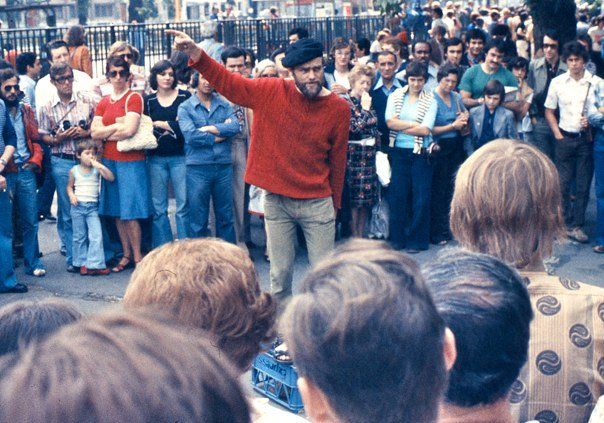
“Orator at Speakers’ Corner, London, with crowd, 1974” by GeorgeLouis is licensed under CC BY-SA 3.0 .

I see this term “public intellectual” everywhere nowadays — and it has a nice ring about it. It summons up images of speakers standing on soapboxes proclaiming the truth to passers-by.

That’s actually happened in places like London’s Hyde Park and 125th Street in Harlem. It sounds so very fair and democratic. Not every intellectual teaches at Harvard and Yale. Sometimes they really do exist out in the wild. We ought to nurture and support them.

Not long ago, these same people were often called “working class intellectuals”. I had two uncles who could be described that way — they lacked prestigious degrees and institutional affiliations. They grew up poor, but were smart and well-read and could speak articulately on almost any subject.

A few colleges specialized in educating these working class intellectuals. Consider the case of City College of New York, where the finest minds of the proletariat got book learning on the cheap. (You can find a list of CCNY alums and profs here — it includes an impressive number of Nobel laureates and Pulitzer Prize winners.)

But those days are long gone. Working-class intellectuals have vanished in recent years. Instead we have witnessed the rise of millionaire — or billionaire — intellectuals.

There have always been super-rich people, but in the past they kept a low profile. In my youth, the wealthiest person in the world was Howard Hughes, and he stayed in hiding for the last two decades of his life — you couldn’t even find a current photograph of the man.

He was doing us a favor. Hughes was rumored to have abandoned all the niceties of personal hygiene.

    During the last fifteen years of his life, Hughes was described as a tall gaunt skeleton of a man with long, unwashed matted hair, a scraggly beard, and fingernails and toenails of such length that curled in upon themselves. He dressed only in a pair of dirty undershorts or went nude.

Believe it or not, Martin Scorsese cast Leonardo DiCaprio to play Hughes in the biopic. You gotta love Hollywood.

Hughes briefly emerged from seclusion on just one occasion. On January 7, 1972, he made a brief phone call from the Bahamas to seven journalists assembled in a room in a Hollywood hotel. This was necessary because a scamming author had published a fake autobiography attributed to Hughes, and the world’s richest man wanted to denounce it as a fraud.

He spoke on the phone for a few minutes, then signed off. That was the last time the media had any contact with Howard Hughes.

After Hughes’s death, the richest person in the world was Daniel Ludwig. You have probably never heard his name. But that’s no surprise — Ludwig was even more reclusive than Hughes. He lived for 95 years, and only gave one interview during that time.

Fast forward to today. Elon Musk is now the wealthiest person in the world — and he’s making proclamations every day. He even bought his own social media platform, and posts his opinions constantly. He’s the reverse of Howard Hughes. You can’t escape him. And unless he flies off to Mars, you never will.

It’s not just Musk. There are dozens of billionaires who aspire to public intellectual status. Bill Gates serves up book reviews. Peter Thiel gives a lecture series. Tom Steyer makes speeches and offers himself as a candidate for President.

We have come a long, long way from the working class intellectuals and soapbox pundits of yore. Everything now is pay-to-play.

How did this happen? When did the status of public intellectual become something you can buy, like merchandise on the shelf at a Rodeo Drive boutique?

“The aim always being to shoot the kulaks and who cares about the reasoning?”

Filed under: Economics, Media, Politics — Tags: , , — Nicholas @ 03:00

It’s funny how the latest crisis always seems to have the same recommendations from the great and the good of the land – give us more money and more power. Pollution? More money and more power, please. Global poverty? More money and more power, please. Climate change? More money and more power, please. So it’s not really surprising that when the great and the good decide that global wealth inequality is a huge and growing problem, well, we all know what they’re going to recommend, don’t we?

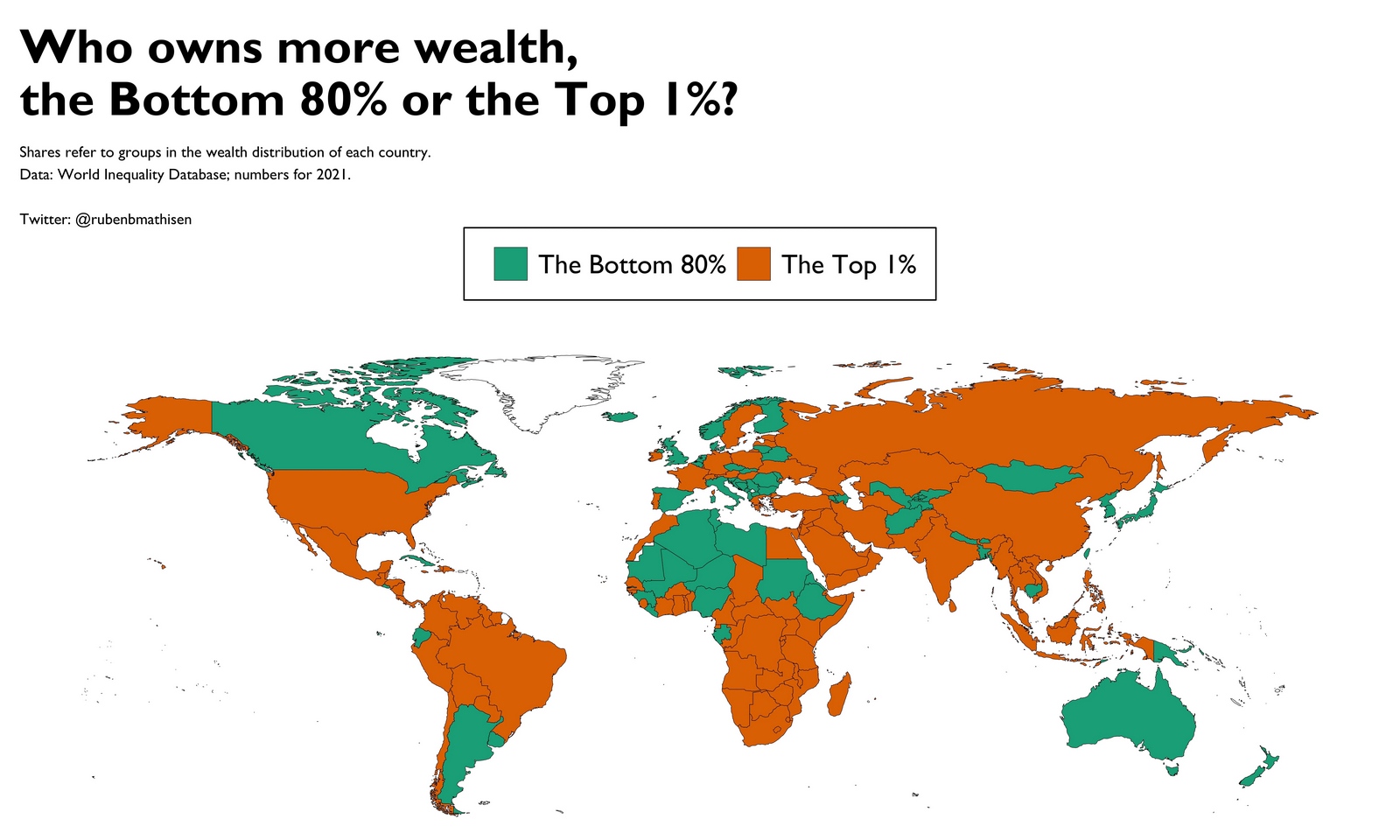
As we all know, because we’re all told it so often, global wealth inequality is rising. Therefore something must be done! Punitive taxation and the bureaucrats get to spend everything, obviously.

The one little problem with this is that the aim, intention, is always punitive taxation and the bureaucrats get to spend everything and damn the actual evidence used to support the proposal. It’s all sub-Marxoid ever increasing concentrations of summat and therefore the kulaks need to be shot. The aim always being to shoot the kulaks and who cares about the reasoning?

30 years back — and yes, I am old enough to recall this — it was all about how income was becoming more unequal in its distribution. Therefore punitive taxes, the bureaucrats get to allocate everything and hey, look, we can shoot the kulaks! This all rather fell apart when it was pointed out that the actual effect of global neoliberalism was that income inequality was declining. For which we can thank the work of Branko Milanovic. Who did prove that income inequality was declining under global neoliberalism.

Thus, to my mind, the move to squeeing about wealth inequality. For we need that reason to shoot the kulaks and damn the intellectual perversions required to find it.

And, well, Branko and his numbers again, eh?

    New paper on the capitalization of the world with @BrankoMilan just out!

    Capital income remains very unequally distributed worldwide, but inequality has slightly declined.

Oh. Global neoliberalism is reducing the inequality of capital income, is it? Why yes yes it is:

    Global capital income inequality has declined in the 21st century, with the Gini coefficient falling from 97% to 94%. Over the same period, the share of the world population with annual capital income above $100 increased from 12% to 27%. This implies more than a doubling of the number of individuals earning positive income from interest, dividends, rents, and privately-funded pensions.

That’s alarmingly high, yes. We’d all like it to be lower too. I certainly would. I’d like us all to be living in that bourgeois American upper middle class in fact. $100k a year family incomes, $500k (later in life, obviously) in the 401(k) and all that. You know, bring it on.

We even have a mapped out plan about how we get from here to there. It’s in the SRES, which is the foundation of all that IPCC work about climate change. If we have globalised neoliberalism for the rest of this century then we’ll all be approaching that — in current $ — American upper middle class income. If we power that by going fracking, developing out solar and so on then climate change won’t be a problem either. If we power it by not going fracking and turn back to the use of coal then Bangladesh gets it. But the base idea that all will rise up into those bourgeois pleasures of three squares, a warm crib and choices in life really is in there. And, yes, it’s globalised neoliberalism that will take us there.

So, while it is alarmingly high, that inequality, we’re already solving it as we did income inequality — global neoliberalism. Pity no one gets to shoot the kulaks but there we are, reality doesn’t always accord with desires.

Grand Strategy of the Roman Empire PART TWO

Filed under: Books, Europe, History, Military — Tags: , , , , , , — Nicholas @ 02:00

Adrian Goldsworthy. Historian and Novelist
Published 27 Aug 2025

This should have posted earlier this morning, but for some reason did not.

This is the follow up to last week’s discussion of grand strategy, looking at the reactions and criticisms of Luttwak’s ideas, followed by some of my own thoughts.

QotD: Faith, Hope, and Charity defended Malta

Filed under: Britain, History, Italy, Military, Quotations, Weapons, WW2 — Tags: , , , — Nicholas @ 01:00

June 1940.

France has collapsed, Hitler is eating Europe alive, and Mussolini doesn’t want to miss out. He wants birthday cake without bringing a present.

Poor show

So he looks at a map and asks the Italian Air Force:

“Who can we bomb that’s really close?”

Answer: Malta, 49 miles away.

The Italians begin their great wartime contribution by flying at 14,000 feet and dropping bombs with the accuracy of a man throwing darts after fourteen pints. Half land in the sea, a few hit fields.

But accuracy wasn’t the point. They just wanted to show Berlin they were “in the war”.

For the Maltese, who had never seen modern bombing, even bad Italian bombing was terrifying.

And unfortunately for them, this was only the warm-up act.

Maynard’s Defence: Faith, Hope and Charity

Air Commodore Foster Maynard is given the job of defending Malta with basically nothing.

He had been promised four fighter squadrons.

Zero have arrived. Typical early war British brilliance.

His only aircraft were some slow, ancient Fairey Swordfish.

Great for torpedoing ships, hopeless for intercepting bombers.

These were the famous “Stringbags”. We will hear from them later on.

Then like an archaeologist opening a cursed tomb the British discover 18 Gloster Gladiators in crates on the island. They were meant for HMS Glorious and HMS Eagle.

What followed was peak British wartime admin:

  • Maynard asks the Navy to release some Gladiators.
  • He gets permission.
  • The ground crew assemble several.
  • THEN the Navy says “No actually, stop, pack them back up.”
  • THEN the decision gets reversed again.
  • So they unpack them, reassemble them … again.

After all this faffing, three Gladiators emerge ready to fight.

Next problem: no fighter pilots.

Big problem I feel, anyway …

Maynard asks for volunteers. Eight bomber men step forward, either heroic or mildly insane.

Problem solved.

A journalist on the island, Harry Kirk, watching these three lonely biplanes scramble day after day, nicknames them Faith, Hope and Charity after his mother’s brooch.

The names stick. The legend begins.

On 21 June 1940 Pilot Officer George Burges shoots down a Savoia-Marchetti bomber over Valletta, the island’s first air victory.

The Maltese take it as a sign from God.

(It wasn’t, but let them have the moment.)

“MALTA: PART 1, Foreboding”, WWII Matters, 2025-11-17.

Powered by WordPress


