
Quotulatiousness

February 21, 2026

Books for boys (unlike the vast majority of books for children these days)

Filed under: Books, History — Tags: , — Nicholas @ 05:00

Just pointing out that boys and girls have different interests is enough to get you labelled as a right-wing extremist, if not an outright white supremacist/homophobic transphobe. Progressives believe, as a matter of deep conviction, that children are tabula rasa and any indication of interest on their part in male-coded activities is proof of patriarchal brainwashing. This is clearly nonsense, but we’re deep in the propagandized years where even pointing out elements of reality will get you added to terrorist watchlists if it doesn’t actually get you arrested and charged. But boys are interested in different things than girls are and trying to force them to be interested in the things that girls like will almost always turn that boy against whatever you’re trying to shove down his throat.

Boys don’t read as much as girls do, but when almost everything they’re given to read is girl-coded, it makes it even more uninteresting to boys. Yet the tiny minority of books that do appeal to boys are not made available in libraries and schools for fear of somehow leading in the direction of “toxic masculinity” or something.

Among the few publishers who do produce books intended to interest boys is Raconteur Press, who explain here why historical adventure books appeal to boys:
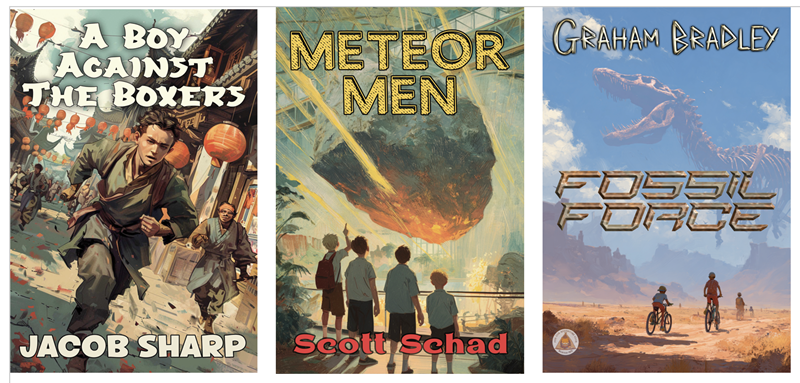
In an era dominated by screens and instant gratification, fostering a deep appreciation for history in young readers can feel like an uphill battle. Yet, historical fiction — especially in the form of thrilling boys’ adventure books — offers a powerful gateway. By weaving real historical events into gripping narratives, these stories not only entertain but also educate, encouraging boys to discover the past, develop essential skills, and cultivate a lifelong love of reading and exploration. Books like A Boy Against the Boxers by Jacob Sharp, Meteor Men by Scott Schad, and Fossil Force by Graham Bradley, all from Raconteur Press, exemplify this approach. Each integrates historical elements in unique ways, showing how adventure can transform history from dry facts into vivid, relatable experiences.

Discovery and Learning Through Historical Events

Historical fiction immerses young readers in the past, making abstract events tangible and personal. By placing protagonists in real-world scenarios, these books help boys “live” history, fostering empathy and understanding that textbooks often lack. For instance, in A Boy Against the Boxers, fourteen-year-old Eddie Donahue is thrust into the heart of the 1900 Boxer Rebellion in Peking (now Beijing). The story draws on actual events like the 55-day Siege of the International Legations, where foreign diplomats and civilians were trapped by anti-Western nationalists. Eddie witnesses martial arts demonstrations, evades violent chases, and participates in scavenging supplies and firing an old black powder cannon known as the “International Gun”. Through Eddie’s eyes, readers learn about the geopolitical tensions of turn-of-the-century China, the unlikely alliances among nations (which would soon fracture in World War I), and the brutal realities of siege warfare. This viewpoint helps boys grasp how ordinary people — much like themselves — navigated chaos, turning history into a lesson in resilience and global interconnectedness.

Similarly, Meteor Men blends scientific discovery with American Civil War history. The five boys — Cinch, Frank, Keith, Joel, and Ronaldo — start as amateur meteorite hunters, using library research and borrowed gadgets like a magnetic probe mounted on a radio-controlled plane. Their quest leads to an unexpected find: a buried Union ironclad riverboat and its Confederate counterpart, solving a fictionalized mystery tied to real Civil War naval battles, such as those on the Mississippi River. Drawing from actual historical markers and artifacts (like the USS Cairo, the only surviving Union armored riverboat), the boys learn about steam-powered warfare, the role of ironclads in river combat, and the human cost of the conflict. From a boy’s perspective, this reveals history as a puzzle to be solved, emphasizing how everyday curiosity can uncover forgotten stories and honor the soldiers who fought.

My own interest in history as a child was nursed by the Ladybird picture books my parents and grandparents bought me (with topics like Alexander the Great, Richard the Lionheart, Henry V, and other interesting-to-boys subjects). One that I still have, in diminished form is a very battered copy of British History in Strip Pictures by James Mainwaring, which must have been published in the late 1950s or early 1960s, as I got it in 1965 and it was already quite battered:
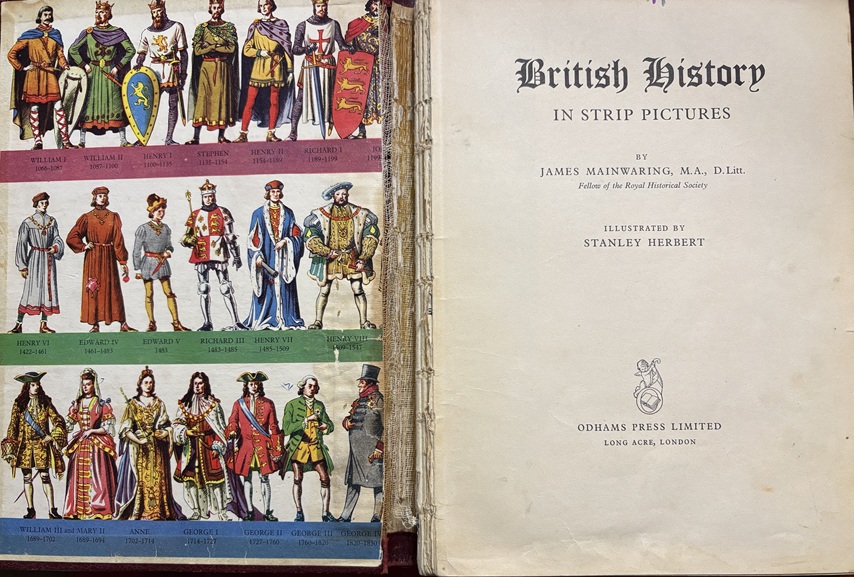
The body of the book got separated from the cover many years ago, and the first few pages got lost, sadly.

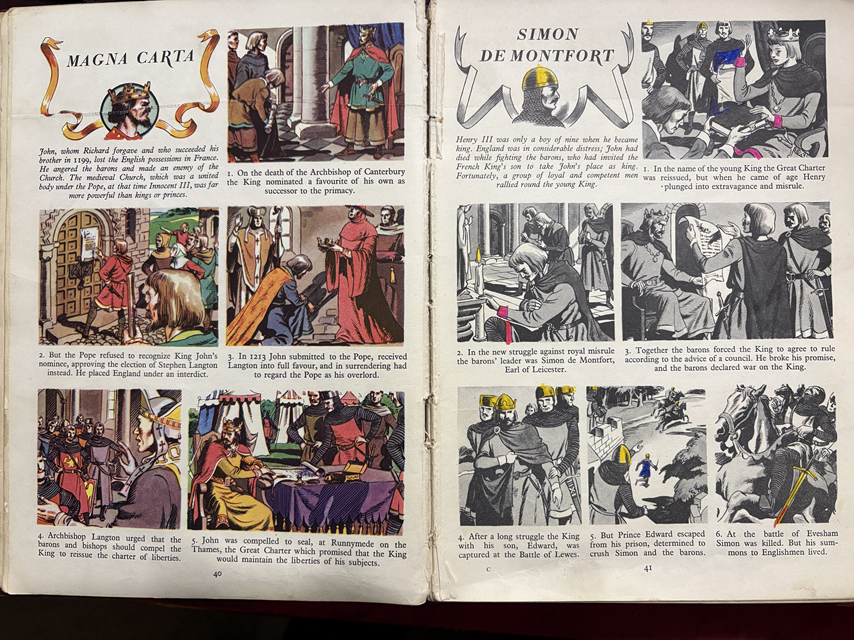
It might have been jingoistic “whig history for children”, but I loved it (please pardon the occasional attempts to colour the black-and-white images … I couldn’t help myself at that age):
Oh Look, They Want a Mercenary Army

Filed under: Europe, Military — Tags: , , , , , — Nicholas @ 04:00

Akkad Daily
Published 20 Feb 2026

Get a country worth fighting for. Join Restore: https://www.restorebritain.org.uk/joi…

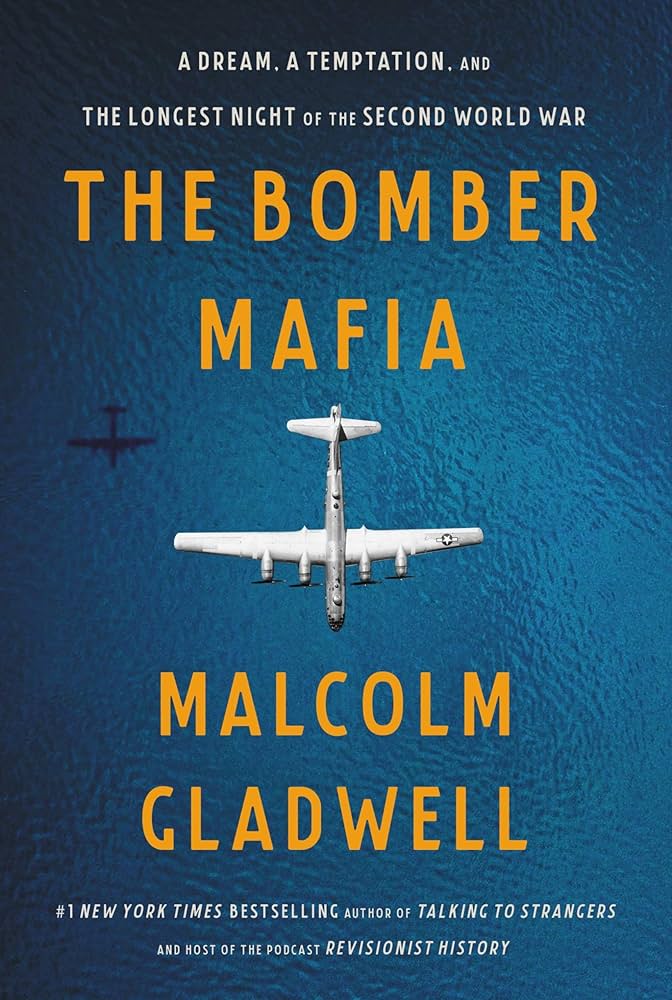
The Bomber Mafia by Malcolm Gladwell

Filed under: Books, Germany, History, Japan, Military, USA, WW2 — Tags: , , , — Nicholas @ 03:00

Based on the few books of his I’d heard of, I wouldn’t have expected Malcolm Gladwell to dip into military history … and from what Secretary of Defense Rock says, it might have been better if Gladwell had steered clear of this particular topic anyway:

I recently received The Bomber Mafia as a gift for my birthday, and it was bad, so bad that I felt compelled to write this review. In so many ways, the book is everything that is wrong with the “pop history” genre: a bestselling author with a massive built-in audience, with a hit podcast to cross-promote the material, and a framing promise to reveal a supposedly “great untold story” about the strategic and moral struggles of American airmen in World War II. The problem in this case is that Gladwell’s narrative about Curtis LeMay, Haywood Hansell, and the evolution of strategic bombing repeatedly collides with the existing scholarship and often ignores it altogether. From his treatment of the raids of Münster and Schweinfurt–Regensburg to his use of the United States Strategic Bombing Survey and his confident claims about what compelled Japan to surrender, The Bomber Mafia exemplifies the worst tendencies of popular history: sweeping pronouncements built on selective reading, caricatured context, and a startling indifference to both primary sources and a vast secondary literature.1

I was only vaguely familiar with Malcolm Gladwell and his work, but for those who don’t know (like me until recently), he has been a staff writer for The New Yorker since 1996, has written a bunch of New York Times bestselling books on sociology, psychology, and economics, and also hosts a very popular podcast called Revisionist History.2 This is all to say he is widely known and already has a big audience that is generally receptive to his projects. The book was originally based on four episodes he did on this topic in July 2020, and then turned into print, so it isn’t so much an actual book as it is a printed podcast.3

Unsurprisingly, both the audiobook and print editions were widely acclaimed upon release. Writing in the Wall Street Journal, Yale professor Paul Kennedy praised the book as “a wonderful book”.4 The journalist Michael Lewis described it as “a riveting tale”, while the bestselling biographer Walter Isaacson called it “a wonderful narrative”.5 The book was named a Kirkus Reviews Best Book of the Year and selected as an Editors’ Choice by The New York Times Book Review. It also enjoyed significant commercial success, reaching number two on The New York Times Best Sellers list.6 To promote the book, Gladwell made appearances on Jimmy Kimmel, MSNBC, and CBS’s Sunday Morning show. MSNBC even stated in the segment title that this is “A great untold story”, which is hilarious, given that I don’t know how much ink has been spilled on the strategic bombing campaigns.7

But it should be noted that the book has been criticized by virtually anyone who has seriously studied this topic. Much of the criticism of the book has come from the fact that it hardly focuses on the Japanese and German perspectives, misinterprets why members of the air tactical school focused on precision bombing, and the actual role strategic bombing played in the surrender of Japan.8 All of that is valid, but what was initially more startling to me was how little use was made of primary or secondary sources. So many important works are left out makes me wonder how much research Gladwell even put in.9 To write about strategic bombing in World War II and not include Michael Sherry’s The Rise of American Air Power, Richard Overy’s The Bombing War, Donald Miller’s Masters of the Air, Ken Werrell’s Blankets of Fire or Death From the Heavens, Geoffrey Perrett’s Winged Victory, and barely using any of the official histories is borderline negligence.10 Anyone doing research on strategic bombing and Air Power in World War II almost certainly would have come across these.


  1. Popular history is a form of historical writing aimed at broad audiences that usually prioritizes storytelling over real scholarship. See Gerald Strauss, “The Dilemma of Popular History,” Past & Present, no. 132 (1991): 130–49, and more recently, Ben Alpers, “The Promise and Perils of Popular History,” Society for U.S. Intellectual History, August 17, 2021.
  2. The show itself isn’t really a conversation with experts and historians (though they do appear) so much as storytelling.
  3. I would also preface that I generally don’t have a problem with this premise. There is definitely a segment of the historical profession that dislikes pop history for reasons tied as much to credentials as to content. Much “popular history” is produced by journalists, independent writers, or commentators rather than credentialed academic historians, and that fact alone generates suspicion. In some cases, this skepticism is warranted: weak sourcing, thin engagement with the scholarship, and overconfident claims do real damage. But the problem is not who writes history so much as how it is written. Plenty of non-historians have produced outstanding historical works by taking the craft seriously — immersing themselves in primary sources, engaging honestly with existing scholarship, and resisting the temptation to oversimplify for the sake of narrative punch. Conversely, academic credentials have never been a guarantee for insight or even accuracy. If a writer does the work, respects the evidence, and treats complexity as something to be explained rather than avoided, there is no real reason to dismiss the result simply because of the writer’s background.
  4. Paul Kennedy, “The Bomber Mafia’ Review: Architects of a Firestorm”, The Wall Street Journal, April 30, 2021.
  5. Summary of reviews in paperback.
  6. “Hardcover Nonfiction – May 16, 2021”. The New York Times.
  7. Malcolm Gladwell: ‘Bomber Mafia’ Looks At A Great Untold Story From WWII.
  8. Some critical reviews include David Fedman and Cary Karacas, “When Pop History Bombs: A Response to Malcolm Gladwell’s Love Letter to American Air Power”, Los Angeles Review of Books, June 12, 2021; Saul David, “Malcolm Gladwell’s The Bomber Mafia is misleading history-lite”, The Daily Telegraph, April 25, 2021, and Steve Agoratus, Air & Space Power History 68, no. 4 (2021): 52–53.
  9. This is also coming from a guy who famously wrote that achieving world-class expertise in any field is, to a large extent, a function of accumulating roughly 10,000 hours of deliberate practice, as described in his book Outliers: The Story of Success.
  10. Gladwell doesn’t really deal with British strategic bombing; there’s just a brief chapter on Arthur Harris. If interested, see Noble Frankland, Bomber Offensive, the Devastation of Europe (New York: Ballantine Books, 1971) Max Hastings, Bomber Command: The Myths and Reality of the Strategic Bombing Offensive, 1939-45 (New York: Dial Press/James Wade, 1979), and Norman Longmate, The Bombers: The RAF Air Offensive against Germany, 1939-1945 (London: Hutchinson, 1983).

Canada’s Only Mass-Production Fighter Jet – Avro Canada CF-100 Canuck

Filed under: Cancon, History, Military, Technology — Tags: , , , , , , — Nicholas @ 02:00

Ruairidh MacVeigh
Published 18 Oct 2025

During the 1940s and 50s, with World War II rapidly transitioning into the Cold War, Canada, as a major ally of the NATO nations and with large swathes of remote countryside that could easily be penetrated by Soviet fighters and bombers, created the CF-100 Canuck, one of the earliest production jet fighters in the world an a machine that, despite some early flaws, would go on to prove itself rugged and robust for patrolling the turbulent weather of the frozen Canadian north.

At the same time, though, the CF-100 was very much a product of its time, and despite its exceptional rigidity, by the middle of the 1950s it was very much obsolete as swept-wing and delta fighters rapidly became the norm for both Communist and Capitalist factions alike, and through its initial success would lay the groundwork for even more ambitious projects that sadly would not continue Canada’s major involvement in cutting edge military aerospace design.

Chapters:

0:00 – Preamble
0:49 – Facing a New Kind of War
4:28 – Ups and Downs
7:12 – Reworking the Design
10:36 – The CF-103 Project
15:51 – The Canuck Career
19:06 – Later Years
20:30 – Conclusion
(more…)

QotD: Warren G. Harding’s successful depression-breaking policies

One is viewed as among America’s greatest presidents; the other perhaps the worst of all. One is hailed as a savior; the other as a failure. One is given memorials to enshrine his name for all time; the other is pushed into the sea of forgetfulness.

Driven by academia, this is where American history has placed Franklin Delano Roosevelt (in office 1933-1945) and Warren Gamaliel Harding (in office 1921-1923). It is impossible to see FDR absent a “great presidents” ranking; it is likewise impossible to see Harding absent the lowest rungs.

Both men came into office with an economy in tatters and both men instituted ambitious agendas to correct the respective downturns. Yet their policies were the polar opposite of one another and, as a result, had the opposite effect. In short, Harding used laissez faire-style capitalism and the economy boomed; FDR intervened and things went from bad to worse.

Despite these clear facts, in C-SPAN’s latest poll ranking US presidents, FDR finished third in the rankings, while Harding finished 37th. Surveying how both handled the economy, scholars ranked FDR third in that category, while Harding came in at 32. This is a tragedy of history.

America in 1920, the year Harding was elected, fell into a serious economic slide called by some “the forgotten depression“. Coming out of World War I and the upheavals of 1919, the economy struggled to adjust to peacetime realities, falling into a serious slump.

The depression lasted about 18 months, from January 1920 to July 1921. During that time, the conditions for average Americans steadily deteriorated. Industrial production fell by a third, stocks dropped nearly 50 percent, corporate profits were down more than 90 percent. Unemployment rose from 4 percent to 12, putting nearly 5 million Americans out of work. Small businesses were devastated, including a Kansas City haberdashery owned by Edward Jacobson and future president Harry S. Truman.

The nation’s finances were also in shambles. America had spent $50 billion on the Great War, more than half the nation’s GNP (gross national product). The national debt jumped from $1.2 billion in 1916 to $26 billion in 1919, while the Allied Powers owed the US Treasury $10 billion. Annual government spending soared more than twenty-five times, from around $700 million in 1916 to nearly $19 billion in 1919.

Harding campaigned on exactly what he wanted to do for the economy – retrenchment. He would slash taxes, cut government spending, and roll back the progressive tide. He would return the country to fiscal sanity and economic normalcy.

“We need a rigid and yet sane economy, combined with fiscal justice,” he said in his inaugural address, “and it must be attended by individual prudence and thrift, which are so essential to this trying hour and reassuring for our future”.

The business community expressed excitement about the new administration. The Wall Street Journal headlined on Election Day, “Wall Street sees better times after election”. The Los Angeles Times headlined the following day, “Eight years of Democratic incompetency and waste are drawing rapidly to a close”. Others read “Harding’s Advent Means New Prosperity” and “Inauguration ‘Let’s Go!’ Signal to Business”.

The day after Harding’s inauguration, the Times editors predicted “good times ahead”, writing, “The inauguration yesterday of President Harding and the advent of an era of Republicanism after years of business harassment and uncertainty under the Democratic regime were hailed” by the nation’s business leaders. I. H. Rice, the president of the Merchants and Manufacturers Association, told the press, “Good times are now ahead of us. Prosperity is at our door. We are headed toward pre-war conditions … Business men are well pleased with President Harding’s selections for his Cabinet and by the caliber of men he has chosen we know that he means business”.

Under Harding and his successor, Calvin Coolidge, and with the leadership of Andrew Mellon at Treasury, taxes were slashed from more than 70 percent to 25 percent. Government spending was cut in half. Regulations were reduced. The result was an economic boom. Growth averaged 7 percent per year, unemployment fell to less than 2 percent, and revenue to the government increased, generating a budget surplus every year, enough to reduce the national debt by a third. Wages rose for every class of American worker. It was unparalleled prosperity.

Ryan S. Walters, “The Two Presidents Whose Economic Policies Are Most Misunderstood by Historians”, Foundation for Economic Education, 2022-03-05.

Powered by WordPress



