Quotulatiousness

February 20, 2026

Stephen A. Smith as a Democratic Trump

Filed under: Media, Politics, Sports, USA — Tags: , , , — Nicholas @ 05:00

It’s been noted many times that the Democratic Party has had a logjam of aged boomers at the top of their “bench” for future leadership positions. This is a serious problem for the self-described “Party of Youth”, that they have remarkably few viable Gen X, Millennial or Gen Z rising stars who might be future presidential candidates. Donald Trump took the political insiders by surprise in 2015/16, because he was an outsider with no political track record but a huge media profile. He may be the template that Stephen A. Smith hopes to follow on the Democratic side:
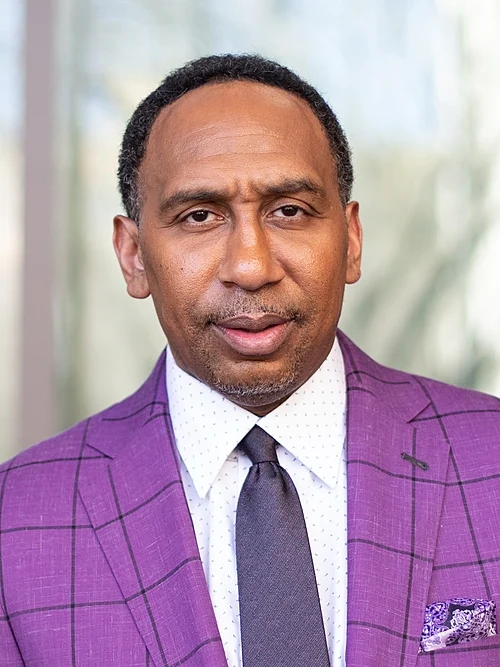
Stephen A. Smith at The Moody College of Communications, 23 January 2021.
Wikimedia Commons.

Stephen A. Smith is flirting with a run for president. In a recent CBS News interview, the telegenic ESPN commentator openly entertained the possibility of seeking the Democratic nomination in 2028. He offered additional comments on policy that were striking in their normalcy. He dismissed the idea that racism defines contemporary American life, rejected “defund the police”, and emphasized economic flourishing as the surest path to social stability.

Smith has a gift for performance, a fondness for hyperbole, and a resume devoid of elective office. Historically, that would have made him an unorthodox fit for the White House. But since Donald Trump’s 2016 election, those facts do less to disqualify a figure than to clarify his potential appeal.

And Smith seems to be taking the possibility seriously. His CBS interview builds on previous comments criticizing politicians who support income caps or engage in class-war rhetoric, framing prosperity as a moral and civic good, and condemning the Democratic Party’s excesses on cultural matters like transgenderism. In these comments, Smith captured the sensibility of millions of voters who feel alienated by the ideological vocabulary of contemporary Democratic politics.

While it’s tempting to write off Smith’s flirtation as unserious celebrity theater, that impulse overlooks the weakness of the Democratic field. Kamala Harris enters the cycle as the nominal frontrunner, but her standing reflects name recognition more than enthusiasm. Gavin Newsom commands attention through media savvy and partisan combativeness but carries the burden of California’s abysmal policy record. Other prospective contenders — none of whom have managed to crack double-digit support — may offer competence without excitement or excitement without coalitional appeal.

A primary defined by such choices creates space for an outsider, especially one who can command attention and articulate a distinct political persona. Smith lacks the accumulated baggage of conventional politicians. Even more importantly, he speaks like someone accustomed to unscripted confrontation. Two decades of live television have trained him to think quickly, read audiences, and project conviction. While such skills cannot substitute for governing experience, they matter a great deal in an era where voters evaluate authenticity and affect alongside ideology.

In fact, Donald Trump demonstrates that a candidate who pairs ideological flexibility with rhetorical aggression can reshape a party. Trump softened Republican orthodoxy on entitlement reform, health care, and even social issues — like gay marriage, guns, and abortion — at various points. Yet he maintained the loyalty of a base that valued his willingness to fight. That in turn forced GOP insiders to capitulate to many of his views. Smith shares Trump’s intensity, and could by the same method push the Democrats to moderate.

At the same time, his nascent platform could complicate Democratic coalition politics. The party’s donor and activist classes exert powerful pressure against moderation. These interests remain influential in candidate recruitment, messaging, and resource allocation. That influence often produces nominees who align with activist priorities even when those priorities diverge from median Democratic voter preferences.


Reform UK falters, but Restore Britain rises to challenge it

Filed under: Britain, Media, Politics — Tags: , , , , , — Nicholas @ 04:00

Since the last general election in Britain, the rising power has been Reform UK under the unsteady leadership of Nigel Farage. A right-wing alternative to the horrifically incompetent Conservative Party, led by the man who kept the fires burning for Brexit? Seems like an obvious winner over the sagging Labour Party under Keir Starmer who just had to be less incompetent than the Conservatives but couldn’t manage even that low bar. But all was not well with Reform UK, despite being likely winners of the next election, and a lot of it comes down to Nigel Farage’s weaknesses. He seems incapable of dealing with strong personalities in his own party and seems to see any disagreement as a form of betrayal. One of the men he exiled from the party has now raised his own banner to much acclaim from the people who once were strong Farage supporters:

On Friday, Rupert Lowe, the independent Member of Parliament formerly of Reform UK, launched his own political party named Restore Britain. At the time of writing, the announcement video has amassed upwards of 30 million views on X, with many of the Western world’s most popular right-wing social media accounts — from Raw Egg Nationalist to Wall Street Mav — cheering him on.

Critics of Lowe argue that few outside of the culture war circles on X have heard of him, but these claims don’t track — Lowe has over 250,000 followers more on Facebook than he does on X, and has stated that he reaches “far more people on Facebook than X”. Still, while Lowe’s popularity has dramatically increased in the short year-and-a-half following his election to Parliament, he does not carry the same name recognition as Nigel Farage, let alone the latter’s proven experience of winning elections, as recent Reform victories have demonstrated, and contentious campaigns, being a key figure in the pro-Brexit campaign.

Restore Britain has the potential to be both very positive and hugely detrimental to Britain’s political future. Lowe’s announcement video was a masterclass in giving his admirers exactly what they want: decisive language promising a rebirth of a pre-Blair Britain, with fewer foreign nationals, fewer people on benefits, and more money to go round. The sober nature of the message was appealing — Lowe made it clear that the challenge facing the party, and the country, is not an easy one, but nor is it insurmountable. With stronger language than we have heard from Reform, Lowe promised to remove all people who arrived in Britain illegally, along with legal foreign nationals who do not meaningfully contribute to society.

Policy proposals like this — from a brand-new party with very little in the way of a party infrastructure as yet — do not have to be fully fleshed out to grab hold of the public imagination. What is likely is that it pushes the Overton window even farther rightward, and we begin hearing traditional centre-right figures like Kemi Badenoch (as she is centre-right in the political landscape of 2026) parroting some of the same points. With much of the online right rallying behind Lowe, we may begin to see a surge in the early stages of the posting to policy pipeline, whereby anonymous meme accounts — the modern politician’s crowdsourced spin doctor — churns out a large volume of pro-Lowe content, driving the narrative as others strive to keep up.

Lowe’s party may inadvertently help Reform, though, this by helping solve one of the main problems it has faced: attracting too many nutcases. Restore is positioning itself further to the right than Reform — and while this is no bad thing in and of itself, it will likely mean that those who believe in the most extreme solutions see Restore as the closest party to what they believe.

In UnHerd, Rob Lownie calls the movement “Lowe’s Powellite revolution”:

Rupert Lowe’s official portrait by Laurie Noble, 10 July, 2024 via Wikimedia Commons

Rupert Lowe deals in the politics of return: illegal immigrants are going back, and so is Britain. The Great Yarmouth MP, formerly of Reform UK, has now launched Restore Britain as a new political party, and on Wednesday evening claimed that it had passed 70,000 members. The launch announcement was marked with a stirring video of Lowe in his farmer’s get-up, as well as a series of semi-ironic nationalist compilations presumably made by Restore’s Zoomer footsoldiers. In one of these, among nostalgic nods to Geoff Hurst and Zulu, 1997 is invoked as the year when everything started to go wrong. Speaking over grainy images of a lost Britain, Lowe sums up his political outlook: “I think the state is bad, and I think the individual is good.

One area where the state has undoubtedly failed, in Lowe’s eyes, is on the matter of immigration. While Reform has pledged to deport all illegal immigrants, Restore wants to go further. Lowe has promised to scrap the asylum system entirely, also stating last week that “legal immigration will almost come to a complete halt”. The goal is not just to halt migrant influxes but to reverse them. “Net zero immigration is weak, weak, weak. It is insufficient and it is too late,” he said in the speech with which he launched the party. “The barbarians are already in the gates.”

The remedy, Lowe warns, will be “incredibly painful”: a characteristically abrasive verdict. It is one thing to criticise quangos, and quite another to say that “we must crush parasitic Britain”. And as for the dissonance between government and individual? “The state has definitively become the enemy of the people.”

In his doom-laden pronouncements, Lowe resembles no British political figure so closely as Enoch Powell, whose 1968 “Rivers of Blood” speech has led a radioactive afterlife in the national consciousness. For Powell, Britain’s willingness to take in tens of thousands of immigrants rendered it “a nation busily engaged in heaping up its own funeral pyre”. And compare Lowe’s talk of necessary pain to that 1968 call for an “extreme urgency of action now, of just that kind of action which is hardest for politicians to take”. For better or worse, Powell presaged contemporary debates over migration and nationhood. The challenge, as Keir Starmer found out with his more milquetoast “island of strangers” line, is to acknowledge voters’ frustrations without sounding like him.

Powell has been a political lodestar of sorts for Nigel Farage, Lowe’s bête noire and former boss who suspended him last year over dubious accusations of bullying. The Reform leader recalled being “dazzled”, as a schoolboy in the Eighties, listening to the former Tory MP speak. Last year, he insisted that Powell was fundamentally right about the scale of “community change” in the country.

On The Podcast of the Lotus Eaters, Carl Benjamin interviews Rupert Lowe:

The Canadian Patrol Submarine Project

Filed under: Asia, Cancon, Germany, Military, Technology, Weapons — Tags: , , , , , , — Nicholas @ 03:00

The Royal Canadian Navy is planning to replace its four current conventional submarines, the British-built Victoria class with a dozen new conventional submarines from either South Korea or Germany (a joint German-Norwegian design). Michael J. Lalonde, a former Canadian intelligence officer, goes through the requirements for the new submarines, the two contending designs’ strengths and weaknesses, and makes his own recommendation for the RCN’s next submarine class:

Rough transit routes to Canada’s Arctic from Esquimalt BC and Halifax NS

The first step is to assess what the Government of Canada wants out of its new submarine fleet and what capabilities it will need to achieve its objectives. I’m starting here because there is a common misconception that Canada needs submarines exclusively for Arctic patrol and surveillance, which is false. While it’s true that Arctic sovereignty and security are quite rightfully a preoccupation for the government, patrolling Canada’s Arctic is not the only capability Canada needs out of its new fleet. However, it is the most common argument in favour of a submarine fleet since Arctic sovereignty remains popular within Liberal and Conservative circles alike, along with mainstream media.

Unfortunately, this narrative forces a lopsided conversation about the role these new boats will be expected to play over the coming decades. In addition to Arctic operations, these subs will be expected to deploy far into the North Atlantic with NATO and push across the Pacific to support the Indo-Pacific Strategy. Ottawa’s own defence policy update ties submarine recapitalization to contributions with allies in both theatres.

This implies a blue-water capability, which means these conventionally powered submarines must be able to deploy and fight in the open ocean, far from home ports and daily logistics, for extended periods. This requires long range and endurance for transoceanic transits, sustained submerged persistence through air independent propulsion (AIP) and high-capacity batteries to minimize snorkelling, and habitability and maintenance margins that keep the crew and systems effective past the 30- to 60-day mark. Simply put, the new boats must be able to cross an ocean, remain covert and lethal on station, and deliver effects.

The government further stipulated specific capabilities that the new submarines must have in one of its press releases stating “Through the Canadian Patrol Submarine Project (CPSP), Canada will acquire a larger, modernized submarine fleet to enable the Royal Canadian Navy to covertly detect and deter maritime threats, control our maritime approaches, project power and striking capability further from our shores, and project a persistent deterrent on all three coasts.”

What caught my attention here is the ability to project power and striking capability further from our shores. Power projection is synonymous with a blue-water capability; however, a striking capability, which I take to mean a land strike capability, is not typical for a conventionally powered SSK, which are typically armed only with torpedoes to take out other submarines or surface vessels.

To sum up, Canada’s new subs must be able to:

  • Patrol the Arctic with under-ice capability year-round
  • Deploy with NATO in the North Atlantic and support Canada’s commitment to the Indo-Pacific Strategy – A blue-water capability
  • Remain submerged for three weeks or more at a time
  • Covertly detect and deter maritime threats
  • Control Canada’s maritime approaches
  • A range of 7000 + nautical miles
  • Project power far from home ports
  • Anti-surface and subsurface warfare
  • Land-attack capability via cruise and/or non-nuclear ballistic missiles
  • Insert Tier-1 special operators on coastal infiltration missions
  • Conduct intelligence, surveillance, and reconnaissance in Canadian maritime approaches and abroad.

With that out of the way, let’s look at what each submarine can do.

He outlines the two competing designs and how they could meet the RCN’s needs and then plumps for the South Korean KSS-III for its stronger case for meeting those needs in the wider ocean environments than the German/Norwegian Type 212CD:

ROKS Shin Chae-ho, a KSS-III submarine at sea on 4 April, 2024.
Photo from the Defense Acquisition Program Administration (DAPA) via Wikimedia Commons.

The KSS-III is the only conventional submarine that can meet all of Canada’s requirements. It combines the blue-water reach and endurance demanded by transoceanic tasking with a vertical launch system that enables credible land-attack and complex anti-surface strike options, supported by lithium-ion batteries that lengthen quiet submerged persistence and improve sortie tempo on distant stations. Its larger hull and higher automation provide the habitability and crew margin needed for 30 to 60 day deployments from Halifax and Esquimalt to the North Atlantic, the Indo-Pacific, and the Arctic ice edge, while remaining within the conventional, non-nuclear profile Canada has set. The design’s modern combat system and sensor suite can be integrated with Canadian and allied command, control, and targeting architectures, and the bilateral sustainment framework required with South Korea can be structured by contract to include full technical data access, in-country training pipelines, and an industrial workshare that anchors through-life support domestically. The delivery cadence proposed for a 2026 award would shorten Canada’s reliance on the Victoria class and reduce associated sustainment exposure during transition, while an initial Canadian order of up to twelve boats would give Ottawa a controlling voice over configuration management, growth paths, and export-variant standards for the life of the class.

Sci-Fi, Satire, and the Post-WWII Mythos

Filed under: History, Media, Politics — Tags: , , , , — Nicholas @ 02:00

Feral Historian
Published 17 Oct 2025

The caricature of fascism as the arch-evil, born in WWII propaganda and endlessly re-imagined in popular entertainment ever since, has served both as an inoculation against that particular brand of tyranny and blinders to many others. Is it still relevant? Or has it become one of our culture’s foundational archetypes that will live on for centuries disconnected from its roots? Let’s explore a bunch of facets and ask some odd, sometimes difficult questions along the way.

00:00 Intro
03:02 Myth of Singular Evil
06:06 Andor and Now
09:18 Fading Narratives
12:01 Iron Sky
16:21 What Comes Next?
(more…)

QotD: The burden of “emotional labour”

Filed under: Britain, Health, Media, Quotations — Tags: , , , , , — Nicholas @ 01:00

I paraphrase, of course. Though not, I think, wildly:

    Researchers at Stanford have finally given a name to something many women have been dealing with for years. It’s called mankeeping. And it’s helping explain why so many women are stepping away from dating altogether.

Yes, from the pages of Vice, it’s a men-are-the-problem-and-therefore-unnecessary article. Because we haven’t had one of those in weeks.

    Mankeeping describes the emotional labour women end up doing in heterosexual relationships.

Lesbian relationships being entirely free of aggravation and disappointment, you see. With rates of failure and divorce twice that of heterosexuals, more than double that of gay male couples, and with high rates of alcoholism and spousal abuse. What one might infer from that, I leave to others.

    [Mankeeping] goes beyond remembering birthdays or coordinating social plans. It means being your partner’s one-man support system. Managing his stress.

And,

    Interpreting his moods.

At which point, readers may wish to share their favourite joke about female indirectness and the two dozen possible meanings of the words “I’m fine” when uttered by a woman, depending on the precise intonation and the current alignment of the planets.

Readers may also note the replacement of a once common but now seemingly unfashionable grievance – “Men don’t express their feelings” – with one of a much more modish kind – “Men are expressing their feelings and it’s exhausting and unfair”.

    Holding his hand through feelings he won’t share with anyone else. All of it unpaid, unacknowledged, and often unreciprocated.

One more time:

    All of it unpaid,

It occurs to me that there’s something a little dissonant about the framing of affection and basic consideration – say, remembering your partner’s birthday – as “unpaid”. As “emotional labour”. As if being in a relationship or having any concern for those you supposedly care about were some onerous, crushing chore. As if you should be applauded – and financially compensated – for the thirty-second task of adding a birthday to the calendar on your phone.

The attitude implied by the above would, I think, explain many failures on the progressive partner-finding front and the consequent “stepping away from dating altogether”. Though possibly not in ways the author intended.

Before we go further, it’s perhaps worth pondering how the conceit of “emotional labour” is typically deployed by a certain type of woman. Say, the kind who complains, in print and at great length, about the “emotional labour” of hiring a servant to clean her multiple bathrooms. Or writing a shopping list. Or brushing her daughter’s hair.

And for whom explaining to her husband the concept of “emotional labour” is itself bemoaned as “emotional labour”. The final indignity.

The kind of woman who bitches in tremendous detail about her husband and his shortcomings – among which, an inability to receive instructions sent via telepathy – in the pages of a national magazine, where friends and colleagues of said husband, and perhaps his own children, can read on with amusement. The kind of woman who tells the world about how hiring servants is just so “exhausting”, while professing some heroic reluctance to complain.

As I said, worth pondering.

But back to the pages of Vice, where Ms Ashley Fike is telling us how it is:

    According to Pew Research, only 38 percent of single women in the US are currently looking for a relationship. Among single men, that number jumps to 61 percent. The gap says a lot. Women aren’t opting out of love. They’re opting out of being someone’s therapist with benefits.

Stoic, heroic women burdened by needy, emotional men. It’s a bold take.

And I can’t help but wonder what all of those single women, cited above, are doing instead of finding a suitable mate and building a happy life, perhaps even a family. Are they searching for a sense of purpose in causes, protests and political fashion, fuelled at least in part by envy and resentment? Just speculation, of course. But it would, I think, explain the tone and emotional convulsions of so many single, progressive women.

    The Guardian calls mankeeping a modern extension of emotional labour, one that turns a partner into a life coach. This isn’t about avoiding vulnerability. It’s about refusing to carry someone else’s emotional weight while getting little to nothing in return. And there’s nothing wrong with feeling that way.

Again, the term “emotional labour” and its connotations of calculation, antagonism, and something vaguely inhuman. As if the concept of wanting to care, to help, to remember those birthdays, were somehow alien or offensive.

The reliance on this conceit – as the basis for an article, perhaps an entire worldview – doesn’t strike me as an obvious recipe for contentment, or indeed love. What with the endless cataloguing of shortcomings. All those reasons to resent.

    Some men have started opening up more, which is good.

Ah, a glimmer of hope.

    But too often, that openness lands in the lap of the person they’re sleeping with instead of a friend or a therapist. Vulnerability without boundaries can feel more like a burden than a breakthrough.

So, don’t bore your wife with your troubles, gentlemen. No, search out a therapist. Or, “Be vulnerable, like we asked, but somewhere else”.

David Thompson, “Let’s Be Alone And Unhappy”, Thompson, blog, 2025-11-16.

Powered by WordPress