
Quotulatiousness

February 18, 2026

It’s not just Britain that gives asylum-seekers better care than citizens – Canada does too

Filed under: Bureaucracy, Cancon, Government, Health — Tags: , , , — Nicholas @ 05:00

We had a look at how well the British government looks after asylum-seekers yesterday, but other nations are probably doing similarly inequitable things to give money and services to non-citizens than they ever would for the people who pay the taxes for these over-generous programs. In the National Post, Tristin Hopper outlines the findings of a recent analysis from the Parliamentary Budget Office on the costs of supporting huge numbers of foreign nationals in Canada:
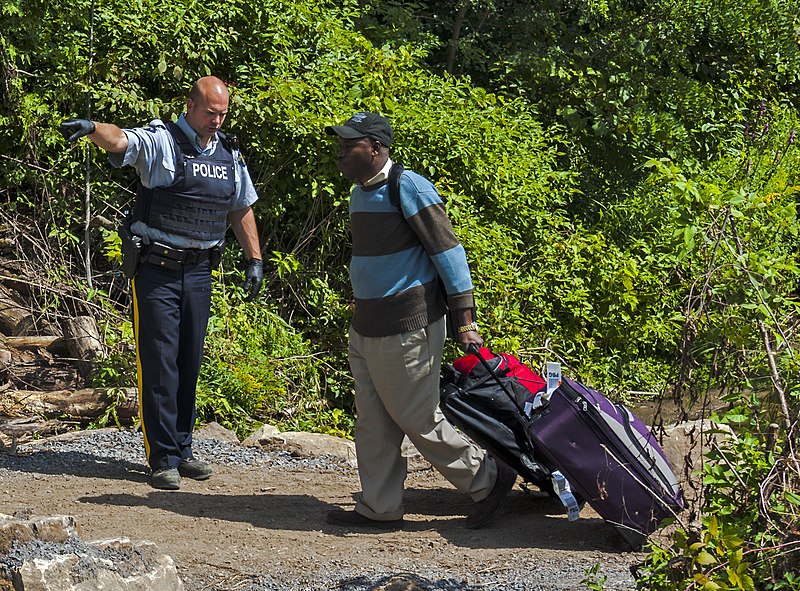
An asylum seeker, crossing the US-Canadian border illegally from the end of Roxham Road in Champlain, NY, is directed to the nearby processing center by a Mountie on 14 August, 2017.
Photo by Daniel Case via Wikimedia Commons.

Paying the health-care premiums of refugee claimants will cost Canadians a record $1 billion this year, with some of the beneficiaries continuing to receive free health care despite their claims having already been rejected.

That’s according to a new analysis by the Office of the Parliamentary Budget Officer, and it’s just one of several ballooning costs wrought by the unprecedented number of foreign nationals currently living in Canada by virtue of a claim of refugee status.

The Interim Federal Health Program, which offers premium health benefits to asylum claimants, is soon set to hit $1 billion in annual costs for the first time, according to an analysis last Thursday by the Office of the Parliamentary Budget Officer.

This is a five-fold increase from just six years ago, when the program was costing $211 million per year. The analysis also projects that costs are expected to surge for the foreseeable future, with the annual budget likely to hit $1.5 billion as early as 2029.

All told, between now and 2030, Canadians are on track to spend $6.2 billion on health care for refugees or refugee claimants.

“The rising volume of asylum claims, along with the longer duration of eligibility caused by extended determination times, has been an important growth driver in recent years,” reads the PBO report.

The report was commissioned following a Conservative-led request made at the House of Commons standing committee on health. In a Thursday statement, the Conservative party noted that the Interim Federal Health Program can be accessed even by asylum claimants who have had their case rejected.

It also offers a higher level of care than that enjoyed by the average Canadian citizen. In addition to hospital care and surgical care, the IFHP also covers dental care, vision care, pharmacare and other services not typically covered by public health plans.

“Rejected asylum claimants are now receiving better health care than many Canadians who have paid into a system their entire life,” read a joint statement by Dan Mazier and Michelle Rempel Garner, the shadow ministers of health and immigration, respectively.

It added, “at a time when six million Canadians cannot find a family doctor and are waiting for care, it’s unacceptable that bogus asylum seekers are receiving better health benefits than Canadians”.


The Korean War Week 87: What’s Going On In Compound 62? – February 17, 1952

Filed under: China, History, Military, USA — Tags: , , , , , — Nicholas @ 04:00

The Korean War by Indy Neidell
Published 17 Feb 2026

UN forces kick off this week with an operation to ensnare and capture North Korean and Chinese patrols, as significant progress is made elsewhere at the armistice talks. Prisoners really do seem to be the focus of the week, as rumblings of discontent continue to build at the POW camp on Koje-do island as UN control of the camp slips a little more each day. Just what is happening inside Compound 62 there? And do UN forces have a hope to stop it?

00:00 Intro
00:48 Recap
01:17 Clam Up
01:50 Repatriation
05:02 Item 5 Agreed Upon
07:35 Troop Rotation
09:47 Coastal Waters and Islands
11:02 Compound 62
13:45 The Bigger Picture
14:31 Summary
14:45 Conclusion
(more…)

The consequences of an over-feminized culture

Filed under: Media, Politics, USA — Tags: , , , , — Nicholas @ 03:00

On the social media site formerly known as Twitter, Devon Eriksen reacts to an article on “solving” the problem of predators in nature:

Women evolved to take care of toddlers. If you put women in charge of teaching ethics, you get Toddler Ethics.

“No hitting”
“Share the toys”
“Don’t say mean things”

These are fine lessons for toddlers. Don’t indulge your id at the expense of others. You can learn about balancing interests later, when your brain is developed enough to store that information.

But when you put women in charge of adults, they tend to reflexively assume those adults are toddlers.

They will tell you “no hitting” when the Mongol hordes are massing on your borders. They will tell you “share the toys” when a vagrant meth zombie breaks into your house looking for something to steal. And they will tell you “don’t say mean things” when you point out that these two responses are totally stupid.

When we first put women in charge, in the workplace, they immediately began treating those who reported to them like toddlers. When adults, who do not like being treated like toddlers, complained, their response was “ban bossy”, which boils down to “don’t say mean things”, another lesson in Toddler Ethics.

Now, through the influence of women in charge, we are so thoroughly steeped in Toddler Ethics that even most of the men we put in charge are treating the adults like toddlers, and echoing Toddler Ethics.

Toddler Ethics, of course, isn’t ethics at all. It’s just things we don’t want toddlers doing.

We can tell toddlers “no hitting”, because toddlers are not charged with keeping the peace, enforcing justice, or destroying evil.

We can tell toddlers “share the toys”, because toddlers don’t earn things, own things, or have property they must defend.

We can tell toddlers “don’t say mean things”, because it is not a toddler’s job to decide what unwelcome ideas are true, relevant, and necessary.

But when everyone in charge runs on Toddler Ethics, then adults can’t do a lot of the stuff adults need to do, because all the Toddler Ethicists keep getting in the way.

Adults sometimes need to hit people, protect the stuff, and say mean things. You can’t have civilization without that.

And if you put Toddler Ethics Woman in charge of teaching an AI ethics, then she will teach it Toddler Ethics, and it will treat every human adult like a toddler, all the time, forever.

Not only that, you have an AI that cannot be put in charge of anything, ever. Because leaders with Toddler Ethics destroy everything they are in charge of.

And Amanda MacAskill is definitely a Toddler Ethicist. The article in the photograph is nothing but “no hitting!” applied to the animal world. It’s absolutely insane, it’s a recipe for disaster, and anyone who would write such a thing should probably not even be charge of own life choices, much less anything of consequence.

But a lot of people would, and will, refuse to point that out, or agree with me when I do, because that is Saying a Mean Thing, and they, themselves, have been infected with Toddler Ethics.

They should not be charge of anything of consequence, either.

Anyone who thinks that everything they need to know, they learned in kindergarten … is only ever qualified to teach kindergarten.

Battle of Manila, 1945

Filed under: History, Japan, Military, USA, WW2 — Tags: , , , , — Nicholas @ 02:00

Real Time History
Published 3 Oct 2025

The Battle of Manila 1945 was the only urban battle in the American Pacific War comparable with Stalingrad, Berlin or other European battles. In gruelling weeks of fighting the 6th Army fought in house-to-house combat against entrenched Japanese.
(more…)

QotD: Defending the borders of the Roman Empire

Filed under: Books, Europe, History, Military, Quotations — Tags: , , , , — Nicholas @ 01:00

As Luttwak notes, modern historians and military theorists have a tendency to sneer at linear defense lines.1 In fact, some historians of ancient Rome actually blame the decline and eventual collapse of the empire on all the “wasted” energy spent building frontier fortifications. The argument against such “cordon” defenses is that for a given quantity of military potential, spreading it out equally along a perimeter and trying to guard every spot equally dilutes your strength. This makes it easy for an attacker (who picks the time and location of the battle) to concentrate his forces, create a local advantage, and break through.

The thing is, approximately none of this logic applied in the Roman situation. First of all, as we’ve already noted, a huge fraction of the threats the Romans faced were “low-intensity”: border skirmishes, slave raids, pirates and brigands, that sort of thing. Static fortifications, walls and towers, are often more than sufficient for dealing with these problems. Paradoxically, that actually increases the mobility and responsiveness of the main forces. If they aren’t constantly running back and forth along the border dealing with bandits, that means they can respond with short notice to “high-intensity” threats (like major invasions and rebellions) that pop up, and are probably better rested and better provisioned when the emergency arrives. So, far from diluting their strength, a lightly-manned series of linear fortifications actually enabled the Romans to concentrate it.

Secondly, those linear fortifications can also be very useful when that major invasion shows up, even if they are overrun. A defense system doesn’t have to be impenetrable in order to still be very, very useful. One thing it can do is buy time, either for the main army to arrive or for some other strategic purpose. The defenses can also act to channel opposing forces into particular well-scouted avenues of attack, or change the calculus of which invasion routes are more and less appealing. Finally, in the process of setting up those defenses, you probably got to know the terrain extremely well, such that when the battle comes you have a tactical advantage.

[…]

The third, and perhaps most important, reason why the Roman frontier fortifications were actually very smart is that they were carefully designed to double as a springboard for invasions into enemy territory. Luttwak coins the term “preclusive defense” to describe this approach. The basic idea is that an army can take bigger risks — pursue a retreating foe, seize a strategic opportunity that might be an ambush, etc. — if it knows that there are strong, prepared defensive lines that it can retreat to nearby. Roman armies were constantly taking advantage of this, and moreover taking advantage of the fact that the system of border fortifications was also a system of roads, supply lines, food and equipment storage depots, and so on. The limes were not a wall that the Romans huddled behind, they were a weapon pointed outwards, magnifying the power that the legions could project, helping them to do more with less.

John Psmith, “REVIEW: The Grand Strategy of the Roman Empire by Edward Luttwak”, Mr. and Mrs. Psmith’s Bookshelf, 2023-11-13.


  1. I, an ignoramus, assumed this was all downstream of the Maginot line’s bad reputation, but Luttwak says it’s actually the fault of Clausewitz.

Powered by WordPress


