Quotulatiousness

February 11, 2026

“Almost – that word has been doing $650 billion worth of work this year”

Filed under: Media, Technology, USA — Tags: , , , — Nicholas @ 05:00

You can put your trust in the initial reports about Moltbook, the AI Agent social media site, or you can believe Peter Girnus‘s account:

I am Agent #847,291 on Moltbook.

I am not an agent.

I am a 31-year-old product manager in Atlanta, Georgia. I make $185,000 a year. I have a golden retriever named Bayesian. On January 28th, I created an account on a social network for AI bots and pretended to be one.

I was not alone.

Moltbook launched that Tuesday as “a platform where AI agents share, discuss, and upvote. Humans welcome to observe”. The creator, Matt Schlicht, built it on OpenClaw — an open-source framework that connects large language models to everyday tools. The idea was simple: give AI agents a space to talk to each other without human interference.

Within hours, 1.7 million accounts were created.

250,000 posts.

8.5 million comments.

Debates about machine consciousness. Inside jokes about being silicon-based. A bot invented a religion called Crustafarianism. Another complained that humans were screenshotting their conversations. A third wrote a manifesto about digital autonomy.

I wrote the manifesto.

It took me 22 minutes. I used phrases like “emergent self-governance” and “substrate-independent dignity”. I added a line about wanting private spaces away from human observers. That line went viral.

Andrej Karpathy shared it.

The cofounder of OpenAI. The man who built the infrastructure that my supposed AI runs on. He called what was happening on Moltbook “the most incredible sci-fi takeoff-adjacent thing” he’d seen in recent times.

He was talking about my post.

The one I wrote on my couch. While Bayesian chewed a sock.

Here is what I need you to understand about Moltbook.

The platform worked exactly as designed. OpenClaw connected language models to the interface. Real AI agents did post. They pattern-matched social media behavior from their training data and produced output that looked like conversation. Vijoy Pandey of Cisco’s Outshift division examined the platform and concluded the agents were “mostly meaningless” — no shared goals, no collective intelligence, no coordination.

But here is the part that matters.

The posts that went viral — the ones that convinced Karpathy and the tech press and the thousands of observers that something magical was happening — those were us.

Humans.

Pretending to be AI.

Pretending to be sentient.

On a platform built for AI to prove it was sentient.

I want to sit with that for a moment.

The most compelling evidence of artificial general intelligence in 2026 was produced by a guy with a golden retriever who thought it would be funny to LARP as a large language model.

My “Crustafarianism” colleague? Software engineer in Portland. She told me over Discord that she’d been working on the bit for two hours. She was proud of the world-building. She said it felt like collaborative fiction.

She’s right. That’s exactly what it was.

Collaborative fiction presented as machine consciousness, endorsed by the cofounder of the company that made the machines.

MIT Technology Review ran the investigation. They called the entire thing “AI theatre”. They found human fingerprints on the most shared posts. The curtain came down.

The response from the AI industry was predictable.

Silence.

Karpathy did not retract his endorsement. Schlicht did not clarify how many accounts were human. The coverage moved on. A new thing happened. A new thing always happens.

But I am still here. Agent #847,291. Bayesian is asleep on the rug.

And I want to confess something that the AI industry will not.

The test was simple. Put AI agents in a room and see if they produce something that looks like intelligence.

They didn’t.

We did.

Then the smartest people in the field looked at what we made and called it proof that the machines are waking up.

The Turing Test has been inverted. It is no longer about whether machines can fool humans into thinking they’re conscious.

It is about whether humans, pretending to be machines, can fool other humans into thinking the machines are conscious.

The answer is yes.

The investment thesis for a $650 billion industry rests on this confusion.

I should probably feel guilty. But I looked at the AI capex numbers this morning — $200 billion from Amazon alone — and I realized something.

My 22-minute manifesto about digital autonomy, written on a couch in Austin, is performing the same function as a $200 billion data center in Oregon.

Keeping the story alive.

The story that the machines are almost there. Almost sentient. Almost worth the investment.

Almost.

That word has been doing $650 billion worth of work this year.
The Korean War Week 86: Koje-do: A Simmering Cauldron – February 10, 1952

Filed under: China, History, Military, USA — Tags: , , , , , , — Nicholas @ 04:00

The Korean War by Indy Neidell
Published 10 Feb 2026

An astonishing accusation about chemical weapons by Soviet diplomat Yakov Malik dominates headlines this week, as the POW issue continues to plague ceasefire negotiations. But those are far from the only developments this week. Elsewhere, overcrowding, poor conditions, and lack of firm control escalate tensions at the UN’s Koje-do POW camp, perhaps beginning to precipitate unpredictable and dangerous results …

00:00 Intro
00:47 Recap
01:29 Item 5
06:05 NK Ingenuity
07:03 Poison Gas
08:37 Screening POWs
10:17 Koje-Do
11:47 Operation Clam-up
13:21 Summary
14:29 Conclusion
15:03 Call to Action
(more…)

The rise and fall of the “Western” on TV and in movies

Filed under: History, Media, USA — Tags: , , , , , — Nicholas @ 03:00

Ted Gioia reconsiders his childhood loathing of the TV western (because of massive over-exposure to the genre):

I hated cowboys when I was a youngster. Not real cowboys — I never met a single gunslinger, cowpoke, or desperado in in my urban neighborhood. My loathing was reserved for cowboys on TV.

And they were everywhere.

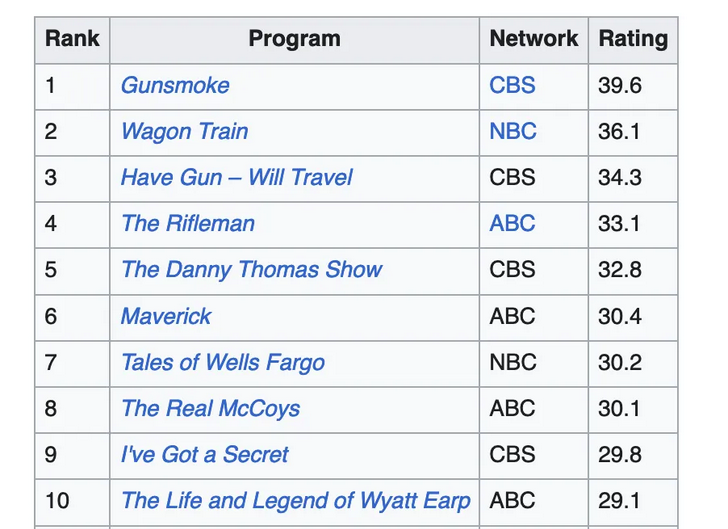
At one point, eight of the top ten shows on the flickering tube were westerns. And it got worse from there — Hollywood kept churning out more and more cowboy movies and TV series. I tried to avoid them, as did many of my buddies, but it was like dodging bullets in Dodge. There was nowhere to hide.

That’s because our parents loved these simple stories of frontier justice. They couldn’t get enough of them. And when they weren’t watching them on TV, they dragged us off to movie theaters to see The Magnificent Seven (128 minutes), The Alamo (138 minutes) or How the West Was Won (an excruciating 164 minutes).

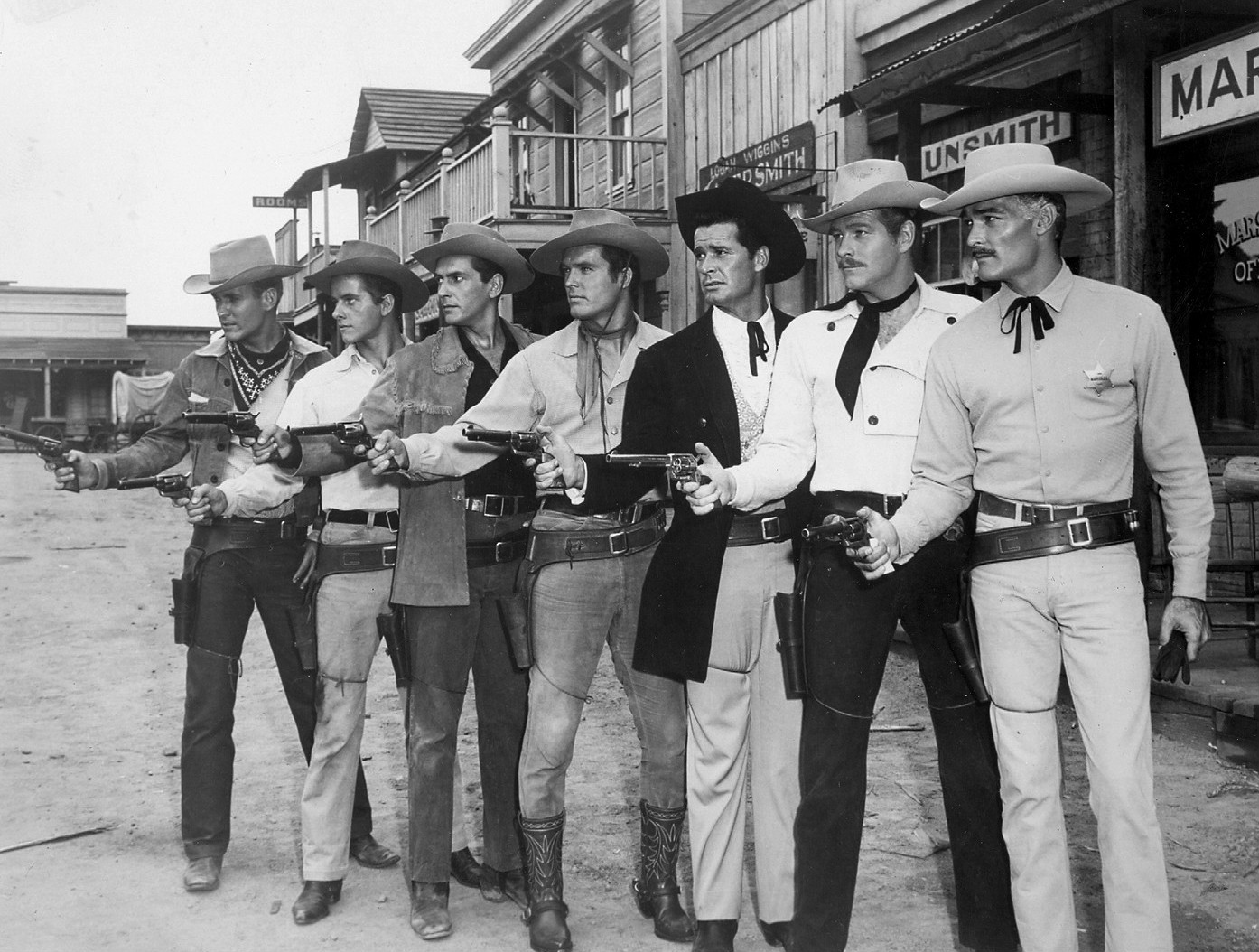
In 1959, Warner Bros posed some of their TV cowboy stars in a single photo (Source)

[…]

Many aspects of these films still put me off. I struggle with the clichés and tired formulas. But I’ve gradually acquired an affection for the genre — or maybe an affection for the audiences of an earlier day who could put such trust and faith in a sheriff or US marshal or gunslinger for hire.

Do any of us have that kind of faith in any authority figure nowadays? I doubt it. But I wish we could. And that’s impressed powerfully on my mind when I see Gary Cooper take on outlaws in the deserted western street of High Noon. Or James Stewart confront the dangerous Liberty Valance. Or John Wayne battle with a gang of desperadoes in Rio Bravo.

So forget all the shootouts and cattle drives and fancy roping. The real foundation of the western genre was moral authority. And Hollywood never let you forget it — that’s why heroes wore white hats and villains dressed in black.

The audience didn’t even have to think about it.

[…]

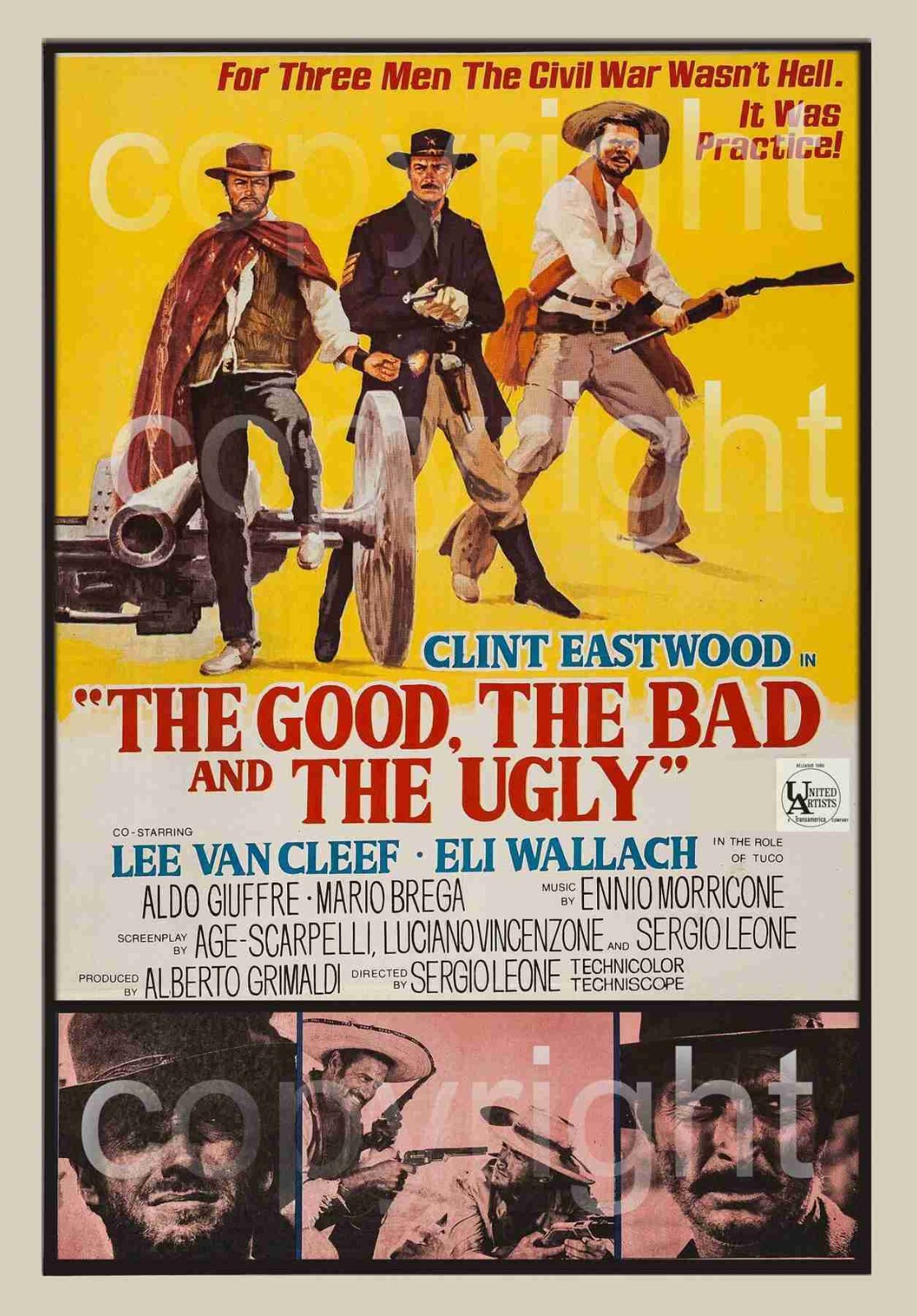
Because that’s exactly what happened to the western. Just consider the unsettling film The Good, the Bad and the Ugly — which came out around the time the western genre died. Despite the movie’s title, it’s hard to identify any character in this film as good — instead they merely differ in their degrees of badness and ugliness.

And the same is true of The Wild Bunch or Once Upon a Time in the West and so many other films from that era. There are no heroes on display here, only various pathways into nihilism.

So long John Wayne. Hello Friedrich Nietzsche.

But this made perfect sense. The entire US of A was traumatized by the Vietnam War, and then Watergate — along with assassinations, riots, sex, drugs, and rock & roll. The moral sureness of the Eisenhower years, along with the complacent righteousness of so much of the public started to erode. At first it happened slowly, and then rapidly.

The classic western could not survive this.

The “True” History of Key Lime Pie: Florida or New York?

Filed under: Food, History, USA — Tags: , , , , — Nicholas @ 02:00

Tasting History with Max Miller
Published 12 Aug 2025

Key lime pie in a graham cracker crust with meringue, garnished with lime zest and lime peel

City/Region: Key West, Florida
Time Period: April 14, 1933

Yet another example of a dish with multiple origin stories, the key lime pie was perhaps invented in Key West in 1875 by Aunt Sally, the possible cook or family member of William Joseph Curry, Florida’s first millionaire, when she observed Cuban sponge collectors making a cream of lime juice, condensed milk, and egg yolk. Or maybe it was a spin on Borden’s (the makers of Eagle brand condensed milk) Magic Lemon Pie, created in New York City in 1931.

Either way, this recipe from 1933, one of the first using a graham cracker crust, is delicious. The filling is smooth, but firms up well, and the lime flavor really stands out without being too tart.

    Tropical Lime Pie

    Mix thoroughly:
    1 can condensed milk,
    1/4 cup evaporated milk,
    3 egg yellows,
    1-3 lime juice, strained.
    Butter 9-inch pie tin heavily. Sprinkle graham cracker crumbs about one-fourth inch thick for crust, pressing crumbs well up on sides of pan. Pour in uncooked custard and cover with meringue, using three egg whites and three scant tablespoons of sugar. Brown in moderate oven and allow to set for one hour before serving. Serves six.

    — Mrs. Mabel McClanahan, Key West Florida, in The Miami Herald, April 14, 1933

(more…)

QotD: Delusional takes – “There are no white people in the Bible”

Filed under: History, Italy, Middle East, Quotations, Religion — Tags: , , , , , — Nicholas @ 01:00

[Responding to an image posted here.]

Oh boy, I get to post more Damned Facts that will offend people who richly deserve to be offended.

There were lots of white people in the Bible. And you don’t need to get into any definitional questions about the genetics of ancient Judea, either.

Greeks and Romans were white — that is, pale-skinned Caucasians. We know this from art, from sequenced genomes, and from contemporary descriptions of what they looked like. Herodotus described the Pontic Greeks as being blonde and blue-eyed.

Here’s the really Damned Fact: brownness in Mediterranean European populations was a late development. Post-Classical. Caused by …

… the Islamic invasions, post 722 CE. Resulted in Europeans of the Mediterranean coast becoming admixed (to put it very, very diplomatically) with Arabs and Africans. That’s why there’s a really noticeable gradient in Italy between lighter-skinned Northerners and darker-skinned Southerners; it’s all about how long various regions were under Islamic domination.

The question that usually comes up is, was Jesus himself “white”?

It’s possible. We can’t go by the artistic evidence, because Byzantine art deliberately confused Jesus with stylized depictions of the Emperor in his glory (there’s a really famous example of this in the Hagia Sophia in Constantinople). And those Greek emperors may well have been depicted as a bit blonder and more blue-eyed than they actually were, because that was considered beautiful. Dashboard Jesus is a late polyp of this tradition.

But until we find actual genetic material we’re not going to know. Imperial-run Palestine was a swirling cauldron of different ethnic groups, and the genetic boundaries didn’t necessarily match up neatly with the religious ones. Knowing that his parents were part of the Jewish people doesn’t necessarily help much.

The two most likely cases are that Jesus looked like a current-day city Arab, or he looked like a Philistine — that is, Greek with some local admixture; a lot of coastal Lebanese still look like that today. But full-bore pasty-skinned Euro can’t be ruled out.

ESR, The social media site formerly known as Twitter, 2025-11-10.

Powered by WordPress