
Quotulatiousness

January 5, 2026

Friedman on Orwell

On his Substack, David Friedman considers some of the things that George Orwell was mistaken about in his non-fiction writings:
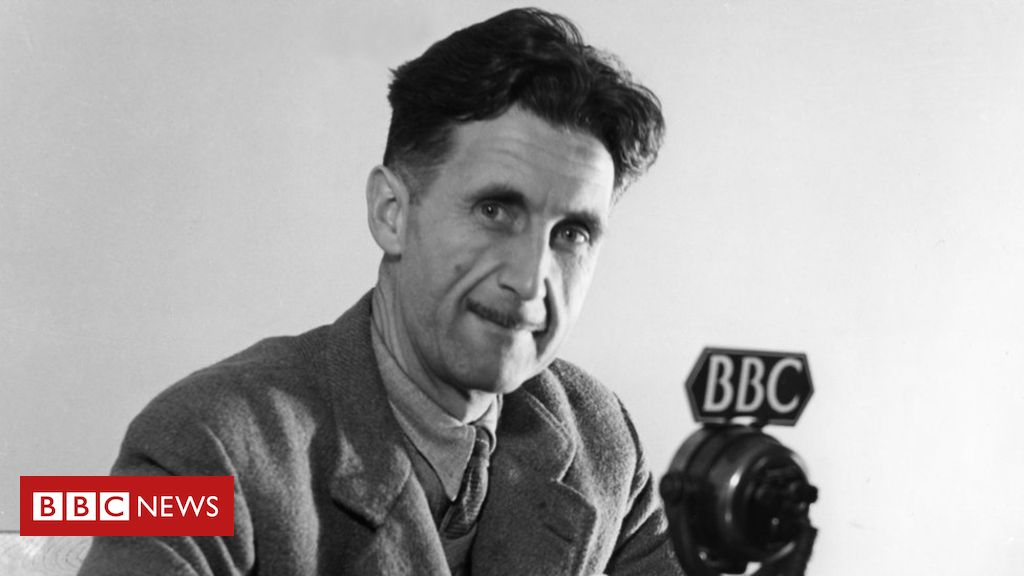
    It cannot be said too often – at any rate, it is not being said nearly often enough – that collectivism is not inherently democratic, but, on the contrary, gives to a tyrannical minority such powers as the Spanish Inquisitors never dreamed of. (George Orwell, The Observer, April 9, 1944)

George Orwell got some things right; unlike most political partisans, he saw the problems with the position he supported. He also got quite a lot of things wrong. The quote is from Orwell’s review of two books, The Road to Serfdom by Friedrich Hayek and The Mirror of the Past by K. Zilliacus, a left-wing writer and politician. The conclusion of the review is that Hayek is right about what is wrong with socialism, Zilliacus is right about what is wrong with capitalism, hence that “the combined effect of their books is a depressing one”.

But Zilliacus was wrong about capitalism, as was Orwell, who wrote:

    But he [Hayek] does not see, or will not admit, that a return to “free” competition means for the great mass of people a tyranny probably worse, because more irresponsible, than that of the State. The trouble with competitions is that somebody wins them. Professor Hayek denies that free capitalism necessarily leads to monopoly, but in practice that is where it has led, and since the vast majority of people would far rather have State regimentation than slumps and unemployment, the drift towards collectivism is bound to continue if popular opinion has any say in the matter. (“As I Please”, pp.117-119)1

The problem is that Orwell, like many of his contemporaries (and ours), did not understand economics and thought he did. Since he wrote we have had extensive experience with free competition, if not as free as Hayek would have wanted, and the result has not been the nightmare that Orwell expected. “The trouble with competitions is that somebody wins them” sounds right only if you don’t actually understand the logic of a competitive market. In most industries organizational diseconomies of scale, the effect of more layers between the head office and the factory floor, limit the size of the firm to something considerably below the size of the market for what the firm produces. In some fields, such as restaurants or barber shops, the result is an industry with thousands of firms, in some five or ten, in only the rare case of a natural monopoly can one large firm outcompete all of its smaller competitors.

The effect of free competition is not the only thing that Orwell got wrong. Consider his essay on Kipling.2 He gets some things right, realizes that Kipling is not a fascist, indeed less of one than most moderns, and recognizes his talent:

    During five literary generations every enlightened person has despised him, and at the end of that time nine-tenths of those enlightened persons are forgotten and Kipling is in some sense still there.

But he gets quite a lot wrong. In arguing that Kipling misunderstood the economics of imperialism, Orwell writes:

    He could not understand what was happening, because he had never had any grasp of the economic forces underlying imperial expansion. It is notable that Kipling does not seem to realize, any more than the average soldier or colonial administrator, that an empire is primarily a money-making concern.

In explaining his own view of the logic of empire, what he thought Kipling was missing, Orwell writes:

    We all live by robbing Asiatic coolies, and those of us who are “enlightened” all maintain that those coolies ought to be set free; but our standard of living, and hence our “enlightenment”, demands that the robbery shall continue.3

Britain let go of its empire, starting with India. British standards of living did not collapse; by the time all of the colonies were independent, the average real wage in the UK was 50% higher than when Orwell wrote. He could not know the future but he could observe that Switzerland, before the war, was richer than England, Denmark, with no significant colonies, almost as rich, Portugal, with an enormous African empire, much poorer. Whether Britain ran its empire at a net profit or a net loss is, I think, still an open question, but Orwell’s view of colonialism is strikingly inconsistent with the observed effects of decolonization.

Economics is not all that Orwell got wrong about Kipling; he badly underestimated the quality of Kipling’s work, due to having read very little of it. The clearest evidence is Orwell’s description of The Light that Failed as Kipling’s “solitary novel”. Kipling wrote three novels, of which that is by a good margin the worst. Orwell not only had not read Kim, Kipling’s one world class novel, he did not know it existed. In a recent post I listed eighteen works by Kipling that I liked. Orwell mentions only one of them.


  1. That free capitalism would ultimately fail was still Orwell’s view in 1947:
  2. In North America the masses are contented with capitalism, and one cannot tell what turn they will take when capitalism begins to collapse (“Toward European Unity“)

  3. Discussed in more detail in an earlier post.
  4. As late as 1947, Orwell wrote:
  5. The European peoples, and especially the British, have long owed their high standard of life to direct or indirect exploitation of the coloured peoples. (“Toward European Unity“)
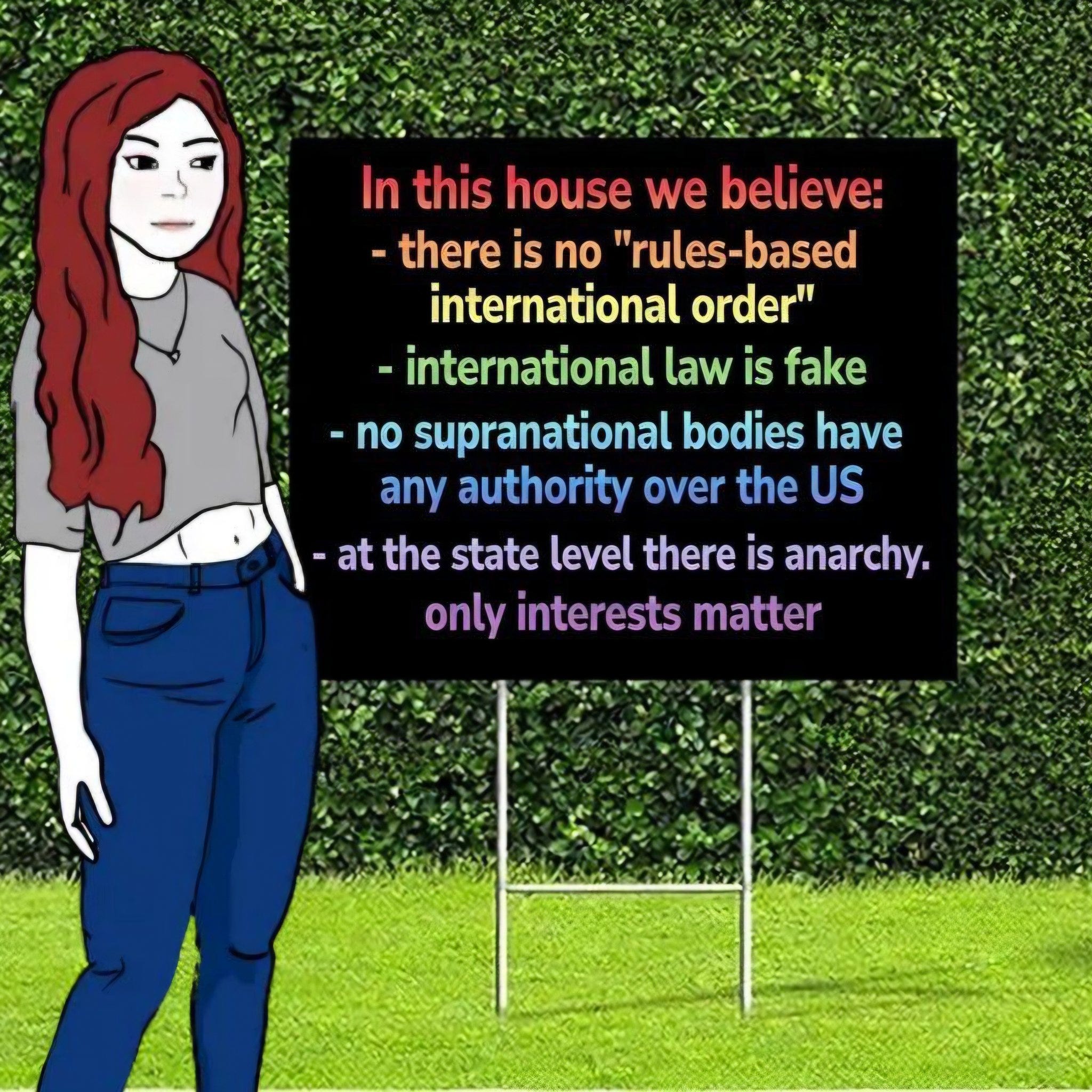
International law is more like International “law”

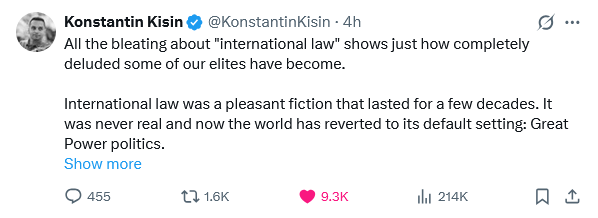
On the social media site formerly known as Twitter, Konstantin Kisin points out that calling it “International Law” gives it a semi-mythic quality that it absolutely does not deserve:

All the bleating about “international law” shows just how completely deluded some of our elites have become.

International law was a pleasant fiction that lasted for a few decades. It was never real and now the world has reverted to its default setting: Great Power politics.

This is why, as a strong Ukraine supporter, I have never talked about international law or called Putin’s attack an “illegal invasion”.

Laws are based on submission to an overarching authority backed by force. There is no such international authority and even if you view the UN as one, it does not have the ability to use force against those who violate “international law” other than against small countries with weak militaries.

When the US attacked Iraq, the UN did nothing.
When Russia invaded Ukraine, the UN did nothing.
If China invades Taiwan tomorrow, the UN will do nothing.

If you cannot enforce a law, it’s not a law.

I do not support Ukraine because naughty Vlad broke the rules. I support Ukraine because it’s not in OUR interest in the West to have Russia marauding its way through friendly countries on the borders of Europe. It’s in our interest for us to be as strong as possible and for our adversaries to be as weak as possible.

President Trump is a realist and a pragmatist. He sees through the fictions other “leaders” cling to.

A good leader advances the national interests of his country. If more Western leaders did this, our civilisation would be in a much better place.

I commented on another post that,

For a lot of people (Canadian Liberals and American Democrats in particular), the invocation “international law” has a mesmerizing effect on their ability to reason [insert usual disclaimer that if they could foresee the results of their enlightened beliefs, they wouldn’t be progressives]. They seem to have a quasi-religious belief in the UN as if it were some kind of God-given supergovernment that is always right and must always be obeyed. “World opinion” might as well be the hand of God to them, so any time the legacy media can portray the US (and Trump in particular) as going against “world opinion” they want to get out the sackcloth and ashes … or sack a city and turn it into ashes, whichever comes first.

vittorio analyzes the default position of most progressives on the social media site formerly known as Twitter:

most political issues nowadays can be explained by understanding that american leftists dont have positions, they have oppositions.

their entire belief system is defined by negation of whatever the right supports. this is why portland chants “free maduro” while actual venezuelans celebrate in the streets. they’re not pro-venezuelan or pro democracies, or pro tyrant, or pro maduro, they’re simply anti-american-right.

they’ve outsourced their worldview to institutional narratives for so long that genuine self-reflection would require questioning everything. for them it’s much easier to just oppose. the beliefs arent coherent because they were never meant to be coherent. they only need to signal tribal membership, and leftist membership is gained by opposing the right.

trump does X? the left screams and cries because they wanted Y

trump does Y? the left screams and cries and riots because even if they said they wanted Y, what they meant is that X was the way to go

trump cures cancer? they’ll argue that the cancer cells are alive have a right of free determination

trump saves lives? they’ll protest because somehow those lives didn’t matter and should have been ended

no coherent word model. no logic. pure opposition

at some point you just have to stop engaging with it as if it’s a real political position. it’s not. it’s aesthetic opposition wearing the costume of ideology

As Severian at Founding Questions often remarks, progressives’ core belief is The Great Inversion: “whatever is, is wrong”.

Bingo Bobbins makes the case that “International law is fake and gay”:

Was this operation necessary? Was Maduro really a “narcoterrorist”? I admit that I haven’t really been following all the drama with Venezuela recently, but my intuition is that Maduro was probably accepting bribes to look the other way with regards to drug trafficking, rather than being directly involved. And sure, he was a socialist dictator but there’s plenty of those around. The US doesn’t go and topple dictators unless there is a perceived US interest in doing so.

What Maduro was actually doing was cozying up to China. In fact, he had just finished a meeting with some Chinese ambassadors hours before Delta Force snatched him up by the scruff. This was actually a warning to China not to mess around in our hemisphere. The Trump administration is re-establishing the Monroe Doctrine, or, as he recently called in a press conference, “The Donroe Doctrine“. As far as I can see, this is completely in keeping with my preferred Vitalist Foreign Policy.

You can agree or disagree with this show of force, but please don’t whine to me about “International Law”. International Law is fake and gay. I certainly don’t care that the Trump administration “targeted a political leader”. This is the complaint being leveled by many leftists in regard to the operation. Really, this is just because leftists are anti-American third-worldists, and they are filled with butthurt because “their guy” lost. But, let’s examine this “rule” of not being allowed to target a countries rulers, because it’s particularly ridiculous.

If you have a problem with a specific country, who do you really have a problem with? You have a problem with that country’s leaders, since they are the ones making the decisions. Why wouldn’t you target the leaders? The only reason is that all the leaders from all the countries got together and agreed that they wouldn’t target each other. They would rather resolve their differences by throwing cannon fodder at each other, while keeping themselves off the table. And sure, I understand why that is great for them, but not why it would be great for me (or you).

Of course, the CIA has been ignoring this “international law” for decades, but they’ve been doing it in a very effeminate way, skulking about the world, funding Color Revolutions and clandestinely arming insurgent groups in order to subvert existing regimes. The Donroe Doctrine is much better. Imagine if the Trump administration had tried to handle Maduro the way the Obama administration tried to handle Assad. Fund a decades long civil war, accidentally establish a caliphate, fight a war against said caliphate, facilitate the deaths of tens of thousands of Christians, all to have an even worse dictator eventually rise to power.

Update, 6 January: Welcome, Instapundit readers! Please do have a look around at some of my other posts you may find of interest. I send out a daily summary of posts here through my Substackhttps://substack.com/@nicholasrusson that you can subscribe to if you’d like to be informed of new posts in the future.

Interdynamic MP-9 SMG: Origin of the TEC-9

Filed under: Europe, History, USA, Weapons — Tags: , , , , , — Nicholas @ 02:00

Forgotten Weapons
Published 13 Aug 2025

The story of the Tec-9 begins with a Swedish company called Interdynamic AB and their designer Göran Lars Magnus Kjellgren designing a cheap and simple submachine gun for military use. It found no interested clients, and so the company decided to market it in the United States as a semiautomatic pistol. Kjellgren moved to the US in 1979, anglicized his name to George Kellgren, and founded Interdynamic USA with a partner, Carlos Garcia.

The pair produced a few dozen MP-9 submachine guns in 1982 (they were all transferrable, as this was before 1986) as well as a semiauto open bolt version called the KG-9 (Kellgren-Garcia). About 2500 of the KG-9s were made before later in 1982 the ATF determined that it was a machine gun, and they had to redesign it as a closed bolt semiauto, which they named the KG-99. At about this point Kellgren decided to move on to other plans, and he sold his interest in the company to Garcia, who formed a new company called Intratec. Kellgren used the proceeds to start Grendel a few years later.
(more…)

QotD: Nitpicking the opening battle in Gladiator (2000)

Filed under: Europe, History, Military, Quotations — Tags: , , , , , , — Nicholas @ 01:00

This week, we’re going to take a close look at arguably the most famous and recognizable Roman battle sequence in film: the iconic opening battle from Gladiator (2000).1 Despite being a relatively short sequence (about ten minutes), there’s actually enough to talk about here that we’re going to split it over two weeks, talking about the setup – the battlefield, army composition, equipment and battle plan – this week and then the actual conduct of the battle next week.

The iconic opening battle, set in the Marcomannic Wars (166-180) during the reign of Marcus Aurelius (r. 161-180) dominates the pop-cultural reference points for the Roman army in battle and you can see its heavy influence in things like how the Total War series presents Roman armies (particularly in trailers and other promotional material). Students and enthusiasts alike will often cite this sequence as the thing which sparked their interest in the Roman army. It is hard to overstate how pervasive its influence is in the public imagination of what the Roman army, particularly of the imperial period, was like, especially as its style is imitated by later pop culture works.

Which is why it is so unfortunate that it is such a deceptive historical mess. This sequence in particular is a banner example of what I’ve termed elsewhere the “perils of historical verisimilitude“, the habit of historically based popular-culture works including what we might think of as fake signifiers of research, things that seem historically grounded rather than being historically grounded, as a way to cheaply cash in on the cachet that an actually grounded representation gets.

Gladiator actually provides a perfect metaphor for this: its main character’s name. Russell Crowe proudly informs us he is, “Maximus Decimus Meridius”, a name that certainly sounds suitably Roman, picking up the three-part name with that standard second declension -us ending. It sounds like it could be a real name – if you didn’t know Latin you would probably assume that it could be a real Roman name. But, as we’ve noted, it isn’t a Roman name and in fact gets nearly all of the Roman naming conventions wrong: Roman names are ordered as praenomen, nomen and cognomen, with the nomen indicating one’s gens (“clan” more or less) and the praenomen selected from just a couple dozen common personal names. Decimus is one of those two-dozen common praenomina (which also means it is never going to show up as the name of a gens), so it ought to go first as it is actually his personal name. Meanwhile Maximus (“the greatest”) is very much not one of those roughly two-dozen praenomina, instead being always cognomen (essentially a nickname). Finally Meridius isn’t a Latin word at all (so it can’t be a praenomen personal name nor a cognomen nickname),2 meaning it has to be the nomen (referencing a fictive gens Meridia). Every part of his name is wrong and it should read Decimus Meridius Maximus.

It sounds just right enough to fool your average viewer, while being entirely wrong. It is “truthy” rather than true – verisimilitudinous (like truth), rather than veristic (realistic, true).

In the case of Gladiator‘s opening battle scene, the attention is on creating verisimilitude (without fidelity, as we’ll see) in the visual elements of the sequence and only the visual elements. The visual representation of a Roman army – the equipment in particular – is heavily based on the Column of Trajan (including replicating the Column’s own deceptions) and since that is the one thing a viewer can easily check, that verisimilitude leads a lot of viewers to conclude that the entire sequence is much more historically grounded than it is. They take their cues from the one thing they can judge – “do these fellows wear that strange armor I saw on that picture of a Roman column?” – and assume everything is about as well researched, when in fact none of it is.

Instead, apart from the equipment – which has its own deep flaws – this is a sequence that bears almost no resemblance to the way Roman armies fought and expected to win their battles. The Roman army in this sequence has the wrong composition, is deployed incorrectly, uses the wrong tactics, has the wrong theory of victory and employs the wrong weapons and then employs them incorrectly. Perhaps most importantly the sequence suggests an oddly cavalry-and-archer focused Roman army which is simply not how the Romans in this period expected to win their battles.

Now I want to be clear here that this isn’t a review of the film Gladiator (2000) or my opinion in general on the film. To be honest, unlike the recent sequel, I enjoy Gladiator even though it is historical gibberish. So I am not telling you that you aren’t “allowed” to like Gladiator, but rather simply that, despite appearances, it is historical gibberish, particularly this opening scene, which I often find folks who are aware the rest of the film is historical gibberish nevertheless assume this opening scene is at least somewhat grounded. It is not.

Bret Devereaux, “Collections: Nitpicking Gladiator’s Iconic Opening Battle, Part I”, A Collection of Unmitigated Pedantry, 2025-06-06.


  1. I’d think its only real rival for prominence would be Spartacus (1960).
  2. If you are wondering, “but then were does our word “meridian” come from, the answer is from Latin meridies, meaning “midday”.

Powered by WordPress



